The Grow Awards 2026 🏆 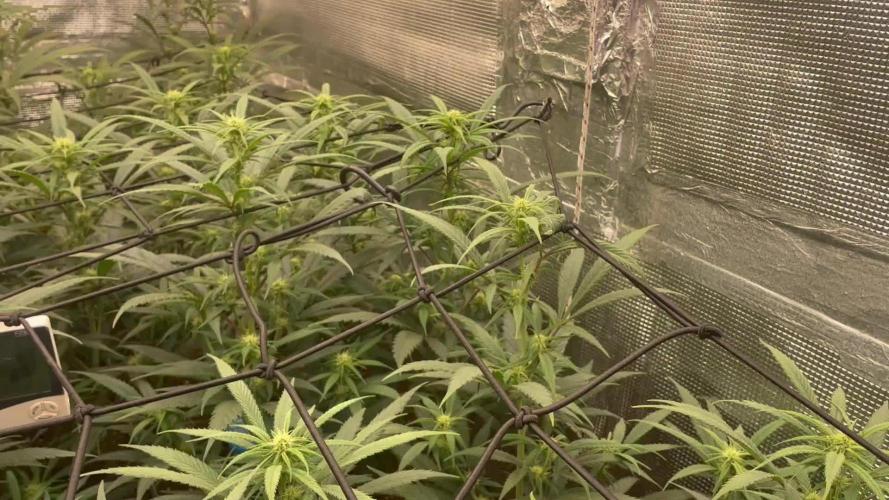






Likes
Comments
Share
@carlitoshaze44
Follow
Día 20!!! Estamos en el punto de comienzo de la 4 semana de floración ! Esa en la que notamos como el cultivo nos da el cambio que queremos y a partir de los dos vemos como
Nuestras flores evolucionan de una manera u otra dependiendo de clima,genética,nuestra mano con ella etc..
Vamos a comenzar la media floración bien cargados con la paleta de nutrientes alta en potasio y nitrógeno!
Siempre añadiendo también,nuestras mañanas de agricultor.
Tuve el fallo de abrir el tupper de lombrices y echarlas a el cultivo y no poderos grabar el proceso.
Fue algo rápido que hice con el armario apagado..lo tuve que iluminar por un minuto para añadir la bola de lombrices unas 60!!!
La siguiente tanda de flores si empezara a sacarle provecho a estas amigas!!
Deciros que el cambio en altura es muy grande no para aún de crecer!
Y las últimas están engordando mucho las flores a pesar de el corto periodo se ve que nuestra selección de amnesia haze,es un fenotipo muy especial..
Es de unas 8 semanas de floración y muy buena productora!
Día 21
Primer día de la cuarta semana de floración tenemos una escalera
Desde la puerta del armario hacia el fondo tenemos alturas que van 54cm/62cm/71cm/80cm
Gracias a el control individual en altura de cada luminaria iré trabajando con el control de dividir el área en tres Alturas diferentes,así lo requiera cada planta.
Una pequeña planta que está cerca de una rendija de ventilación tuvo unas pequeñas picaduras de tips”.
Observaré si no es de un periodo anterior de antes del fumigado..
Si no es así trabajaré un poco de jabón potásico y ajo!
De momento el olor es muy sutil.
Algunas flores empiezan a producir resina de manera temprana.
Dia 22
Va todo sobre ruedas,un verde lima en las hojas,las puntas tensas y bien firmes esperando el regado de mañana!
Una humedad de un 55% en el armario,cerrándolo con un 59% una vez echo el seguimiento,inspecccion de este en el día de hoy.
Seguimos con una semana de humedad en el exterior del 90% y toda una semana por delante de más lluvias.
Seguiremos controlando la humedad como hasta ahora con los riegos.
Guardo paciencia en las plantas que aún no llegaron a la red,para poder tener un control visual de todas las puntas!
Me alegra ver la cantidad de flores que están produciendo por casi todas partes de la planta y la resina que empieza a producir alrededor de estas,es un gran fenotipo de amnesia haze,con gran rendimiento productivo de flores y resina.
Todo un hacierto para quienes buscan genes de sativa bien marcados con un corto periodo de floración.
Día 24
Primero felices fiestas y feliz navidad a todos.
Mi pequeño jardín de pinos 🌲 jejejej está estos días espectacular,ya comienza a afinar el olor ese toque a madera recién cortada y ese fondo de lima tan característico de las haze,aaag que rico olerá en las siguientes semanas buen fenotipo y no es el más oloroso..
Esta semana la humedad ronda 65% después de un riego que fueron 60litros,más de un litro por planta!.
Justo lo que va necesitando para esta etapa de formación y engorde de flores… espero que en los siguientes días vuelva mejor clima también a esta zona ya que estos días de agua fueron nefastos para la interacción de aire de el exterior..no ayudaban a reducir la humedad.
Deciros que el riego se aplicó el día 23.
Con una EC1300 PH6,3.
Una de las 44 en el último riego sufrió un poco de sobrefertilizacion,mostrando está un poco de color en el tallo,rojizo.
Solo una quedó más pequeña,siendo esta 52 cm.
🏴☠️
Dia 25
Todo perfecto,las plantas están al 100x100
Un color perfecto,las hojas tensas y cojiendo volumen como es debido.
Ya solo queda mantenerlas,y que no sufran ninguna carencia nutritiva ni exceso de esta.
Dia 26
Último riego de la cuarta semana de floración.
Esta vez adaptando el riego subiendo la EC de 1400 a 1700.
En la siguiente semana ya trabajaremos con una EC de 2000,si es que la planta lo permite ya que con la EC de la tabla no me convence.
El PH sube a 6,3 y se mantendra entre 6,2/6,3 en el sustrato.
El siguiente riego será otro con carga de azúcares y aminoácidos.
Intercalando riego sí y riego no el PK 50-30.
Hoy me sorprendió mucho lo definido que es el olor con la humedad ambiental exterior,teniendo la puerta abierta salía un rico aroma que gana más en madera que lima 🍋

Likes
29
Share
@Sidbank
Follow
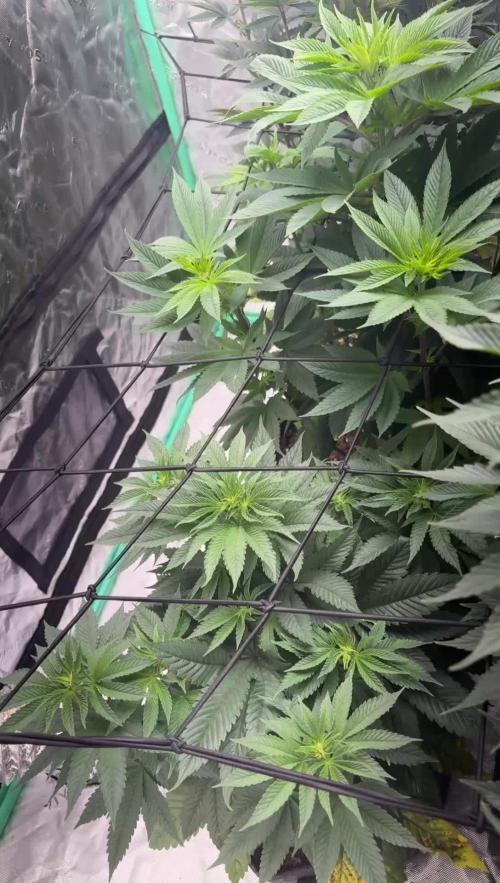
11.06 - I watered them without fertilizers. They look good and healthy. The leaves around the buds at the tops begin to darken, this is the effect of adding trace elements. Next time I water, I'll add a little more.
12.06, I cut off the two lowest floors of the branches, I left the leaves in case there were any problems with deficiencies. Unfortunately, I've already spotted a few squids with my own eye plus what I caught with sticks. This does not bode well for the future. I'll have to double dose Soil Attack soon.
14.06 They growing fast, I hope that soon they will stop ;). Last watering was with a little bit PK and Bloom Stimulator from BAC and Soil Attack, Azot Bacterias and little bit BAC Silicium. Next watering will be only with little Bit Trace Elements to fight with manganese deficiency.

Likes
19
Share
@Sergio_721
Follow
despite the maximum temperature with lights on she grows very well, drinks a lot and I hope she will produce dense and juicy buds soon. 😂

Likes
19
Share
@Scandinavia
Follow
Spiders has taken over the pot of plant C but i guess they will keep the insects away, so they welcome. Pictures from day 42. I do not think they will be ready in one month but we will see. How long do you think they have left?
Im actually going on holiday in July so its a bit of a dilemma for me whether to harvest before or after and hope for rain in the 2 weeks i will be gone. Any ideas would be helpful!
Likes
8
Share
@TorvicKofran
Follow
ESPAÑOL:
Hola chicos, espero se encuentren muy bien!
Esta semana las chicas han mejorado un poco, se detuvo el amarillamiento, descubri que Cal-Max de Grotek interfiere en la composicion de la linea hesi por lo que las chicas sufren un bloqueo de nutrientes, dejé de utilizarlo y las chicas han continuado con su desarrollo relativamente normal.
ya estan en su 5ta semana de floracion, Tutankhamon ha producido una cantidad gigantesca de resina, Lennon esta engordando a toda velocidad y aun le quedan 6 semanas aprox.
Anubis a pesar de su color intenso amarillo palido esta engordando bastante bien y su produccion de resina es inimaginable y ya solo que quedan 2 semanas y media aprox.
espero que a partir de ahora ya no surjan mas problemas y que las chicas terminen su floracion de la mejor manera.
esto es todo por esta semana chicos, espero que se encuentren muy bien !
INGLES:
Hello guys, I hope you are very well!
This week the girls have improved a little, the yellowing stopped, I discovered that Cal-Max from Grotek interferes with the composition of the hesi line so the girls suffer a nutrient lock, I stopped using it and the girls have continued with their relatively normal development.
They are already in their 5th week of flowering, Tutankhamun has produced a gigantic amount of resin, Lennon is gaining weight at full speed and he still has about 6 weeks left.
Anubis, despite its intense pale yellow color, is gaining weight quite well and its resin production is unimaginable and there are only about 2 and a half weeks left.
I hope that from now on no more problems arise and that the girls finish their flowering in the best way.
This is it for this week guys, I hope you are doing well!


Likes
31
Share
@Dunk_Junk
Follow
Day 70 - She's really getting frosty now! The smell is very sweet, like Icing Sugar. Amazing 😍
Only 1cm vertical growth this week, I think flowering stretch is over. Bud and trichome production is in full swing.

Likes
16
Share
@Chocolopeison
Follow
Estuvimos un poco desaparecido por andar un poco desmotivado pero aquí vamos nuevamente, las nenas van bastante bien en la semana 8 la cambiamos a maceta de 3.5L y aprovechamos de darle GREAT WHITE SHARK, la técnica que usamos es de amarrar el central ya que le hicimos supper cropping y apical a nuestro central, amarramos el apical que le hicimos super cropping y le dimos fuerza a varios brazos. Para ir controlando la altura de los brazos le hicimos poda a pical a los que estaban tomando más altura y así poder ir equiparando los brazos. La verdad que no se cuantos brazos tengo que sacar y aun me quedan unas 4 semanas para poder desocupar mi armario de floración y poder pasarlas a flora, así que intentaremos hacer una muy buena estructura antes de pasarlas a floración. La defoliación la aplico cada vez que saco foto ósea semanal y trato de ir manteniendo de a 4 nudos o 6 nudos
La alimentación se mantiene igual lo que si no se si lo dije pero:
Rhizotonic: Lo estoy usando solo en trasplantes y cuando hago alguna poda.
Cannazym: Lo estoy usando 1 vez por semana.
Orca y Myco Chum: Lo estoy usando 1 vez cada 1-2 semanas
Alimentación diaria: Calmag, silicia, supervit y canna coco a+b
Alimento a cada una con 250-350 cc de solución, 2 horas que encienden las luces y 2 horas antes de que se apaguen. Gracias a esta receta no eh tenido tanta variedad en mi runoff y las nenas se mantienen muy sanas.
Saludos


Likes
Comments
Share
@Ctrellis90
Follow
End of another week and dang are these girls going!
The alfalfa Ferment is definitely doing work down in that rhizosphere. It's pretty amazing how well this Ferment does for veging cannabis. I seriously cut my veg time down by almost half when I use it! That's the main objective right there, to be able to continuously flip into flower right after harvesting, and we're basically their now that we have everything dialed in.
These girls will be getting synthetics next week. We're going to start them on a light feed of Athena blended then go from there.
Thanks for stopping by and we'll see ya next week.


Likes
1
Share
@TTerpz
Follow
Week 1 of flower lights have been switched to a 12/12 schedule
Back pot is plastic so she was fed nutrients 8/5 because it takes a little bit longer to dry up
Processing
Likes
Comments
Share
@Steviegrows
Follow
By end of week was watering every other day with about 300 ml/plant and adjusting PH to between 6.0-7.0. Turned on the SF-1000 QB this week.

Likes
14
Share
@Pleasant_Internet
Follow
Growing at a good pace. Going to top the leaders at the 3rd node on day 28. Might wait a week for the others. Going to mainline my grow for the first time. I will wait to defoliate after they heal from being topped. I will update this week with more pictures after they are topped.
Topped day 28.
Defoliated day 30.
Lst day 32?

Processing
Likes
43
Share
@Pisstank85
Follow
In all honesty I'm not sure if I got the nutrients dialed in . I tested runoff and it was all within range of soiless mixes , calibrated my ph meter every watering as I thought maybe that's why I was getting yellowing leaves . They are still growing and budding rapidly and seemingly on par with what I've seen with others in like mediums so I'm trying not to worry too much . My carbon filter shit the bed already so my Mrs isnt happy with me today as my whole basement wreaks . The plants went from not too bad to wicked bad smelling within a couple days . I've been defoliating but do you think I should do more ?
Likes
33
Share
@Ferenc
Follow
Day 72: 600W LED, 18 hours on 6 hours off the same with ventilation. Ferilization is the same except BlackBerry Kush and LSD-25 they are being flushed. Water intake also remains the same 200ml per day. Humidity approx 35 percent.
Day 74: BlackBerry Kush and LSD-25 have to be harvested this week Friday so no more water. Colorado Cookies and Northern Light next week so started flushing them. Glueberry OG needs a bit more time.


Likes
154
Share
@Tropicannibis_Todd
Follow
💩Holy Crap Growmies We Are Back💩
Code Name FBT2311
Well growmies we are at 63 days in and everything is going as good as it can 👌
👉Shes been doing really good , lots of buds and some nice colors and smells 👌💪she's the top of of the lot 💪
Lights being readjusted and chart updated .........👍Even with early major issues due to the soil/medium she's come a long way 👈
👉I used NutriNPK for nutrients for my grows and welcome anyone to give them a try .👈
👉 www.nutrinpk.com 👈
NutriNPK Cal MAG 14-0-14
NutriNPK Grow 28-14-14
NutriNPK Bloom 8-20-30
NutriNPK Bloom Booster 0-52-34
I GOT MULTIPLE DIARIES ON THE GO 😱 please check them out 😎
👉THANKS FOR TAKING THE TIME TO GO OVER MY DIARIES 👈
Likes
52
Share
@Ultraviolet
Follow
Lacewings seemed to have mostly killed themselves by flying into hot light fixtures. I may have left the UV on which was smart of me :) Done very little to combat if anything but make a sea of carcasses, on the bright side its good nutrition for the soil.
Made a concoction of ethanol 70%, equal parts water, and cayenne pepper with a couple of squirts of dish soap.
Took around an hour of good scrubbing the entire canopy.
Worked a lot more effectively and way cheaper.
Scorched earth right now, but it seems to have wiped them out almost entirely very pleased.
Attempted a "Fudge I Missed" for the topping. So just time to wait and see how it goes.
Question?
If I attached a plant to two separate pots but it was connected by rootzone, one has a pH of 7.5 ish the other has 4.5. Would the Intelligence of the plant able to dictate each pot separately to uptake the nutrients best suited to pH or would it still try to draw nitrogen from a pot with a pH where nitrogen struggles to uptake?
Food for stoner thought experiments!
Another was on my mind.
What happens when a plant gets too much light?
Well, it burns and curls up leaves.
That's the heat radiation, let's remove excess heat, now what?
I've always read it's just bad, or not good, but when I look for an explanation on a deeper level it's just bad and you shouldn't do it.
So I did.
How much can a cannabis plant absorb, 40 moles in a day, ok I'll give it 60 moles. 80 nothing bad ever happened.
The answer, finally. Oh great........more questions........
Reactive oxygen species (ROS) are molecules capable of independent existence, containing at least one oxygen atom and one or more unpaired electrons.
"Sunlight is the essential source of energy for most photosynthetic organisms, yet sunlight in excess of the organism’s photosynthetic capacity can generate reactive oxygen species (ROS) that lead to cellular damage. To avoid damage, plants respond to high light (HL) by activating photophysical pathways that safely convert excess energy to heat, which is known as nonphotochemical quenching (NPQ) (Rochaix, 2014). While NPQ allows for healthy growth, it also limits the overall photosynthetic efficiency under many conditions. If NPQ were optimized for biomass, yields would improve dramatically, potentially by up to 30% (Kromdijk et al., 2016; Zhu et al., 2010). However, critical information to guide optimization is still lacking, including the molecular origin of NPQ and the mechanism of regulation."
What I found most interesting was research pointing out that pH is linked to this defense mechanism. The organism can better facilitate "quenching" when oversaturated with light in a low pH. Now I Know during photosynthesis plants naturally produce exudates (chemicals that are secreted through their roots). Do they have the ability to alter pH themselves using these excretions? Or is that done by the beneficial bacteria?
If I can prevent reactive oxygen species from causing damage by "too much light".
The extra water needed to keep this level of burn cooled though, I must learn to crawl before I can run.
Reactive oxygen species (ROS) are key signaling molecules that enable cells to rapidly respond to different stimuli. In plants, ROS plays a crucial role in abiotic and biotic stress sensing, integration of different environmental signals, and activation of stress-response networks, thus contributing to the establishment of defense mechanisms and plant resilience. Recent advances in the study of ROS signaling in plants include the identification of ROS receptors and key regulatory hubs that connect ROS signaling with other important stress-response signal transduction pathways and hormones, as well as new roles for ROS in organelle-to-organelle and cell-to-cell signaling. Our understanding of how ROS are regulated in cells by balancing production, scavenging, and transport has also increased. In this Review, we discuss these promising developments and how they might be used to increase plant resilience to environmental stress.
Temperature stress is one of the major abiotic stresses that adversely affect agricultural productivity worldwide. Temperatures beyond a plant's physiological optimum can trigger significant physiological and biochemical perturbations, reducing plant growth and tolerance to stress. Improving a plant's tolerance to these temperature fluctuations requires a deep understanding of its responses to environmental change. To adapt to temperature fluctuations, plants tailor their acclimatory signal transduction events, specifically, cellular redox state, that are governed by plant hormones, reactive oxygen species (ROS) regulatory systems, and other molecular components. The role of ROS in plants as important signaling molecules during stress acclimation has recently been established. Here, hormone-triggered ROS produced by NADPH oxidases, feedback regulation, and integrated signaling events during temperature stress activate stress-response pathways and induce acclimation or defense mechanisms. At the other extreme, excess ROS accumulation, following temperature-induced oxidative stress, can have negative consequences on plant growth and stress acclimation. The excessive ROS is regulated by the ROS scavenging system, which subsequently promotes plant tolerance. All these signaling events, including crosstalk between hormones and ROS, modify the plant's transcriptomic, metabolomic, and biochemical states and promote plant acclimation, tolerance, and survival. Here, we provide a comprehensive review of the ROS, hormones, and their joint role in shaping a plant's responses to high and low temperatures, and we conclude by outlining hormone/ROS-regulated plant-responsive strategies for developing stress-tolerant crops to combat temperature changes.
Onward upward for now.
Next!
Adenosine triphosphate
(ATP) is an energy-carrying molecule known as "the energy currency of life" or "the fuel of life," because it's the universal energy source for all living cells.1
Every living organism consists of cells that rely on ATP for their energy needs. ATP is made by converting the food we eat into energy. It's an essential building block for all life forms. Without ATP, cells wouldn't have the fuel or power to perform functions necessary to stay alive, and they would eventually die. All forms of life rely on ATP to do the things they must do to survive.2
ATP is made of a nitrogen base (adenine) and a sugar molecule (ribose), which create adenosine, plus three phosphate molecules. If adenosine only has one phosphate molecule, it’s called adenosine monophosphate (AMP). If it has two phosphates, it’s called adenosine diphosphate (ADP).
Although adenosine is a fundamental part of ATP, when it comes to providing energy to a cell and fueling cellular processes, the phosphate molecules are what really matter. The most energy-loaded composition for adenosine is ATP, which has three phosphates.3
ATP was first discovered in the 1920s. In 1929, Karl Lohmann—a German chemist studying muscle contractions—isolated what we now call adenosine triphosphate in a laboratory. At the time, Lohmann called ATP by a different name. It wasn't until a decade later, in 1939, that Nobel Prize–-winner Fritz Lipmann established that ATP is the universal carrier of energy in all living cells and coined the term "energy-rich phosphate bonds."45
Lipmann focused on phosphate bonds as the key to ATP being the universal energy source for all living cells, because adenosine triphosphate releases energy when one of its three phosphate bonds breaks off to form ADP. ATP is a high-energy molecule with three phosphate bonds; ADP is low-energy with only two phosphate bonds.
The Twos and Threes of ATP and ADP
Adenosine triphosphate (ATP) becomes adenosine diphosphate (ADP) when one of its three phosphate molecules breaks free and releases energy (“tri” means “three,” while “di” means “two”). Conversely, ADP becomes ATP when a phosphate molecule is added. As part of an ongoing energy cycle, ADP is constantly recycled back into ATP.3
Much like a rechargeable battery with a fluctuating state of charge, ATP represents a fully charged battery, and ADP represents a "low-power mode." Every time a fully charged ATP molecule loses a phosphate bond, it becomes ADP; energy is released via the process of ATP becoming ADP.
On the flip side, when a phosphate bond is added, ADP becomes ATP. When ADP becomes ATP, what was previously a low-charged energy adenosine molecule (ADP) becomes fully charged ATP. This energy-creation and energy-depletion cycle happens time and time again, much like your smartphone battery can be recharged countless times during its lifespan.
The human body uses molecules held in the fats, proteins, and carbohydrates we eat or drink as sources of energy to make ATP. This happens through a process called hydrolysis
.
After food is digested, it's synthesized into glucose, which is a form of sugar. Glucose is the main source of fuel that our cells' mitochondria
use to convert caloric energy from food into ATP, which is an energy form that can be used by cells.
ATP is made via a process called cellular respiration that occurs in the mitochondria of a cell. Mitochondria are tiny subunits within a cell that specialize in extracting energy from the foods we eat and converting it into ATP.
Mitochondria can convert glucose into ATP via two different types of cellular respiration:
Aerobic (with oxygen)
Anaerobic (without oxygen)
Aerobic cellular respiration transforms glucose into ATP in a three-step process, as follows:
Step 1: Glycolysis
Step 2: The Krebs cycle (also called the citric acid cycle)
Step 3: Electron transport chain
During glycolysis, glucose (i.e., sugar) from food sources is broken down into pyruvate
molecules. This is followed by the Krebs cycle, which is an aerobic process that uses oxygen to finish breaking down sugar and harnesses energy into electron carriers that fuel the synthesis of ATP. Lastly, the electron transport chain (ETC) pumps positively charged protons that drive ATP production throughout the mitochondria’s inner membrane.2
ATP can also be produced without oxygen (i.e., anaerobic), which is something plants, algae, and some bacteria do by converting the energy held in sunlight into energy that can be used by a cell via photosynthesis.
Anaerobic exercise means that your body is working out "without oxygen." Anaerobic glycolysis occurs in human cells when there isn't enough oxygen available during an anaerobic workout. If no oxygen is present during cellular respiration, pyruvate can't enter the Krebs cycle and is oxidized into lactic acid. In the absence of oxygen, lactic acid fermentation makes ATP anaerobically.
The burning sensation you feel in your muscles when you're huffing and puffing during anaerobic high-intensity interval training (HIIT) that maxes out your aerobic capacity or during a strenuous weight-lifting workout is lactic acid, which is used to make ATP via anaerobic glycolysis.
During aerobic exercise, mitochondria have enough oxygen to make ATP aerobically. However, when you're out of breath and your cells don’t have enough oxygen to perform cellular respiration aerobically, the process can still happen anaerobically, but it creates a temporary burning sensation in your skeletal muscles.
Why ATP Is So Important?
ATP is essential for life and makes it possible for us to do the things we do. Without ATP, cells wouldn't be able to use the energy held in food to fuel cellular processes, and an organism couldn't stay alive.
As a real-world example, when a car runs out of gas and is parked on the side of the road, the only thing that will make the car drivable again is putting some gasoline back in the tank. For all living cells, ATP is like the gas in a car's fuel tank. Without ATP, cells wouldn't have a source of usable energy, and the organism would die.
Eating a well-balanced diet and staying hydrated should give your body all the resources it needs to produce plenty of ATP. Although some athletes may slightly improve their performance by taking supplements or ergonomic aids designed to increase ATP production, it's debatable that oral adenosine triphosphate supplementation actually increases energy.
An average cell in the human body uses about 10 million ATP molecules per second and can recycle all of its ATP in less than a minute. Over 24 hours, the human body turns over its weight in ATP.
You can last weeks without food.
You can last days without water.
You can last minutes without oxygen.
You can last 16 seconds at most without ATP.
Food amounts to one-third of ATP production within the human body.

Likes
184
Share
@Still_Smoq
Follow
#seedsman420growoff and #SeedsmanSeeds
📆 Germination Week, 20-26 April 2024
20 April - Placed 3 seeds in a cup of RO water, put in seedling grow tent under 24hrs light at 25% power, temp 74 degrees F.
21 April - 2 seeds cracked, roots appeared. Placed into Root Riot starter cubes.
22 April - 3d seed cracked. Placed into wet paper towel.
24 April - 1st seed sprouted from starter cube. Main root exposed, moved to permanent DWC system (see pictures). Filled for first time with solution.
25-26 April - Let seedling grow.
Thank you Seedsman Seeds! I’m very excited to be a sponsored participant and given the opportunity to cultivate during SeedsmanSeeds Growoff this year!
The strain I received was Pineapple OG. This is a new 2024 release from Seedsman Seeds. Its genetics are a hybrid 3 way cross with Pineapple Kush, Pineapple Muffin, and Pineapple Express. This unique fusion results in tall plants boasting remarkable uniformity, and delightful sweet, tropical fruit flavors. It also has notably high THC levels (25-27%), 50% Sativa / 50% Indica, with harvest yielding up to 450g indoor - 750g outdoor /m2, and a flowering time between 56-70 days. I’m anticipating the upcoming weeks with great optimism.
📑 The Plan - use a Deep Water Culture, 3 gal system, as a permanent home. Apply a weekly feeding schedule using time tested blends of Terra Aquatica (formerly General Hydroponics), Botanicare, and Europonics nutrients throughout the cycle. Depending on the speed of the grow, veg the plant for 6-10 weeks using the scrog method of training. Then flip into flower where she will continue for another 8-10 weeks. So my forecast is this grow should be finished around 30 August.
🍶 24 April initial nutrient solution TDS 530, PH 6.1
🍽️ 24 April initial feeding schedule first 2 weeks
💧 Using reverse osmosis water with EC/TDS at 0
🐉 Nutrient Solution EC 1.0 at 63 degree F
🔆 Light power at 50%, DLI 13 canopy coverage at 18hrs
😤 Using General Hydroponics, HGC728040, Dual Diaphragm Air Pump, 320 GPH
That is it for this week. Thanks for the look, read and stopping by.


Likes
35
Share
@StonedandSteady
Follow
1st Day of Flower: 2nd Feed Humboldt
Let's Grow and Stretch Out to Fill your Mighty Branches with Giant Gorgeous Budz Ladies! Happy Birthday HoneyBuns!!! I Love you so Much and Thankful to be your Man and Husband! It's been a few days since I gave the Ladies thier 2nd Feed of #HumboldtCountysOwn Nutrients and they look Super Awesome!!! We'll definitely Grow back to everything here soon! I'm Glad it's May 1st and Flipped to Flower and also to Celebrate my Wonderful and Beautiful Wife's Birthday!
11th w/ Veg and Flowers Update #Pre-Sexed🚺 #SuperCropped #Defoliated #Lollipoped
Good Day and Happy Growing Everyone! These Ladies were Growing into thier 11th Week of Veg and Looking Totally Tight and Phenomenally *Femed* from the Right!
#Pre-Sexed 4/9/21 #Opium/#PabloEscobar *Fems* breed by Team #DivineSeeds #DivineSeedsSquad #DivineSeedsBreedingCompany and #SuperCropping continued! I'm Very Excited and Extremely Gracious!!!
Heck Yeah Growmies and Growmets!!! Check Out these Confirmed Females with thier Wild Pistol Hairs popping and I'm still Training and Widening them Out with #SuperCropping Everything looks Expanded and Growing Great!
After #SuperCropping the plant will Grow Bushier, Produce More Buds, and possibly even Produce More THC! This is how the plant naturally responses to danger and protects itself! Growers take advantage of this technique to get Bigger Yields and More Potent Buds than would be produced otherwise!
Getting Trained out into thier 11th Week of Veg and Looking Mighty Fine!!! Thier getting Humongous and Hearty in thier 10 gallon Grow Bag from Broski #www.as420.ca These Cannabis plants are Camping out in the Closet for a week or so! Lol
This is my 2nd run using the Osree.Light QB1000w and Everything is Mesmerizing!!!
My #Opium and #PabloEscobar *Fems* from #DivineSeeds Regs: SalamiLegF3's×2 and FireAlienRomulan look$ Outstandingly Awesome and Growing Up Phenomenally Fine into thier 11th week of Veg in our 2- 10 gallon The Grow Bags from Broski #www.as420.ca and also 2- 5 gallons as Well! Our others are Super and Breed by #thehumancannabiniod #AlienBloodGenetix #TNBNaturals #Foop
Yo!!! Thanks Again for All the Love and Support my fellow Growmies and Growmets!!! These Magnificent and Magical Ladies were Growing in our 48×24×60 ViparSpectra Official Club 🌿 ®️ Grow Tent and under our #Osree QB1000w and #GrowStarStore Kokokala QB1000w and our Purple Rose Cutting×2, Aloe Vera Cutting, Maters×3, Morel Mushroom, Lavender×3, Sunflowers×5 and The 6 Brand New and Fresh Starts are Wonderful with a Huge Hint of Fantastical Fire is my #SalamiLegF3×2 by Broski #thehumancannabiniod #DankFlowGenetics #EastCoastSeedBank #FireAlienRomulan by Broski #AlienBloodGenetix my #PabloEscobar and #Opium by Team #DivineSeeds #DivineSeedsBreedingCompany We Grow with #Growatt 600w with #FoopOrangicBioSciences and #TNBNaturals The Enhancer Co2 Despersal canister and ph'd them w/ Declorinated watering w/ TNB ph Up and Down! Totally Top Quality Topz all Around! Thanks Again #GallowGlas420 #HarleyGrower #thehumancannabiniod #AlienBloodGenetix #TNBNATURALS #FoopOrangicBioSciences #www.as420.ca #divineseeds #divineseedssquad #divineseedsbreedingcompany #BioFlux Family's and Teams!!! Your Genetics are Merry Magnificent, Mega Marvelous and Mighty Medical! Love um!!! I really Can't stress enough how Thankful and Grateful I am of All of you and what you've Shared with Us! Means the World!!! It's definitely a Pleasure being able to Grow with these Phenomenal Grow Lights! Please Enjoy! BudBrothers4-Life! Cheers Famz!!! Much Props and Much Topz!💯🔥 #Osree #GrowStarStore #Growatt #TNBNaturals #TNBTeam #FoopOrangics #GrowYourOwn #Bliss
HumboldtCounty'sOwn:
Email: [email protected]
Phone: (707) 725-4119
Toll free: (866) 872-9434
Humboldt Bottling
Po Box 429 · Fortuna, CA 95540
HumboldtCounty'sOwn Website Link: https://humboldtcountysown.com/
HumboldtCounty'sOwn Instagram Link: https://instagram.com/humboldtcountysown?igshid=1qj809qkkwych
https://instagram.com/divine.seeds?igshid=1r90iwe9xiwz8
https://instagram.com/thehumancannabinoid?igshid=17k159pumklkq
https://www.instagram.com/alienblood_genetix_official/
https://instagram.com/as420.ca?igshid=1f116alw054wp
The Grow Bags: https://www.as420
Likes
7
Share
@Stickygreens420
Follow
3/13/2024 - Day 15 Flower: Ran into some issues after the last watering. The newest leaves have some severe curling going on, and I've had a few leaves with some minor brown spotting. I'm not 100% sure what caused it, but narrowed it down to either TeaCo Super Tea, Recharge, or the foliar spray I did with Dr. Zymes Eliminator. I did the foliar at lights out, but maybe there was still some residue when the light came back on. Either way, I'm taking it easy on this watering. Gave them 4 gallons of 6.5 ph water mixed with Jay Plantspeaker Quillaja, Coconut Powder, and a half dose of Rootwise Bio-Catalyst and Yah-Whey. The curling does not seem ro be getting worse, so hopefully they will grow out of this. Also, they have started to slow on rhe stretching, which is good, because they are getting close to the light.
3/14/2023 - Day 16 Flower: So I've been looking at some of the more deformed leaves and I'm pretty sure the leaf curl and brown is from the Dr. Zymes. The leaves with issues appear to have a slight glossy residue to them. I'm guessing when the Dr. Zymes dried on the leaves, it had a reaction when the light came back on. Now that I'm into week 3 of flower, I plan to cut out any foliar sprays, so hopefully I'm right an the issue won't get worse. I had some seeds that I sprouted and forgot to use yesterday, so I made a 2 gallon Sprouted Seed Tea (SST) and added some Jay Plantspeaker Quillaja, Rootwise Bio-Phos, and a half dose of Fermented Comfrey Extract and Fermented Peach Extract.
3/16/2023 - Day 18 Flower: plants are looking good. Flowers are starting to develop and I'm already seeing the beginning of some tricomes. Stretch appears to be just about done, so hopefully it will be smooth sailing from here. The curling from last week has not gotten any worse.
3/17/2023 - Day 19 Flower: watered about 6 gallons of worm tea I brewed for about 24 hours. Added some Jay Plantspeaker Quillaja, BuildASoil BuildABloom, and Rootwise Bio-Catalyst. Also, did some minor defoliation of some of the larger fan leaves blocking lower bud sights. Still need to do more, but I plan to spread it out over a few days.
3/18/2023 - Day 20 Flower: Cleaned them all up real good. Took off all the large fan leaves, except for the top two, and cut off basically anything on the lower half of the plant. May have gone a little higher than I would have liked, now that I'm seeing it done, but too late now. Normally, i only like to take off about 1/3, but i guess we will see what happens when the bottom half is stripped. Always learning around here, haha. Hopefully I should have very little popcorn buds.
