Likes
Comments
Share
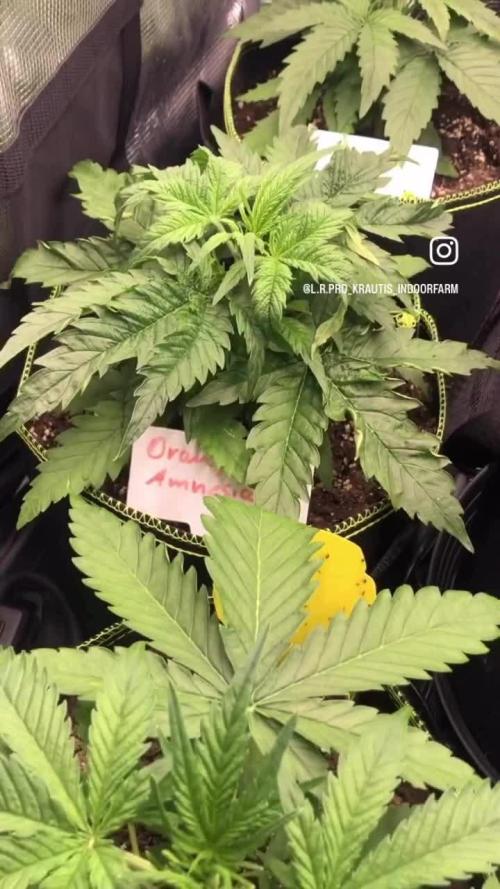
🌱 Update Tag 26 Die letzten zwei Tage sind die Mädels förmlich explodiert 🚀💚 Vor 5 Tagen gab’s das erste Mal was Feines von @panova25.de ein Top Dressing (22g) + Living Soil Bloom Boost. Und ganz ehrlich Man sieht’s jetzt schon richtig deutlich! 🔥 ✨ Warum der Dünger so gut ist? Der Living Soil Dünger von @panova25.de arbeitet mit organischen Nährstoffen, die langsam und gleichmäßig freigesetzt werden. 🌿 Dadurch werden die Wurzeln gestärkt, das Bodenleben gefördert und die Pflanze kann optimal Nährstoffe aufnehmen. Ergebnis mehr Power fürs Wachstum und später fette, gesunde Blüten. 🌸 🌱 @ganjafarmer.seed • Auto Orange Amnesia XL • Blue Dream Auto • Auto Amnesia 47 XL • Red Velvet Auto 💸 Tipp: Mit dem Code krauti10 spart ihr 10% bei @ganjafarmer.seed 🌱 #krauti_outdoorfarm #krautis_indoorfarm #growupdate #biobizz #panavo25.de#ganjafarmerseeds
Likes
25
Share
@Mr2toke
Follow
Milky Way F1 grew so nice, this run was pretty automatic! Plant 2 grew big, and she had the least amount of problems in the cycle. LST worked well on her, even though I got there late.
Likes
10
Share
@Luv2Grow
Follow
Day 85 - Starting week 13 today and still no issues. Checked some trichs today and still quite a bit clear in there but quite a bit cloudy. Going to start flushing her for her next watering and looking at her, think she’s got about 2ish weeks left. Day 86 - All still on track for a chop in about two weeks. There’s less and less clear trichs but would like to get a good amount of amber before cutting so hopefully she’ll push them out in the next two weeks. Day 87 - Gave her 2 gallons of plain 6.5 pH’d water today to start flushing out the nutes. She’s almost all ccloudy now and hopefully start getting some amber in there in the next two weeks before chopping. Day 88 - All is going good still. Checked the trichs all over and it’s pretty much all milky and seeing a couple ambers in there. So it seems like about a week to two weeks left. Day 89 - No real update, she’s getting a bit more amber in her so almost thinking she’ll be ready to chop this weekend. Just gonna keep an eye on her and when the trichs are right, she’ll get the axe. Day 90 - Lots more amber are showing now so looks like it’ll be day 91 or 92 when I chop her. Will probably chop her on Friday but may end up doing it tomorrow. Not sure yet, depends on how I’m feeling and what she’s looking like tomorrow but definitely excited about getting her chopped, trimmed and start drying her. Day 91 - The end of week 13 and Letting the girl finish drying out today and will be chopping her tomorrow. She has some lower fluff bud but everything else is ready.
Likes
15
Share
9/28 Day 24. Raised air pumps above the water line using two 5 gal buckets. Removed the inline air backflow valve and this increased aeration greatly! - Feeding day. Red TDS 850. EC 1.8 / Blue TDS 800. EC 1.7 / Yellow TDS 785. EC 1.6 / 10ml CalMag, 10ml Micro, 5ml Grow, 5ml Bloom, 2ml UC Roots. Will check TDS & EC through the week as they are starting to drink up the water. - LST started today. I will be adjusting them daily to pull off shoot branches in different directions. 9/30 Day 26. Added water for the first time. Used purified drinking water from the grocery store (Ph 7.45 TDS 95 EC .2) and PH'd it down to 5.9 10/1 Day 27. Readjusted the LST wires and added some new ones on the stems that can now be pulled in different directions. Red suffered a break on the main stem that went 1/2 through the stalk. I decided to use the LST wire to push it back together so that it can heal. I will still train the other shoots in different directions and let the main stem just do it's thing. Blue and Yellow pulled in new directions to open up the middle and spread out the stems. - I defoliated (light amount) some of the 3 leaf blades that were touching the container lids, and any larger 5 leaf blades that were blocking light to any new shoots with new stem growth and potential bud sites. I wanted to allow the air flow at the lower section of the plant. 10/2 Day 28. Everyone is bouncing back from the LST. Keeping a close eye on Red and the injury healing. I've decided to do a 1/2 of a weekly feed every 4 days instead of a mass feeding once a week. I will test the TDS and EC, see what the plants are telling me before I feed of course. (All values before feeding) - Red PH 5.98 TDS 720 EC 1.512 - Blue PH 6.17 TDS 728 EC 1.544 / Will add .25 PH down and re-test all in an hour after the feed to check PH values. - Yellow PH 5.93 TDS 708 EC 1.497 Feeding: 5ml CalMag, 5ml Micro, 4 ml Gro, 2ml Bloom, 2ml UC Root Guard. Post Feed values: - Red PH 5.78 TDS 808 EC 1.695 - Blue PH 5.90 TDS 846 EC 1.796 - Yellow PH 5.73 TDS 803 EC 1.700 Lessons learned week 4. 1. Be a little more gentle on LST. 2. Mark the water sight gauge at each 1 gallon increment so that I can track water replenishment levels. 3. Started a spreadsheet to monitor feeding value changes.
Likes
16
Share
@Ashbash
Follow
Holy. Shit. This is most likely gonna be my best plant up to this point Smell is unreal and hard to describe. Sweet and earthy but still different somehow. I think judging by the trichomes that it is largely ready to be pulled, so im going to do that over the next day or two. If anybody recommends I leave it please do say haha.
Likes
3
Share
Grow Diaries Report: Flower Week 1 – Stretch Madness & Heavy Grooming 🌿🚀 Week 9 – Flower Week 1 Update The flowering phase has officially kicked off, and wow, this plant is on a mission to touch the sky! The stretch this week has been intense, with the plant shooting up significantly. To manage her vigor and focus her energy on bud production, I’ve had to step in with defoliation and additional lollipopping. This Week’s Highlights Massive Stretch: The plant stretched dramatically this week, filling up the vertical space in the tent. Defoliation: I removed a significant amount of fan leaves to improve light penetration to the lower branches. Lollipopping Redux: Further cleaned up the lower parts of the plant, focusing her resources on the top colas. What I Did Lollipopping: Removed more of the lower branches and leaves that were unlikely to contribute to bud production. Defoliation: Took off some large fan leaves to improve airflow and light exposure throughout the canopy. Nutrients: Continued with the bloom feeding schedule, ensuring a balance of phosphorus and potassium for flower development. Environment Management: Adjusted the light height to prevent light burn and tweaked the fan placement to improve airflow in the now more open canopy. Observations The plant’s stretch has been both impressive and challenging, but the defoliation and lollipopping seem to be working. The top canopy looks well-lit and primed for flower development. No signs of stress from the grooming, which is always a relief during such an aggressive stretch. Challenges The rapid vertical growth is pushing the limits of the grow tent. I’ll need to monitor her closely to prevent overcrowding or light burn. Next Steps Keep monitoring the stretch over the next week—potential supercropping if necessary to control height. Fine-tune the nutrient schedule to ensure the plant has everything it needs as bud sites develop. Maintain low humidity to reduce the risk of mold or mildew during early flowering. Conclusion The first week of flowering has been an explosive start! The stretch is real, but with proper management, she’s looking set to develop some fantastic buds in the weeks ahead. 🌟 Any tips for managing a stretch-happy plant in a tight grow tent? Drop your advice below! 😊
Likes
2
Share
I keep increasing the light and she seems to enjoy it, growing new bud sides and leaves everyday. Defoliation continues. I can’t go below 25-26 Celcius due to increased light though. She has also been moved to back middle.
Likes
20
Share
@DrGanj
Follow
Standard week. starting to swell. No issues really. Wish this girl smelled more. My Bakers delight grow has set the bar high and I think this will be just an average pheno. Probably grow this strain from seed again next run unless she gets her dank on. Defoliating heavy around the tops to keep main canopy below strip level. Aim is for even light on every single bud site, or as much as possible
Likes
12
Share
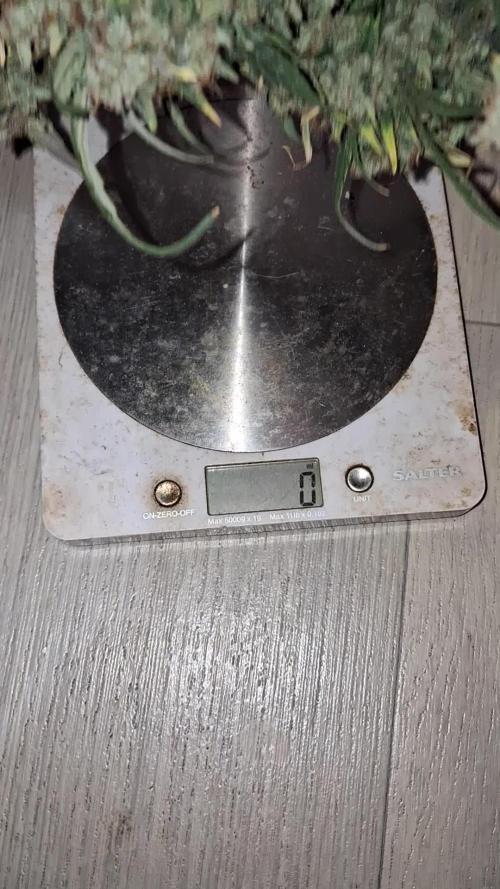
They were super easy to grow but took ill very quickly and didn't bounce back all that well but no great impact on the harvest, I'm still really happy with what's on the scales and I learned plenty from this round.
Likes
1
Share
@nickeri
Follow
Tropicana Cookies FF - Fastbuds 420 👌✅💚
Likes
5
Share
Overall I enjoyed this grow and learned a lot about living soil. Going for a slow dry, trim, then at least a one month cure. Hopefully another six days and I’ll update with a dry yield. My next batch is already cooking but with 5 gallon pots. 03/25 - Day 7 Drying B & C are done drying and have been in jars for a day now with RH ~60%. Total 3oz from B & C. Total 1.5oz from A & D
Likes
21
Share
@BigDaddyK
Follow
Just getting huge , and huger , lol , keep a close eye on the EC and ph , I’ll change reservoir today or tomorrow changed buckets today, 2/5/19 added a couple of pics in the dark.. also one thing ive noticed, if you try and play video it doesnt work, but if you go forward to next pic, then back again with the arrows on the side, it works!!! on my ipad anyway.
Likes
15
Share
@No_Clout
Follow
Everything’s looking well just waiting for them to swell up now.
Likes
38
Share
What's up fellow growers another week in the books! Well let me start off with this has been a horrible week for this grow! My ladies are sick. So acouple days after their 10/15 feeding I noticed both plants were moist on bottom and moist on top and dry as hell in the middle. I found this out by my pineapple auto leaning over! The roots on one side of this plant are practically gone. With having this knowledge I gave them a couple more days to dry out and then yesterday I did a ten gallon flush and the 11th gal I gave them another feeding. I also added more of the walmart soil that I still had left to try to firm the plant up more. It seems to have helped. But upon adding more of this soil I just added more pest. There's little white bugs crawling all over my pots. The flush seems to have made things worse but I know it takes a few days for signs of corrections to take place. So I'm waiting and hoping I don't lose these plants in that amount of time. They are both yellowing badly. 10/15/21 5.3ml Micro 4.7ml Grow 6.1ml Bloom Ph 6.5 Solution temp 73.1°F 10/22/21 10 gal flush with 11th gal being feed 3ml cal mag 2ml micro 4ml bloom Ph 6.28 631ppm Solution temp 73.3°F At this point I'm not sure if it's pest related or deficiency. So I will just sit and see what happens. The new growth on buds is green but all the old growth is dying off. Well until next week if their is one! Best of luck and Happy growing!😎🌱💚💪💪
Likes
12
Share
best cannabis I ever grew and smoked. Others agree. This is a cup winner I would win with no competition. 3 months harvested, 90% consumed. Will run more genetics and future cross, backcross. Feels like energy drinks, positive, 100% youre high and lit, extreme ripped. Smell is slight citrus, this is very sweet tasting and smelling because of my methods of growing. Oozing sticky like an industrial adhesive. Daytime smoke, ripped no couchlock. For heavy daily smoker this is above your level of comprehension, good luck finishing 0.5g session. 10/10 all categories. 4 months after harvest video macro, this is what 40% looks like
Likes
2
Share
18 hours in seconds, 60x60x18 = 64,800 seconds, now multiply by the 833μMol/s reading off the PAR metre. μMol/s (micromol) is the unit in which P.A.R. is expressed. 64,800x833=53,784,000μMol 53,784,000μMol = 54 Mol 54 DLI @ 800ppm, powerful combination. Pushing photosynthesis to peak capacity, accelerated growth and increased biomass. Applied net, stretching her around for a week. Maintaining a minimum air velocity of 0.3m/s within the inner canopy. E=MC2 looks like a simple multiplication problem; it describes a fundamental physical truth: mass and energy are the same thing. The equation doesn't just calculate a value; it reveals that mass is effectively "congealed" energy. Energy is just numbers. Energy isn't a physical "substance" you can hold or touch. It is essentially an abstract, calculated number that we assign to a system to predict how it will change, interact, or move. A numerical label we attach to matter to track how it behaves. Because the universe runs on laws of symmetry (specifically, that the laws of physics don't change over time), a single global number must be conserved. We call that number "energy". How well a seedling grows is down to how much knowledge one can acquire to increase the level of conversion to occur. Applying knowledge effectively requires intuition, which comes from hands-on experience. A seasoned stoner learns to read subtle signs—like a slight change in leaf turgor (stiffness), subtle color shifts, or the specific texture of the soil—before a textbook diagnosis can be made. Ultimately, growing is the application of botanical science blended with active observation. Knowledge dictates your potential, but adaptability and attentiveness to the plant's immediate environment determine your results. The human eye is capable of distinguishing more shades of green than any other color in the visible spectrum. 1.618 Nature mathematically optimizes quantum energy transfer and light absorption efficiency within the photosynthetic machinery, as it naturally dictates energy scaling hierarchies and resonance dynamics. External vibration or electromagnetic wave that perfectly matches a plant's natural frequency directly influences plant growth. Low-frequency sound waves and targeted electromagnetic fields stimulate cellular processes and boost photosynthetic efficiency. An angular frequency aligned with the Golden Ratio is often used in wave mechanics and quantum physics to optimize energy transfer. . Does it produce better yields? All I know is the IVM loves being aligned with it. "Frequencies utilizing this ratio naturally minimize resistance (or impedance) and allow for highly efficient resonance, which can facilitate an increase in Electron Transfer Reactions (ETR) or energy pathways in molecular structures." Quantum coherence in photosynthesis occurs when a photon of sunlight strikes a leaf; the energy it carries must travel to a reaction center to be converted into chemical energy. This process operates at nearly 100% efficiency. If the energy moved in a traditional "bunching" or random hopping manner, a large portion of it would be lost as heat. Instead, plants utilize quantum superposition. The energy particle (exciton) doesn't just take one path; it exists in a wave state and explores multiple pathways simultaneously. It essentially "chooses" the most efficient route to the reaction center simultaneously. Research shows that molecular vibrations and the specific network arrangements of chlorophyll molecules (like the naturally evolved Chlorophyll A & B ratios) actively protect against energy overflow, optimizing light capture across different light intensities. Enzymes are the biological catalysts that speed up chemical reactions within a plant's cells, allowing them to grow, metabolize, and repair. Rather than relying solely on the classical kinetic energy of molecules colliding, plants use quantum tunneling. Subatomic particles like electrons and protons (hydrogen ions) can literally "teleport" through energy barriers that they normally wouldn’t have the energy to climb over. This makes vital metabolic reactions happen far faster than classical physics could ever explain! Chloryphyll b has peak absorption at 460nm (Blue) and at 647nm(Red). If we take the blue peak wavelength 460nm and a UV-B, UVR8 peak absorption wavelength 285nm, Tryptophan-285 (W285) Sensing protein. 460/285=1.618 Φ If we take chlorypyhll b's Red absorption peak 647nm and a UV-A of 400nm, we get 647/400=1.618 Φ. "Structure of light". The cryptochrome photoreceptor (CRY) is a UV-A/blue light receptor that shares this dual sensitivity with several other biological structures and functions, including significant sequence similarity and a common evolutionary ancestor with DNA photolyase enzymes. These are light-activated enzymes that use blue/UV-A light to repair DNA damage caused by UV-B radiation in plants. Synergistic. Effective quantum efficiency of photosystem II, often denoted as ΦPSII, represents the proportion of light absorbed by Photosystem II (ΦPSII) that is actually used in photosynthetic electron transport. It is a key indicator of how efficiently a plant is using light for photosynthesis, as opposed to losing it as heat or fluorescence. ΦPSII (effective quantum yield of photosystem II) functions primarily as a "multiplier" (a coefficient of efficiency) rather than an additive factor when estimating the overall photosynthetic electron transport rate (ETR). Multipliers are considered far more beneficial than additions because they generate exponential growth, leverage existing resources to their full potential, and create sustainable, self-multiplying capacity, rather than just incremental, linear increases. This fascinating observation is rooted in the intersection of subatomic geometry, fractal scaling, and quantum dynamics. In specific molecular arrangements—such as in conjugated polymer networks or biomolecular architectures—the Golden Ratio (PHI) naturally dictates energy scaling hierarchies and resonance dynamics. Mathematically tied to the fine-structure constant, which defines the strength of the electromagnetic interaction. The Golden Ratio can be mapped geometrically as the Golden Angle (137.5 degrees) in atomic structures, linking the charge of the electron to fundamental quantum constants like Planck's constant. An electromagnetic wave is neither electric nor magnetic, but a combination of both. 137.5 The Golden Angle (137.5) This angle is derived from the Golden Ratio (1.618). It is the smaller of two angles created when a circle is divided such that the ratio of the arcs equals the Golden Ratio. An electromagnetic wave (like light or radio waves) is not a static electric field or a static magnetic field, it is a self-propagating combination of both. An oscillating electric field creates an oscillating magnetic field, which then regenerates the electric field. They feed off each other and travel together through space at the speed of light, carrying energy without needing a material medium. The Fine-Structure Constant Alpha (Α/α): In quantum physics, is the approximate denominator of the fine-structure constant (often represented by the Greek letter Alpha (Α/α). It is a fundamental, dimensionless number that dictates how strongly charged particles (like electrons) interact with the electromagnetic field. Its value has puzzled physicists for over a century, as it bridges quantum mechanics, electromagnetism, and relativity. In quantum mechanics, Omega (Ω/ω) usually represents angular frequency. When applied to "quantum coherence"—the ability of particles to exist in overlapping states without immediately degrading—is key to calculating how long these states last. The Golden Angle, the value 137.5° is the geometric Golden Angle. It is derived from the Golden Ratio (1.618) and is famously responsible for the beautiful, mathematically optimized spiral patterns found in nature (such as sunflower seeds, pinecones, and leaf arrangements). Because of this, theoretical physicists and mathematicians have long speculated about why nature relies so heavily on the number 137 and the golden angle to govern everything from subatomic light interactions to the macroscopic geometry of the universe. Quantum coherence allows particles to maintain superposition and entanglement. In realistic, open environments, interactions with a noisy background typically cause decoherence, destroying the system's quantum information. A major challenge in quantum physics and quantum computing is preventing this decoherence at large scales. In quantum optics and driven systems, the Greek letter Omega (Ω/ω) often represents the Rabi frequency, which dictates the strength of the coherent driving laser or electromagnetic field interacting with the quantum system. The interaction of light and water generates specific Coherent Domains. Trapped electromagnetic fields cause water molecules to vibrate in unison at a coherent frequency, separating the liquid into structured quantum areas and an unstructured phase. When water interacts with hydrophilic (water-attracting) surfaces, the energy from UV and Infrared light can drive the formation of larger, structured layers known as Exclusion Zone (EZ) water. Exclusion Zone (EZ) water represents a structured, negatively charged phase of water critical to cellular biology. Driven by light energy and hydrophilic surfaces, this ordered state acts as a natural biological battery, with far-reaching implications for cell function and human health. In this domain, water molecules arrange themselves into a highly ordered, negatively charged lattice that excludes solutes and particles. At higher energy levels, UV light acts as a catalyst for photochemical reactions. Photons can provide enough energy to break the hydrogen and oxygen bonds in molecules, resulting in free radicals and a plasma of quasi-free electrons. This transfer of electrons forms the fundamental basis for redox reactions and energy metabolism in ALL biological systems.
Likes
6
Share
@gr3g4l
Follow
Visto que ya estamos a mediados de agosto y pareceria que quieren empezar a florecer voy a empezar esta semana con el bloom. Mitad bloom mitad grow 51d nuevo tratamiento preventivo con TD + Solabiol, Foliar. Una vez el tratamiento para evitar que las lluvias limpien la planta suelo ponerlas bajo techo. En cuanto deja de llover las vuelvo a sacar. dia 54 126ctms la nº1 y 102 la nº4 y una clara evidencia que ahora empieza lo bueno. Como puede observarse han ensanchado las ramas , han crecido notablemente y empiezan a mostrar claramente sus primeros pistilos.
Likes
2
Share
@bbs42
Follow
Day 23, been QCing the buds and lots defoliation the past 2 days. Getting caked in Trich and some nice bright orange hair poping out. Added trimmed buds to mulch layer. No fan leaves in mulch
Likes
42
Share
@MrJoint
Follow
✂️Defoliation one more time. ✌️🎃Thank you for checking my cultivation.