



@TwinExotics
Follow
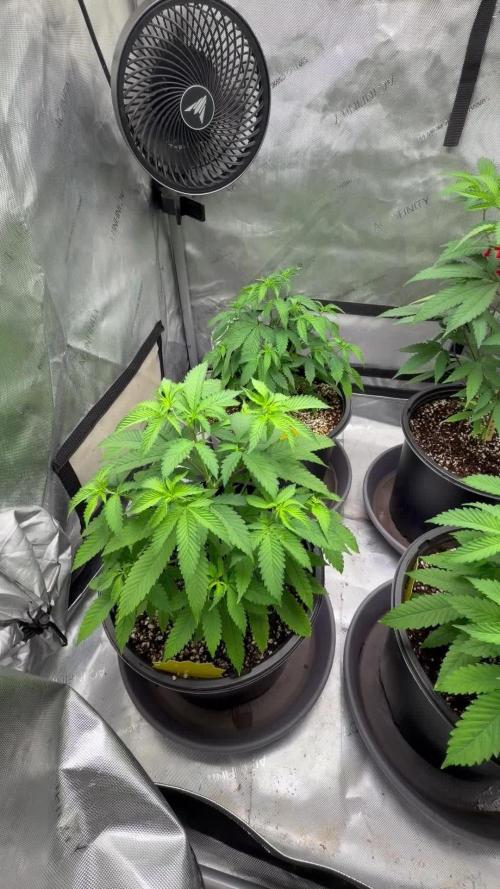
Quick flipping this week! All systems go 🚀!! Did some LST to spread out canopy. One of my Yacht Party clones wants to be a runt but I’m sure this will change after 1st week flower, otherwise everything else is growing uniformly! Lookin forward to changing the schedule after our last cold snap passes in my area.





@Ultraviolet_
Follow
Remember that, however you are played, or by whom, your soul is in your keeping alone. Even though those who presume to play you be kings or men of power, when you stand before God, you cannot say, 'But I was told by others to do thus,' or that virtue was not convenient at the time. This will not suffice. Remember that.
Day:18
84°F and 65% RH (VPD) for the vegetative stage. Approximately 1.15kPa(assuming leaf temperature is about 2°F cooler than the air), which falls right into the ideal vegetative sweet spot (0.8kPa to 1.2kPa). At 1.15kPa, plants can draw water and nutrients efficiently without risking stress or wilting. It keeps the leaf pores (stomata) open, allowing for ideal carbon dioxide intake and maximizing vegetative growth. VPD is determined by the leaf's temperature, not just the ambient air. Because leaves usually run 1° to 3°F cooler than room air under bright grow lights, my actual VPD will be slightly lower, closer to the 1.0kPa mark. As she transitions from vegetative growth to flowering, one can gradually lower the humidity (to around 45–60%) and drop temperatures slightly to prevent disease from settling inside dense buds when they appear.
Night:6
At 70°F and 60% relative humidity, Vapor Pressure Deficit (VPD) is 0.86 kPa. This is right on the cusp of whats optimal for the vegetative stage. During the nighttime, plants generally close their stomata and undergo cellular respiration rather than photosynthesis. Transpiration slows to a near stop, making VPD less critical at night than during the day. However, maintaining a nighttime VPD between 0.8 and 1.0 kPa is highly beneficial in that it ensures the air is dry enough to prevent powdery mildew or bud rot, but moist enough to keep the plant from undergoing unnecessary stress. This range keeps the environment comfortable for cellular processes and prevents large atmospheric swings. Keeping it all flowing.
(Not pushing them yet, these are photoperiods)
The optimal soil (root zone) temperature for cellular root respiration and nutrient uptake in cannabis is between 68F & 72F This narrow range balances biological energy production (cellular respiration) with the dissolved oxygen levels in the soil, maximizing plant growth and health. Warmer soils hold significantly less dissolved oxygen. When soil temperature exceeds 74F oxygen depletion occurs, inhibiting cellular respiration almost entirely, At 68-72F root cells generate optimal adenosine triphosphate (ATP) via respiration to power root-tip elongation and the active transport of water and nutrients.
Too Hot (Above 78F) Root respiration increases, demanding more oxygen, while the water's oxygen-carrying capacity drops. This creates a prime environment for anaerobic pathogens and Pythium (root rot).
Too Cold (Below 60F) Root metabolism and cellular respiration slow to a crawl. This severely impairs nutrient and water absorption, leading to yellowing, wilting, and phosphorus deficiencies.
A lot depends on whether it's automatic or photoperiod; with photoperiod, there is not as much of a need to push "hard" as the real countdown only begins once the flower is initiated. Automatics, on the other hand, the chronological "clock" begins ticking the moment the seed germinates. It is of critical importance that the seedling growth gets off to the races, understanding that early growth is like compound interest, which will pay off come harvest. This reality is why getting autoflowers "off to the races" early on yields such exponential benefits. The "compound interest" is directly related to the surface area of the leaves. Larger, faster-growing seedlings process more light and build bigger root networks early on, which translates into an explosion of vertical and lateral growth during their short vegetative window.
The margins for error are so thin with autoflowers; this early-stage momentum depends on several critical practices. Seedlings exposed to increased atmospheric CO2 levels early in life will develop at an increased rate. To effectively "extend" or optimize the capacity of Photosystem II (PSII) for increased photosynthetic efficiency. In standard oxygenic photosynthesis, Photosystem II (PSII) is naturally limited to the red-light spectrum, peaking at 680nm. Extending its light-harvesting capacity past 700nm into the far-red region requires bypassing the natural limits of standard chlorophyll a. Adding 730 nm (far-red) LEDs alongside standard red/blue lights has been shown to increase canopy photosynthesis by 20–30% in several crops by acting synergistically with shorter wavelengths. However, the limitation is that excessive, pure IR/Far-red light (without accompanying red light) can trigger the "shade avoidance response," causing plants to grow tall, weak, and spindly rather than robust. Utilizing infrared light (specifically the 700-750 nm far-red range) is a viable method to boost photosynthetic efficiency. It acts as a bridge to allow PSII to utilize a broader spectrum of light, breaking the traditional 700 nm barrier. UVR8-mediated signaling (often in conjunction with CRY proteins) triggers protective mechanisms that maintain the stability of the photosynthetic apparatus (including LHCII and reaction center proteins), thus ensuring that the efficiency of Photosystem II remains higher in UV-B-exposed plants compared to plants lacking this receptor. ΦPSII indictates the rate of electron transfer from water to plastoquinone, which drives the production of ATP and NADPH. There is a close link between ΦPSII and the true rate of CO2 fixation (Φ*co2).
ETR stands for Electron Transport Rate. It measures the speed at which electrons are moved through the thylakoid membranes in a plant's chloroplasts during the light-dependent reactions of photosynthesis. Infrared light (particularly Near-Infrared or NIR) improves cellular energy by interacting directly with the electron transport chain (ETC) in mitochondria. This process boosts adenosine triphosphate production, which acts as a metabolic coefficient multiplier by accelerating enzyme activity dramatically.
Extend then multiply.
Far-Red photons interact with plant photoreceptors to accelerate the plant’s biological "clock" or trigger a shade-avoidance response. Autoflowers don't use the plant's biological clock, although the IR will initiate a shade avoidance and make them stretchy. You can just add equal measures of 660nm-680nm to negate the shade avoidance effect. Replacing nights' "darkness" with a combination of IR+ and 660nm. Because autoflowers don't require a dark period to flower, many growers just blast them with light. 18/6 24/0. However, this ignores the plant's metabolic rhythms, where daytime photosynthesis (light reactions) must be perfectly balanced with nighttime carbon fixation and assimilation (Calvin cycle) to avoid bottlenecking plant development. Cellular respiration is a 24/7 process, but it can only function while the plant has the free oxidative capacity to do so. A 100% photosynthetically active leaf cannot perform cellular respiration. The viral trend of defoliation of every leaf that isn't "getting enough light" is of great detriment overall, putting 100% of the cellular respiratory "workload" and responsibility on the 0/4/6 hours of darkness in sub-optimal conditions for enzymatic activity. Photosynthesis captures nearly 100% of the initial energy as carbon, while cellular respiration is the process that unlocks 90% of that captured energy into usable ATP so the plant can use it. Respiration is considered roughly 30% to 40% efficient. It captures enough of the potential energy in glucose to synthesize around 30 to 38 ATP molecules per glucose molecule. The remaining 60% to 70% of the energy in the sugar is not captured in ATP; instead, it naturally escapes into the environment as heat, which helps regulate plant temperature. In plants, the primary enzymes of the Electron Transport Chain (ETC) and the ATP synthase complexes are typically adapted to function optimally in warmer temperatures (roughly 25°C to 35°C depending on the specific plant strain). As temperatures rise within this physiological range, molecular collisions increase, speeding up respiration and ATP production. The cannabis plant has a branched respiratory pathway. During heat or cold stress, plants activate Alternative Oxidase (AOX). AOX burns sugars to dissipate energy as heat rather than coupling it to ATP production. This pathway actually functions optimally at elevated temperatures to help protect the cell from the damaging build-up of Reactive Oxygen Species (ROS) during heat stress. Enzyme activity generally scales with heat; there is a strict biological limit. If canopy temperatures in a grow room exceed 40°C, the enzymes and their supporting lipid membranes lose stability. Not saying you need to go crazy, just optimize nights the same as we optimize days.
Phosphorus is the driving force behind early seedling development. It acts as the "energy hub" of the plant, directly driving cell division, robust root growth, and the creation of DNA. Without an adequate, easily accessible supply early on, the plant's overall growth potential and final yield can suffer permanently.
E=MC2 looks like a simple multiplication problem; it describes a fundamental physical truth: mass and energy are the same thing. The equation doesn't just calculate a value; it reveals that mass is effectively "congealed" energy. Energy is just numbers. Energy isn't a physical "substance" you can hold or touch. It is essentially an abstract, calculated number that we assign to a system to predict how it will change, interact, or move. A numerical label we attach to matter to track how it behaves. Because the universe runs on laws of symmetry (specifically, that the laws of physics don't change over time), a single global number must be conserved. We call that number "energy".
We don't grow; we facilitate energy conversion.
How well a seedling grows is essentially down to how much knowledge one can acquire to increase the level of conversion to occur. Applying knowledge effectively requires intuition, which comes from hands-on experience. A seasoned stoner learns to read subtle signs—like a slight change in leaf turgor (stiffness), subtle color shifts, or the specific texture of the soil—before a textbook diagnosis can be made. Ultimately, growing is the application of botanical science blended with active observation. Knowledge dictates your potential, but adaptability and attentiveness to the plant's immediate environment determine your results.
1.618 nature mathematically optimizes quantum energy transfer and light absorption efficiency within the photosynthetic machinery, as it naturally dictates energy scaling hierarchies and resonance dynamics. External vibration or electromagnetic wave that perfectly matches a plant's natural frequency directly influences plant growth. Low-frequency sound waves and targeted electromagnetic fields stimulate cellular processes and boost photosynthetic efficiency
Does it produce better yields?
How long is a piece of string? As long as you cut it. But isssss the juice worth the squeeze? The quantum framework of the IVM seems to think so. Good enough for the quantum firmware, good enough for the DNA software. Genetics are not dictated; they are expressed; the rate of that expression is dictated by the environment in which growth occurs.
Quantum Coherence in Photosynthesis occurs When a photon of sunlight strikes a leaf, the energy it carries must travel to a reaction center to be converted into chemical energy. This process operates at nearly 100% efficiency. If the energy moved in a traditional "bunching" or random hopping manner, a large portion of it would be lost as heat. Instead, plants utilize quantum superposition. The energy particle (exciton) doesn't just take one path; it exists in a wave state and explores multiple pathways simultaneously. It essentially "chooses" the most efficient route to the reaction center simultaneously. Research shows that molecular vibrations and the specific network arrangements of chlorophyll molecules (like the naturally evolved Chlorophyll A & B ratios) actively protect against energy overflow, optimizing light capture across different light intensities. Enzymes are the biological catalysts that speed up chemical reactions within a plant's cells, allowing them to grow, metabolize, and repair. Rather than relying solely on the classical kinetic energy of molecules colliding, plants use quantum tunneling. Subatomic particles like electrons and protons (hydrogen ions) can literally "teleport" through energy barriers that they normally wouldn’t have the energy to climb over. This makes vital metabolic reactions happen far faster than classical physics could ever explain.
Chloryphyll b has peak absorption at 460nm (Blue) and at 647nm(Red). If we take the blue peak wavelength 460nm and a UV-B, UVR8 peak absorption wavelength 285nm, Tryptophan-285 (W285) Sensing protein. 460/285=1.618 Φ If we take chlorypyhll b's Red absorption peak 647nm and a UV-A of 400nm, we get 647/400=1.618 Φ. "Structure of light". The cryptochrome photoreceptor (CRY) is a UV-A/blue light receptor that shares this dual sensitivity with several other biological structures and functions, including significant sequence similarity and a common evolutionary ancestor with DNA photolyase enzymes. These are light-activated enzymes that use blue/UV-A light to repair DNA damage caused by UV-B radiation in plants. Synergistic. But Shhh, it's a secret.
Effective quantum efficiency of photosystem II, often denoted as ΦPSII, represents the proportion of light absorbed by Photosystem II (ΦPSII) that is actually used in photosynthetic electron transport. It is a key indicator of how efficiently a plant is using light for photosynthesis, as opposed to losing it as heat or fluorescence. ΦPSII (effective quantum yield of photosystem II) functions primarily as a "multiplier" (a coefficient of efficiency) rather than an additive factor when estimating the overall photosynthetic electron transport rate (ETR). Multipliers are considered far more beneficial than additions because they generate exponential growth, leverage existing resources to their full potential, and create sustainable, self-multiplying capacity, rather than just incremental, linear increases. This fascinating observation is rooted in the intersection of subatomic geometry, fractal scaling, and quantum dynamics. In specific molecular arrangements—such as in conjugated polymer networks or biomolecular architectures—the Golden Ratio (PHI) naturally dictates energy scaling hierarchies and resonance dynamics. Mathematically tied to the fine-structure constant, which defines the strength of the electromagnetic interaction. The Golden Ratio can be mapped geometrically as the Golden Angle (137.5 degrees) in atomic structures, linking the charge of the electron to fundamental quantum constants like Planck's constant.
Electromagnetic.
The Golden Angle (137.5): This angle is derived from the Golden Ratio (1.618). It is the smaller of two angles created when a circle is divided such that the ratio of the arcs equals the Golden Ratio.


@GrowPassionItalyChris
Follow
È stata una settimana molto calda e piena di bellissime giornate, il meteo è meraviglioso questo periodo. Le bellissime autofiorenti dutchfemseeds sono tutte vicinissime alla fase finale della fioritura e alcune sono già pronte per essere raccolte ma aspetteremo un altra settimana abbondante prima di raccogliere tutte le infiorescenze mature in maniera graduale. Molto colorate le mimosa Purple Kush e molto resinose, il resto delle varietà ognuna ha il suo aroma speciale ed inconfondibile,tutte molto resinose e piene di infiorescenze molto dure e cariche di resina appiccicosa. Sono felice perché queste varietà come sempre soddisfano a pieno le mie esigenze e sono spettacolari vederle fiorire nel giardino. Alcune sfiorano il metro ed ottanta centimetri di altezza con infiorescenze ovunque. Manca poco! Un abbraccio a tutti.


@CaninhaSativa
Follow
25/01 Still having problems with the heat, I've build a exaust with 2 120mm computer fan, this week has arrived the humidity controller and I noticed that is to low for the temperature.
Now I waiting for a mist maker to build a DIY humidifier(using a simple water spray for now) I belive this will be the solution to get a better VPD and control this fucking heat inside the tent 😎
30/01 The temperature is reaching more suitable levels, between 25-27°C. Even with the rainy days and higher humidity outside, the grow is stabilizing well at around 65% humidity.


@Damonkey
Follow
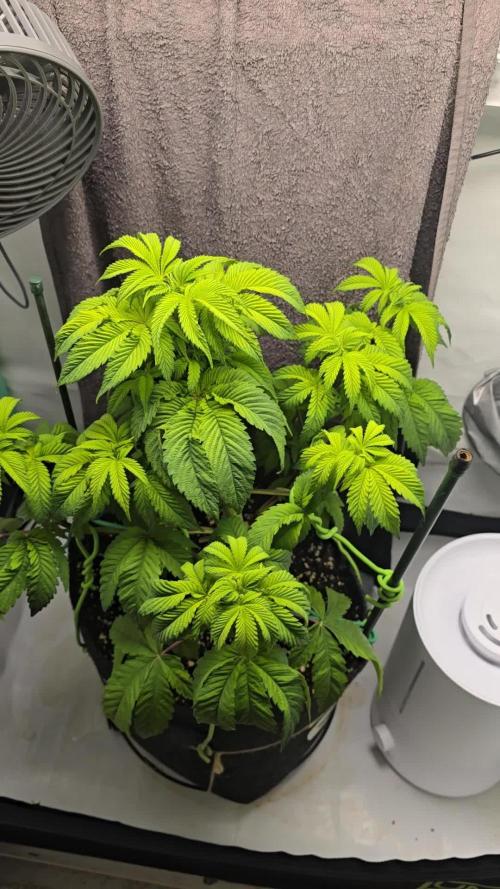
First day of the seventh week of flower. Realised I’ve been over feeding meaning the buds had kinda stagnated😩😤🤬 a friend pointed out a possible cause and when I laid off feeding every day they seem to have kicked up again.🤗 Anyway live and learn. Now I’m feeding once every 2-3 days.




@Naujas
Follow
Taigi, šią savaitę išvykstu, turiu tik tiek naujienų, atrodo, kad ji sveiksta, kitą savaitę vėl grįšiu jos aplankyti :) Sėkmės visiems :).


@TOMI08
Follow
Sziasztok
A középsőt le kellet vágnom a penész miatt...viszont nagyon erősen fejbe vág ...elcsavarja a fejet🤣🤣🤣
Ezt a törzset biztosan újra növesztem


@BlueDream123
Follow
We are actually around week 20........ Canuck Seeds seems to have sensored the review i left about the seeds not autoflowerings, as did TrueNorthSeed


@Dargaville_Dukes
Follow
Germination went well - 100% success rate. Seedlings look healthy and seems to be growing well/ I'm not able to get air temperature above 18 degrees Celsius during the day cycle but I don't think that will be an issue with this strain.


@Reyden
Follow
Siamo ormai entrati nella 3º settimana di fioritura e sto cercando di tenere un EC intorno a 1650 e PH 6.5, le piante crescono sane e con pochi problemi di carenze, con questi vasi bevono più o meno il 3º giorno e si asciugano benissimo…dovrò sicuramente comprarne altri molto presto!😎
Sono curioso di vedere fino a che punto posso spingere questi semi di Anesia! La prossima settimana saliamo a 1.750 💚🌱


@Tazard
Follow
I checked her trichs and I’m confused 😂. Have a look and see what you think. The trichs photo was 19/2/2020. I think I’ll harvest her 22/2/2020.


shorts_status_processing


@maxpain
Follow
In cure mode ..tried a bud couldn't wait ...I .can tell it will be good once properly cured..




@tterpy
Follow
Fed with week 7 Fox farm
Plant to the right is a berry tsunami had to swap out that guavas and berries bc it stretched into the light.


@AsNoriu
Follow
Day 118. Trim jail and heavy upload session for 48 hours at least. Don't like to keep photos, so ill upload each plant separately and will delete them. Phone camera is still cracked and off-focus, but they are all nice !
Day 118. Late night, all girls trimmed !!! Drying starts now ! ;)
Day 121. Everything looks beautifull, took small sample from Runtz .... ---> My morning is waisted, big mistake ;)))
Day 128. #1 88, #2 98, #3 144 of most airy bud i ever grew indoors, for UK outdoors it would be good, here was saddened by end result ... will update everything after good rethought what has happend ...
Happy Growing !!!





@The_Projexx
Follow
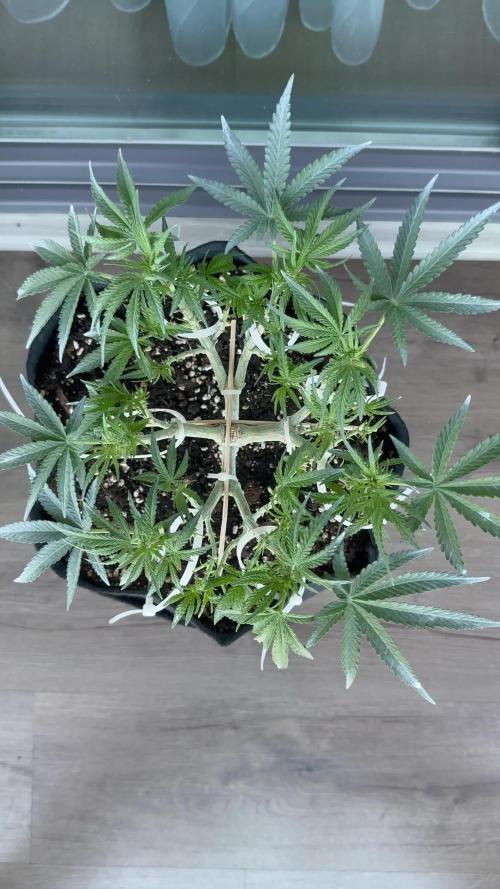
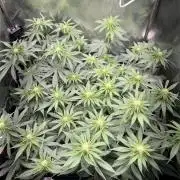
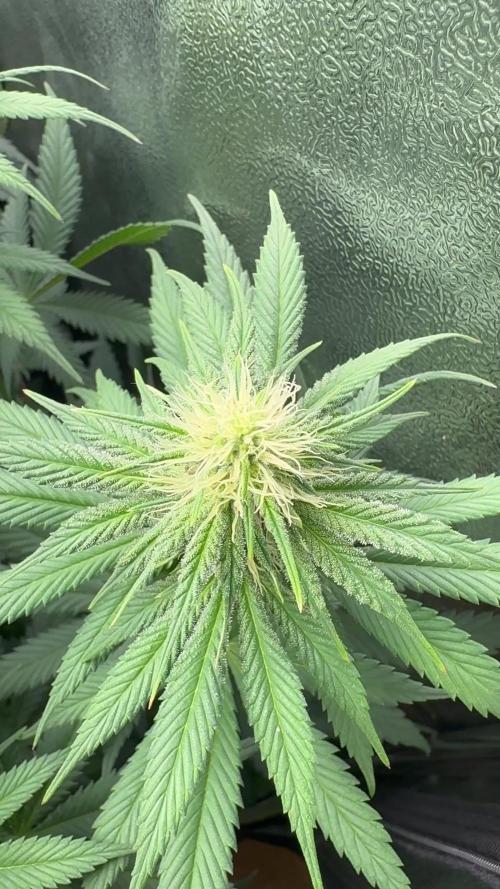
Very fun strain to grow. Easy to train and love to get big. We had 2 different expressions on the plants and both where very pleasing. Both plants grew vigorously and provided me with just over 3/4 pound of dry medicine!



@JonnyTerpen
Follow
Hey Freunde heute ein kleines Update, mittlerweile ist Blütetag 24 der stretch war wohl noch nicht ganz zu Ende und besonders die Papaya und die Pink Chai haben nochmal nen richtigen Schub gemacht. Heute hab ich mal doppelt soviel Wasser gegossen, da die unteren Blätter schon leicht vertrocknet waren und die Töpfe immer sehr leicht. Die Pink Chai bekommt minimal gelbe spitzen, aber is glaub zu vernachlässigen, verdacht war zuviel Licht. Sie hat danach auf jedenfall auf gehört die Blätter zum Licht zu strecken, also erstmal keine praying leaves mehr, heute Abstand verringert und sie Betet wieder. Freu mich über jede Rückmeldung und wünsch euch n schönes Wochenende! ✌️💚


@El_Bottanico
Follow
Hello everyone.
Another week passed, gave her water and some enzimes on day 33, I noticed some leaf intervenal discoloration, not too concerning in my opinion. Maybe the enzimes were too much or some nutrient lock out due to a somewhat excessive fertilization. Any opinion on this issue?
I think will go on with plain water to the end I think, hoping the problem will sort out itself. What do you think?
Other then that I think buds oare forming fast and fine, she's putting out a little resin and smell now.
Ciao 😊


@DrWeed420
Follow
We are starting the second week!!! The girls feel good, they are growing like crazy. Tomorrow we will transplant them into larger pots (10 l). I also increase the fertilizer dose to 2 ml/l. Maybe I'll start LST training this week. I still keep the lamps at 30 cm, but I increase the light power to 70%. I'm full of enthusiasm, keep it up! Thank you for all the likes and I wish you successful growth as well.
🙂🙃🙂🙃🙂🙃🙂🙃🙂🙃🙂🙃🙂🙃🙂Hello to all cannabis lovers🤩. The girls have already been transplanted into 10-liter pots. I replanted them yesterday, but I only took photos today. Thanks to valuable advice from @Crashoverite, three days ago I stopped fertilizing and watered the plants with clean water. Thank you very much !!! 🙏🤪😁
