






Likes
6
Share


Processing
Likes
Comments
Share


@CityFarmer
Follow
Hello everyone,
The girls are finally outside in 20 gallon fabric pots. This season I have a greenhouse for them and I hope it goes good. Still have to build the first cages around them and start stretching them. 🎊🎉 finally, summer is here 🎉🎊
See you guys next week 🤞🤞🤘🤘👊👊👊
Likes
13
Share


@FlavoursUk
Follow
Started off by setting up the growing environment and dialling everything in such as;
RO Water for the RDWC hydroponic system.
Water Heater being set at 20 degrees C.
Water chiller being set at 21 degrees C.
pH being set at 5.7/5.8
Room Temp and humidity 20/23 Degrees C / 60%/80%RH.
Instead of using rockwool cubes to place my seeds, I put them directly into the clay pebbles. I then used a DIY humidity dome to place over the seeds until they make an appearance.
I have been top feeding RO water every 6 hours.
Foil was used to cover the net pot to ensure no light leaks were going into the system. Highly important in DWC.
Will add some light nutrients once seeds are more established.
Until the next one!

Likes
4
Share

@Black_Widow
Follow
Привет садоводы !!!
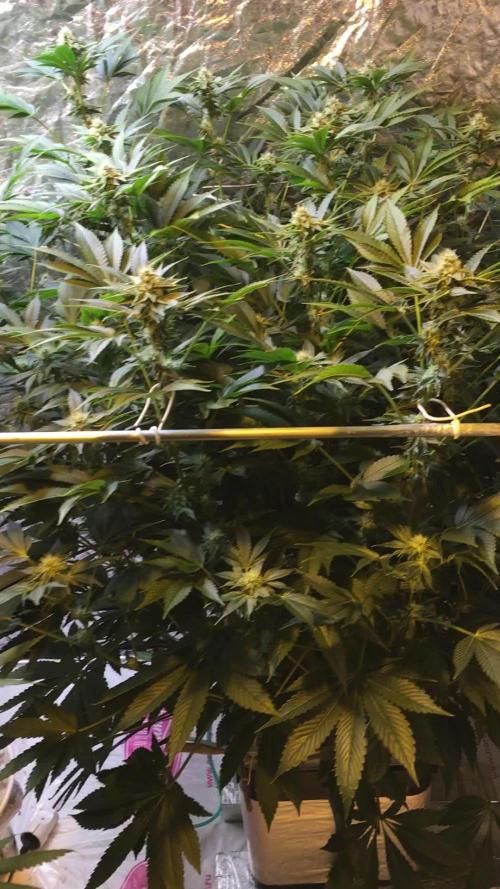
началась новая неделя и сегодня я поменял раствор на новый у подруги гидропоники
тот цветок ,что в земле я полил последний раз Ripen и теперь промывка чистой водой
растения чувствуют себя хорошо и активно кушают
вот такие дела в саду😊

Likes
8
Share


@Roberts
Follow
Tangerine Band is growing great. She has gotten too big, and I have been hst her. She is eating a lot and growing good. Thank you Exotic Seeds, Spider Farmer, and Athena. 🤜🏻🤛🏻🌱🌱🌱
Thank you grow diaries community for the 👇likes👇, follows, comments, and subscriptions on my YouTube channel👇.
❄️🌱🍻 Happy Growing 🌱🌱🌱
https://youtube.com/channel/UCAhN7yRzWLpcaRHhMIQ7X4g.

Likes
8
Share


@AlbasDiary
Follow
Buenas Jardineros!!🌱🌱💚
Hoy podé un poco las plantitas y las voy a abonar con las cantidades q puse en nutrientes.
He tenido un sustito con orugas, malditas, ya estaban dentro de dos hojas!!!😑
Revisé bien, están limpias, seguiré atenta
Muy buenos humos compis!😙💨🌿

Likes
Comments
Share

@dinosdarko
Follow
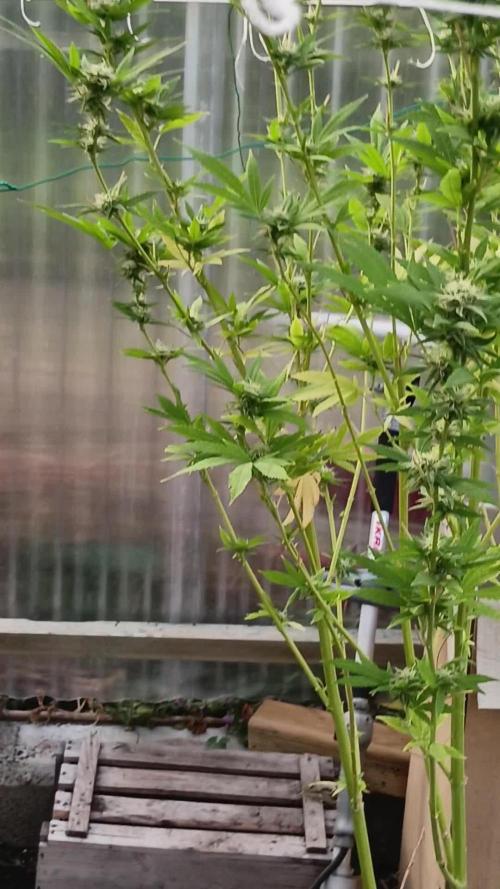
Morgen beginnt offiziell die 5. Blütewoche, und diese gewaltige Papaya Frosting (Barney's Farm) [Barney's Farm] entwickelt sich zu einem absoluten Prachtexemplar! Mit einer beeindruckenden Höhe von 2,50 Metern, tief eingewurzelt in der Muttererde, hat sie das Höhenwachstum (Stretch) nun komplett eingestellt. Sie steckt ab jetzt 100 % ihrer Energie in den Ausbau der Knospen und die Produktion von Trichomen.Klima & Umgebung:Das Gewächshaus-Setup funktioniert fehlerfrei. Obwohl der Herbst einzieht und die Außentemperaturen ab 1:00 Uhr nachts auf kühle 5 °C bis 11 °C fallen, bleibt es im Gewächshaus innen und außen vollkommen trocken. Kein Kondenswasser, kein Tau auf den Blättern. Mein kontrolliertes Luftsystem läuft die ganze Nacht durch und hält die relative Luftfeuchtigkeit sicher im optimalen Bereich. Mit 50 cm Abstand zwischen den obersten Trieben und dem Gewächshausdach ist die Luftzirkulation über dem Kronendach perfekt.Pflanzenstruktur & Erziehung:Das System mit den zwei Stütznetzen erweist sich als Lebensretter. Das erste Netz sitzt bei 1,40 m, das zweite bei ca. 2,20 m. Die Haupttriebe wachsen schnurgerade durch die Maschen, was ihnen genau den Halt gibt, den sie für das enorme Gewicht in den kommenden Wochen brauchen.Entlaubungs-Strategie: Ich habe das Innere der Pflanze stark entlaubt und nur die großen Fächerblätter an der Außenseite stehen gelassen. Das sorgt für einen natürlichen „Kamineffekt“, bei dem die Luft frei durch das Zentrum strömen kann – optimal für den Luftaustausch und ein perfekter Schutz gegen Schimmel.Lollipoppen: Kümmerliche Triebe unterhalb der 1,00-Meter-Marke, die komplett im Schatten lagen, wurden konsequent entfernt, um die gesamte Energie nach oben in die Hauptblüten zu jagen.Blüten- & Harzentwicklung:Der „Frost“ (die Harzbildung) ist für das Ende der 4. Woche absolut genial! Betrachtet man die Knospen im Bereich der 1,30-Meter-Marke, sieht man extrem kurze Internodienabstände und sehr dichte Blütencluster. Die Blütenfäden (Pistille) sind lang, schneeweiß und voller Vitalität. Die Zuckerblätter sind jetzt schon von einer dicken, klebrigen Schicht weißer Trichome überzogen. Durch die kühlen Temperaturen in der zweiten Nachthälfte bin ich sehr gespannt, ob die Pflanze in den nächsten zwei Wochen schöne, dunkle Herbstfarben (Purpeln) zeigt.Sie ist absolut gesund, kräftig und bereit, in den nächsten Wochen massiv an Gewicht zuzulegen!


Likes
1
Share


@jojopfoh
Follow
they are all growing great and starting to get taller. a very robust plant and very easy to grow and maintain. they are getiing 1/2 the recommeneded dose of nutrients 3 times a week

Likes
15
Share


@NoviceGrower313
Follow
The plant had some issues earlier in the week, but thanks to a fellow grower who helped me to sort it out! The pant is doing fine just that the leaves that turned pale never turned back green… but I still see new pistil formations very often in new sites!! Hope everything goes well.
Likes
44
Share


@Hempface86
Follow
All right so I'm starting week one at day 6 it just makes it easier for me to line up with other diaries.. with that being said this girl is happy as you can tell she's praying and not just because it's Church Day 🥁🥁😉 .. big shout out to Zamnesia Seeds for the opportunity to grow this pretty little girl.. I'm looking forward to this more than any other grow because of what her parents are being grape pie x fruity pebbles OG and a 50/50 hybrid split.. this will not be a small pot grow I am going to eventually have her in anywhere between 4 and 5 gallons of medium and I'm going to use my maxi Bloom silica calm mag combo and she's going to be big and strong and I can't wait.. definitely check out Zamnesia Seeds they have an awesome website and have absolutely every and anything you could possibly need.. hope everyone is doing well God bless and happy growing ✌️😎
Day 11 : just wanted to add a couple photos to show that this girl is growing great she has grown so much in the last couple days I have extremely high hopes she is going to be a very good plant!!
https://www.zamnesia.com/us/

Likes
5
Share


@Smokeitup091191
Follow
All in all there were some major mistakes I made myself in which I can honestly say I think has affected the yield and quality to some extent. As this was my first use of the equipment for this run. After everything I have learnt on this run I hoping the next one there will be no errors at all.

Likes
26
Share


@D33jW
Follow
📅 Week 10 – Day 69 / FLO35
🌞 Temp: 26–28°C
💦 RH: 60%
💥 PPFD: 720 µmol/m²/s
🌬️ VPD: ~1.3
Nothing major this week – the flowers are stacking up nicely considering the conditions we have during this summer run.
It's warm during the day and warm at night, so metabolism isn’t running at its best.
A lot depends on the weather now, so I'm keeping my fingers crossed for cooler nights to help things along.
Stay wild – and keep growing 🌱

Likes
45
Share


@Ultraviolet
Follow
2nd net is up. Early bud formations are promising. holding up to the extremes pretty well, some leaves taking minor damage, but overall, she is holding up, gave her 1 night at 50F see how she would react, stressful. Not advised as it messes with her metabolism, but I want to see if it triggers any anthocyanin response. Love to see her purp up but no signs yet.
My homework.
Rubisco regeneration is intrinsically linked to nitrogen supply because Rubisco is a major sink for nitrogen in plants, typically accounting for 15% to over 25% of total leaf nitrogen. The regeneration phase itself consumes nitrogen through the synthesis of the Rubisco enzyme and associated proteins (like Rubisco activase), and overall nitrogen status heavily influences the efficiency of RuBP regeneration.Structural Component: Nitrogen is an essential building block for all proteins, and the sheer abundance of the Rubisco protein makes it the single largest storage of nitrogen in the leaf.
Synthesis and Activity: Adequate nitrogen supply is crucial for the synthesis and maintenance of sufficient Rubisco enzyme and Rubisco activase (Rca), the regulatory protein responsible for maintaining Rubisco's active state. Nitrogen deficiency leads to a decrease in the content and activity of both Rubisco and Rca, which in turn limits the maximum carboxylation rate, Vmax, and the rate of RuBP regeneration Jmax, thus reducing overall photosynthetic capacity.
Nitrogen Storage and Remobilization: Rubisco can act as a temporary nitrogen storage protein, which is degraded to remobilize nitrogen to other growing parts of the plant, especially under conditions of nitrogen deficiency or senescence.
Nitrogen Use Efficiency (NUE): The allocation of nitrogen to Rubisco is a key determinant of a plant's photosynthetic nitrogen use efficiency (PNUE). In high-nitrogen conditions, plants may accumulate a surplus of Rubisco, which may not be fully activated, leading to a lower PNUE. Optimizing the amount and activity of Rubisco relative to nitrogen availability is a target for improving crop NUE.
Photorespiration and Nitrogen Metabolism: Nitrogen metabolism is also linked to the photorespiration pathway (which competes with carboxylation at the Rubisco active site), particularly in the reassimilation of ammonia released during the process.
To increase RuBisCO regeneration, which refers to the process of forming the CO2 acceptor molecule Ribulose-1,5-bisphosphate (RuBP) during photosynthesis, the primary methods involve optimizing the levels and activity of Rubisco activase (Rca) and enhancing the performance of other Calvin-Benson-Bassham (CBB) cycle enzymes.
Biochemical and Environmental Approaches:
Optimize Rubisco Activase (Rca) activity: Rca is a crucial chaperone protein that removes inhibitory sugar phosphates, such as CA1P (2-carboxy-D-arabinitol 1-phosphate), from the Rubisco active site, thus maintaining its catalytic competence.
•Ensure optimal light conditions: Rca is light-activated via the chloroplast's redox status. Adequate light intensity ensures Rca can effectively maintain Rubisco in its active, carbamylated state.
•Maintain optimal temperature: Rca is highly temperature-sensitive and can become unstable at moderately high temperatures (e.g., above 35°C/95F° in many C3 plants), which decreases its ability to activate Rubisco. Maintaining temperatures within the optimal range for a specific plant species is important.
•Optimize Mg2+ concentration: Mg2+ is a key cofactor for both Rubisco carbamylation and Rca activity. In the light, Mg2+ concentration in the chloroplast stroma increases, promoting activation.
•Manage ATP/ADP ratio: Rca activity depends on ATP hydrolysis and is inhibited by ADP. Conditions that maintain a high ATP/ADP ratio in the chloroplast stroma favor Rca activity.
Enhance Calvin-Benson-Bassham (CBB) cycle enzyme activity: The overall rate of RuBP regeneration can be limited by other enzymes in the cycle.
•Increase SBPase activity: Sedoheptulose-1,7-bisphosphatase (SBPase) is a key regulatory enzyme in the regeneration pathway, and increasing its activity can enhance RuBP regeneration and overall photosynthesis.
•Optimize other enzymes: Overexpression of other CBB cycle enzymes such as fructose-1,6-bisphosphate aldolase (FBA) and triose phosphate isomerase (TPI) can also help to balance the metabolic flux and improve RuBP regeneration capacity.
Magnesium ions, Mg2+, are specifically required for Rubisco activation because the cation plays a critical structural and chemical role in forming the active site: A specific lysine residue in the active site must be carbamylated by a CO2 molecule to activate the enzyme. The resulting negatively charged carbamyl group then facilitates the binding of the positively charged Mg2+ion. While other divalent metal ions like Mn2+ can bind to Rubisco, they alter the enzyme's substrate specificity and lead to dramatically lower activity or a higher rate of the non-productive oxygenation reaction compared to Mg2+, making them biologically unfavorable in the context of efficient carbon fixation. The concentration of Mg2+ in the chloroplast stroma naturally increases in the light due to ion potential balancing during ATP synthesis, providing a physiological mechanism to ensure the enzyme is activated when photosynthesis is possible. At the center of the porphyrin ring, nestled within its nitrogen atoms, is a Magnesium ion (Mg2+). This magnesium ion is crucial for the function of chlorophyll, and without it, the pigment cannot effectively capture and transfer light energy.
Mg acts as a cofactor: Mg2+ binds to Rubisco after an activator CO2 molecule, forming a catalytically competent complex (Enzyme-CO2-Mg2+). High light + CO2) increases demand: Under high light (60 DLI is a very high intensity, potentially saturating) and high CO2, the plant's capacity for photosynthesis is high, and thus the demand for activated Rubisco and the necessary Mg2+ cofactor increases. Mg deficiency becomes limiting: If Mg2+ is deficient under these conditions, the higher levels of Rubisco and Rubisco activase produced cannot be fully activated, leading to lower photosynthetic rates and potential photo-oxidative damage.
Optimal range: Studies show that adequate Mg2+ application can enhance Rubisco activation and stabilize net photosynthetic rates under stress conditions, but the required concentration is specific to the experimental setup.
Monitoring is key: The most effective approach in a controlled environment is to monitor the plant's physiological responses e.g., leaf Mg2+ concentration, photosynthetic rate, Rubisco activation state, and adjust the nutrient solution/fertilizer to maintain adequate levels, rather than supplementing a fixed "extra" amount.
In practice, this means ensuring that Mg2+ is not a limiting factor in the plant's standard nutrient solution when pushing the limits with high light and CO2.
Applying Mg2+ through foliar spray is beneficial to Rubisco regeneration, particularly in alleviating the negative effects of magnesium (Mg) deficiency and high-temperature stress (HTS). While Mg can be leached from soil, within the plant it is considered a mobile nutrient, particularly in the phloem. Foliar-applied Mg is quickly absorbed by the leaves and can be translocate to other plant parts, including new growth and sink organs.
Foliar application of: NATURES VERY OWN MgSO4 @ 15.0g L-1 in a spray bottle.
Foliar sprays are often recommended as a rapid rescue measure for existing deficiencies or as a supplement during critical growth stages, when demand for Mg is high. Application in the early morning or late evening can improve absorption and prevent leaf burn.
The starting point [of creativity] is curiosity: pondering why the default exists in the first place. We’re driven to question defaults when we experience vuja de, the opposite of déjà vu. Déjà vu occurs when we encounter something new, but it feels as if we’ve seen it before. Vuja de is the reverse—we face something familiar, but we see it with a fresh perspective that enables us to gain new insights into old problems. Come walk in the enchanted forest.
Likes
30
Share


@DrewbieDoobieNoobie
Follow
It still looks like there humming along gonna give one more week of veg after transplanting them so the roots can settle in. I don't want to stress them with to much after repotting them as the roots were air pruning though the 3 gal pots. My freaking camera stopped taking pictures at day 4 of week 4 not sure why, then today the power went out in my neighborhood it happened around the dark cycle so I hope with that and the transplanting it would not stress them to much. Another VEG feeding this week with extra (N) I hope the pale ones benefit from that. I diluted the food per the advice of you all to 500 ppm @ 6.0 ph will see how it goes this week I will post more at the end of the week as always.
Thanks Drewbie


Likes
16
Share


@thefrozenking
Follow
starting week 8!
Brrrr its getting frosty in there! :-)
they are really gettting tall.
Processing
Likes
13
Share


@GrowGuy97
Follow
Flower day 31 - Having a little trouble with the temperature getting higher than I would like because my dehumidifier puts off some heat while it’s running so it’s been a constant struggle to keep the environment in this tent stable! Definitely will not have so many plants next run lol, but all in all the ladies are growing great & I can’t wait to see how they turn out! Thanks for following friends & happy growing!✌️🏼🌱
Flower day 33 - Fed half the plants today with PH at 6.4 to try and keep the humidity down some I’ll water the other half tomorrow!


