Likes
Comments
Share
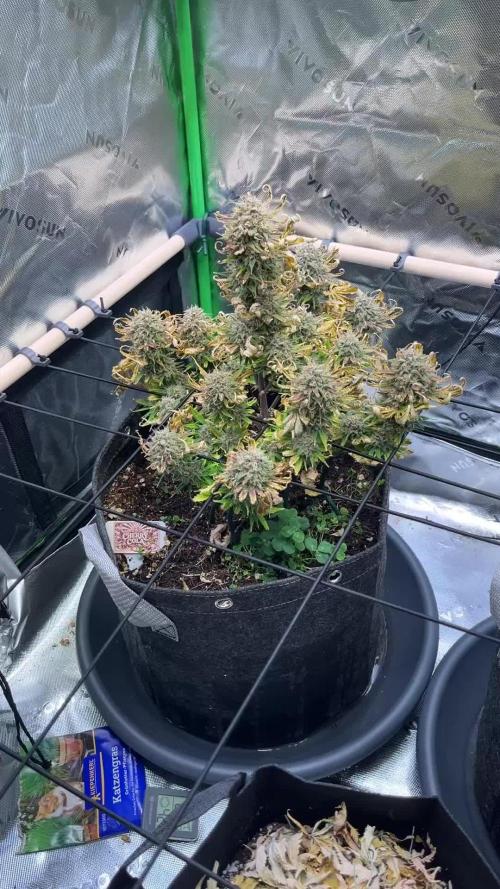
Endlich geerntet. Trotz einiger Mängel sind die Buds doch sehr schön fest und klebrig geworden. 220g Nass mit Stiel und Stängeln. Einfach im Zelt bei ca 62%LF trocknen lassen. Nach ca 5 Tagen, werde ich mir die schönsten Buds heraussuchen und weiter im Dryferm Bag bis zum Curing weitertrocknen lassen. Der Rest fällt dann leider dem CanG zum Opfer und wird im Misthaufen entsorgt.
Likes
18
Share
10/22: wow… what a mess. I should have defoliated last week. They were incredibly overgrown and now i had to stress the hell out of them to get the tent cleared up for light. Hopefully the stress does not cause any issues. As if the defoliation was bot enough stress on them, my light height has reached its top, and PL1 had two colas starting that were already pressed into the light. And so i removed their tops a node or two down. Im sure this was as good as hitting the plant in the face with a brick. Hope she recovers! If youve been following along, you know i planted these with hopes for the extremely purple pheno. And i believe that if i had it, she would have started showing her colors by now. Looking forward to seeing what these turn into and if they make it without any issues after i kicked them around a bit.
Likes
Comments
Share
@youdan
Follow
Ho praticato il lollipopping per cercare di traferire le energia solo in alcune parti e sembra andare benissimo. la prossima settimana pubblichero delle foto pazzesche sicuramente.
Likes
2
Share
So far - so good, as always. Yesterday switched to 12/12 as the photoperiod one needs to start flowering, it means that autos will spend last two three weeks of their life at 12/12
Likes
100
Share
Hi people :-) This week the Victory Kush F1 (Phenotype 1-3) and the Zkittlez (Phenotype 1) were harvested. The Orange Sherbert (Phenotype 1-2) and the Zkittlez (Phenotype 2) were flushed. The rest fertilized as usual. Next week it continues :-) I wish you all a nice and healthy weekend.
Likes
1
Share
@Genji
Follow
Bloom week 8. Ec 0.4 (only water). Ph 5.8. Trichomes looks nice.
Likes
1
Share
Getting up there with the longest fattest buds ive had on a plant still a long way to go been a breeze to grow no problems or hiccups had the best start to life and the best nuitrents since switching to xpertnuitrents ive seen a massive improvement in my buds quality amd size
Likes
30
Share
Hello Diary. The first week of flowering is over, the plants have grown over 50 cm, the branches have spread and now they have already started to crumple. Specifically, the Watermelon Auto has grown to 50 cm, while its roommates, Purple Punch, have grown to 60 cm. Purple Punch # 2 that sprouted a few days later has now outgrown Watermelon by a few inches. Along with the height, and in width it has expanded greatly and has rather dense branches. On the lower leaves I noticed the appearance of yellow-brown spots, I probably overdosed with fertilizers, I will see how they will behave further. The flowers started to form, so I have new motives to photograph. I water every two to three days, when each plant gets about 2 liters of water. I add food at about every other watering. Sometimes biobizz and sometimes I put Easy Grow or Easy Bloom tablet, depending on the stage the plant is in. p.H. I always adjust the water value to a value between 6.2 and 6.5. Conditions on the Farm are more or less satisfactory, the temperature is about 25 degrees while the humidity is slightly lower than satisfactory, varying between 40% and 50%. At the beginning of the week, I also changed the light regime to 20 hours of the day and 4 hours of the night. Here’s a brief overview of the past week. 18/02/2021 - Day 23. Watering. I adjusted the water to 6.3 p.H with Plagron’s Lemon Kick and added 1.5 mL / lit CalMg preventively. Temp / Humidity on the farm - 25 degrees and 41% humidity. 20/02/2021 - Day 25. Watering. I regulated the water to 6.4 p.H, I added 1ml / lit CalMg and BioBizz as scheduled for the first week of flowering. Temp / Humidity on the farm - 24.4 degrees and 43% humidity. 22/02/2021 - Day 27. Watering. This time I watered only with water which I regulated p.H at 6.3. Temp / Humidity on the farm - 24.6 degrees and 40% humidity. 23/02/2021 - Day 28. Photography and height measurement. Temp / Humidity on the farm - 25 degrees and 42% humidity. That’s it for this week, a big hello and thank you to everyone who follows the diary and thanks for the comments. See you soon.
Likes
9
Share
@MG2009
Follow
02/11/2021 Doing water cure
Likes
5
Share
@Ninjabuds
Follow
My gas tax plant is looking absolutely incredible right now. It's got these massive buds that are super dense and have this awesome dark color to the leaves. I'm so excited to see how it turns out when it's finally ready to be harvested. I've been checking the height, the thickness of the stem, and the density of the buds to get an idea of how much longer I have to wait. I think I might start flushing it soon. The past few weeks have been so beautiful, watching the plants grow and change. It's amazing how something so small and fragile can turn into something so strong and vibrant. Now that they're getting ready to bloom, it feels a little bittersweet. I'm so excited to see the finished product, but I'll definitely miss having them around while they're growing.
Likes
35
Share
So, it's the end of Week 4 of Flower, and the ladies are doing really great. Only issue I'm encountering at the moment is with the Carbon Filter which doesn't seem to be exhausting as much air as I'd like it to. I have attached a video which explains everything. Happy Growing guys
Likes
27
Share
Ghost Train Haze automatic by Zamnesia has breathtaking genetics and heritage, we are particularly fond of its parents and we are sure it will be a show. Everything was born in order and in its place for a day we are also giving alga grow and the plant flies but this week we had not given it yet. Growing projects for autoflowering plants ----- As for autoflowering plants I really love preserving the Main Cola. So I will try to make or grow the plants well or badly without affecting the main cola. Nowadays topping autoflowering plants is very accepted but it is not my favorite thing to transform a baby born to finish in 10 weeks into a baby that finishes in 14, I say at this point I do photoperiodic. But in times of people who only grow autoflowering everything is permitted for goodness sake if you want to do it, do it I will not be the one to stop you. Also because the results are excellent nothing to really discuss about anything except time. All this to tell us that I recommend for example fimming on plants that tend to grow tall to give power to the lateral branches, LST as much as you want, I don't like too much, spread me out, I need space. HST and splitting are with experience. These are my tips not the absolute truth please do not mistake me for a great sage holder of the truth I speak as I see it. The first week went only with Power Roots 1 Ml/l and Pure Zym 1 ml/l from now on we will start with ALga Grow. The plants were transplanted shortly after germination because the biodegradable pots were very small. The soil is Plagron Pro Mix 100% organic renewed with 30% new soil and 20% Perlite added. (Pro mix does not have perlite but is airy, we added it anyway) Plagron fertilizers are available on Zamnesia in convenient Pack formats for all growing styles. I used this with a simple search you can find the other products. ---- https://www.zamnesia.io/it/12119-plagron-top-grow-box-100-naturale.html Try a seed of this variety that drives us crazy... ---- https://www.zamnesia.io/en/12511-zamnesia-seeds-ghost-train-haze-auto.html Description Zamnesia // From the day its cotyledons emerge from the substrate, Ghost Train Haze Auto will surprise you with its rapid growth and robustness. When it starts to flower, this short sativa will develop long and compact buds with pungent scents of spice, citrus and fuel. Growbox and Air System - Secret Jardin DS120w + fans + exhaust fans and DF16 filters kit ---- https://www.secretjardin.com All the best that mother nature has to offer is at ----www.zamnesia.com Collaboration request: I am available for collaborations with companies of lights and various growing equipment (please no seed and nut companies) I would like to renovate my 120x120 space that has slightly outdated lights and would like to try some controllers. If you have any proposals available.
Likes
5
Share
no fertilizer for the last 2 weeks of flower. Plant has Grape candy smell and beautiful dense nugs.
Processing
Likes
5
Share
@O_GrowTom
Follow
WEEK☆7 J•1 Premier jour de la semaine, les branches latérales rattrapent bientôt la tête centrale. J'attends encore que ça se développe avant de penser à la floraison.@++ WEEK☆7 J•4 La progression continue, j'ai commencé un peu à défolier le bas du plant. J'attends encore pour la floraison.
Likes
4
Share
The roots have developed at this point haven’t done any training but topping
Likes
9
Share
@FoxCrow
Follow
Entering week 9 of flower. According to the breeder about the week of harvest. I think she has still 1 or 2 weeks to go!
Likes
45
Share
2nd net is up. Early bud formations are promising. holding up to the extremes pretty well, some leaves taking minor damage, but overall, she is holding up, gave her 1 night at 50F see how she would react, stressful. Not advised as it messes with her metabolism, but I want to see if it triggers any anthocyanin response. Love to see her purp up but no signs yet. My homework. Rubisco regeneration is intrinsically linked to nitrogen supply because Rubisco is a major sink for nitrogen in plants, typically accounting for 15% to over 25% of total leaf nitrogen. The regeneration phase itself consumes nitrogen through the synthesis of the Rubisco enzyme and associated proteins (like Rubisco activase), and overall nitrogen status heavily influences the efficiency of RuBP regeneration.Structural Component: Nitrogen is an essential building block for all proteins, and the sheer abundance of the Rubisco protein makes it the single largest storage of nitrogen in the leaf. Synthesis and Activity: Adequate nitrogen supply is crucial for the synthesis and maintenance of sufficient Rubisco enzyme and Rubisco activase (Rca), the regulatory protein responsible for maintaining Rubisco's active state. Nitrogen deficiency leads to a decrease in the content and activity of both Rubisco and Rca, which in turn limits the maximum carboxylation rate, Vmax, and the rate of RuBP regeneration Jmax, thus reducing overall photosynthetic capacity. Nitrogen Storage and Remobilization: Rubisco can act as a temporary nitrogen storage protein, which is degraded to remobilize nitrogen to other growing parts of the plant, especially under conditions of nitrogen deficiency or senescence. Nitrogen Use Efficiency (NUE): The allocation of nitrogen to Rubisco is a key determinant of a plant's photosynthetic nitrogen use efficiency (PNUE). In high-nitrogen conditions, plants may accumulate a surplus of Rubisco, which may not be fully activated, leading to a lower PNUE. Optimizing the amount and activity of Rubisco relative to nitrogen availability is a target for improving crop NUE. Photorespiration and Nitrogen Metabolism: Nitrogen metabolism is also linked to the photorespiration pathway (which competes with carboxylation at the Rubisco active site), particularly in the reassimilation of ammonia released during the process. To increase RuBisCO regeneration, which refers to the process of forming the CO2 acceptor molecule Ribulose-1,5-bisphosphate (RuBP) during photosynthesis, the primary methods involve optimizing the levels and activity of Rubisco activase (Rca) and enhancing the performance of other Calvin-Benson-Bassham (CBB) cycle enzymes. Biochemical and Environmental Approaches: Optimize Rubisco Activase (Rca) activity: Rca is a crucial chaperone protein that removes inhibitory sugar phosphates, such as CA1P (2-carboxy-D-arabinitol 1-phosphate), from the Rubisco active site, thus maintaining its catalytic competence. •Ensure optimal light conditions: Rca is light-activated via the chloroplast's redox status. Adequate light intensity ensures Rca can effectively maintain Rubisco in its active, carbamylated state. •Maintain optimal temperature: Rca is highly temperature-sensitive and can become unstable at moderately high temperatures (e.g., above 35°C/95F° in many C3 plants), which decreases its ability to activate Rubisco. Maintaining temperatures within the optimal range for a specific plant species is important. •Optimize Mg2+ concentration: Mg2+ is a key cofactor for both Rubisco carbamylation and Rca activity. In the light, Mg2+ concentration in the chloroplast stroma increases, promoting activation. •Manage ATP/ADP ratio: Rca activity depends on ATP hydrolysis and is inhibited by ADP. Conditions that maintain a high ATP/ADP ratio in the chloroplast stroma favor Rca activity. Enhance Calvin-Benson-Bassham (CBB) cycle enzyme activity: The overall rate of RuBP regeneration can be limited by other enzymes in the cycle. •Increase SBPase activity: Sedoheptulose-1,7-bisphosphatase (SBPase) is a key regulatory enzyme in the regeneration pathway, and increasing its activity can enhance RuBP regeneration and overall photosynthesis. •Optimize other enzymes: Overexpression of other CBB cycle enzymes such as fructose-1,6-bisphosphate aldolase (FBA) and triose phosphate isomerase (TPI) can also help to balance the metabolic flux and improve RuBP regeneration capacity. Magnesium ions, Mg2+, are specifically required for Rubisco activation because the cation plays a critical structural and chemical role in forming the active site: A specific lysine residue in the active site must be carbamylated by a CO2 molecule to activate the enzyme. The resulting negatively charged carbamyl group then facilitates the binding of the positively charged Mg2+ion. While other divalent metal ions like Mn2+ can bind to Rubisco, they alter the enzyme's substrate specificity and lead to dramatically lower activity or a higher rate of the non-productive oxygenation reaction compared to Mg2+, making them biologically unfavorable in the context of efficient carbon fixation. The concentration of Mg2+ in the chloroplast stroma naturally increases in the light due to ion potential balancing during ATP synthesis, providing a physiological mechanism to ensure the enzyme is activated when photosynthesis is possible. At the center of the porphyrin ring, nestled within its nitrogen atoms, is a Magnesium ion (Mg2+). This magnesium ion is crucial for the function of chlorophyll, and without it, the pigment cannot effectively capture and transfer light energy. Mg acts as a cofactor: Mg2+ binds to Rubisco after an activator CO2 molecule, forming a catalytically competent complex (Enzyme-CO2-Mg2+). High light + CO2) increases demand: Under high light (60 DLI is a very high intensity, potentially saturating) and high CO2, the plant's capacity for photosynthesis is high, and thus the demand for activated Rubisco and the necessary Mg2+ cofactor increases. Mg deficiency becomes limiting: If Mg2+ is deficient under these conditions, the higher levels of Rubisco and Rubisco activase produced cannot be fully activated, leading to lower photosynthetic rates and potential photo-oxidative damage. Optimal range: Studies show that adequate Mg2+ application can enhance Rubisco activation and stabilize net photosynthetic rates under stress conditions, but the required concentration is specific to the experimental setup. Monitoring is key: The most effective approach in a controlled environment is to monitor the plant's physiological responses e.g., leaf Mg2+ concentration, photosynthetic rate, Rubisco activation state, and adjust the nutrient solution/fertilizer to maintain adequate levels, rather than supplementing a fixed "extra" amount. In practice, this means ensuring that Mg2+ is not a limiting factor in the plant's standard nutrient solution when pushing the limits with high light and CO2. Applying Mg2+ through foliar spray is beneficial to Rubisco regeneration, particularly in alleviating the negative effects of magnesium (Mg) deficiency and high-temperature stress (HTS). While Mg can be leached from soil, within the plant it is considered a mobile nutrient, particularly in the phloem. Foliar-applied Mg is quickly absorbed by the leaves and can be translocate to other plant parts, including new growth and sink organs. Foliar application of: NATURES VERY OWN MgSO4 @ 15.0g L-1 in a spray bottle. Foliar sprays are often recommended as a rapid rescue measure for existing deficiencies or as a supplement during critical growth stages, when demand for Mg is high. Application in the early morning or late evening can improve absorption and prevent leaf burn. The starting point [of creativity] is curiosity: pondering why the default exists in the first place. We’re driven to question defaults when we experience vuja de, the opposite of déjà vu. Déjà vu occurs when we encounter something new, but it feels as if we’ve seen it before. Vuja de is the reverse—we face something familiar, but we see it with a fresh perspective that enables us to gain new insights into old problems. Come walk in the enchanted forest.
Likes
2
Share
@Danylo
Follow
This was the final week. Very satisfied with this harvest. She was just in the process to turn beautifully reddish/purple - but trichomes were exactly at the right point for harvesting so with a heavy heart she got the axe! Will update this one with actual dried flower pictures as well as a smoke/vape report in the coming days.
Processing
Likes
12
Share
Checkout my Instagram @smallbudz to see the Small budget grow setup for indoor use, low watt, low heat, low noise, step by step. 27/02/2020 - Gave her 1.5l of RO water.