Likes
Comments
Share


@GERGrowDesigns
Follow
Special Project from Germany and Welcome to Harvest Week of GoodTimesGenetix Blue Cream Haze
Likes
52
Share


@PEAKYPLANTERS
Follow
Brothers and sisters farmers.
My job here is over!
Growth was rather difficult because of the heat, but I believe that this strain is the only one who perhaps kept more than all the others, rediscovering to give me the solid nuggets!
Greetings to all of you, fantastic Weed friends
Happy and abundant harvesters

Likes
2
Share


@High_Grade_Dadli
Follow
Growth has been great so far the main crown end up breaking .....see pic nxt week
Likes
15
Share


@38PLAN
Follow
Pubblico oggi ad 8 giorni perché la settimana scorsa avevo pubblicato a 6 giorni così mi sono rimesso in paro,siamo arrivati alla 6 settimana di vita per le più grandi,quasi 4 1/2 per le più piccole, sono diventate altissime,una si é allungata un pò per via di una carenza di manganese poi risolta con l'inverdente SANA COMPO,però promettono bene sono molto grandi e già i prefiori strabordano di resina,continuiamo questo percorso e vedremo col passare del tempo la grandezza dei fiori

Likes
2
Share


@YehGreen420
Follow
Foi uma excelente semana, fui aumentando gradualmente as regas de 70ml/100/250 e no dia 17 já levou meio litro de agua + a primeira nutrição.
Apenas 3 estão assim menos bem desenvolvidas e serão aquelas que irão ficar fora da tenda.
Aumentei a potencia para 400W que resulta nos tais 600ppfd no centro e 400 e tal nas pontas da tenda.
Estava apenas uma ventoinha ligada e o extrator esta semana, iniciarem adicionando uma ventoinha e talvez
para o fim da semana coloque a entrada de ar, isto porque tirei-a para tentar manter a tem e a humidade no ponto,
tendo em conta que sempre faz a circulação de ar porque deixo a entrada de baixo aberto e faz o ar circular.
Likes
13
Share


@XperencdGmanXG
Follow
well looks like this plant has gone into flower, I would have liked it to have been bigger before this began but oh well. As the French say C'est la Vie!

Likes
9
Share


@bigolebuds
Follow
Week 16: *whewww* well technically this is the first full week of Flower... I followed the directions and went to 18/6 for "Early Flower".. but in the future I will refer to this as pre-flower and will start this about a month before going into Flower... I think this helps make the flip more pronounced and will help with a more consistent flower in my tent. Who knows tho?
We do see pistils - so that's exciting... and tbh I was saying we vegged for too long.. but who knows, maybe we will have an extensive root system and will be able to support larger buds! Nothing is really a loss at this point, and I will say I'm even learning more about myself. I'm a thinker I like to process things, I like doing it with people.. and I don't mind making mistakes... but I rather them be calculated.. So I know what to do or not to do in the future... I'm realizing my partner is more of a tinkerer.. he always has big ideas and likes to use his energy to move toward them.... I think we complement each other because my thoughts would've led me toward stopping the growth of this project a long time ago.. but I'm happy it's still going!


Likes
9
Share


@Dgessy
Follow
La Petite fille a atteint sont potentiel en taille, maintenant j'attends le mûrissement des têtes 👍😊 Le ratio fleurs/feuilles est super !!! De beaux calices et pas beaucoup de feuilles 😊 Le soleil est toujours au rendez-vous, rarement il fait autant beau dans ma région à cette période de l'année.

Likes
1
Share


@walterwhiteee
Follow
Aug 13th transplant day
Using Gai Greens Organics 4-4-4 with worm castings and mykos for root structure
Aug 15th Start of LST
Likes
41
Share


@Mrs_Larimar
Follow
2024-07-02
OUTDOOR
The Outdoor lady is a Queen, she grows very beautiful
despite the weather, we had aweek with very warm and sunny , now we are back to
cold, humid and rainy
it looks like she dont catres.
INDOOR
the lady stretches and shows alot of Colas with sweet Flowers, i havent counted the colas
iam feeding the indootr Pland additionally to the topdressing with insectfrass
iam watching her, because it looks like she dont needs alot of feedings and is fine
Divine Seeds developed Opium as a new champion strain, unprecedently powerful and loaded with unbelievable quantities of resin. Certainly, no average genetic base could be behind such brilliant parameters! Several Afghani Indica landraces, recognized as most potent and resinous, were bred together with a mighty Brazilian Sativa which Opium inherits its bright berry taste from. Then a great deal of work followed aiming for the highest THC level and endurability as well as a branchy structure that would provide maximal yields. Now we can proudly title Opium the best Indica you could dream of growing!
Indoors these plants mostly stay mid-height (1.5 m), reaching up to 2.0 m out of doors. Depending on your height limitations, Opium flourishes universally in grow boxes, balconies, green houses and terraces. Due to its Afghani parentage, this strain can stand hot weather if provided enough water and some shadow. Responds well to any training techniques: ScroG and SoG, LST, topping and FIM, supercropping. The start of blooming is marked with a rush of growth, when plants stretch almost 1.4x. Expect heavy colas that often require additional supports. Whilst ripening, Opium gives off a pungent earthy stench with fruity and berry undertones, also a bit of pine. Ready for outdoor harvesting in October.
The stoning psychedelic impact of Opium is like being hypnotized (unless you’ve had too much, then it feels more like a blackout). Stone-lovers will appreciate every minute with Opium: its spicy taste immerses your mind into daydreaming, while the body rests flat. Recreation with this psychedelic Indica means silent tripping from one insight to another. Mighty enough to kill chronical pains, Opium is also medically efficient against insomnia, nausea, appetite disorders, muscle spasms, headaches, irritation, fatigue, panic attacks, epilepsy. Best consumed at night time, the effects keep going for up to 4 hours.

Likes
43
Share

@Philhsy
Follow
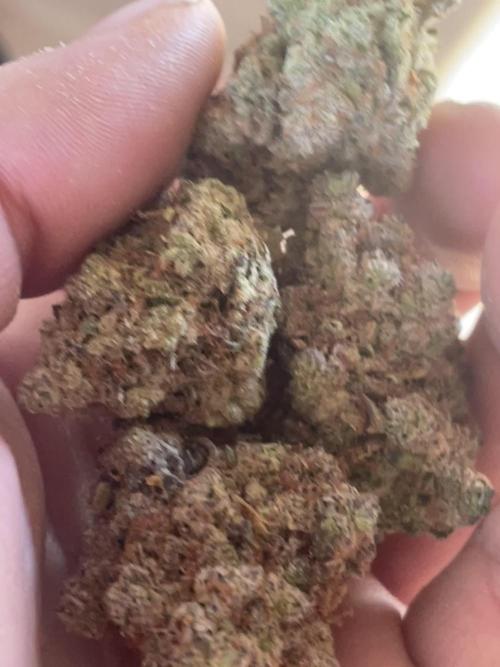
All in all, love to thank everyone that made this contest possible, and to all sponsors, and thanks dogdoctor for including me 👌😄 its been a blast, cant wait to smoke this honey and also press some honey 🍯 this one is going to be tasty! Big fat buds on this one, jusat kept stacking up but now chop chop! See uou blut the smoke review guys, and good luck! Love to everyone
Likes
7
Share


@Kushma666
Follow
Day 1 beginning of wk 3 flower fed the girls up this morning 4.5 ltr phostrogen to all but bubblegum #1 she gets fed 10ltrs of bud burst they are starting to smell so good 3 strains iv never grown before or even smoked lol exciting stuff 5-6 more weeks to go

Likes
3
Share


@Drtomb
Follow
Had an issue this week with a fsn getting unplugged and the tent was extremely hot for several hours. Some of the top buds even got cooked. I took off thendesd material at the top and I'm hoping for a speedy recovery.

Likes
7
Share


@Adam22
Follow
Today I changed the CFL from 125>250w to try help hold a higher temperature overnight as it has been fairly cold in there. Roots are now touching the bottom of the pot they look healthy and white. Soon I will repot I got a bag of Coco today and some micorizor 😅 just to get new pots I've lost the old ones. Vegging fast these are already showing tiny preflowers starting to form and starting to smell slightly of blueberry muffins
Likes
13
Share


@Yiyis_Grow
Follow
Bestva Quantum Board 2000 W & MrHide Seeds
Semana sin problemas. Se aplicó a modo preventivo tierra diatomea disuelta en agua y pulverizada foliar.
También se utilizó hongo Clonostachys, trichoderma, levaduras lácticas y transformadoras de celulosa, y Streptomyces; todos para evitar enfermedades bacterianas y hongos.
Se están regando con agua llovida, regulada a un ph de 6.3 - 6.5.
Se empezó a utilizar fertilizante de flora a razón de 4ml por litro de agua.
Se ha defoliado 2 veces (1 en vegetación y otra apenas empezó a florar). Las hojas se están recolectando para hacer aceite full espectro medicinal sin THC.
Suerte y buenos humos

Likes
22
Share


@Rap_a_cap
Follow
Hello Gromigos,
well, I've lost the count of days with hell hell temps, always around 95°F.
Cookie is starting to stretch but internode length is incredibly short. This pheno is perfect for indoor growing in a large pot, a single but great plant. I've trained to low main bud obtaining an homogeneous canopy. Now branches are full formed and fat. Incredibly hybrid vigour. No need for fertilization, maybe 1-2 shoots later, in blooming. I'm watering them every other day with 2 gallons each, little by little, trying to avoid past's run mistakes.

Likes
7
Share

@DeepRootsGrowTrees
Follow
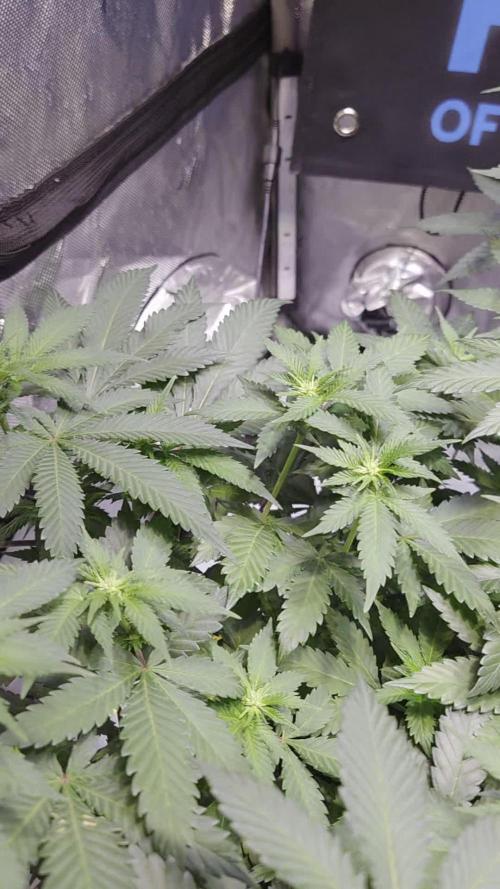
GRANDPA ZOMBIE 🧟♂️ / IZI SEEDS
WEEK #8 OVERALL
WEEK #2 FLOWER
This week you can 👀 she's slowed 🐌 down the stretch and started focusing on flower she's still stretching but not at such a rapid rate. She's about as wide as she is tall and she's got multiple bud sites going on. She's looking healthy and vibrant green 💚!! STAY GROWING MY FRIENDS!!!
THANK YOU FOR STOPPING ✋️ BY AND TAKING A LOOK IT'S MUCH APPRECIATED!!
THANK YOU IZI SEEDS!!!
GRANDPA ZOMBIE 🧟♂️ / IZI SEEDS


Likes
52
Share


@Ultraviolet
Follow
Once again she passes my expectations, late to the show with trichome production. I'm surprised there is purple on the bud, maybe Purpinator does work. I thought I could see hints under the grow lights and thought my eyes were deceiving me, I was just being hopeful. But nah 2 of the 3(under the UV) have developed a beautiful tone of purple. I was never going to bother with a deep freeze but maybe the whole bud will change given conditions, that would be something, fingers crossed. 🤔 was a little skeptical that reducing temps humidity would change density, but it does, buds are solid something I've not been able to achieve before.
Rule of thumb is never to surpass 60% RH in the flowering phase and try to progressively reduce it down to 40% in the last 2–3 weeks before harvest. The plant will react as it seeks to protect its flowers, responding by producing denser buds and a higher concentration of resin. Cannabis plants are sensitive to sudden temperature changes, especially in the flowering stage. Extreme heat or cold can impact bud density and overall yields. In nature as a defense mechanism from cold, the plant sensing sudden dips in temperature will attempt to remove the pockets of air within the bud, it achieves this by compacting itself in doing so to better protect itself from cold snaps which are normally indicators in nature that worse weather is on the way.
Terpene levels are the highest just before the sun comes out. Ideally, you want as many terpenes present in your plants as possible when you harvest. Cannabis plants soak up the sun during the day and produce resin and other goodies at night. The plant is at its emptiest from "harvest undesirables" so to speak right before the lights on. Boiling cannabis roots during harvesting slows down the drying process. When you boil cannabis roots, it shocks the plant, closing the stomata on the leaves. This prevents massive moisture loss through the leaves, leaving only the floral clusters actively losing moisture at a reduced pace. I've always run a strict 60/60 and it took almost twice as long to dry to a snap than previous grows where I didn't boil for what it's worth.
Chlorophyll is good for the plant but not for you. When you harvest the buds, even after you flush them, if you flush them, they’re still filled with chlorophyll. Freshly cut buds are greener than dried buds because they still contain loads of chlorophyll. However, when rushed through the drying process, the buds dry but retain some chlorophyll, and when you smoke it, you will taste it. Chlorophyll-filled buds are smokable, but they aren’t clean. Slow drying gives the buds enough time and favorable conditions to lose the chlorophyll and sugars, giving you a smoother smoke. How the plant disposes of the chlorophyll and sugars by a process of chemically breaking them down and attaching the decomposed matter once small enough to water molecules which then evaporate back into the ether. Time must be given to the process to break down the chlorophyll and sugars. Think of it like optimizing the environment for decay.
All the nutrients it could ever need are in abundance, it eats nutrients based on its demand for growth, which is dictated primarily by available light.
Plant growth and geographic distribution (where the plant can grow) are greatly affected by the environment. If any environmental factor is less than ideal, it limits a plant's growth and/or distribution. For example, only plants adapted to limited amounts of water can live in deserts. Either directly or indirectly, most plant problems are caused by environmental stress. In some cases, poor environmental conditions (e.g., too little water) damage a plant directly. In other cases, environmental stress weakens a plant and makes it more susceptible to disease or insect attack. Environmental factors that affect plant growth include light, temperature, water, humidity, and nutrition. It's important to understand how these factors affect plant growth and development. With a basic understanding of these factors, you may be able to manipulate plants to meet your needs, whether for increased leaf, flower, or fruit production. By recognizing the roles of these factors, you'll also be better able to diagnose plant problems caused by environmental stress.
Water and humidity
*Most growing plants contain about 90 percent water. Water plays many roles in plants. It is:*
A primary component in photosynthesis and respiration
Responsible for turgor pressure in cells (Like the air in an inflated balloon, water is responsible for the fullness and firmness of plant tissue. Turgor is needed to maintain cell shape and ensure cell growth.)
A solvent for minerals and carbohydrates moving through the plant
Responsible for cooling leaves as it evaporates from leaf tissue during transpiration
A regulator of stomatal opening and closing, thus controlling transpiration and, to some degree, photosynthesis
The source of pressure to move roots through the soil
The medium in which most biochemical reactions take place
Relative humidity is the ratio of water vapor in the air to the amount of water the air could hold at the current temperature and pressure. Warm air can hold more water vapor than cold air. Relative humidity (RH) is expressed by the following equation:
RH = water in air ÷ water air could hold (at constant temperature and pressure)
The relative humidity is given as a percent. For example, if a pound of air at 75°F could hold 4 grams of water vapor, and there are only 3 grams of water in the air, then the relative humidity (RH) is:
3 ÷ 4 = 0.75 = 75%
Water vapor moves from an area of high relative humidity to one of low relative humidity. The greater the difference in humidity, the faster water moves. This factor is important because the rate of water movement directly affects a plant's transpiration rate.
The relative humidity in the air spaces between leaf cells approaches 100 percent. When a stoma opens, water vapor inside the leaf rushes out into the surrounding air (Figure 2), and a bubble of high humidity forms around the stoma. By saturating this small area of air, the bubble reduces the difference in relative humidity between the air spaces within the leaf and the air adjacent to the leaf. As a result, transpiration slows down.
If the wind blows the humidity bubble away, however, transpiration increases. Thus, transpiration usually is at its peak on hot, dry, windy days. On the other hand, transpiration generally is quite slow when temperatures are cool, humidity is high, and there is no wind.
Hot, dry conditions generally occur during the summer, which partially explains why plants wilt quickly in the summer. If a constant supply of water is not available to be absorbed by the roots and moved to the leaves, turgor pressure is lost and leaves go limp.
Plant Nutrition
Plant nutrition often is confused with fertilization. Plant nutrition refers to a plant's need for and use of basic chemical elements. Fertilization is the term used when these materials are added to the environment around a plant. A lot must happen before a chemical element in a fertilizer can be used by a plant.
Plants need 17 elements for normal growth. Three of them--carbon, hydrogen, and oxygen--are found in air and water. The rest are found in the soil.
Six soil elements are called macronutrients because they are used in relatively large amounts by plants. They are nitrogen, potassium, magnesium, calcium, phosphorus, and sulfur.
Eight other soil elements are used in much smaller amounts and are called micronutrients or trace elements. They are iron, zinc, molybdenum, manganese, boron, copper, cobalt, and chlorine. They make up less than 1% of total but are none the less vital.
Most of the nutrients a plant needs are dissolved in water and then absorbed by its roots. In fact, 98 percent are absorbed from the soil-water solution, and only about 2 percent are actually extracted from soil particles.
Fertilizers
Fertilizers are materials containing plant nutrients that are added to the environment around a plant. Generally, they are added to the water or soil, but some can be sprayed on leaves. This method is called foliar fertilization. It should be done carefully with a dilute solution because a high fertilizer concentration can injure leaf cells. The nutrient, however, does need to pass through the thin layer of wax (cutin) on the leaf surface.
It is to be noted applying a immobile nutrient via foliar application it will remain immobile within the leaf it was absorbed through.
Fertilizers are not plant food! Plants produce their own food from water, carbon dioxide, and solar energy through photosynthesis. This food (sugars and carbohydrates) is combined with plant nutrients to produce proteins, enzymes, vitamins, and other elements essential to growth.
Nutrient absorption
Anything that reduces or stops sugar production in leaves can lower nutrient absorption. Thus, if a plant is under stress because of low light or extreme temperatures, nutrient deficiency may develop.
A plant's developmental stage or rate of growth also may affect the amount of nutrients absorbed. Many plants have a rest (dormant) period during part of the year. During this time, few nutrients are absorbed. Plants also may absorb different nutrients as flower buds begin to develop than they do during periods of rapid vegetative growth.
432 Hz is said to be mathematically consistent with the patterns of the universe. Studies reveal that 432 Hz tuning vibrates with the universe’s golden mean PHI and unifies the properties of light, time, space, matter, gravity and magnetism with biology, the DNA code and consciousness. When our atoms and DNA start to resonate in harmony with the spiraling pattern of nature, our sense of connection to nature is said to be magnified.
Another interesting factor to consider is that the A=432 Hz tuning correlates with the color spectrum while the A=440 Hz is off.
Audiophiles have also stated that A = 432 Hz music seems to be non-local and can fill an entire room, whereas A=440 Hz can be perceived as directional or linear in sound propagation.
Once you adopt the idea that sound (or vibration in general) can have an equalizing and harmonizing effect (as well as a disturbing effect), the science of harmony can be applied to bring greater harmony into ones life or a tune to specific energies. There is a form of absolute and of relative harmony. Absolute harmony can for example be determined by the tuning of an instrument. The ancients tuned their instruments at an A of 432 Hz instead of 440 Hz - and for a good reason. There are plenty of music examples on the internet that you can listen to in order to establish the difference for yourself. Attuning the instrument to 432 Hz results in a more relaxing sound, while 440 Hz slightly tenses up to body. This is because 440 Hz is out of tune with both macro and micro cosmos. On the contrary, 432 Hz is in tune. To give an example of how this is manifested micro cosmically: our breath (0,3 Hz) and our pulse (1,2 Hz) relate to the frequency of the lower octave of an A of 432 Hz (108 Hz) as 1:360 and 1:90.
It is interesting to note that 432 Hz was the standard pitch of many old instruments, and that it was only recently (19th and 20th century) the standard pitch was increased. This was done in order to be able to play for bigger audiences. Bigger audiences (more bodies) absorb more of the lower frequencies, so the higher pitch was more likely to “cut through”. One of the oldest instruments of the world is the bell ensemble of Yi Zeng (dated 423 BC), tuned to a standard F4 of 345 Hz which gives an A= 432 Hz. The frequency of 345 Hz is that of the platonic year! Similarly many old organs are tuned in an A=432 as well; for example: St. Peter’s Capella Gregoriana, St. Peter’s Capella Giulia, S. Maria Maggiore in Rome.
Maria Renold’s book “Intervals Scales Tones and the Concert Pitch C=128 Hz” claims conclusive evidence that 440 Hz and raising concert pitch above scientific “C” Prime=128 Hz (Concert A=432 Hz) disassociates the connection of consciousness to the body and creates anti-social conditions in humanity.
The difference between concert pitch A=440 Hz and Concert A=432 Hz is only 8 cycles per second, but it is a perceptible difference of awareness in the human consciousness experience of the dream we share called existence.