


Processing
Likes
Comments
Share


@eldruida_lamota
Follow
Que pasa familia, hemos vuelto para actualizar las skunk que ya tenemos cosechadas.
Que gran genética, y muy típica entre fumadores de hierba, un crecimiento más indico pero floración lenta bastante lenta, en teoría se supone que es Sativa, 17% thc en la tas con un tamaño medio pequeño pero flores mi compactas y dulces, un cultivo ni fácil ni difícil, sin más, bastante neutral para los cambios climáticos algo sensible con el aspecto alimentación.
La recomendaría en verdad, sobre todo para aquellos amantes del dulce.
Nos vemos en próximos proyectos fumetillas

Likes
5
Share


@I_Identify_As_A_Dan
Follow
Im defenetely finding that goin into 25L instead of 15 Liters is worth it plant size but the 15h of light instead of 20+ really makes a difference with bud development.

Likes
3
Share

@Wizardgreen317
Follow
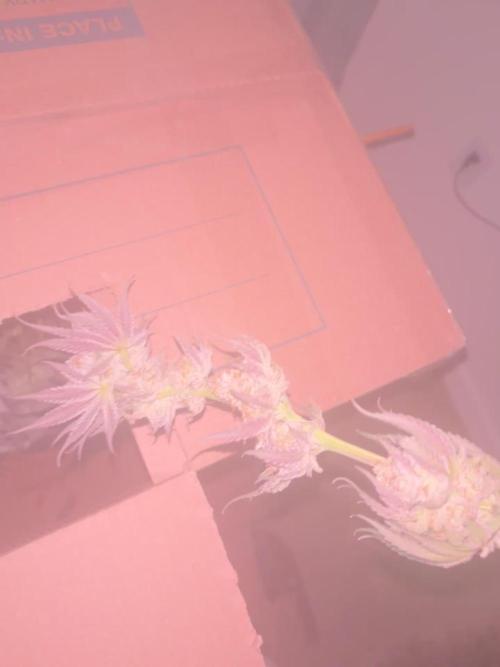
Hello everybody seem like we are on week nine and this cheese danish x gmintz is going at lease 11 week which is quite long but it is growing really bud kinda fast for a tall thick bud plant definitely getting at lease a qp of this one plant which is pretty much standard for a plant that veg for two months but it didn’t maybe six weeks so if you do get these seeds which are a great deal on North Atlantic seeds .. this a plant you should definitely srog. Smell amazing like anything Humboldt seed company throw out there from my experience. But yes she a stretch girl but the big density is an amazing smell is skunk, cheese sweet , gassy ..
Bbm pheno 1 has been chopped it start to fox tell and I had the light dem but this also a trait from the but berry muffins . This was a pretty cool this on swel in 45 days and was ready to be took down in 60 days. 9 weeks is usually for a plant and these plant can be took early and can be some fire head weed .
Pheno 2 is still going and may require another two weeks . It produced really well I think I should have feed heavy in early flower for sure . But the smell on this plant is berry and straight gas no plant matter smell , in the morning it smell like ripping fruit and weed lol. But it smells amazing I must say .
So with the bbm xNf90 s1 it definitely smells and looks amazing and got auper icy , I wanna say shout out North Atlantic seed company for these amazing girl and Humboldt the breed for creating something fire

Likes
29
Share

@HumanCompanion
Follow
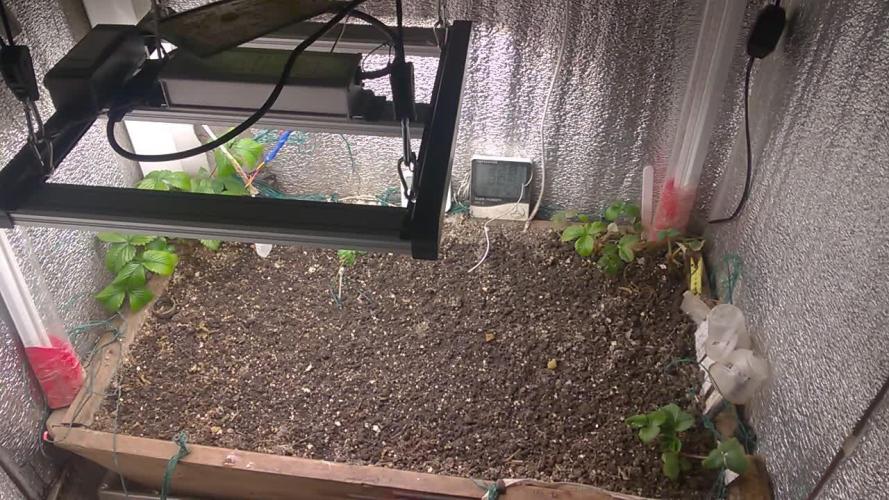
6nov11pm.After 2 weeks. 3 day since transplantation. pH meter broke. Humidity around 50%. Light intensity: 50%.

Likes
12
Share


@Big0zGrower420
Follow
Plants are finishing up, maybe another week and I can wrap things up. Buds didn’t get as fat as I would have liked but everything looks really nice and frosty. cleaned up all the plants with some defoliation.
Processing
Likes
2
Share


@Cannibalgardens
Follow
This is the tester strain sent to me by @toon_town it's a #saskatoonberry x #afghani mystery .. She has been great since day one very good growth rate excellent structure and lots of bud sites formed and filling out .. she has 7 friends to start but we down to three two females and a male plant .. The selected male show resistance to cold, humidity, lack of water .. the male had lots of growth and will make a suitable plant for some pollen ...
Likes
11
Share


@jen_zee
Follow
Big bush and beautiful dwarf
All going well. Really interesting to see how different they develep
Strawberry cough starts to develop dark leaves. Pineapple gets really nice and fat buds with a lot of frosting.

Processing
Likes
6
Share


@StonerMike
Follow
The girls took off after some training and topping. I broke a stem training the green crack so I had to make a splint for her. I’m also noticing the leaves starting to like pinch at the bud sites. I read that this may be wind burn? Help.
Likes
36
Share


@AutoCrazy
Follow
These plants were great. I messed things up a bit but they still turned out a half decent yield. The taste and smell of the final product are great.
I am growing one of these plants in my greenhouse and I can’t wait to see what it produces as I don’t have the small space to confine the plant.
I love Humboldt genetics and can’t wait to grow more.

Likes
29
Share


@Ultraviolet
Follow
Hope you are well. Thanks for taking the time.
Little main line defoliation to focus growth.
A cell is a quantum measuring device for light’s frequency to make order from the chaos that light frequencies bring from our environment. A cell performs mechanical resonance, where its intrinsic structures vibrate at specific resonant frequencies when exposed to external mechanical stimulation. Cells possess the ability to sense and respond to mechanical cues from their environment, a process known as mechanosensing. This can involve the activation of signaling pathways and changes in gene expression. Cellular resonance is a component of mechanotransduction, the process by which cells convert mechanical force into a biochemical signal that triggers a cellular response.
Plants perceive mechanosensory stimuli, such as vibration and touch, through structures like trichomes (hairs) and specialized ion channels embedded in their cell membranes. Plants are sensitive to frequencies ranging from ultrasound to lower sound waves, such as 250 Hz. The perception depends on various factors, including the stiffness of the underlying tissue, which can be tuned by the plant to perceive specific frequencies associated with environmental cues like insect herbivory.
While the exact molecular mechanisms are still being explored, scientists have identified several potential pathways that may be affected by acoustic vibrations in this frequency range: 4000-5000 Hz. Enzyme activity: Sound waves can increase the activity of certain enzymes, such as amylase, and elevate the content of soluble sugars and proteins. Increased stomatal opening in response to specific frequencies can optimize photosynthesis by increasing the plant's absorption of water and CO2. In addition to enhancing drought tolerance, sound vibrations can strengthen plants' overall resistance to stress. Studies have shown that some genes related to stress response can be activated by sound stimulation.
The Emerson effect is a phenomenon where the combination of red and far-red light increases the rate of photosynthesis beyond the sum of the two wavelengths used separately. This synergy is important for understanding Extended Photosynthetically Active Radiation (ePAR), which includes the far-red spectrum, because it means a more comprehensive measurement is needed to fully understand light's effect on plant growth. ePAR meters measure light up to 750 nm, which is necessary to capture the far-red light that participates in the Emerson effect.
The human eye can detect more shades of green than any other color due to a combination of our cone cell sensitivity and evolutionary history. Our eyes are most sensitive to the yellow-green part of the spectrum, which is the peak of our visual sensitivity, and a large part of our ancestry was spent needing to distinguish subtle variations in greenery for survival. or our primate ancestors, being able to discern subtle differences in green was crucial for survival. It helped them identify edible plants and avoid poisonous ones, as well as detect predators hiding in foliage. This constant need to distinguish shades of green drove the evolution of our color perception to become most sensitive to it.
S-cones: Detect short wavelengths, perceived as blues and violets.
M-cones: Detect medium wavelengths, perceived as greens.
L-cones: Detect long wavelengths, perceived as reds and yellows.
The primary reason for our enhanced sensitivity to green is that the peak sensitivities of the M-cones and L-cones are very close together in the green-yellow region of the visible spectrum. This overlap means that green light stimulates both the M-cones and L-cones, creating a more robust and detailed signal for the brain to interpret. In contrast, the S-cones are more isolated and respond to a much narrower band of light, leading to less sensitivity for blues.
The brain's visual processing pathways also play a role. Our visual system processes color differences through "opponent channels," which compare the signals from different types of cones. The opponent channel that processes red versus green has a more precise and intricate system than the blue versus yellow channel, leading to finer discrimination in the green part of the spectrum.
Likes
11
Share


@TgOgFaRms
Follow
Starting to see alot of yellowing abit of purpling its day 66 starting to flush slowly for the last week smell is intense can smell it from other side of the block plus im using a fat carbon filter xD
not all plants smell the same few i have smell tasted are Tangie / Fruity / Gass/ Funk cant wait to slap those blue gloves on and start chopping these ladies
Will Chop on day 70

Likes
2
Share

@The_Doctor_Green
Follow
Hola a todos!!!.
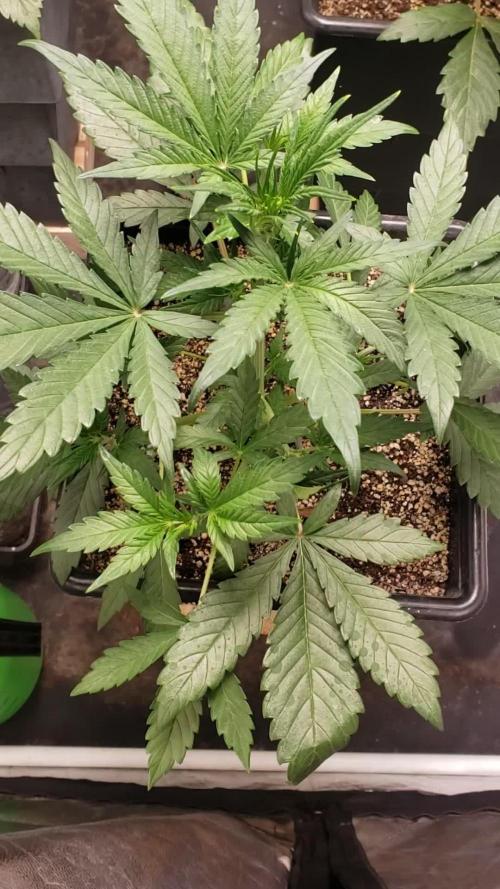
Les comento como le fue esta semana a la Strawberry Gorila Auto.
La he regado en 2 ocasiones, en una solo con agua y en la otra regue con top auto 1.5ml x l y la última de top veg 2ml x litro de agua.
En ambas ocasiones regue con 400ml .
Ya comenzó a mostrar los pestillos, asique la próxima semana intuyo que será de floracion.
El ph de dichos riego anduvo en los 6.4 , las ppm no las he medido..creo que no me olvido de anotar nada más.
Hasta la próxima semana, y buenos humos!!!.
Las imágenes corresponden al periodo 04/09 -10/09 inclusive.
Likes
12
Share


@gr3g4l
Follow
No hay mucho que comentar, sigo añadiendo humedad pulverizando con agua destilada 3 o 4 veces al dia. Y riego en cuanto veo que está "seco"
A los 18 dias les hice un foliar con Hemplex , un bioestimulador.
Con estas raices ya necesitan un transplante urgentemente, xd.
Processing
Likes
6
Share


@Moss420
Follow
Added the first screen into the tent. Decided to kick Big Mumma out because she just wasn't growing any taller and the other plants were really over growing her.
For the new setup I used kitty litter trays and mesh to sit the plants on - each plant gets its own tray so I can track runoff EC individually and I cut little flaps in the mesh so I can wet vac the runoff. With this setup I shouldn't need to move the plants out of the tent until harvest.
For the scrog I just tied some builders rope around the poles of the tent and tied the trellis netting off with training wire. I've been manipulating the growth just to try and fill out the whole screen, I also gave them a good haircut because I plan on flipping them soon, don't want them to outgrow the tent.

Likes
10
Share


@candiedamberfarms
Follow
Bloom has begun. I have two plants that are Sedona shorter than the other three but still very happy with each of them. There is a favorite which is in the center. I like her structure, bounce back from the heat and training. She’s absolutely lovely. I’ve also been bottom watering/feeding. They love it. The roots have creeped out from the bottom of the power pots.
Likes
10
Share


@Cr4zyElite
Follow
Second Week / 15. - 22.05.24
🌿 Week 2 of my grow and my little green friends are thriving! 🚀 Strong leaf growth this week, just sticking to watering with plain water as it's still early days—no nutrients added yet. 🚫💧
Everything's running smoothly and the autos are showing promising vigor. Loving this journey so far, fingers crossed for more lush growth ahead! 🤞🌱

Likes
20
Share


Processing
Likes
10
Share


@GrowerGaz
Follow
Just water and calmag, then I have them a KNF soil soak . Some light defoliation.


Likes
4
Share


@Wilstang
Follow
Her grow was not particularly easy but with a little care and attention she will be a masterpiece, not a very strong eater, less is better when she's a baby and deffently as a clone, but once flower hit it was smooth sailing. 100% recommend an amazing overall plant 💯 and was such a pleasure to grow and smoke🌱🌳💨
