Likes
Comments
Share

@Vet_J
Follow
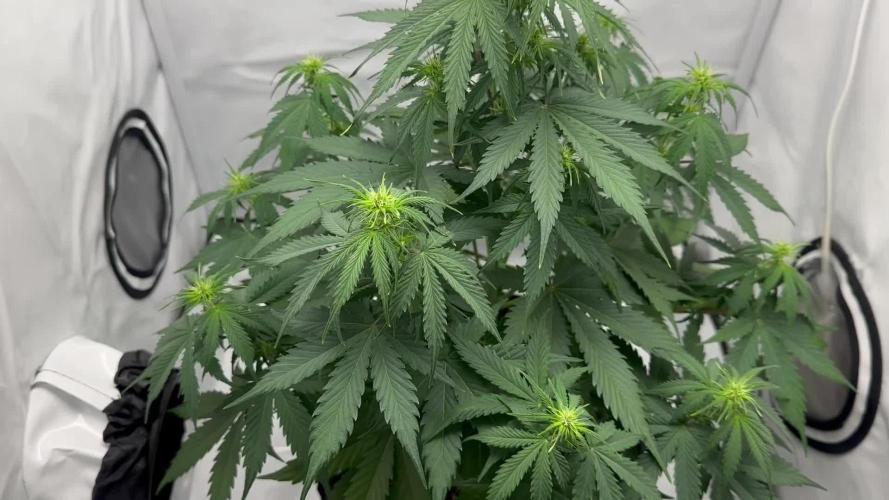
The flowering stage is progressing really well and I’m genuinely happy with how she’s coming along at week 7. The first brown pistils have already started showing on two of the branches, which confirms she’s deep into her flowering cycle now — right on schedule for Glue Gelato Auto.
Next week I’m planning to significantly increase the flowering nutrients — particularly Big One and Top Candy, which should really push bud size and resin production from here on. Around the middle of the week I’ll also do a proper defoliation, clearing out the fan leaves that are blocking light from reaching the lower bud sites. The canopy has filled in nicely but it needs opening up to let those buds really fatten up.
Water intake has increased quite a bit — I’ve stepped up from one liter to two, and even then the soil is nearly bone dry by early morning. That kind of uptake is a good sign — the roots are clearly healthy and the plant is working hard to fuel bud development. I’ll be watching closely to see if she needs even more as things progress.
I’ve also been doing regular branch adjustments, gently repositioning the roped branches to keep the canopy level and make sure every top is getting its share of light. Nothing too aggressive at this point — just keeping things tidy.
Week 7 feels like a critical stage now. Pushing the flowering nutrients harder from here should make a real difference in final bud size and density.

Likes
3
Share


@MicroHidroGrow
Follow
Día 36.
Estamos en 6ta semana. Los esquejes se atrasaron debido a que han sido días muy fríos y no he logrado enraizarlos. Decidí poner el extractor de aire junto con la bomba de aire, así solamente se prende 15 minutos cada hora. Así estoy logrando temperaturas mayores a 24°C en el indoor y así voy a lograr el enraizado. La planta ya tiene un tamaño que ocupa casi todo el indoor. Pero lo importante es que la voy guiando y ya estoy proyectando como va a ir cada rama. El tamaño va a exceder lo que esperaba, pero aún así creo que si logro lo que tengo en mente, voy a sacar muy buenos resultados. Igual no me voy a arriesgar demasiado, así que si contando 10 días desde ahora, no logro que los esquejes enraicen, voy a pasar la madre a floración sola. Cómo pueden ver, las ramas están bastante gruesas, y el la ramificaciones van ganando su lugar cada una. Las raíces son demasiado grandes, aunque sé que voy a poder poner la planta en el sistema de arriba igual, aunque me voy a tener que ayudar de algo para meterlas. Es importante no utilizar las manos, ya que se pueden transmitir muchos hongos.
Voy a seguir actualizando e ir viendo que pasa. Pero ya estamos en los últimos días de crecimiento, haya o no esquejes. Incluso puede que ya pase la planta al indoor de arriba para darle mayor libertad de crecimiento. Esto me va a servir para tlmar en cuenta en la próxima camada que se vendrá. La idea de esto es hacer las cosas rápido, y no en gran tamaño. Pero siendo que ya estoy en el baile, no me queda otra que bailar.
Día 40
Los esquejes no estaban enraizando, así que decidí cambiarlos de lugar y los puse arriba de la luz, donde les da calor y luz tenue. Espero que ahora si agarren.
Y hoy fue el gran día, pasé la planta madre al módulo de arriba. Pero lo voy a dejar una semana más creciendo. De esa forma veo si los esquejes llegan a agarrar a tiempo. Y además tuve un problema en el trasplante. Primero que la planta se hizo más grande que lo esperado, y la raíz también. Cuando la pasé, hubo contacto de la raiz con prácticamente todo lo que había cerca. Sumado a que se enredó en el oxigenador, así que quedó una pidra difusora en la raíz.
Dado el alto riesgo de haberla contaminado con algún hongo, le puse una solución de agua con agua oxigenada, recirculando continuamente, para lavar las raices y de paso bajar el stress de teansplante. Mañana veremos cómo arranca el día.
En el aprendizaje me llevo que en la madre, es mejor hacer un corte en el primer nudo, o dejar las ramas del segundo y quitar las del primero. Y así que queden sólo dos ramas, para luego dejar a los esquejes en el medio. Eso planeo hacer con la próxima variedad.
Entre tanto ahora sólo me preocupa que la raíz no se haya contaminado en el traspaso. Ya en 8 días estaré pasando a floración si no hay esquejes. Si llegan a agarrar, habrá que dar unos días de crecimiento hasta que alcancen a la madre en altura. Pero ya está todo en definición. Ahora sólo queda esperar y seguir guiando a la planta. Ya tengo ganas de poner la próxima, pero falta bastante para eso. Tengo 10 semanas de flora, así que recién en 5 semanas voy a poner la nueva madre.
Processing
Likes
34
Share


@LockDownGrow
Follow
My first time making alcohol tintcure
Using the c1 ,
Hold on tight gonna be a trip

Likes
4
Share


@420rollweek
Follow
Seeds directly In coco jiffy
Bruce banner seed spend more time then other 2 to get out...


Likes
3
Share


@Vincentsta7
Follow
Super sour grape(small it was stunned early )
Bruce strawberry Fumes
Watermelon Zkittles Fumes
Likes
7
Share


@TrickzGrowz
Follow
Servus Moin!
Die Super Lemon Haze hat richtig gut aufgeholt und sich super ausgebildet. Jetzt kann es ja in den Sommer gehen.



Likes
16
Share

@Chucky324
Follow
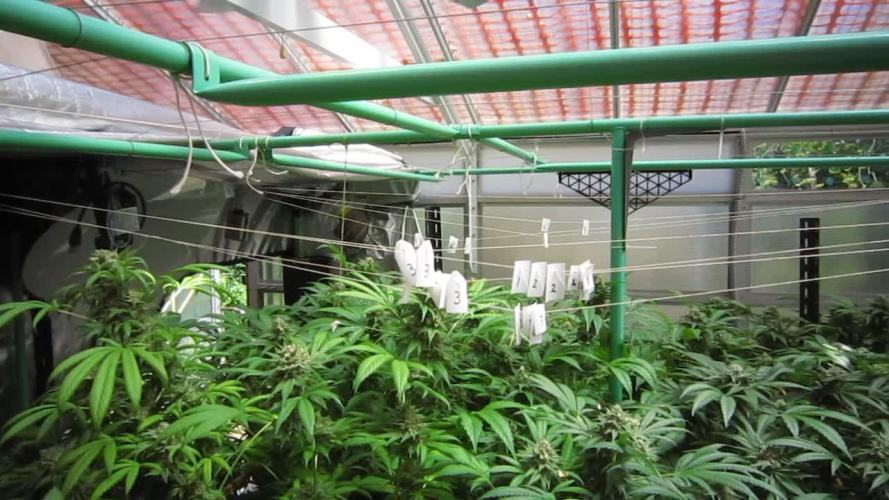
Hello, This is the end of week 7 and the beginning of week 8 of flowering.
I completely forgot about reporting last week. Got the roof re-shingled and they finished on Tue and I chopped fire wood when they left.
Chopped for 3 days and on Sat. I couldn't remember if I reported... so I had to look... I hadn't... Oh well..
Got 3 weeks left to go and this is the last week for nutrients. I'll give a couple of weeks of ph adjusted tap water only, before harvest.
Yes... I still like to flush... For better taste.
I've tried growing right up to harvest before and was disappointed with the pot. Or had to harvest early, because of pests, and didn't flush.
I could taste the nutrients left in the plant tissue. Have you ever tried the ash test to see how clean your pot is?
When you smoke a joint, the ash at the end is supposed to be white and fall off the end easily, for the cleanest cannabis.
It always takes 2 weeks flushing, for me, to get that good white ash.
If your ash is gray... that's not too bad, if it falls off easily.
But if it's dark gray with black streaks in it and is stiff and has to be pushed off the end of the joint, then it will probably taste bad too and has too much nutrient left in it...
Have you ever smoked a joint and had it sizzle and soft pop (not like a seed pop) It has too much nutrient left in the plant
Try your own test (smoke a joint) to see how your pot stacks up.
OK. Keep Growing Straight.
Chuck.


Likes
Comments
Share

@Amboss
Follow
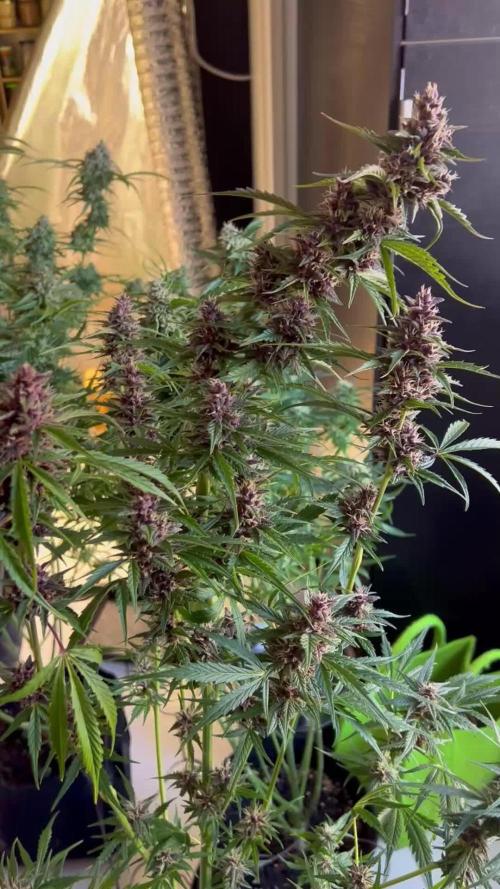
A champion
Amazing plant… bulk for the win
And huge colas
Feed her until the week then start flushing

Processing
Likes
88
Share


@Lady_NugWitch
Follow
She can't drink enough. It's crazy. Solid growth, good stems and major defoliation for this girl.
Likes
Comments
Share

@cdxxbuds
Follow
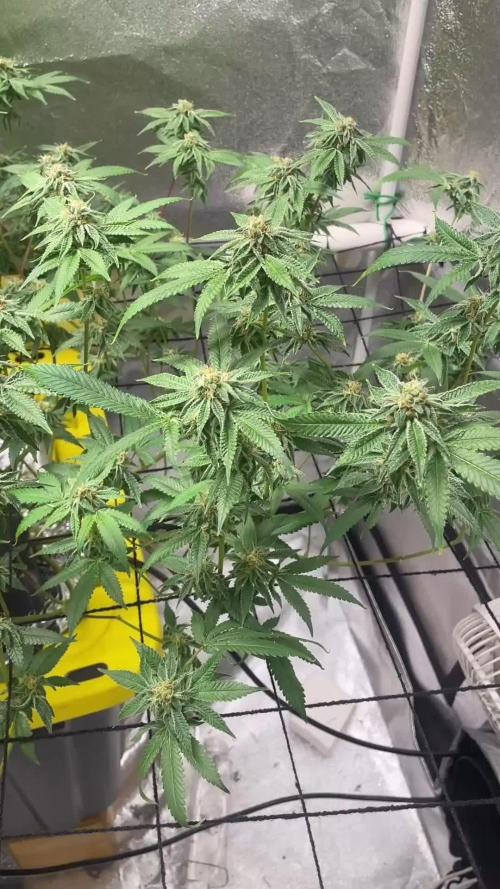
Bulking timex ladies are iced out. Looks like we might have 3 weeks more. Fingers crossed.
Cheers yall thanks fr stopping by
Likes
18
Share


@Laplantadelpie
Follow
•plaguicida foliar(ain grow)
•poda baja(2do y 3er nudo)
•1g de enhancer x litro de agua
aplicacion en el riego

Likes
3
Share

@IlseImWeedland
Follow
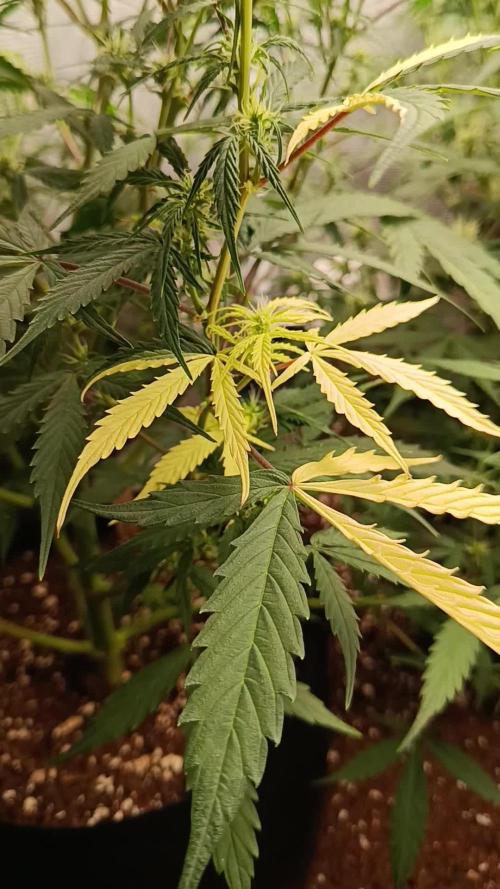
Der Topf ist unten geöffnet die Wurzel kann sich entfalten. Nach Oben ist nicht so viel Platz. Die Pflanze zeigt sehr interessante ,, Albino" Ansicht. Dünger wird verlangt. Blätter zeigten Magnesiummangel, mehr als gewöhnlich (2x in 4 Wochen) zugefügt.


Likes
35
Share


@SmokingTiki
Follow
I looked at the trichomes every 2 days this week. There are still some clear ones but they look cloudy overall. The OG Kush begins to have many amber ones.
I started to flush too soon and the plants are now struggling a bit. I will harvest everything next week!
The final grow area is around 1,1m x 1,1m.

Likes
29
Share


@Ultraviolet
Follow
👋Top is a clean cut, no confusion for the plant, road ahead is clear, by completely removing the main growth tip, the auxin source is eliminated. The plant permanently halts vertical growth from that main stem and immediately sends its energy and hormones to the two new, evenly spaced branches just below the cut.
Fimming slightly different because a small tuft of the top growth is left behind, the auxin disruption is temporary and less severe. The plant recovers more quickly and sends its energy to multiple surrounding growth points, often creating four or more new shoots from the same spot. It will eventually regain some vertical dominance after a few weeks if left to its own devices, but with a little more LST, bending the apex to the same height as the rest of the internodes, this shatters dominance, hopefully creating around 8-9 main shoots growing at equal height once recovered and grown out.
Reduced environmental intensity for now and let her focus on dealing with this new stress for a week or two.
When H+ ions are added to soil, the first nutrient displaced from exchange sites is typically aluminum (Al3+), if it's present, followed by calcium (Ca2+), magnesium (Mg2+), and potassium (K+), because aluminum and these base cations have different binding strengths. The order of displacement depends on the lyotropic series, where ions with a higher positive charge and those with weaker binding strengths are displaced first.
The specific order of nutrient displacement is determined by the lyotropic series, which ranks the strength with which cations are adsorbed by soil particles:
Al3+: Most strongly adsorbed, so if present, it will be displaced by H+ ions, leading to increased solubility of aluminum and potential plant toxicity.
Ca2+: Displaced next, as it is more strongly bound than Mg2+ or K+ but less than Al3+.
Mg2+ and K+: Displaced after Ca2+.
The displaced nutrients can be lost from the root zone through leaching, becoming unavailable to plants.
As H+ ions increase, the proportion of acid cations (H+ and Al3+) on the exchange sites increases, while base cations (Ca2+, Mg2+, K+) decrease, resulting in a lower soil pH.
The amount of photosynthesis (water splitting) directly determines the availability of H+ ions (protons) in a plant.
90% of water is for cooling of photosynthetic apparatus the other 10% is split for its H+ among others things.
Carbon sugars, like glucose, do oxidize in soil through a process primarily driven by microorganisms, which break down these sugars for energy. This oxidation converts the sugars into carbon dioxide (CO2) through cellular respiration, a key part of the soil carbon cycle, though some carbon may also be incorporated into soil organic matter. The rate and extent of sugar oxidation depend on factors like oxygen availability, the presence of Fe oxides, and soil redox conditions, which can all influence the process.
My understanding of why we flush.
Just plain water, what does it do?
Strips the medium of salts and nutrients making it empty.
What does that do?
Triggers nutrient recycling within the plant.
What's nutrient recycling?
It is a natural part of plant senescence, which can be triggered once you know the switches. A 24:1 carbon-to-nitrogen ratio will also trigger.
Why won't it trigger autophagy for me?
Nitrogen needs to be gone, gone, gone almost. Ammoniacal (organic) nitrogen takes 4-5 times more water to separate it from soil particles than nitrates so what happens is most people jist flush the nitrates, leave all the ammoniacal in there and this prevents autophagy initiating.
Nitrogen decays differently depending on its form during the dry.
Ammoniacal nitrogen will oxidize in the air, leaving no trace. But nitrates do no decay and turn volatile and smelly and remain trapped until smoked, no matter how long you cure it does not oxidize. This is why you need to trigger it and begin the denitrfication process prior to harvest to get rid of all the nitrates. Otherwise, you will smoke it.
Flush till autophagy begins, just make sure you add no nitrogen afterwards. Micronutrients for trichomes. Don't leave the medium empty for 2 weeks, that does nothing but reduce yield 10%ish. Trichomes are another thing. Trichomes themselves are not directly affected by flushing; rather, flushing affects the plant's nutrient uptake, which influences the development and final state of the trichomes. Trichomes are filled with antioxidants in the last weeks, which is what makes them cloudy. A lot of the processing of antioxidants requires energy and nutrients (mostly micronutrients ), so you don't want that soil empty for 2 weeks, you just want the carbon nitrogen ratio 24:1and no higher. She still wants what she needs to ripen.
Processing antioxidants is energy-intensive; heat and light accelerate the rate at which THC converts to CBN. This is why you lower DLI, lower temps. By doing so, you reduce the oxidative workload caused by photosynthesis, which opens up the oxidative capacity for the production of antioxidants. THC is mostly processed at night when the plant's oxidative capacity is generally moreso "free and available" for work
Likes
Comments
Share


@Anditsch
Follow
Drying is over, now it goes into the jars.
No Problem with mold while drying and growing.