


Likes
Comments
Share

@PapaTerps
Follow
Potion - Wizard Trees
Day 111
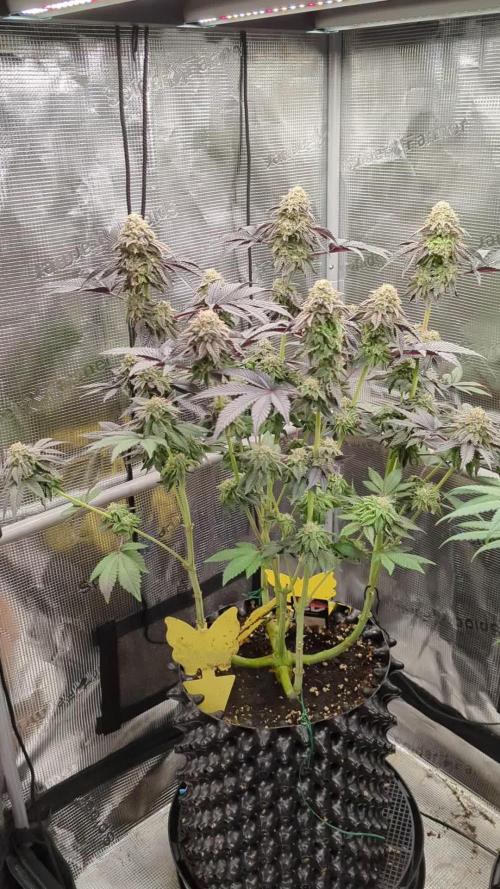
🚿 She has been watered every thee days with 2L of RO tap water pH'd to 6.3. As she is approaching harvest, I have slowly reduced the nutrients until she was receiving just plain water. From today, she is just about half way through flush, so another watering and then she'll be left to dry back.
✂️ I've removed a couple of larger sugar leaves from around the flowers at the top canopy to improve light penetration, as well as the usual inspections for mold and pests👍🏻
🌸 She's now in week 8 of bloom, her leaves have all turned purple, most of her sugar leaves too - the trichomes on her sugar leaves have also started to turn amber in clusters, which can almost be mistaken for rust 🤣 All of her trichomes have turned milky clear and her pistils are mostly amber too, so one more watering and that'll be that folks 🏻

Likes
Comments
Share

@Dr_4NdY
Follow
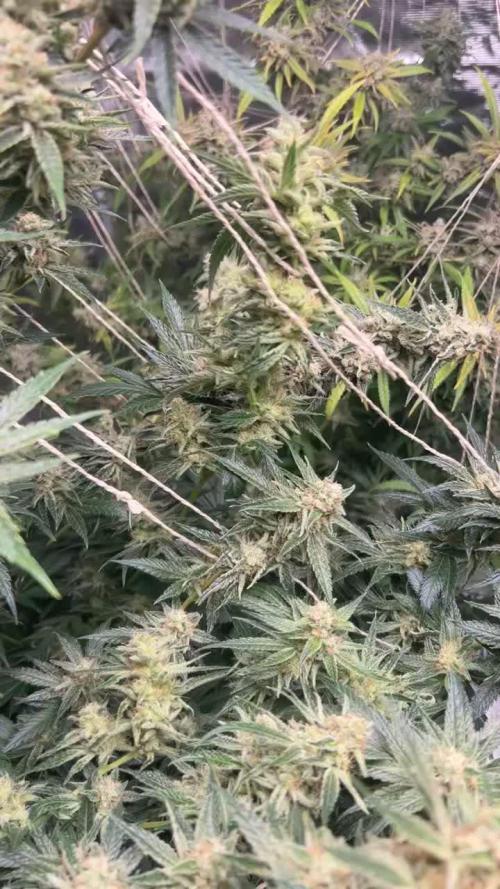
Sadly only pictures before harvest
Didnt used any fertilizer in week 9


Likes
2
Share


@krst97
Follow
I cut the plant after 48 hours of total darkness. To flush the best, I ran a few dozen liters of water through the jar until the one that came out below was transparent. Although the flowers failed to close, I am satisfied with the result and the smell of the buds inspires a good terpene. To dry well, I moved the grow box to the room with an air conditioner. I'm keeping the temperature around 26-27 degrees and the humidity around 50%.


Likes
3
Share


@Northern_Ent
Follow
June 7: i think Mimosa Shot likes it to be a bit warmer but she’s doing alright. Long daylight hours now and warm enough so she should make up for a slow-ish start.
June 9: loose scrog net is doing the job of keeping the growth tips exposed to light. Very effective. Re-arrange it a bit as needed as the plant grows. No need to even tie it off as the weight of the string is enough.
Video is a tip about keeping leaves moist in dry air. Plants are much happier when their leaves also get some moisture to make up for the low humidity.
June 12: looks good.


Likes
422
Share


@Crashoverite
Follow
Hi all 🧑🌾
Welcome to my 🍌💜👊 week update.
Hope everyone keeping well and having a great week😁
Thank you so much for so much support on this bananas ride 🙏💜💚💜💚
Everything still going pretty well. Girls are developing and stretching like crazy. Athena currently Dec 14 90cm and main stem of Xena is not far of this height either. Unfortunately noticed first signs of calcium deficiency(my opinion) on Athena. Thankfully started feeding both girls with calmag weeks back but the dosage wasn't not enough for Athena. Started small treatment very next day on Dec 11 (see description below) I belive got my baby back on right track.
Week 9
Dec 11-17
Dec 11
Watering was planned for Tuesday but due to calcium deficiency decided for a little treatment. Watered both girls with mixture of reduced content of growth nutes by 50% calmag at 1.2 ml per ltr. Reduced solution PH to 6.2 as apperently it's ideal for calcium consumption. Over period 4h I have watered Athena with 5ltr with couple runoffs. Xena 3ltr. Total of 7-10 leaves affected mainly at top colas close to the light.
Dec 12-13
Purely observation and all looking well. Of course all affected leaves will progres of showing signs but good news is that growth and development booming and don't see any new leaves with symptoms.
Very nice trichomes development in recent days and more and more colours.
Dec 14
Second watering for this week 6.5l Increased calmag to 1.4ml per ltr and if still things will be looking well reduce to 1 or 1.2 on next feeding.
Dec 15
Very nice respond on yesterday feeding. They definitely fatten over night and getting more and more frosty. Will need to remove some foliage soon as getting extremely bushy again.
Dec 17
Xenas main stem top cola almost touched the light today. Tied her to left side of the cabinet, applied selective defoliation on both girls, tied few branches to netting and on the end of this busy day a third watering for this week. 7 ltrs beetwen both. Runoffs Xena PH6.4 Athena 6.3.
Very nice week have to say. I belive that calcium deficiency on Athena is no longer a case here and both girls developing very nicely. Both are still stretching, buds are gaining in size and both girls started exploding with trichomes,
Thank you all again for such amazing support 🙏peace and love brothers and sisters ✌️💚💜💚💜💚
Stay tuned for new week update 😉🧑🌾✌️💚




Likes
2
Share


@koci263
Follow
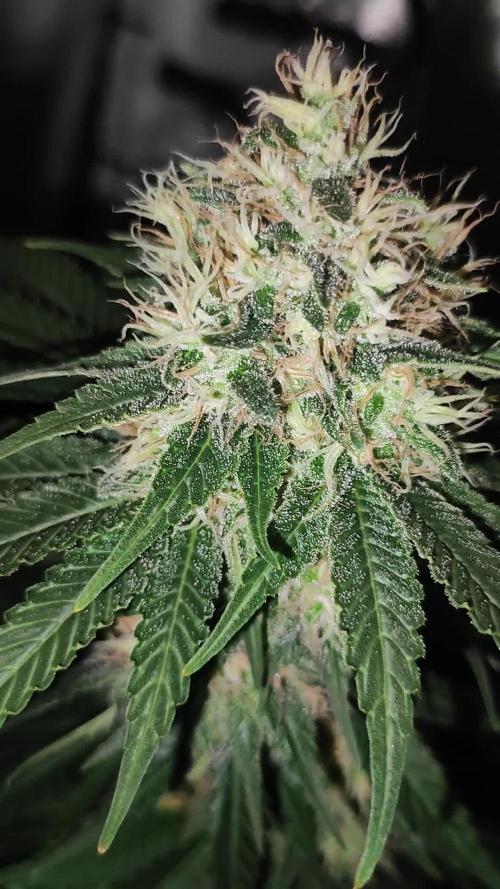
growing chem pie was amazing from start to finish, he made beautiful buds covered in resin. Every day it was wonderful to go and see how it blooms.
during cultivation I came across two completely different phenotypes. One had rather more open but very firm buds, but the other was more like a crossbow and also firm buds.
During drying, a little mold appeared on one of the bud, but otherwise everything is fine. after a month of curing, the taste of the smoke was very pronounced.


Likes
16
Share


@DESER90
Follow
The plants are not fully in the same stage, but most started getting milky trichomes so I decided to flush. Roughly 3-4 times the usual amount of water. Ph to 6.2 and a lot of run off water. Never experienced with flushing so here goes nothing. I will try and cut all the plants at the same time. The trichome development will be at different stages but this might be a good way to see what trichome stage I like most, and I will be able to decide better in future grows. To be honest I'm not looking for highest possible THC content ;) Taste/smell are priority.


Processing
Likes
16
Share


@GirlGoneWeed
Follow
All 3 plants are adapting very well to LST, the shape its growing into have been allowing the light to reach further into the lower growth nodes and branches. I like to start bending the branches close to the main stem as early as week 3 of VEG.
Now these 3 Northern Lights Auto seeds are from Sun West Genetics, they were all germinated, planted, trained, fed the same way they have been on the same controlled environment since day 1, the 3 are totally different, I know each plant is unique in its own way, but I find strange that 1 plant is taller and stronger than the other 2, the smaller one is growing weak leaves with signs of mutation, all 3 plants show signs of Magnesium deficiency, these 3 plants are sharing a grow tent with a Haze Auto from Seedsman, all 4 plants are under the same diet, the Haze have no signs of deficiencies or mutations, I guess that shows what good genetics look like.
For the Magnesium deficiency I have mixed my own Epson salts into water and applied as a foliar spray, internet said the spray should be used every other week, wait 2 weeks to see results.
Signs of Nutes burn, I decided to stop feeding for this coming week.
The 3 NL leaves are looking unhappy, kind of clawing under, they look lifeless, I have ruled off a few potential problems such as:
Wind Burn
Under Watering
Water PH
Light Burn, just moved the QB higher to 17 inches from the highest canopy today.
If any of you fellow growers have advice for the leaves, please let me know.
Stay Lit folks 👩🌾🏻

Likes
3
Share


@weedelicious
Follow
Today I switched the light to the flowering phase. The light is now on for 12 hours.
All plants were fertilized with Hesi Bio Bloom. The Tropical Marker and the Plurple Kush each received 2 liters of water, and the Pink Gelato received 1 liter. I trimmed off some large leaves. I hope they have a smooth transition into flowering.
Day 42:
The girls are growing well. The Purple Kush and Pink Gelato received 2 liters of water with Hesi Bio Bloom and some Biobizz Calmag today.
I dimmed the light to 60%. The Pink Gelato is catching up a bit, but is very small in comparison.
Day 43:
They're all still growing well. The tropical marker has been given 2 liters of water with hesi bio bloom and biobizz call mag. I've raised the lamp a bit higher. Here you can see how the stems of the plants have developed; the pink gelato has grown like crazy. The humidifier from Spider Farmer does a great job!
Day 47:
The girls look good; the first signs of flowering are visible on the Tropical Marker and the Purple Kush. I also defoliated them; it was definitely too much, and they thanked me a day later with preaching leaves. Unfortunately, the Pink Gelato didn't tolerate the topping well and only developed one shoot. I then removed this shoot. Afterward, I watered the Tropical and the Purple with 2 liters of water mixed with fertilizer and Calmag at a pH of 6.3. I set the ventilation to 50%.

Likes
134
Share


@BigDaddyK
Follow
Day 43 - Tuesday 27/11/18 - changed the reservoir with fresh solution , getting a few mottled under leaves that suggest cal mag issue , or possibly ph , but I have double checked both of these so fingers crossed , I measured her today with my metre ruler and she is 73 cm tall , looks very bushy , I took a light on pic with my iPhone , and made you a little video 😜
I should just add , there are 3 plants in this picture , look back to week 5 and you will see , the lemon is very bushy , gorilla is tallest , Tangie seems to be fastest 👁️
I have also changed the temperature and humidity slightly.
Day 44 - Wednesday - I have included the ruler for scale today, i see so many good pictures on here but the size can be questionable, so also proof i own a 1m ruler...lol , topped up with about 1.5 litres of water, EC was ok and ph perfect. If there are any pictures you would like to see please comment , with a little description.
Day 45 - Thursday - I dont know what happened yesterday but she had drunk so much water ( added 3 litres + ) and needed 10 ml of A+B ,
Day 46 - Friday - Added 12 ml A+B and about 3 litres of water, she is in her super feeding stage, this week she has been devouring everything, some of the leaves I think are showing signs of under feeding but I really think its the strain on the plant as she tries to buildit is really tempting to up the nutrients but once you burn it, its never the same.I made you a video, enjoy.
Day 47 - Saturday - Added 3 litres of water , 12 ml A+B ( I mix it 6 at a time in 20 ml of water syringe )
Day ( insert generic day here ) - JOKE , Day 48 Sunday - still eating and drinking like a monster, i measured her at 89 cm today, added 3 litres of water ,12 ml of A+B
DRAMA ALERT - DRAMA ALERT
Day 49 - Monday - added 10 ml Of A+B and 3 litres of water, came home later an found the electric had tripped, usually this is just a case of flipping the switch, but this time it kept on tripping, so i went through the painstaking unplugging of everything, and had literally unplugged every fucking thing , when i finally ( at my wits en after 2 hrs ) found the fucking culprit,excuse my language but i find that cursing really does help, i think its a middle age thing,and it was.............. A SIX INCH FAN , you know the little clip on one. anyway i added a couple of tAnGiEmAtIc PICS TODAY TO MAKE ME FEEL BETTER ...
A WORD OF ADVICE IN DWC SYSTEMS, DO NOT HAVE MULTI PLUG EXTENSIONS ON THE FLOOR, CABLE TIE THEM TO THE SIDES OR THE TOP, THIS WILL PREVENT ACCIDENTAL WATER SPLASH!!
Likes
4
Share

@Bud_vista
Follow
Welcome to week 6 of my White Truffle grow!
First things first: Still no signs of pre flower yet 😄
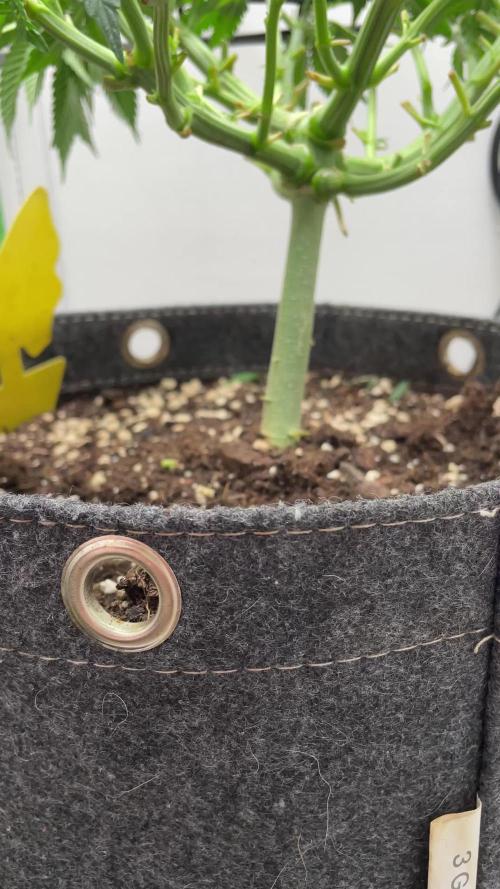
She’s taken the training and the continuous defoliation like a champ. She got a massive stem and also the 4 main branches are thickening up that I could get some problems later this week of holding the branches under the trellis.
Hopefully some signs of pre flowering will show up this week or I have to move the trellis a little bit upwards.
Update: the lady seems to be a photoperiod and none autoflower, as i asked the breeder recently. So she is going to flower by switching to 12/12 from the mid of week 6. Hopefully she has not a huge stretch, because of the limited space in the Vgrow.
The plant itself looks healthy and vital. Looking forward to this week. ✌️
Likes
49
Share


@GERGrowDesigns
Follow
Dear Growers ,
Welcome to Week 6 or Flower week 3 // Day 42-49 from Kannabia Purple Dream Auto .
Incase of Moving to a New Home . I Decided to skip 3-4 Weeks from every Diarie of the 12x12 Automatic Project . Everything should be Normal in the next Weeks .
Whether you're a beginner or an expert, you are warmly invited to join, ask questions, and share your own experiences along the way!
Project Setup & Conditions:
• Brand/Manufacturer: Kannabia Seeds
• Tent: 222cmx150cmx150cm
• Light: 2x 720 Watt Full Spectrum
• Humidity: 50%
• Soil: Narcos Organix Mix
• Nutrients: Narcos Products
• pH Value: 6
If you want Germinitation results like mine , check out Kannabia Seeds with my link [https://www.kannabia.com/de?ref=61966] and grab the germination device or the strains I used . Trust me – it’s worth it for sure !
Get another 20% Discount at all products using the code [GGD] at the Checkout .
Stay curious and keep up Growing —we look forward to welcoming you back for the next chapter soon!
Likes
2
Share


@Never96
Follow
My friends raved about this strain. Great taste great high and density was fantastic! Overall five stars and I only did one plant because I only had one seed and I may grow this one again. I always LST my plants and I got almost 7 ounces off of this one with only about six weeks of veg.
Likes
18
Share


@ReefermanGenetics
Follow
More leaf picking just sprayed for mildew and bugs.About 7 more weeks to go here on this one
