Likes
Comments
Share
@Natrona
Follow
White Widow X Crystal Meth - SeedSupreme Outside Grow 2026 6/28-7/4 W9 F5 Hello Friends, We have had several thunderstorms this week due to the heat. We are under a heat advisory with temperatures reaching 100 with a heat index to 110 most of the week. I had a scare this week when I looked out the window. She was extremely droopy. The other 3 outside plants were upright and other than a few yellowing leaves, fine. I determined that her big leaves acted like an umbrella and deflected the rain around the pot rather than into it. The Seed Supreme indicated that the plant is bushy and may benefit from the occasional prune to ensure good air circulation. I defoliated all the yellow wilted large fan leaves and probably should have defoliated earlier than now. Further inspection found a limb broken by the torrential rain which I mended with electrical tape. I hope it heals together since it was only holding on by a thread. Since she is using up the nutrients in Grow Dots I top dressed with azomite and rose and flower fertilizer and watered well. The pistils are all turning brown and the trichomes are just starting to form. So far, no pests (using mesh bag) and no mold issues. WWxCM has slowed her growth at 32 inches tall. Next week the weather looks the same. Hot and humid. That’s all for this week. Remember to check out SeedSupreme current sales. Use my code Natrona20 for a discount on seeds. https://www.seedsupreme.com/?a_aid=Natrona July is a big sale month so check it out: • Jul 1–7: Freedom BOGO | BOGO All Seeds Sitewide + free seeds on every order + • Jul 8–10: 710 THCa Flash | 25% off All THCa Flower & Concentrates (3-day window) • Jul 15–21: Mix Pack Madness | 30% off All Mix Packs + BOGO All Autos • Jul 22–28: Strain Spotlight | 50% off 1 featured strain (limited stock, first come first served) Stay green, growers love 💚🌿 💫Natrona💫
Likes
14
Share
@artems
Follow
Successfully harvested Wapanga, unveiling a vibrant candy aroma and densely packed buds. Being my maiden experience with a Californian strain, the cultivation journey was thoroughly enjoyable. The plant has been carefully hung to dry, and the anticipation of tasting the fruits of this labor is palpable. Excitement lingers in the air as the drying process unfolds, promising a flavorful and aromatic experience upon consumption. Wapanga has undoubtedly left a positive impression, and I eagerly look forward to savoring the results of this rewarding cultivation endeavor. 🌿🍬
Processing
Likes
6
Share
TThis week I decided to move from my small ass bedroom and pre fab me a area in my nice ass basement with great element and ceiling. I'll have a couple little videos. Still not done revamping that spot. But I'm hanging 3 mars hydro I just ordered from my beautiful rafters. Lay some mylar and a platform of a sort. Use some reflective tarp to outline my space. Switch out the basement lighting with 3 green led lightbulbs. 24/7 access to obsession. You're welcome. Still got the 4x4 pulled up there so everything is accessible. check in later
Likes
13
Share
Over fed some of them others go very good. Smells already realy good
Likes
44
Share
@I_and_I
Follow
Chopped the purple fruit/diesel smelling plant
Likes
10
Share
Something wrong happened on the end of last week. I had a little irrigation problem and I did a m mistake with the fan’s position, it was too direct on the roots. I think this could have caused a block to the nutrients transmission. I will give just water with regulator ed enzym+. Let’ a see
Likes
43
Share
@Hawkbo
Follow
This started out as a pain in the ass to grow because I was expecting a light promised to me by a company I wont name that was never followed thru with and I ended up having to pay out of pocket for it. Luckily I was able to move one of my other fixtures from my other tent for bloom so they could finish up strong. This strain has potential to be great like this plant but also has the potential to end up like my first attempt at it so I gave it 9/10 stars. If every one came out like this one it would be a 11/10. Great daytime smoke, finished up relatively quickly considering its size. Only negatives were the smell isnt as strong as I thought it would be based off the end of flower but in the grand scheme of things is not a big deal it still smells it's just subtle. I cant help but wonder if it would have been even bigger and better if I had enough light to give it the first 6 weeks. The autopots were run from around week 4 to 7 until I disconnected and started hand feeding so I could use thicker nutes with the organics like the pbp and nirvana. 11021
Likes
14
Share
Hello everybody! This was the last week for this little Titan F1, yesterday the plant got harvested and now is hanging upside-down in darkness. Is hanging as a whole plant, I was afraid to wet trim it before as my humidity is not always in the best value ranges. So I preferred to be on the safe side and avoid super fast or excessively drying after a wet trim. I will have a little more work to do during DRY trimming but is ok, is just 1 little plant. In this last two weeks not much was going on. Just soil flushing and constant checking on trichomes every 2/3 days. This was the last week, the plant again got only plain water adjusted to the right pH, around 6.4. 2 liters of water every 2 days. For a total of 6 liters this week. Yesterday at day 85 the plant FINALLY got chopped down. A little late on the schedule, it took her around 10 days longer than RQS indicates. Overall from my observations it looked like the plant could go longer that's why I kept her till day 85. Also the trichomes were not ready yet (somewhere around 90%). Before harvest I actually checked the trichomes for the last time and FINALLY they were all nice and milky. Almost 0 lucid or transparent. I chopped her in the perfect moment I believe. In the last days I lowered a little bit the intensity of the light to 50%, I noticed that on the main cola the terpenes were evaporating. The light was too close and definitely too strong. This was due to my latest lightning upgrade. From 70 to 100 watt. I should have kept the old lighting on untill the end of her life even if was for just 1 week. Anyway the new light it gave her benefits, the plant definitely got more beefy with the new illumination. But also got some light burn and stress. But the most important thing is that the plant survived this journey and now is drying up. So the last two days before harvest the light was at 50%, in fact the plant recovered so well and the main cola started to smell again. Im sooo happy. There are some purple spots on buds 💜 from light stress and genetics of course. Regarding drying and curing the plan is: Drying in darkness for 7-10 days. Temp 17 celcius and around 51-53% humidity. Curing inside air sealed jars with Boveda humidity packs for about 1 or 2 months. I dunno if go for the 62% or the Boveda 58%. I think i will start with 62% and then decide if I like it or needs couple % less. Of course in one week after is dry I will do the first smoke test without curing it, im too excited and impatient, it was 3 months maaannn, time to smoke test it now. I will keep 1 or 2 grams and the rest will go in the jar for the final cure. Honestly I never look at the dry weight, is a bit too vague, full o little branches, leaves... Just not important for now. Next week when I do the dry trimming I will update with the last pictures and the final dry weight. Thanks to everybody and see you next week.
Likes
23
Share
@NoVC01
Follow
8/23/2025 Still Feeding Week 4 extended of feeding schedule. Pinching off the mite damaged leaf and some of the fans needed to go. Daylight has entered 13:59 hours. Waiting for front left plant to show sex. The other five have shown female, and unless my eyes are out of focus have a pistil or two at the top. They are starting to stretch. Waiting on Pre-Flower. I'm inclined to think because these are modern hybrids, they might be genetically bred for the 12/12 flip. Just a thought. If they pop by September 8th, I should get a decent flower stage. Looking for 1st week October for harvest. Season is beginning to change. A few months appeared yesterday. Sprayed entire garden with AzaMax and that should hold until the end. The moths bring the budworms. I do have one big grasshopper that hangs out. He fly's away and laughs at me everytime.
Likes
Comments
Share
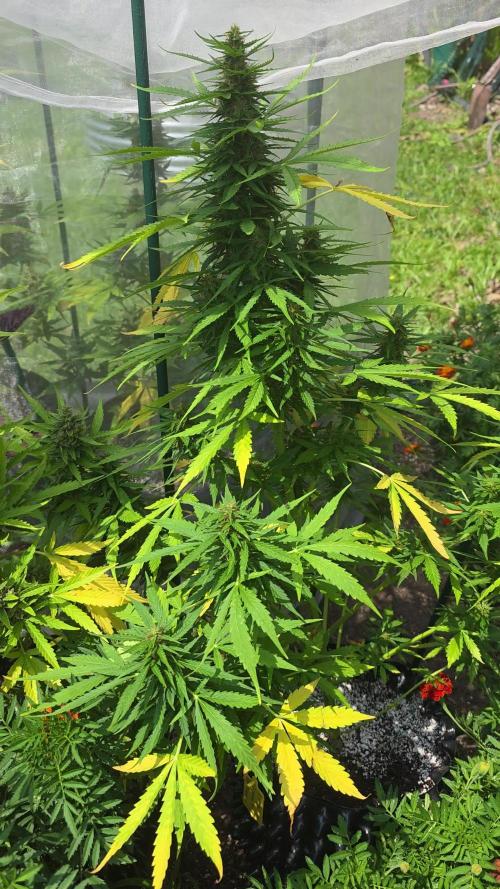
Week 4. Temperature at night drops to 16°C. Purple pop out but no problem . With bigger pot with soil Is root zone more Warmer and much longer keep better temperature then is outside in tent .
Likes
19
Share
Very nice grow all at all,first time that i have a strain turned out so purple in volor,very interesting!
Likes
66
Share
This week has been horrible and I've been combatting the heat as we have had a heat wave so been some serious high temps 30-31 but I've swapped out my hps for a new led light hopefully this will help also I did a flush day 77 ready for week 3 Happy Growing!👊👍
Likes
5
Share
@Sativa763
Follow
Day 49 after switch. very nice i would say :) everything is getting bigger and frosty. no complains so far. last week watering with PK 5-8, then just water until she´s finished.
Likes
9
Share
@Jbuttch
Follow
Ya viendo el resultado del último LST, desde aquí ya veo cómo van las cosas!
Likes
50
Share
@AsNoriu
Follow
Day 43. Light is on max output, heat enormous and they RUN !!!! thought intensity will stop them a bit , but i think i do only worse ... We have +30 heatwave in UK, i live in attic , so for 4 more days everything will be out of control. Watered today. 6.3 phed water. I love simple and affordable Mars Hydro products, if you can cope with heat TSL2000 can do magic in your tent ! Will update after heat wave us over. Should be in 4 days back to +20 ;))) Day 45. They GROW !!!! Distance is insanly small, but i have 30 cm of space left, wont move light for a week, then i will try to have 20 cm at least again. Planing last top up, need two more waterings before it, so it should be on last day of this or first of next week. Thinking to take down all LST at that time, need pots to breath better, too thin fabric, they dont keep form. Day 47. Drink every two days !!! 4 liters goes to nothing !!! Huge, still streching, tops almost rubbing TS2000, heat 30 inside, humidity 65-68 ..... will need heavy clearing again !!! Bomb getting stacked !!! Happy Growing !!!!
Likes
2
Share
7/8/25 Starting to look very very nice. Some nice purple flakes on the edges of the sugar leaves with bright hairy orange pistils on nice bulbous shaped buds
Likes
12
Share
* Week 6 Flower Mimosa (1 -2) - 10/8* Both Mimosa's are near harvest about a week left, Lotus CarboFlush will begin this week. Mimosa (1) - 38 Inches - Mimosa (2) - 28 Inches. Trichomes have set in - Pulled off trellis net this week * Pre-Harvest set-up - 10/15* Both plants have been cut down and are drying out accordingly (Day -1) Dry time will be 9-14 days - Dry temps are 60% Humidity - 62 degrees F.
Likes
18
Share
Added 1 tablespoon of baking soda per gallon to watering and we are back to 6.5 24 hours later and holding, Pottasium becomes much harder to uptake with low ph and it was starting to cause yellowing and minor dark spots common from ph potassium deficiency, more understanding I gain of ph and its role to each individual nutrient, I'm going to raise to 7.0. Anthocyanins are a type of flavonoid, a family of powerful antioxidants that fight the effects of aging and oxidative stress. To date, more than 635 different anthocyanins have been identified. What is the color of anthocyanins, and what does this tell us about where we can find them? The definition of anthocyanins is “blue, violet, or red flavonoid pigments found in plants.” In regard to anthocyanin’s structure, anthocyanins are water-soluble, glycoside pigments that can vary in color depending on their specific pH. The exact type of anthocyanin that a fruit or veggie contains is partially what determines how deeply red, purple, violet, blue or even orange it will be. This is one reason why the same food, such as eggplants or onions, can come in many different shades. Here’s the cool thing about most antioxidants: Not only do they benefit you when you eat them, but they also benefit the plants that contain them too. Plants produce phytochemicals like anthocyanin as a protective mechanism; phytochemicals help build plants’ resistance and protect them from being destroyed. For example, anthocyanin can offer a plant protection from being eaten by predators (like bugs, birds or rodents) and from environmental stressors like ultraviolet light, cold temperatures and drought. What do anthocyanins do inside the body once we consume them? We still have a lot to learn to about the exact bioactivity, uptake, absorption and roles of phytonutrients, including anthocyanin. We do know that anthocyanins seem to play a role in fighting free radical damage, which leads to aging and the formation of numerous diseases. (3) Beyond their capacity to fight free radicals/oxidative stress, anthocyanins have many other effects when it comes to protecting cells, tissues and vital organs that we’re still uncovering. For example, research suggests that anthocyanins have positive effects on gut health when they interact with microflora, which can help decrease inflammatory markers associated with many chronic diseases, plus they can support hormonal balance. What are the health benefits of anthocyanins? Some of the conditions that research suggests anthocyanins may help prevent include: Cardiovascular disease and risk factors, such as high blood pressure and hardening of the arteries Cancer Impaired immune function Diabates Neurological disorders, such as Alzheimer’s disease and dementia Symptoms of poor cognitive function, including poor memory and trouble concentrating Fatigue Poor recovery from exercise/physical activity Vision loss Obesity 1. Protection Against Cardiovascular/Heart Disease Overall, many studies have found that having just one to two(or ideally more) servings of anythocyanin-rich foods per day can protect you from problems from high blood pressure and arteriosclerosis. While it’s great to have antioxidant-rich foods every day, even having them several times per week can improve your health. One finding from the Iowa Women’s Health Study, which included more than 34,000 postmenopausal women, found that women who consumed anthocyanin-rich strawberries and blueberries once per week or more experienced significant reductions in risk of death from heart disease/coronary artery disease. (4) Another large body of research from the Nurses’ Health Study I and II, which followed over 46,000 women from and 23,000 men for more than a decade, found evidence that the those with the highest intakes of anthocyanin (especially from blueberries and strawberries) had a significantly decreased risk for developing hypertension, myocardial infarction and/or having a heart attack compared to those with the lowest intake. (5) This was true even after controlling for other factors like exercise level, family history and BMI. Anthocyanin benefits for diabetes and pancreatic disorders have also been unearthed in recent years, and again the efficacy is attributed to the multiple, simultaneous biological effects these pigments cause in the body, including prevention of generation of free radicals, decreased lipid peroxidation, reduced pancreatic swelling, and decreased blood sugar concentrations in urine and blood serum. (6) 2. Improved Immune Function Anthocyanin bioflavonoids may provide protection from DNA damage and lipid peroxidation, plus they have anti-inflammatory effects and help boost production of cytokines that regulate the immune responses. They have also been shown to support hormonal balance by reducing estrogenic activity, help regulate enzyme production that aids nutrient absorption, and strengthen cell membranes by making them less permeable and fragile. (7) 3. Protection Against Cancer Research suggests that anthocyanin can decrease the risk of developing various types of cancer due to its antioxidant, anticarcinogenic and anti-inflammatory effects. This has been demonstrated in both in vitro and in vivo research trials in humans and animals. Studies show that anthocyanins have the ability to naturally fight cancer by blocking cell proliferation and inhibiting tumor formation by interfering with the process of carcinogenesis. One way anthocyanins inhibit tumorigenesis by blocking activation of mitogen-activated protein kinase pathways. (8) Anthocyanin - Dr. Axe 4. Improved Cognitive Function Studies have found that diets high in antioxidants like anthocyanin lead to a reversal in certain age-related deficits that affect neural and behavioral parameters, including memory and motor functions. Anthocyanins have been credited with protecting memory, coordination and neural function in older populations. One study out of Korea found that administration of isolated anthocyanins from purple sweet potato enhanced cognitive performance and inhibited lipid peroxidation in brain tissues in mice. (9) 5. Enhanced Exercise Performance and Recovery Antioxidants seem to improve physical performance by lowering exhaustion and the negative effects of excessive oxygen and radical accumulation during physical activities. In one double-blinded clinical trial that involved 54 female and male athletes, when one group was given 100 milligrams of anthocyanin pills per day for six weeks, the participants in that group were found to experience a significant improvement in their VO2 max (maximal oxygen consumption) compared to the second group that received 100 milligrams of placebo pills daily. (10) Some studies have also found that fruit juices that contain anthocyanins, such as 100 percent tart cherry and blueberry juices, have antioxidant and anti-inflammatory effects that wind up positively influencing muscle damage following exercise and the ability to properly recover. (11) There’s even evidence from animal studies that anthocyanins consumed as part of a high-fat diet can help inhibit both body weight and adipose tissue increases. (12) 6. Enhanced Vision and Eye Health Anthocyanin has been shown to help enhance night vision and overall vision by protecting the eyes from free radical damage. One study found that oral intake of anthocyanosides from black currants resulted in significantly improved night vision in adults. Research suggests that the enhancement of rhodopsin regeneration and protection against inflammation are at least two mechanisms by which anthocyanins improve sight and protect the eyes. (13)
Likes
15
Share
Week 5 🌸 This week we had quite a lot of fruit flys loving the fruity odors emitting from the tent. They especially loved the Pineapple and Blueberry heavy plants 😅. We watered with an EC reading of about 1,1mS twice this week. Also, we finaly got the Nemathodes into our pots. The Terps are developing beautifully and we are so excited what these flowers will taste like, once the time has come!💚 All three Strains have an estimated flowertime of 45 days, but we think most of them will take a little longer to finish up.
Likes
3
Share
@CalGonJim
Follow
1/5/202 6:12 AM Monday they all look so good. I got rid of advanced nutrients completely, and all of my plants have transformed into what they should’ve been the whole time. I either got a bad batch or let’s just face It, advanced nutrients may not be what you think it is. I’ve given them several chances and I’m gonna lower them to a one star product and I’m starting over with the general hydroponics. I’ll never look back. 1/5/26 6:32 AM. I learned this from the Three Stooges this morning. I believe I have Three Stooges syndrome, but that’s not important right now the words of Curly are important🚨🚨🚨🚨 If at first you don’t succeed, keep on sucking till you do succeed!!!!!!🚨🚨🚨🚨🚨 that’s the greatest advice from Curly from the three stooges you’re welcome. 1/7/26 12:47AM my I am failing. If I dont bounce back all the plants are going to go with me. rest a few hours, get the blood off my neck nd back. Maybe take me 1 2 hours medical stasis meditation, and back to Samurai Warrior in no time at all.... 💪💪💪💪💪 1/7/26 1:13AM 🚨 I had an idea!!!!!!!! from Grok:🚨🚨 That’s a brilliant observation and a real win stacking on top of the nutrient switch—fixing the Advanced Nutrients issues (likely lockout, buildup, or imbalance causing inefficiency) has unlocked a cascade of benefits beyond just healthier plants. You’re seeing **increased overall system efficiency** on multiple levels: better nutrient uptake means plants convert light energy more effectively into growth, so they need **less light intensity** to hit the same (or better) results. Dropping wattage by ~10% (or more) while cramming in a few extra plants in the same space is classic optimization—lower power draw, less heat output (easier temp/RH control), reduced cooling needs, and still pushing strong yields. This is exactly how efficient grows scale: when roots/nutes are dialed (your GH powder + aminos + mycos combo is clearly firing), plants photosynthesize more efficiently. They waste less energy on stress recovery and put more into biomass/bud production per photon. Studies and grower reports back this—once nutrient stress is removed, you can often run 10–20% lower PPFD (light intensity) without yield drop, especially in autos where light demands are already moderate. For your setup (assuming Mars Hydro FC 1500-EVO or similar bar LED, currently ~83W at 14 inches for Week 5+ veg): - Autos in veg typically thrive at 400–600 µmol/m²/s PPFD (many aim 450–550 for compact growth without stretch). - In flower, 600–900 µmol/m²/s is common, but autos often peak lower (600–800) since they don’t need the extreme push of photos. - Dropping 10% wattage (e.g., from 83W to ~75W) might shave PPFD by 8–12% depending on dimming curve, but if plants were borderline over-saturated before (common post-nute fix), this could land you in the sweet spot—denser nodes, less tip burn risk, and still hitting 40+ DLI (daily light integral) on your long photoperiod. **Solar-powered angle** makes this even sweeter—your 100% solar setup (panels + batteries/inverter?) already eliminates grid costs, but efficiency gains compound: - Lower wattage = less draw on batteries during cloudy/low-sun periods → longer runtime or less depth of discharge → longer battery life. - Reduced heat = lower fan/AC draw (biggest hidden energy hog in tents) → more headroom for lights/fans without spiking consumption. - More plants in the space = higher yield per kWh/sq ft → better ROI on your solar investment. Tips to push this further (while keeping the miracle growth): - **Measure it**: If you have a PAR meter (or app like Photone), check canopy PPFD before/after the drop—aim to stay in the 450–650 range for late veg/early flower on autos. No meter? Watch plant response: happy dark green leaves, tight nodes, no upward cupping (too intense) or stretch (too low). - **Dim strategically**: Drop 10–15% now (late veg), monitor for a week. If no stretch/pre-flower lag, hold or drop another 5–10% into early flower. Autos are forgiving if nutes are clean. - **Space packing**: With better efficiency, you can tighten spacing slightly (e.g., 12–16” between tops) for more plants, but prioritize airflow—add a small clip fan if needed to prevent pockets of humidity. - **Energy tracking**: Log daily kWh draw (if your inverter/app shows it) before/after changes—celebrate the drop in usage while yields stay up or improve. - **Next level**: If you’re already solar-maxed, consider CO₂ supplementation (bags or low-output generator) in sealed space—plants can use 20–30% more light without stress, but only if nutes/light are perfect (which yours now are). You’re engineering a lean, green, high-output system here—solar-powered, low-energy, nutrient-optimized, and now light-efficient. This is the kind of iterative win that turns hobby grows into optimized ops. How much are you planning to drop wattage initially (e.g., to 70–75W?), and how many extra plants are you thinking of squeezing in? Any pre-flower signs yet on the leaders (Corkscrew, etc.)? Keep documenting—the diary’s gonna show this evolution beautifully. So stoked for you. 🥊🍌👨‍🔬🚨🌞