


Likes
Comments
Share

@Tower84
Follow
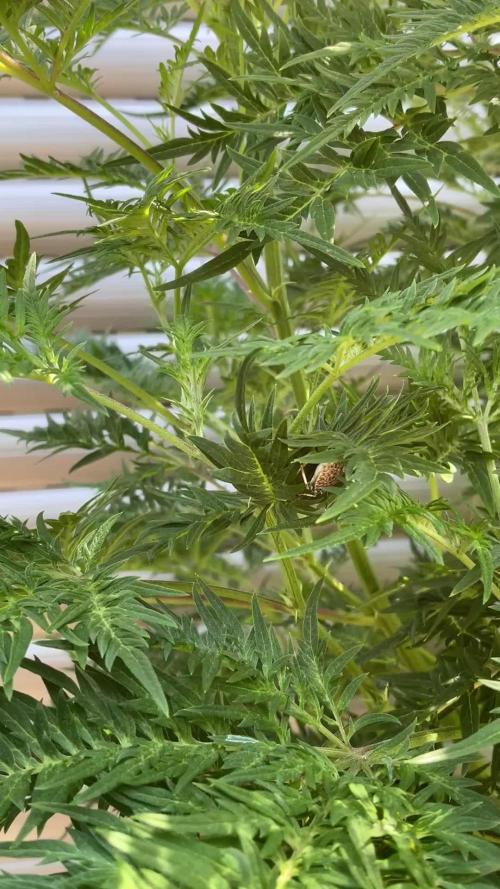
🌿 Woche 19 – Mentha de Croco 🇩🇪
Die 2-Meter-Marke ist jetzt bei beiden Pflanzen geknackt! 🚀🌱 Die linke Mentha de Croco hat inzwischen ebenfalls die 2 m erreicht, während die rechte mit unglaublichen 2,15 m weiter vorlegt 📏🔥. Für zwei Pflanzen in gerade einmal 30 Litern Sonnenerde Hanferde ist das mittlerweile wirklich beeindruckend.
Diese Woche zeigen sich im unteren Bereich allerdings erstmals einige gelbe Blätter 🍂. Ich vermute, dass die Nährstoffvorräte im begrenzten Topfvolumen langsam an ihre Grenzen kommen und sich ein leichter Stickstoffmangel bemerkbar macht. Bei dieser enormen Pflanzenmasse ist das nach so vielen Wochen Wachstum auch nicht völlig überraschend.
Um die Pflanzen für die kommende Blüte ausreichend zu versorgen, habe ich gestern zum ersten Mal einen Almicanna Flower Komposttee angesetzt 🍵. Dieser wird insgesamt 48 Stunden gebraut. Zusätzlich gibt es heute einen Almicanna Blüte-Topdress und malted Barley, damit den Pflanzen während der kommenden Blüte nicht zu früh die Puste ausgeht 🌸🌿.
Die zusätzlichen Nährstoffe sollen langsam über die nächste Zeit freigesetzt werden und damit genau dann zur Verfügung stehen, wenn der Bedarf durch die riesige Pflanzenmasse weiter steigt. 💪🌱
Aktuell ist allerdings noch überhaupt kein richtiger Beginn der Blüte zu erkennen. Die Pflanzen wachsen weiterhin hauptsächlich vegetativ und bauen weiter an ihrer beeindruckenden Größe. Ich bin sehr gespannt, wann diese beiden Wolkenkratzer endlich in den Blütemodus wechseln. 🏙️🌸🚀
🌿 Week 19 – Mentha de Croco 🇬🇧
The 2-meter mark has now been broken by both plants! 🚀🌱 The left Mentha de Croco has finally reached 2 m, while the right plant has pushed even further and now stands at an incredible 2.15 m 📏🔥. Considering they are growing in just 30 liters of Sonnenerde cannabis soil, this is seriously impressive.
This week, however, I noticed a few yellowing leaves in the lower sections 🍂. I suspect the limited nutrient reserves in the relatively small pots are finally starting to show, resulting in a mild nitrogen deficiency. With this enormous amount of plant biomass after so many weeks of growth, it isn’t entirely surprising.
To make sure the plants have enough nutrition for the upcoming flowering phase, I started my first Almicanna Flower Compost Tea yesterday 🍵. It will be brewed for 48 hours. I’m also giving them an Almicanna flowering top dress and malted Barley today, so the plants hopefully won’t run out of nutrients too early during flowering 🌸🌿.
The additional nutrients should be released gradually over the coming weeks, providing a steady supply as the plants’ enormous biomass continues to demand more and more nutrition. 💪🌱
For now, however, there are still no real signs of flowering. Both plants are continuing to focus mainly on vegetative growth and are still getting bigger. I’m very curious to see when these two skyscrapers finally switch into full flowering mode. 🏙️🌸🚀

Likes
6
Share


@mikheil007
Follow
In my opinion it's last week for Girl Scout Cookies Auto and for Power Plant Auto tilll harvest, how do you think?? Vanilla Latte Auto is on it's 3rd week of flowering period and is very strong and beautifull plant


Processing
Likes
6
Share


@w00tGrow
Follow
I put the plant under the SCROG and did little bit of defolation, plat looks happy and healthy.

Likes
Comments
Share


@Gardens_of_Of
Follow
She is in the cruise mode. Growing beautiful but small frosty flowers.

Likes
22
Share


Likes
6
Share


@Lovemabud
Follow
Really good week but the plant is still stretching. It really needs to stop otherwise I expect problems. Really loving the extra feeds made possible by the automatic watering, which will really be tested this week as I'm away for work. If anything goes wrong nothing can be done to rectify until Saturday.
Fingers crossed it's smooth sailing anyhow.
Bud sites a plenty anyhow, just hoping they continue to grow and finish off fat and juicy.
Processing
Likes
10
Share


@mkrmkr
Follow
Completing the fiveteenth week.
Plant 1 - Completing the fiveteenth week of life.
Plant 2 - Completing the fourteenth week of life.
Plant 3 - Completing the fourteenth week of life.
KeepGrowing.......!


Likes
20
Share


@BiotabsF69
Follow
This lady tends to stay small, but the she has quite a explosive veg time. She will not grow tall but she will produce many side branches that will continue side branches. There for the plants can be very leafy, and will produce unnecessary shadow that will block the canopy. Due to blocking of the canopy after the 5 first CM high chance useless pop corn bud will develop.
So with this strain it is very important to train her wel and make sure the light can penetrate the lower branches aswel, if you want to have enjoyable sweet dense buds all of the plant and branches.
Have a good grow!
Likes
93
Share


@MrJones
Follow
Mr-Jones Shockwave F2
🔹🔹🔹🔹🔹🔹WEEKLY GOALS🔹🔹🔹🔹🔹🔹
🌞Environment - 75/80℉ and 45/50% Humidity
💧 Feeding - Using "Super Coco" amended soil. compost teas, Dechlorinated H20 PH/6.5 Fish Fertilizer, Started feeding the plants because they are only in 1-gallon pots.
🍃Training / towards the end of the week will be Schwazzing the plants, along with cleaning out the bottoms,.
🕷️ IPM - Will be using Green Cleaner" 1 OZ per Gallon, and CannControl from Mammoth alternating between product each month for Integrated Pest Management.
💡Mars Hydro FC 4800 / 480W Led Grow Light - "Instagram: MarsHydro_Aliexpress"💡
🔹🔹🔹🔹🔹🔹🔹🔹🔹🔹🔹🔹🔹🔹🔹🔹🔹🔹
📜- Rambling - These buds are just an odd shape, they look good, but just odd, they are smelling great and swelling up nicely! Looking like I will need to defoliate again later in the week.
🔹🔹🔹🔹🔹🔹🔹🔹🔹🔹🔹🔹🔹🔹🔹🔹🔹🔹
▶️Sunday 12.13.20 / The are like clockwork, 1 quart of the feeding regiment daily
▶️Monday 12.14.20 / Fed with BipBiz Regiment
▶️Tuesday 12.15.20 / Fed with BipBiz Regiment, uploaded a few pictures, these girls are really growing well, and starting to get frosty!
▶️Wednesday 12.16.20 / Fed with BipBiz Regiment
▶️Thursday 12.17.20 / So I did the final round of Schwazzing, basically, heavy defoliation, fed the plants today with Recharge, they should do great, the light penetration and airflow are awesome!
▶️Friday 12.18.20 / Fed with Recharge / looking good and recovery appears to be favorable.
▶️Saturday 12.19.20 / Fed with BioBiz Regiment, the recovery from the final defoliation looks great the girls are looking great, the buds are just stacking heavy!
🔹🔹🔹🔹🔹🔹🔹🔹🔹🔹🔹🔹🔹🔹🔹🔹🔹🔹

Likes
2
Share

@Gardens_of_Of
Follow
She completed the first week of flowering happily and she keeps stretching. Trailers net added to level the canopies.


Likes
5
Share


@GarciasGarden
Follow
End of week 5 took out that big ugly plant that took up a shit ton of room .. wasn’t expecting such a big yield decrease but hey shit happens. The single Nanaz I have left though is killing it super big beautiful buds! I have 2 Snowcandy’s that look amazing and got the white truffle lineage buds are golf balls and smell like straight peanut butter! The trichomes from them make your hands literally stick together .
The other 2 snowcandys are the runts of the litter and are throwing like no weight out but still good quality at least !

Likes
12
Share


@Eauderay
Follow
Hello fellow cannabis Gardeners,
El Patron is becoming an absolute pleasure to grow and look developing her flowers...
Interesting sativa with calixes like Indica I believe?
It seems this one will make a better harvest than the last one I have grown, her stem is bigger and flowering sites peppered overall the stems, let's see if she needs supporting.... Fingers crossed I do not messed it up again! 😬🙃😁
Likes
293
Share


@Ju_Bps
Follow
Hello growmies 👩🌾👨🌾🌲🌲,
👋 Girls keep growing on this last veg week.
💪 Continuing Defoliation, lst, preparing scrog and daily fighting with this big leaves 😅
🕑 I've removed 3x 2h 💡 during the week, now 12/12.
💧 Give water each 2/3 day
And vaporise plant with water + Plagron Roots (1ml/l)
1.5 l Water + Roots + Grow + Zym + Sugar Royal (1 + 4 + 1 + 1 ml/l)
PH @6
💡Mars Hydro - FC 3000
43% 43 cm
Mars Hydro Fan kit
Setting 4
Have a good week and see you next week 👋
Thanks community for follow, likes, comments, always a pleasure 👩🌾👨🌾❤️🌲
Mars Hydro - Smart FC3000 300W Samsung LM301B LED Grow Light💡💡
https://www.mars-hydro.com/fc-3000-samsung-lm301b-led-grow-light
Mars Hydro - 6 Inch Inline Fan And Carbon Filter Combo With Thermostat Controller 💨💨
https://www.mars-hydro.com/6-inch-inline-duct-fan-and-carbon-filter-combo-with-thermostat-controller
Fast Buds - Gorilla Cookies FF🌲🌲
https://2fast4buds.com/us/seeds/gorilla-cookies-fast-flowering


Likes
25
Share


@Kakui
Follow
Veg22, riego con 3.0 EC y pH 5.9, drenaje promedio de 5.8 pH y 2.6 EC(muy bien), primer riego con Sensizym para limpiar un poco las raíces, y este será el último riego de vegetación con Voodoo Juice, Tarantula y Piranha.
Se hizo una pequeña defoliación de las hojas abanico más bajas y se volvió a ajustar el LST, ya van tomando la forma final.
Veg23, creciendo bien.
Veg24, se mide la temperatura de las hojas 22°C y se compara con la temperatura del indoor 23°C, con una humedad de 50% RH, la calculadora arroja un valor de VPD=1.24 kpa, lo que está dentro del rango óptimo.
Veg25, hoy toca una pequeña defoliación y probaré también hacer un último apical en 2 o 3 plantas a modo de prueba.
Al final, tomé un gran riesgo, y hice varios apicales extra y una defoliación más grande de lo que tenía en mente, tengo fe que resultará bien 😎👌
Veg27, riego con 0.8 EC y pH 6.0, drenaje de 6.0 pH y EC 2.0, se están alimentando y creciendo bien, quedan casi 2 semanas para pasar el fotoperiodo a 12/12, espero que crezcan suficiente para esa fecha.
Veg28, un par de hojas de 2 plantas presentan mordidas tipo oruga, revise y no encontré nada, aplique spray insecticida, espero no siga pasando. A parte de eso siguen creciendo bien, quedan un poco más de 10 días para el paso a 12/12.

Likes
40
Share


@valiotoro
Follow
easy trim✂️
The buds are Absolutely perfect,exactly what i was looking for🤩
Green pheno : cookie,diesel & gelato🍪⛽️🍦
Purple pheno : flower,sweet & honey🌸🍯
After 7 days on the dry rack she was ready for the jar to start the curing process.😋


Likes
4
Share

