


Likes
Comments
Share

@Lf1190
Follow
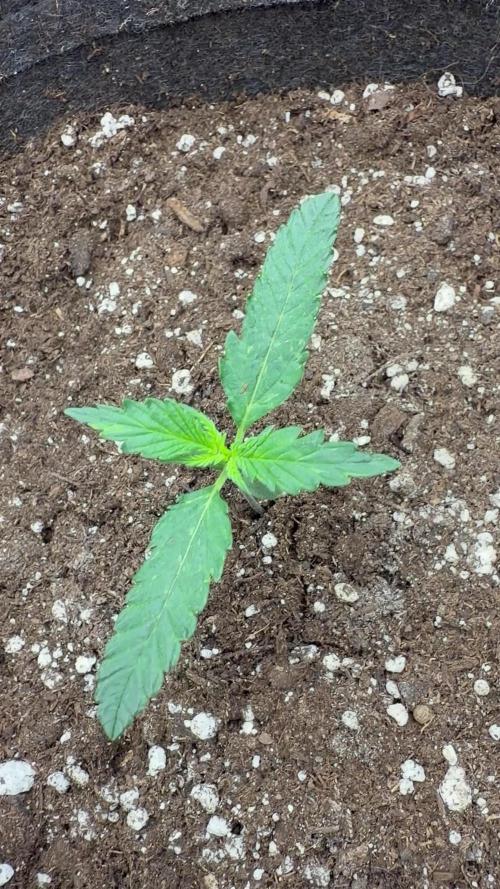
Day 7: I removed the small Royal Jack Auto, since it hadn't shown any growth in the past 48 hours, and I'm germinating a new seed for the tent today. The remaining plants look robust and are growing fast. For now they're getting plain water only, and I'll water again mid-week. Next week I'll add a little nitrogen, some micronutrients and a drop of Supervit.
The light is 35 cm above the canopy. It's a dimmable Mars Hydro, currently set at around 30–35%, so every plant gets roughly the same amount of light. Below is a conversion Gemini gave me.
Lighting data (Day 7)
- Lamp: Mars Hydro TS2000
- Height: 35 cm above the plant tops
- Dimmer: 30–35%
- Foot-candles: 940–1,100 FC
- Lux: 10,114–11,836 lux
- PPFD: 151–176 μmol/m²/s
I'll wait until every plant has its third set of leaves before raising the power to around 40–45%.
My usual light schedule for autoflowers:
- Days 9–14 (early veg, third leaf set): 40% dimmer, about 200–250 PPFD
- Days 15–21 (mid veg, multiple nodes): 50–60% dimmer, about 350–450 PPFD
- Days 22–28 (late veg, pre-flower): 70–80% dimmer, about 550–650 PPFD
- Flowering (week 5 onward): 100%, about 700–900+ PPFD
Day 8: Thick, short stems with no stretching, and the second set of true leaves is fully formed.
Day 9: 150 ml of water each, poured in a ring 6–7 cm from the stem.
Day 10: The third and fourth sets of leaves are coming in strong. The structure is very compact and the leaves are a healthy, firm green. I gave each plant a single drop of Supervit. I plan to raise the dimmer to about 40% in the next day or two, depending on how the Royal Jack develops. I'll also raise the lamp a little, because the plants are getting taller and I don't want the new seedling to struggle right under it.
Day 11: The replacement Royal Jack seed germinated today. The two Atlas are compact, with short internodes and no stretching. The Royal Jack is a little smaller, with narrower, slightly darker leaves, but it looks healthy.
Day 12: I raised the lamp a few centimetres and set the dimmer to 40%. The replacement Royal Jack went into its 11 L pot, watered around the plug with Easy Root bacteria, under a cut-bottle dome to keep the humidity up. The larger plants are starting to push side branches.
Day 13: No stress from the jump to 40%. The Atlas leaves are wide and well spread, with new side shoots at the nodes. The Royal Jack has put out a new set of leaves and is growing day by day, just more slowly than the Atlas. The replacement's cotyledons are open and healthy.
Day 14: Today the three larger plants (2x Atlas F1 Auto, 1x Royal Jack Auto) got their first feed, RQS Easy Grow plus Easy Plus, at 30% of the recommended dose. The Easy Grow tablet is 3 g for 10 L of water, so I used 0.06 g in 0.7 L: about 260 ml for each Atlas and 160 ml for the Royal Jack, poured around the edge of the canopy rather than at the stem. I'm starting low on purpose: you can always add more nutrients later, but you can't take them out. There's also already 50 g of Easy Boost mixed into the soil. With autoflowers I always use bottled water during veg. The water I drink has a perfect pH of 6.3, but it's low in calcium and magnesium, which is why I've already added some Easy Plus.
The last plain watering was on day 9 (150 ml each). All three look healthy and compact, with no stretching. The replacement Royal Jack stays under its dome until its first true leaves appear. The light is at 40%, about 40 cm above the plants. Next step is 50% for days 15–21.


Likes
53
Share


@Mz876
Follow
Week 6 of flower about another 2 to 3 weeks to go . Buds are forming Nicely but I’ve been a little heavy on the nutrients so I’m trying to remedy that .

Likes
14
Share


@Chimken
Follow
This time I am growing Sativa strain that is Mexican Airlines from FastBuds and some cool hybrid Wedding Cheesecake from the same breeder.
I started with 7 seeds.
Mexican Airlines: 4 out of 5 germinated successfully.
Wedding Cheesecake: 2 out of 2 germinated successfully.
Currently I have 6 sprouts. Will keep 3 strongest of the first week of vegetation stage.

Likes
4
Share


@CheeRz
Follow
Week 7 and both ladies are fully covered with trichomes and still very vital. If Gelato #2 continues to develop so well, I guess another 2.5 weeks to go.

Likes
14
Share


@CanadianFillmore
Follow
Week 2 begins, not much to report other than the pro-mix HP hasn't dried out enough to warrant another feeding.

Likes
27
Share


@Major
Follow
in this past week I have defoliated the plants about 40% I have lost some leaves which have turned yellow I think the plants lack nitrogen due to the stretch the buds started to smell good. for nitrogen I add coffee grounds to keep away the pests and it is rich in nitrogen. the hardest part is fighting the humidity it’s been raining for a week 😭 humidity is the worst enemy I much prefer heat. see you soon
Processing
Likes
16
Share


@Ganjagrandaddy
Follow
TRANSITION DAY 10: This lady is my latest favourite. She is progressing amazingly under the new lights and has now started to flower properly. she has been putting her first bract pistils out since day 5 of flip. This is the fastest i have seen this occur with my grows. She has fought back from the stripping ,prior to flip, and her regrowth is virile and very strong looking. I think she will be in my top 10 of strains to grow. Her response to the quadline style has been excellent and i dont think it has slowed her down at all. She is stretching well and will hopefully be setting herself up for long thick colas. I need to strip out all the lower small bits of growth and maybe a few hopeful mains. her size has limited her possibilities with the space i have i think. I am going to be spacing my girls out a little more and trusting the lights will still give me adequate coverage to the canopies edge. We will see. lol All in all i am enjoying working with this strain so far and imagine a future grow to include a few more. Thanks for looking in ( if you are please kick that tumbleweed out of the way , room looks deserted with those knocking round !!)
Have a green day
Likes
18
Share


@Ultraviolet
Follow
Green light is radiation with wavelengths between 520 and 560 nm and it affects photosynthesis, plant height, and flowering. Plants reflect green light and this is why they appear green to our eyes. As a result, some growers think that plants don’t use green wavelengths, but they actually do!
In fact, only around 5 – 10% of green light is reflected from leaves and the rest (90 – 95 %) is absorbed or transmitted to lower leaves [1].
Green wavelengths get used in photosynthesis. Chlorophyll pigments absorb small amounts of green wavelengths. Light that doesn’t get absorbed is transmitted to leaves that are shaded out from direct light. This means that leaves at the bottom of the canopy get more green light than leaves at the top. A high proportion of green wavelengths compared to other colors tells lower leaves that they are being shaded out, so they are able to react accordingly. Lower leaves may react by opening or closing their stomata or growing longer stems that help the leaves reach brighter light [1, 2, 3].
When it comes to growing cannabis, many cultivators are interested in the quality of light used for the flowering stage. In many plants, flowering is regulated by two main photoreceptors: cryptochrome and phytochrome. Both photoreceptors primarily respond to blue light but can also respond to green, although to a lesser extent. Green can accelerate the start of flowering in several species (although cannabis has yet to be tested) [1, 4, 5]. However, once flowering has begun, it’s important to provide plants with a “full spectrum” light that has high amounts of blue and red light, and moderate amounts of green, in order for photosynthesis to be optimized.
Green light mediates seed germination in some species. Seeds use green wavelengths to decide whether the environment is good for germination. Shade environments are enriched in green relative to red and blue light, so a plant can tell if it is shady or sunny. A seed that senses a shaded environment may stay dormant to avoid poor growing conditions [1]. Some examples of plant species where researchers have documented this response are: ryegrass (a grass that grows in tufts) and Chondrilla (a plant related to dandelion) [1, 6].
Although green wavelengths generally tell plants NOT to germinate, there are some exceptions! Surprisingly, green wavelengths can stimulate seed germination in some species like Aeschynomene, Tephrosia, Solidago, Cyrtopodium, and Atriplex [1, 6, 7].
Of course, light is not the only factor affecting seed germination – it’s a combination of many factors, such as soil moisture, soil type, temperature, photoperiod, and light quality.
When combined with red and blue light, green can really enhance plant growth [1, 8]. However, too much green light (more than 50% of the total light) can actually reduce plant growth [8]. Based on the most current research, the ideal ratio of green, red, and blue light is thought to be around 1:2:1 for green:blue:red [9]. When choosing a horticultural light, choose one that has high amounts of blue and red light and moderate amounts of green and other colors of light.
Not many studies can be found about the effect of green light on cannabis growth or metabolism. However, if one reads carefully, there are clues and data available even from the very early papers.
Mahlberg and Hemphill (1983) used colored filters in their study to alter the sunlight spectrum and study green light among others. They concluded that the green filter, which makes the environment green by cutting other wavelengths out, reduced the THC concentration significantly compared to the daylight control treatment. It has been demonstrated that green color can reduce secondary metabolite activity with other species as well. For example, the addition of green to a light spectrum decreases anthocyanin concentration in lettuce (Zhang and Folta 2012).
If green light only reverses the biosynthesis of some secondary metabolites, then why put green light into a growth spectrum at all? Well, there are a couple of good reasons. One is that green penetrates leaf layers effectively. Conversely red and blue light is almost completely absorbed by the first leaf layer.
Green travels through the first, second, and even third layers effectively (Figure 2). Lower leaf layers can utilize green light in photosynthesis and therefore produce yields as well.
Even though a green light-specific photoreceptor has not yet been found, it is known that green light has effects independent from the cryptochrome but then again, also cryptochrome-dependent ones, just like blue light. It is known that green light in low light intensity conditions can enhance far red stimulating secondary metabolite production in microgreens and then again, counteracts the production of these compounds in high-intensity light conditions (Kim et al. 2004). In many cases, green light promoted physiological changes in plants that are opposite to the actions of blue light. In the study by Kim et al. blue light-induced anthocyanin accumulation was inhibited by green light. In another study it has been found that blue light promotes stomatal opening whereas green light promotes stomatal closure (Frechilla et al. 2000). Blue light inhibits the early stem elongation in the seedling stage whereas green light promotes it (Folta 2004). Also, blue light results in flowering induction, and green light inhibits it (Banerjee et al., 2007). As you can see, green light works very closely with blue light, and therefore not only the amount of these two wavelengths separately is important but also the ratio (Blue: Green) between these two in the designed spectrum. Furthermore, green light has been found to affect the elongation of petioles and upward leaf reorientation with the model plant Arabidopsis thaliana both of which are a sign of shade avoidance symptoms (Zhang et al. 2011) and also gene expression in the same plant (Dhingra et al. 2006).
As mentioned before, green light produces shade avoidance symptoms which are quite intuitive if you consider the natural conditions where the plants grow. Not all the green light is reflected from the highest canopy leaves in nature but a lot of it (50-90%) has been estimated to penetrate the upper leaves at the plant level ((Terashima et al., 2009; Nishio, 2000). For the plant growing in the understory of the forest green light is a signal for the plant of being in the shade of a bigger plant. Then again, the plants growing under unobstructed sunlight can take advantage of the green photons that can more easily penetrate the upper leaves than the red and blue photons. From the photosynthetic pigments in higher plants, chlorophyll is crucial for plant growth. Dissolved chlorophyll and absorb maximally in the red (λ600–700 nm) and blue (λ400–500 nm) regions of the spectrum and not as easily in the green (λ500–600 nm) regions. Up to 80% of all green light is thought to be transmitted through the chloroplast (Terashima et al., 2009) and this allows more green photons to pass deeper into the leaf mesophyll layer than red and blue photons. When the green light is scattered in the vertical leaf profile its journey is lengthened and therefore photons have a higher chance of hitting and being absorbed by chloroplasts on their passage through the leaf to the lower leaves of the plant.
Photons of PPFD (photosynthetic photon flux density) are captured by chlorophyll causing an excitation of an electron to enter a higher energy state in which the energy is immediately passed on to the neighboring chlorophyll molecule by resonance transfer or released to the electron transport chain (PSII and PSI). Despite the low extinction coefficient of chlorophyll in the green 500–600 nm region it needs to be noted that the absorbance can be significant if the pigment (chlorophyll) concentration in the leaf is high enough.
The research available clearly shows that plants use green wavelengths to promote higher biomass and yield (photosynthetic activity), and that it is a crucial signal for long-term developmental and short-term dynamic acclimation (Blue:Green ratio) to the environment. It should not be dismissed but studied more because it brings more opportunities to control plant gene expression and physiology in plant production.
REFERENCES
Banerjee R., Schleicher E., Meier S. Viana R. M., Pokorny R., Ahmad M., Bittl R., Batschauer. 2007. The signaling state of Arabidopsis cryptochrome 2 contains flavin semiquinone. The Journal of Biological Chemistry 282, 14916–14922.
Dhingra, A., Bies, D. H., Lehner, K. R., and Folta, K. M. 2006. Green light adjusts the plastic transcriptome during early photomorphogenic development. Plant Physiol. 142, 1256-1266.
Folta, K. M. 2004. Green light stimulates early stem elongation, antagonizing light-mediated growth inhibition. Plant Physiol. 135, 1407-1416.
Frechilla, S., Talbott, L. D., Bogomolmi, R. A., and Zeiger, E. 2000. Reversal of blue light -stimulated stomatal opening by green light. Plant Cell Physiol. 41, 171-176.
Kim, H.H., Goins, G. D., Wheeler, R. M., and Sager, J. C. 2004.Green-light supplementation for enhanced lettuce growth under red- and blue-light emitting diodes. HortScience 39, 1617-1622.
Nishio, J.N. 2000. Why are higher plants green? Evolution of the higher plant photosynthetic pigment complement. Plant Cell and Environment 23, 539–548.
Terashima I., Fujita T., Inoue T., Chow W.S., Oguchi R. 2009. Green light drives leaf photosynthesis more efficiently than red light in strong white light: revisiting the enigmatic question of why leaves are green. Plant & Cell Physiology 50, 684–697.
Zhang, T., Maruhnich, S. A., and Folta, K. M. 2011. Green light induces shade avoidance symptoms. Plant Physiol. 157, 1528-156.
Wang, Y. & Folta, K. M. Contributions of green light to plant growth and development. Am. J. Bot. 100, 70–78 (2013).
Zhang, T. & Folta, K. M. Green light signaling and adaptive response. Plant Signal. Behav. 7, 75–78 (2012).
Johkan, M. et al. Blue light-emitting diode light irradiation of seedlings improves seedling quality and growth after transplanting in red leaf lettuce. HortScience 45, 1809–1814 (2010).
Kasajima, S., et al. Effect of Light Quality on Developmental Rate of Wheat under Continuous Light at a Constant Temperature. Plant Prod. Sci. 10, 286–291 (2007).
Banerjee, R. et al. The signaling state of Arabidopsis cryptochrome 2 contains flavin semiquinone. J. Biol. Chem. 282, 14916–14922 (2007).
Goggin, D. E. & Steadman, K. J. Blue and green are frequently seen: responses of seeds to short- and mid-wavelength light. Seed Sci. Res. 22, 27–35 (2012).
Mandák, B. & Pyšek, P. The effects of light quality, nitrate concentration and presence of bracteoles on germination of different fruit types in the heterocarpous Atriplex sagittata. J. Ecol. 89, 149–158 (2001).
Darko, E. et al. Photosynthesis under artificial light: the shift in primary and secondary metabolism. Philos. Trans. R. Soc. B Biol. Sci. 369 (2014).
Lu, N. et al. Effects of Supplemental Lighting with Light-Emitting Diodes (LEDs) on Tomato Yield and Quality of Single-Truss Tomato Plants Grown at High Planting Density. Environ. Control Biol. 50, 63–74 (2012).

Likes
9
Share


@MuzzFuzz
Follow
Ticking along ok the white widows are starting to thicken up I think another 2 weeks and they will be ready to go. GSC #1 is looking like it’s getting close just by looking at the pistils but I haven’t looked at the trichomes yet. The GSC#2 and #3 are just starting to fatten up and still producing a lot of pistils so I think they will be another 3 weeks.


Likes
8
Share

@GREENPHOENIX6262
Follow
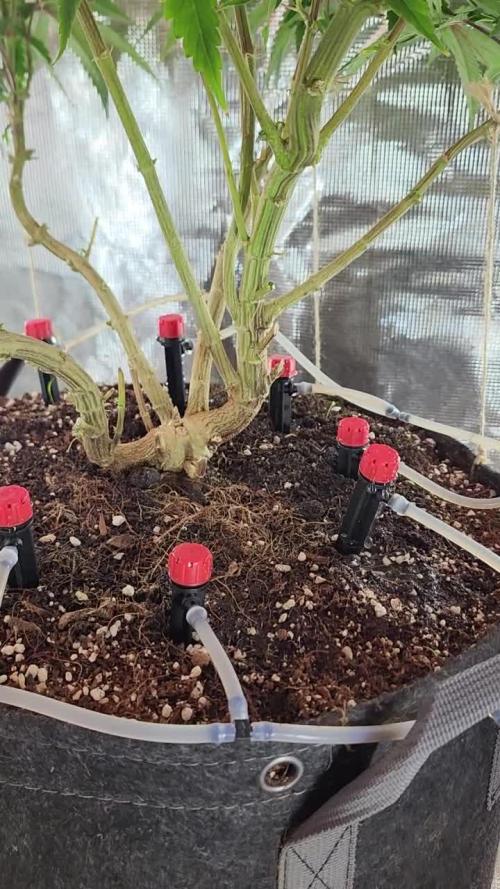
02/23 (M) (Pre-Flower) flipped mother into flower last week - flushed with clean water for 2 days then began giving flower nutes in small doses for now - still feeding off the drip lines seems to be working as planned. Feeds will become more often (once/twice a day - 1 min feeds.
02/23 (C) - 7 of the 15 clones have rooted successfully with thick multi strands in each clone - Green color starting to come back as well - Have begun applying nute feeds to help recovery - Will give the other 8 sometime to begin rooting but if nothing happens in the next week then I will keep the 7 rooting now and cull the other 8.

Likes
28
Share


@GrowInger420
Follow
I decided send her to flower, shes big and healthy enough it seems. Lets see whats going on in next few weeks. Have a nice weekend✌️

Likes
3
Share

@OG_Big_Worm
Follow
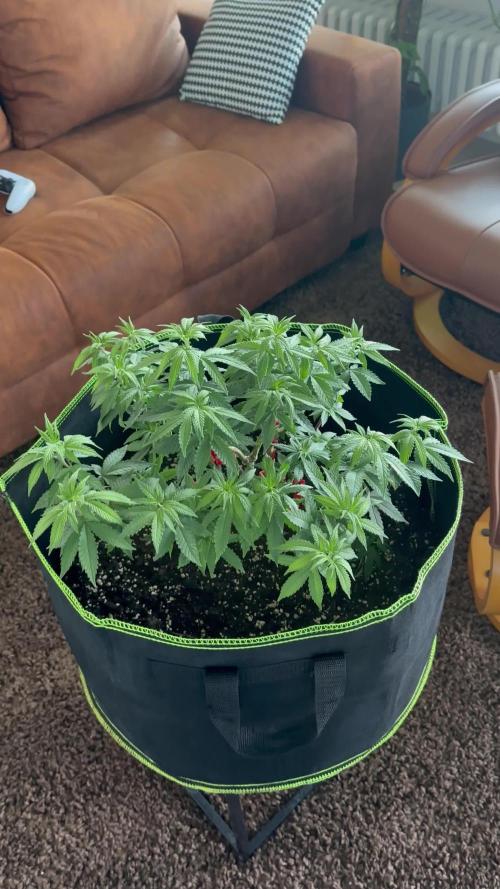
This week was a heavy training week. Yesterday I topped around 20–25 active tips and combined it with strong LST/HST to spread the canopy into the SCROG net. A few branches audibly cracked during bending but remained connected. The video shows her current condition after yesterday’s topping and HST bending. Right after training she looked stressed and droopy, while she is now standing up again and pushing healthy new growth. I’ll give her time to recover before any further work and wait for roughly 2–3 new nodes on the fresh shoots before deciding when to flip.

Likes
15
Share


@Chupus
Follow
I use these fertilizers not for the first time, the whole grove was successful, without any problems. the tree did not hurt, and there was no shortage of fertilizers. organic fertilizers are very good for the earth

Processing
Likes
7
Share


@DrewbieDoobieNoobie
Follow
Week 5 of flower cotton balls are forming Starting the heavy flower feeding and using the rain rings on the pots see video, so far so good just waiting for these ladies to bulk up I have one light that is getting replaced on the next grow as is has some leds not lighting up so its running at 70% and the plant in the lower left corner is showing it its way smaller than the other 5,,, oh well, till next time be safe.


Likes
9
Share


@JamaweedOPO
Follow
Semana 8 acho que a planta teve. Um leve ouverfert e com isso caiu o Ph segurei um pouco na nutrição e aumentei o Ph da Rega
Likes
22
Share


@Chucky324
Follow
Hello. This is the end of week 5 and the beginning of week 6 of flowering.
Things are going good in here. The resin production has really kicked in now.
Smells just wonderful in here. Like a sweet orange flavored chalky candy. Delicious.
Big snow fall last night. Big for here on the west coast of Canada. 30 to 40 cm fell here and I was worried about my little humming birds. It's been -4*c here the last 2 nights. The weather says -8*c tonight with wind. I don't know how they do it, they are just so small to sit on a branch and make it through the freezing night. Such amazing little birds.
It took me 2.5 hours to dig out this morning.
Have fun. Chuck.

Likes
6
Share


@technics702
Follow
The grow itself was really easy, apart from keeping the height in check on a relatively long indoor veg. These did love a lot of nutrients, though I couldn't push them as hard as I would've liked to, even without CO2. There were times of 4.5-7EC in the substrate during vegetative phases of the grow, and they took it with a bit of tip burn, but nothing too serious. During generative phases I was really able to push them, though not as hard as the Florida Pie I grew prior from Jungle Boys.

Likes
12
Share


@Lysidious
Follow
Was bummed out plant got red mites at the end but that’s fine, it didn’t not impact the grow (or at least I didn’t notice.)
Harvested at the end of the 6th week of flower. Trichomes had already started turning amber due to heat degradation (couch lock party) what trichomes that were not dust ridden or amber was milky so I’d say it’s ready.
Choosing the best time to harvest is still puzzling for me due to the fact that this is my 4th time harvesting cannabis.
Thanks for reading... more info to come ...TBC
Likes
7
Share


@SouthernUKgrower
Follow
Had loads of buds appear this week. I think the stretch is pretty much done now so it’s all focused on the weight!