The Grow Awards 2026 🏆
Likes
25
Share
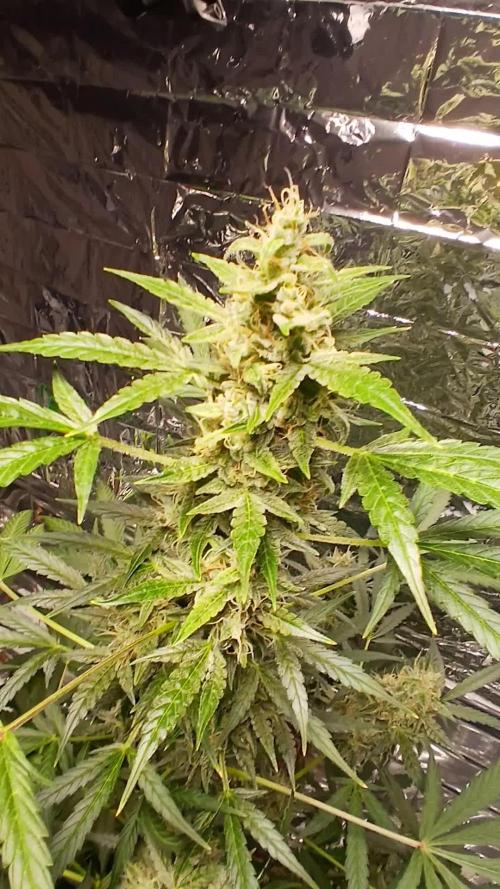
Week 6 Flower Day 45 Fruit Spirits are getting more mature as you can see in the closeups... the trichomes are getting cloudy but I dont see any amber so far. She is definetly the first one who will be cut down, but I will wait a week longer i guess maybe starting flush in 5 days or so. Green Gelato what can i say super frosty big buds awsome smell!!!! I could cut her right now but it would be such a waste. Skittelz is showing more flower and trichomes slowly... lets hope for the best with her 😇
Likes
1
Share
Likes
36
Share
Likes
13
Share
Partially drained the tank at the start of the week and topped up with ro water and 1ml of final solution per Litre. Last 2.5 days were in darkness. I trimmed the majority of fan leaves before hanging up to dry in the tent today. Started out trimming with the plants in the tent and soon realised it would be much easier to just cut them down whole, hang them upside down outside the tent and trim them up a bit. I have a small dehumidifier and a small fan heater setup in the tent and they have been keeping a humidity level of about 60% and a temp of 16 Celsius for the last few days while the lights have been off. I figure that's a good starting point for drying and I can increase the temperature if needed, that will drop the humidity also. Intake fan at the bottom and extract fan at the top are running constantly as they have been since the grow started (low power 4" fans). I might add back in a fan for circulation depending on how the drying goes, or maybe even trim or hang the plants better to get more airflow around the buds
Processing
Likes
10
Share
@Andres
Follow
she grows healthy ... she is in her last weeks outdoor ... the days are cloudy most of the day ... with the substrate top crop mix .. she feeds every 10 days
Likes
57
Share
Two girls one cup week 5?? I cant count ATM.. if you're just tuning in, check previous week's for daily progression. Day 28- off to an explosive start for the week. Eating and drinking more than ever. Topping off RES daily between 30-40 fl oz with calmag'd water. Changed RES yesterday to 3/4 strength week 4 GHE light. Breakdown as follows. 2gal water/calmag - 200ppm Micro - 9mL Grow - 8.4mL Bloom - 6.3mL RES total after ph corrections - 720 @ 5.68. Light up 30in - 20 DLI Already had to top off with 26oz calmag'd water this morning and I just changed RES last night. TDS dropped from 720 to 661 within 12hrs, as well as the water level. Ph drift up to 6.18 as usual. I really think every other day RES changes may help keep these girls npk right where it needs to be with how much they're eating. As long as I don't stress em too much more that is. Last week was rough on the girls for sure. Gave em a .5mL shot of Micro tonight to boost nitrogen levels a bit due to the coloration on lower fan leaves and some uppers. May supplement more N into next RES change right off the bat Will add to the timelapse daily as long as i dont f up the footage like i have done many times already. Day 29- still looking a little hungry and how fast tds is dropping it def shows in more than one place. Bump up RES to full strength week 4 GHE light. Breakdown as follows. Water - 2gal Micro - 12mL Grow - 11.2mL Bloom - 8.4mL Total after ph corrections: 5.68/980 They're def bushing up. The stretch is coming and GC already shows signs of it starting. Wish they'd bush up more before, but i gotta roll with the flow. Definitely branching out down all over and are showing signs of explosive growth yet again. Thinking about turning on the green night light again to show night time movement with the day. Thoughts?? Day 30- these girls are some PIGS! I JUST changed RES yesterday, and they've already eaten 1/3rd of its concentration. From 980 down to 601 in 24hrs! More if you think about my RES top offs every 12hrs (with 200ppm calmag'd water) adding back something versus just diluting further. I know I said I wouldn't stress the girls anymore, BUT... I supercropped the stretching tops on both, and gave em a mild defoliation. Hated to see more big leaves go.. but they're blocking light to everything I want to bush out NOT stretch up. The stretch is coming, but we still have time to train so may as well. *edit* went a lil nuts supercropping.. WG is taking it like a champ. GC I was a little rough with and crushed the 3 up top a lil too much. They're turned up towards the TSW2000, so they're not dead. RES change tonight with TDS drop as fast as it did. So there will be two updates today. woohoo! Day 31- both made a speedy recovery from the second round of abuse. will be doing another RES change tonight. same week 4 GHE light, i may bump up the formula some since the TDS dropped 360+ ppm in 24 hrs the other day. just dont want to overdue it since i just got done stressing them TF out AGAIN and they wont be eating as much while repairing (i think)... i will update later after RES change if i decide on running anything other than whats mentioned above. *TDS broke a thousand tonight.. lets see if we can keep em from dropping too much in the next 12hrs. Not fully repaired, but S.C. locations all over are already growing like nothing even happened. Wedding Glue's branches and main are thick asf! Wait till harvest and I bet they'll double or more. Will have to cut bigger openings in the silicon mat to keep from choking them off. **update** AM RES check, TDS dropped from 1077 to 679 in 12hrs! And I've read all over not to take autos over 6-700ppm... seems I feed em more, they eat ALLOT more. WTF??! Day 32- got out a net to see if it actually fits the tent, and to see how I felt about using it. So far, it fits but I'm not feeling it. So it came back out. Another round of defoliation tonight, and standard top off ph correct RES. am going to start every other day RES changes now to keep em happy. Day 33- plants drinking roughly 42fl Oz every 12hr. Defol AGAIN... got rid of some of the smaller stuff down low so all the plants energy can be focused to somewhere that matters. bumped up the TDS around noon today a bit and moving towards bloom nutes. Giving them a little more calmag to help with repairs from supercropping and all the defol 3 days in a row. Breakdown as follows. Water/calmag/h²o² - 2 gal (300ppm) Micro - 10.6mL Grow - 9.2mL Bloom - 12mL RES total after ph correction - 1174ppm Just did my every 12hr RES check and TDS has dropped from 1174 to 881. I measure before topping off with calmag'd water too. Helps in my data crunching and calculations. At this rate, they'll be down below 600 by morning. Wasn't planning on daily RES changes until they were much further along. Really want to see how big the root structure is in the RES, but don't want to rip roots wrapped on the ice probe. If I had one of those probe cameras I could poke it in my top off/fill port and take a peek. Day 34- really wish i had a spare down tube installed so i could utilize a top off RES. once this gets too low, it stops top feeding. not a big deal cause theres plenty of bubbles brewing in the RES to dwc it for a few hours. well... theres two bitches in the cup, theyre eating and drinking like pigs already. i am WELL over the "650-700" max ppm for an auto and climbing trying to keep both of them as happy as possible without hurting em. theyre only going to get bigger, thirstier, and hungrier as time passes. i see the 2k mark in the near future for sure. GC showing some purple on the tops of a few bigger petioles on GC and WG showing purple striping on the bottom of some of its branches. after watching vid from today, I DEF need to hit my fans with some tape like a lint roll. and yes, I play them music 🤣. WG is def a strong fucking pheno for sure!! thick branches, tight node spacing when given appropriate lighting. props to FastBuds for sure! changed RES tonight around 6pm to the GHE wk1 bloom MEDIUM feed. breakdown as follows: water - 2gal (300ppm) micro - 12.2mL grow - 10.6mL bloom - 13.6mL RES totals after PH corrections - 1237 ppm, 5.51 PH (letting them get the full sweep today) didn't I say I wasn't going to stress the girls anymore?? damnit! guess I'm a liar.. did a lil schwazzz on the girls tonight. left a few fans for shits and giggles. they're either going to stack up or herm out 🤣.. either way, we're in this together to the end. Thanks for stopping by and checking out my current grow. I apologize for rambling, but information collected will be good references for future auto grows for me.
Likes
12
Share
@WoEsWar
Follow
9/30-10/6 10/4: Today, we are halfway through the third week of flower. Bud sites everywhere. Leaves look great. Environment on point. No issues. The smaller plant has completely caught up and is now the larger plant by a little. The plants are sliiiiiightly different colors. It's not yet possible to tell if it's phenotypic variation or just different N levels in the medium. Curious to see how things turn out. The one other time I grew a Barney's Farm plant was the only other time I've grown two plants at once. They looked extremely different from one another. One looked like the pic on the package, and one didn't at all. One had the advertised terpene profile, one didn't. pH upped to 6.1-6.2 I got really paranoid about the pot bases because people online were complaining that roots grew into the wicks and stopped water flow. So, I pulled off a delicate and difficult operation where I pulled out (one of) the bases and swapped in a clean one. In the second one I replaced the wick lines. Neither seemed to be particularly rooty. I think that's because I didn't use the bases through most of the veg stage when the roots are growing. Anyway, the bases are clean now. One last thing: I put ArmorSi and CalMag in the reservoir of the "smaller" plant. In the other one, I only put ArmorSi. It seems like the branches are pretty flimsy, but it's still early in flower.
Likes
7
Share
Eccoci qui... Tutto va per il meglio, questa settimana ho eseguito Lollipopping e Defoliation per far si che le cime principali sprigionino al meglio il loro vigore. Siamo verso la fine del progetto ora bisogna solo aspettare la fine... Grazie a tutti per il supporto🔥🌲❤️
Likes
53
Share
@Almora
Follow
20.05.24 I flushed as of today 23.05.24 Day 119 Bloom 60 - today is harvest day
Likes
55
Share
What's in the soil? What's not in the soil would be an easier question to answer. 16-18 DLI @ the minute. +++ as she grows. Probably not recommended, but to get to where it needs to be, I need to start now. Vegetative @1400ppm 0.8–1.2 kPa 80–86°F (26.7–30°C) 65–75%, LST Day 10, Fim'd Day 11 CEC (Cation Exchange Capacity): This is a measure of a soil's ability to hold and exchange positively charged nutrients, like calcium, magnesium, and potassium. Soils with high CEC (more clay and organic matter) have more negative charges that attract and hold these essential nutrients, preventing them from leaching away. Biochar is highly efficient at increasing cation exchange capacity (CEC) compared to many other amendments. Biochar's high CEC potential stems from its negatively charged functional groups, and studies show it can increase CEC by over 90%. Amendments like compost also increase CEC but are often more prone to rapid biodegradation, which can make biochar's effect more long-lasting. biochar acts as a long-lasting Cation Exchange Capacity (CEC) enhancer because its porous, carbon-rich structure provides sites for nutrients to bind to, effectively improving nutrient retention in soil without relying on the short-term benefits of fresh organic matter like compost or manure. Biochar's stability means these benefits last much longer than those from traditional organic amendments, making it a sustainable way to improve soil fertility, water retention, and structure over time. Needs to be charged first, similar to Coco, or it will immobilize cations, but at a much higher ratio. a high cation exchange capacity (CEC) results in a high buffer protection, meaning the soil can better resist changes in pH and nutrient availability. This is because a high CEC soil has more negatively charged sites to hold onto essential positively charged nutrients, like calcium and magnesium, and to buffer against acid ions, such as hydrogen. EC (Electrical Conductivity): This measures the amount of soluble salts in the soil. High EC levels indicate a high concentration of dissolved salts and can be a sign of potential salinity issues that can harm plants. The stored cations associated with a medium's cation exchange capacity (CEC) do not directly contribute to a real-time electrical conductivity (EC) reading. A real-time EC measurement reflects only the concentration of free, dissolved salt ions in the water solution within the medium. 98% of a plants nutrients comes directly from the water solution. 2% come directly from soil particles. CEC is a mediums storage capacity for cations. These stored cations do not contribute to a mediums EC directly. Electrical Conductivity (EC) does not measure salt ions adsorbed (stored) onto a Cation Exchange Capacity (CEC) site, as EC measures the conductivity of ions in solution within a soil or water sample, not those held on soil particles. A medium releases stored cations to water by ion exchange, where a new, more desirable ion from the water solution temporarily displaces the stored cation from the medium's surface, a process also seen in plants absorbing nutrients via mass flow. For example, in water softeners, sodium ions are released from resin beads to bond with the medium's surface, displacing calcium and magnesium ions which then enter the water. This same principle applies when plants take up nutrients from the soil solution: the cations are released from the soil particles into the water in response to a concentration equilibrium, and then moved to the root surface via mass flow. An example of ion exchange within the context of Cation Exchange Capacity (CEC) is a soil particle with a negative charge attracting and holding positively charged nutrient ions, like potassium (K+) or calcium (Ca2+), and then exchanging them for other positive ions present in the soil solution. For instance, a negatively charged clay particle in soil can hold a K+ ion and later release it to a plant's roots when a different cation, such as calcium (Ca2+), is abundant and replaces the potassium. This process of holding and swapping positively charged ions is fundamental to soil fertility, as it provides plants with essential nutrients. Negative charges on soil particles: Soil particles, particularly clay and organic matter, have negatively charged surfaces due to their chemical structure. Attraction of cations: These negative charges attract and hold positively charged ions, or cations, such as: Potassium (K+) Calcium (Ca2+) Magnesium (Mg2+) Sodium (Na+) Ammonium (NH4+) Plant roots excrete hydrogen ions (H+) through the action of proton pumps embedded in the root cell membranes, which use ATP (energy) to actively transport H+ ions from inside the root cell into the surrounding soil. This process lowers the pH of the soil, which helps to make certain mineral nutrients, such as iron, more available for uptake by the plant. Mechanism of H+ Excretion Proton Pumps: Root cells contain specialized proteins called proton pumps (H+-ATPases) in their cell membranes. Active Transport: These proton pumps use energy from ATP to actively move H+ ions from the cytoplasm of the root cell into the soil, against their concentration gradient. Role in pH Regulation: This active excretion of H+ is a major way plants regulate their internal cytoplasmic pH. Nutrient Availability: The resulting decrease in soil pH makes certain essential mineral nutrients, like iron, more soluble and available for the root cells to absorb. Ion Exchange: The H+ ions also displace positively charged mineral cations from the soil particles, making them available for uptake. Iron Uptake: In response to iron deficiency stress, plants enhance H+ excretion and reductant release to lower the pH and convert Fe3+ to the more available form Fe2+. The altered pH can influence the activity and composition of beneficial microbes in the soil. The H+ gradient created by the proton pumps can also be used for other vital cell functions, such as ATP synthesis and the transport of other solutes. The hydrogen ions (H+) excreted during photosynthesis come from the splitting of water molecules. This splitting, called photolysis, occurs in Photosystem II to replace the electrons used in the light-dependent reactions. The released hydrogen ions are then pumped into the thylakoid lumen, creating a proton gradient that drives ATP synthesis. Plants release hydrogen ions (H+) from their roots into the soil, a process that occurs in conjunction with nutrient uptake and photosynthesis. These H+ ions compete with mineral cations for the negatively charged sites on soil particles, a phenomenon known as cation exchange. By displacing beneficial mineral cations, the excreted H+ ions make these nutrients available for the plant to absorb, which can also lower the soil pH and indirectly affect its Cation Exchange Capacity (CEC) by altering the pool of exchangeable cations in the soil solution. Plants use proton (H+) exudation, driven by the H+-ATPase enzyme, to release H+ ions into the soil, creating a more acidic rhizosphere, which enhances nutrient availability and influences nutrient cycling processes. This acidification mobilizes insoluble nutrients like iron (Fe) by breaking them down, while also facilitating the activity of beneficial microbes involved in the nutrient cycle. Therefore, H+ exudation is a critical plant strategy for nutrient acquisition and management, allowing plants to improve their access to essential elements from the soil. A lack of water splitting during photosynthesis can affect iron uptake because the resulting energy imbalance disrupts the plant's ability to produce ATP and NADPH, which are crucial for overall photosynthetic energy conversion and can trigger a deficiency in iron homeostasis pathways. While photosynthesis uses hydrogen ions produced from water splitting for the Calvin cycle, not to create a hydrogen gas deficiency, the overall process is sensitive to nutrient availability, and iron is essential for chloroplast function. In photosynthesis, water is split to provide electrons to replace those lost in Photosystem II, which is triggered by light absorption. These electrons then travel along a transport chain to generate ATP (energy currency) and NADPH (reducing power). Carbon Fixation: The generated ATP and NADPH are then used to convert carbon dioxide into carbohydrates in the Calvin cycle. Impaired water splitting (via water in or out) breaks the chain reaction of photosynthesis. This leads to an imbalance in ATP and NADPH levels, which disrupts the Calvin cycle and overall energy production in the plant. Plants require a sufficient supply of essential mineral elements like iron for photosynthesis. Iron is vital for chlorophyll formation and plays a crucial role in electron transport within the chloroplasts. The complex relationship between nutrient status and photosynthesis is evident when iron deficiency can be reverted by depleting other micronutrients like manganese. This highlights how nutrient homeostasis influences photosynthetic function. A lack of adequate energy and reducing power from photosynthesis, which is directly linked to water splitting, can trigger complex adaptive responses in the plant's iron uptake and distribution systems. Plants possess receptors called transceptors that can directly detect specific nutrient concentrations in the soil or within the plant's tissues. These receptors trigger signaling pathways, sometimes involving calcium influx or changes in protein complex activity, that then influence nutrient uptake by the roots. Plants use this information to make long-term adjustments, such as Increasing root biomass to explore more soil for nutrients. Modifying metabolic pathways to make better use of available resources. Adjusting the rate of nutrient transport into the roots. That's why I keep a high EC. Abundance resonates Abundance.
Likes
16
Share
@Rungood
Follow
Une jolie semaine début de l'engraisage avec le hesi phosphore plus
Likes
5
Share
@Mateo513
Follow
well i had to take the plant and harvest a week early because the stress I caused on splitting the main trunk cause the leaves to fall off...lucky it has milky trichomes under the microscope!😀 the smell is real sweet and musky to me right now before cut down, the flowers are really dense so it has weight to even the smaller buds! i'll be back after drying to put up my harvest results a few pics and vids with my final review of kabul auto👍👍👍 oh i wanted to add the fact that the genetics seem very good to handle me almost breaking the plant in half and still producing😁
Likes
14
Share
@Kakui
Follow
15 Noviembre: -Hoy se instaló el sistema de riego "Drip to Waste" que me permitirá hacer riego de precisión, con protocolo "Crop Steering". -Se instalaron sensores de humedad de suelo, para saber cuándo y cuánto regar, el sistema manda datos de humedad de suelo, temperatura y humedad ambiente, etc vía internet a mi celular. -Mañana se comienza con el primer riego de precisión. 17 Noviembre: Segundo día de riego automático, 3.0EC y 5.9pH, las plantas crecen a buen ritmo, las raíces ya están saliendo por los orificios de drenaje a 2 días de transplantadas. 20 Noviembre: Se realizó una pequeña defoliacion de las hojas tipo abanico muy grandes.
Likes
11
Share
All done and hanging to dry , ill update when its dry woth a total and smoke report