


Likes
Comments
Share


@Mattheous
Follow
10 juillet , Jour 48 cro+48 :
Sayez moitié du stretch je commence à compter maintenant pour être sûr on change de nutriment


Likes
43
Share


@Sabac
Follow
Plantitas en su semana 12.
Crecen y crecen espero dejarlas entre 13 y 14 semanas.


Likes
79
Share


@Nebula420
Follow
I really love grow ShiskaBerry.It’s a very tasty and strong indica strain.
Suitable for beginners, very easy high-yielding strain.
One of the best indica strains, one of my favorites😇
Thanks to everyone who follow my grow report, love u all, Peace!😘


Likes
2
Share


@Indy4
Follow
-Sunday September 8 switch to 12 12
-Defolition on the bottoms at F1, re-shave at F6.
-Hung up a charcoal filter and exausting via a window -RLF down @50%
-Light is up to 80% to reduce stretch and we are at around 1000 PPFD at canopy level now.
60x60cm tent used for my cuttings (I hope they survive, my cuttings have a high mortality) + a male in there that I don't want to flower while I have the Kalis flowering.
The lights are just 4x e27 at around 30W total. The idea is to keep plants in veg there. Needs a fan to stay cool but fairly cheap solution.

Likes
87
Share


@Wicked_Stix
Follow
Been on 12/12 for a week and I am seeing a little stretch and signs of preflower. I moved her to the back row corner to pair up similar sized plants for even lighting. Spread her branches out a little in hopes that a few more of the lower branches will fight their way to the top. I am excited about all of the girls but I have especially high hopes for this widow.
Nutrients per gallon
.5 tsp maxigro
.25 tsp maxibloom
.25 tsp armor si
.5 tsp calimagic
.1 tsp 90/10 humic/fulvic acid
Ph to 6.0
Pumping nutrients 24 hours

Likes
92
Share


@THcHunteR23
Follow
Bravo Kannabia!! Vraiment!!!j’ai hâte de goûter ça sent tellement doux sucré 😍il
C’est juste incroyable 🤯🤯

Likes
9
Share

@DaedalusGrow
Follow
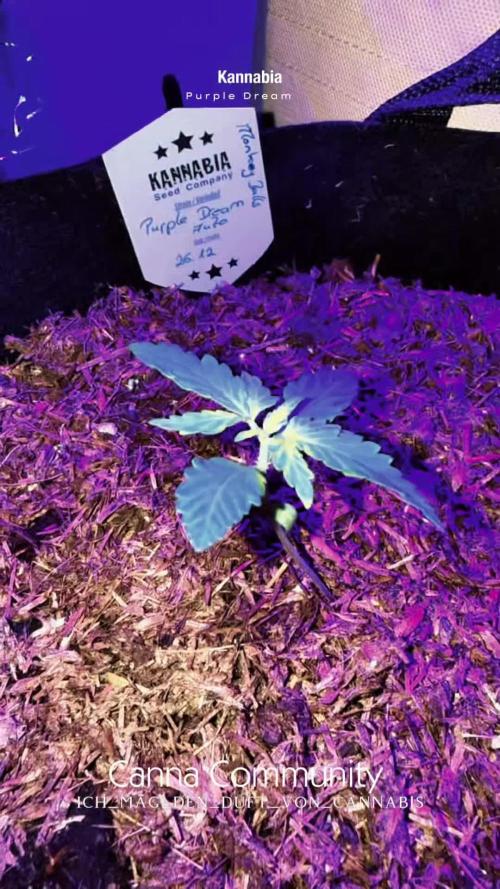
Heute morgen sieht die Pflanze sehr gut aus Wurzeln Zuwachs und die Blätter sind straff nach oben gestellt, habe zusätzlich noch etwas Silizium hinzufügt. Top 🌱🔨 Nice Day allen!

Likes
3
Share


@High_Grade_Dadli
Follow
Quick update I know I been MIA..diary label xmas tree got deleted after losing the mother tree(die back)and about 80 cutting(weather)
1 of the cutting which I took before from the mother that died is the mother to set 1 and 2 (29)...took some cutting off of set 1 (30) jus waiting to see how rooting goes...mother tree jus hit the 2nd week of flowering will update with pic in week 2

Processing
Likes
18
Share


@Silverback_Guerilla
Follow
11/2:
I took everybody out of the garden and did some defoliating and sprayed them with boom boom spray and a little tiger bloom for the last time.
In addition the potassium deficiency, it looks like several of them have a copper deficiency as well. I'm gonna re-calibrate my Ph meter...thinking it's off.
I super-cropped the tallest 5 plants to try and keep the canopy more even, and spent about a half hour training the 4 plants in the upper chamber
11/3:
The 5 plants whose tallest branches I super-cropped turned upwards and are doing their thing again. At least 3 more plants need the same treatment now..stretching like crazy.
They are dry..watering in the morning.
11/4:
I sprinkled a tablespoon of Cavern Culture (bat and seabird guano) onto all of them and watered it in with about 1/2 gallon each, including myco/tricho/beneficial bacteria, humic acid, bembe, terpinator, and cal-mag.
I also did some more super-cropping and training on them today. I can't really spread the branches out too much, as I have no space at all to work with, but I managed to get light to more of the lower branches, so that's a win.
Tomorrow I'm gonna transplant the one with the curly leaves into a 5 gallon pot and check out whatever's going on with her roots.
The extremely curly-leaved plant...ugh...I'd say she's really "sickly", but she's big and bushy and still blooming like crazy....😕
It's like she hates being watered. I've ensured that there are hundreds of little holes in the sides and bottom of her pot and have a half inch airspace beneath it. During the afternoon, I've been leaving the closet door partially open and an industrial fan blowing across the pots to try to get more oxygen to their roots. All, but Curly Sue are doing fine. I'm hoping that maybe a transplant into a 5 gallon pot of perlite-heavy soil mix (roots dusted with myco) will make her straighten out and fly right. I'll water her into the new pot with boomerang and maybe spray her with boom boom spray. Biotabs swears by it as a shock-reducing transplant foliar feed....we'll see. I really hate transplanting when they are this far into flower, but I really don't want her to peter-out before she can finish. Of all the plants, she has the weakest stalk and branches, so...😷
11/5:
I transplanted "Curly Sue" into a 5 gallon pot today and watered her in with myco, humic acid, boomerang, and bembe. Fingers crossed....
I removed the oscillating fan from above my lighting so that I could raise the lights several more inches, and added another oscillating fan above the lights that blows down on the plants.
The one I removed is still up there too, but blowing across the LED drivers and a pair of the panels. I could still remove the ratchet hangers and just use carabiners to attach the fixture to the "ceiling" of the closet....that would give me another 5 inches of possible ceiling if I end up needing it.
11/6:
I fed everybody about 1/3 gallon today, and went heavy on phosphorous..a heavy dose of tiger bloom, along with a normal dose of beastie bloomz, bembe, cal-mag, signal, big bloom, and a 1/3 dose of grow big. It's been raining for 24 hours and the humidity is off the charts, so I dialed up the ac infinity to come on any time it exceeds 55% RH and increased the fan speed on the floor of the closet to try and dry them out quicker than usual.
11/7:
Did pretty much nothing to the bigger plants in the bottom today and only did a little training to two of the shorter ones in the top section.
11/8:
I collected a bunch of rainwater over the past 48 hours and gave everybody about 1/3 gallon including cal-mag, signal, bembe, armor si, and a little bit of tiger bloom..still seeing some signs of phosphorous deficiency here and there. I took a bunch of photos and video while I had some of them out of the closet. 😍
Curly Sue continues to bud up, but she's still curly as hell. No way the old growth will correct itself, but I was hoping to see a few new sugar leaves be straighter than the rest..
Likes
12
Share


@Desertfarmer
Follow
This is a clone only strain I have been running
for a little while and it never disappoints! Dense buds that stink the whole place up with its earthy, pungent, sweet smell. Not a huge yielder but it makes up for it in resin production. Probably not a good strain for First time growers as it needs topped, trained, and trellised. Overall happy with the way this run turned out lots of main buds, I ended up with 316.3 grams of trimmed nice frosty buds. I also took the rest of the buds (when they were wet)and put them in the freezer for some ff bubble hash. I ended up with 433.7 grams of wet fresh frozen material.
Likes
15
Share

@D33jW
Follow
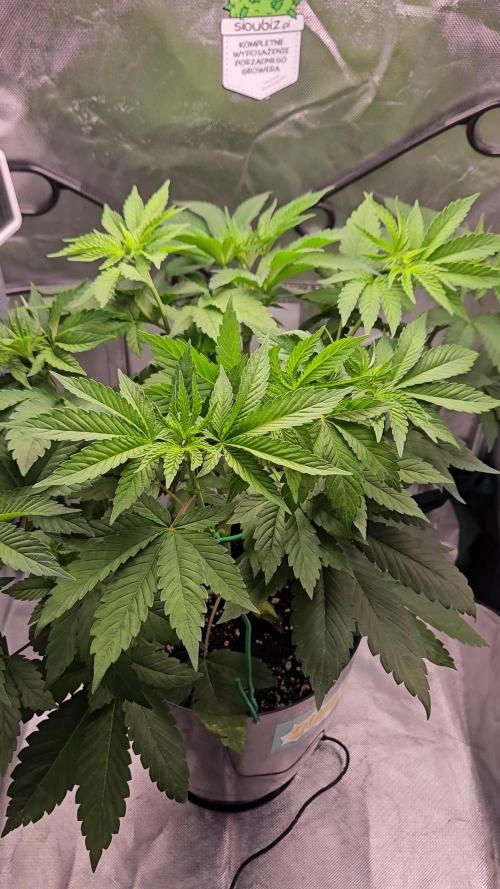
📅 Week 4 – Day 28
BOX: 50x50 – 100W lamp
🌞 Temp: 27°C
💦 RH: 68–70%
💥 PPFD: 650 µmol/m²/s
🌬️ VPD: 1.2 kPa
I switched to 12/12 today after doing a gradual flip, reducing light by 1h per day.
Watering: trying not to overwater – this week they averaged about 600 ml/day. They received two feedings at EC 0.6 and 0.8.
Airflow: keeping the fan strong at this stage so the stems are always working. I’ll keep this going until the first pistils show.
Stay tuned – and keep growing 🌱
Likes
19
Share


@GoldenWeedGrower
Follow
Legend
Timestamp: 📅
EC - pH: ⚗️
Temp - Hum: 🌡️
Water: 🌊
Food: 🍗
pH Correction: 💧
Actions: 💼
Thoughts: 🧠
Events: 🚀
Media: 🎬
D: DAY, G: GERMINATION, V: VEGETATIVE, B: BLOOMING, R: RIPENING, D: DRYING, C: CURING
________________________________
📅 D70/B08 - 24/01/24
⚗️
🌡️
🌊
🍗
💼
🧠 pH is finally stable on the lower side (hopefully)
🚀 The Tent-X is on its way, I can't wait to get it..
🎬 Added Timelapse video
________________________________
📅 D71/B09 - 25/01/24
⚗️ EC: 1.2 pH: 5.6
🌡️ T: 23 °C H: 45%
🌊
🍗
💧
💼 I put T-H Sensor of TrolMaster on the SCroG net
🧠
🚀Tent-X from TrolMaster received, I'm going to set it up tomorrow
🎬 Added Timelapse video
________________________________
📅 D72/B10 - 26/01/24
⚗️ EC: 1.2 pH: 6
🌡️ T: 23 °C H: 40%
🌊 Added 6L
🍗 Added Bloom A-B - CalMag - Big Bud - Bud Candy - B52
💼 Tent-X set up done !
🧠 It works perfectly and as I just see so far, from now on, I'm going to experiment a new way to grow !
🚀
🎬 Added Timelapse video and Set-Up videos and pics
________________________________
📅 D73/B11 - 27/01/24
⚗️ EC: 1 pH: 5.5
🌡️ T: 23 °C H: 40%
🌊
🍗
💧 Added a little of pH-
💼
🧠
🚀
🎬 Added Timelapse video
________________________________
📅 D74/B12 - 28/01/24
⚗️ EC: 1 pH: 5.5
🌡️ T: 23 °C H: 35%
🌊 Added 4L
🍗 Added CalMag - Bloom A-B - B52 - Bud Candy - Big Bud
💧 Added some pH-
💼
🧠
🚀
🎬 Added Timelapse video and 4 pics
________________________________
📅 D75/B13 - 29/01/24
⚗️ EC: 1 pH: 6.0
🌡️ T: 23 °C H: 50%
🌊
🍗
💧
💼
🧠
🚀
🎬 Added Timelapse video and "TM+ Pro" App screenshots. This is the app used to monotoring the Tent-X controller
________________________________
📅 D76/B14 - 30/01/24
⚗️ EC: 1.2 pH 6.1
🌡️ T: 18-26 °C H: 30-55% (from now on, I'll put the Min-Max values of T-H as I can easily read them from the app.)
🌊 4L
🍗 CalMag - Bloom A-B - Bud Candy - Big Bud - B52
💧
💼 I added a Humidifier as the H falls down to 30%
🧠 With the help of Humidifier, according with "TM+ Pro" app, I got the perfect VPD (Vapor Pressure Deficit) rate !! (see screenshots)
🚀 I have to face a very low rate humidity of the external enviroment
🎬 Added Timelapse video and T-H values daily graph, and perfect VPD from the Tent-X controller
________________________________

Likes
10
Share


@Gutismoke102
Follow
She has grown to be a beast. She’s been very easy to grow medium feeder ever other day I keep ppm 400-600 so I’m able to feed more frequently. She loves it stay tuned she just warming up

Likes
9
Share


@Arcadios
Follow
Mon - 1/25/21 The top feed + 5 Tbs of Dr Earth life per 3gallon pot seems to be doing pretty well. Today I'm just watering with 6.2 water.
Tuesday - 1/26/21 Still looking good, no action
Wed - 1/27/21 - Soil was still wet enough that I didn't need to water. Will resume tomorrow
Thur - 1/28/21 - Watered 5 gallons across all 3
Fri - 1/29/21 - No water
Sat - 1/30/21 - No water
Sunday - 1/31/21 - Watered up!
Overall, I'm pretty happy! The leaves have healed up a bit and the buds are super dense. Not quite as frosty as I'd like, but I plan to do some Fox Farm Big bloom next week.

Likes
32
Share


@Hawkbo
Follow
This week they are all just putting on some weight still a few weeks left to go. Pics were taken on Monday video on Tuesday. The aromas are pretty strong in the tent in general.
Shes closing in on the finish going to start the flush sometime this week I think just give it a long one. Took some pics with and without flash, using a 85mm and 40mm lense. The close ups are with the 85mm u can see the vibrance of the trichomes.


Likes
371
Share


@love_2_grow
Follow
D71.
Week five of flower and the girls are simply doing their thing.
I scouted the plants today and found thrips on the second girl. I was hoping the lacewings would have gotten them all by now, but no such luck. I'll give them a week before ordering another batch.
For some reason, the thrips avoid the first girl. Visually, there's also a clear difference between the two girls, with the first girl being darker and having more buds.
------------------------------
D73.
I brewed a short (6 hours) compost tea today consisting of worm castings, kelp meal, neem meal, humic and fulvic acid, rock dust, biochar, and molasses. After the brew, I added homemade Bokashi juice, which lowered the pH of the tea to 6.6. Each girl got 2.5 liters of tea (5% of pot volume.)
I also did another light round of defoliation, down low on the plants.
------------------------------
D75.
Each girl got 2.5 liters of water @ pH 6.5, with 5 ml of FFJ.
The plants stretched SO MUCH after flipping them into flower that it's challenging for the light to penetrate the canopy, and it's pretty dark further down. I bought some LED grow light strips and installed them in the tent to provide additional side lighting. It's only 36 W of extra lighting, but I hope it will help to develop the numerous buds down low.
I put the lights on the left side of the tent, around the first girl, since she has a lot more buds, but now that it looks like the concept works, I might get another set of lights for the right side of the tent.
------------------------------
D77.
We've reached the end of the fifth week of flower, and all is well in the tent. Ahem, almost all since I still have the thrips to contend with, BUT I just put a bunch of Cucumeris predatory mites in the tent, so the war rages on.
A friend suggested adding white cloth below the plants to reflect more light toward the lower buds. Sounds plausible, but I didn't have any fabric, so I went all ghetto by simply putting strips of kitchen paper on top of the scrog net. Not the most fantastic reflector material ever, but it's what I had at hand. Plus, it's easy to work with and costs next to nothing.
I doubt it will make a big difference, but even a slight increase is still an increase, and I could see a visible difference in the amount of light hitting the lower canopy.
Finally, each plant got 2.5 liters of water @ pH 6.3, with FFJ and Bokashi Juice.
------------------------------


