

Likes
32
Share
@Brujha77
Follow
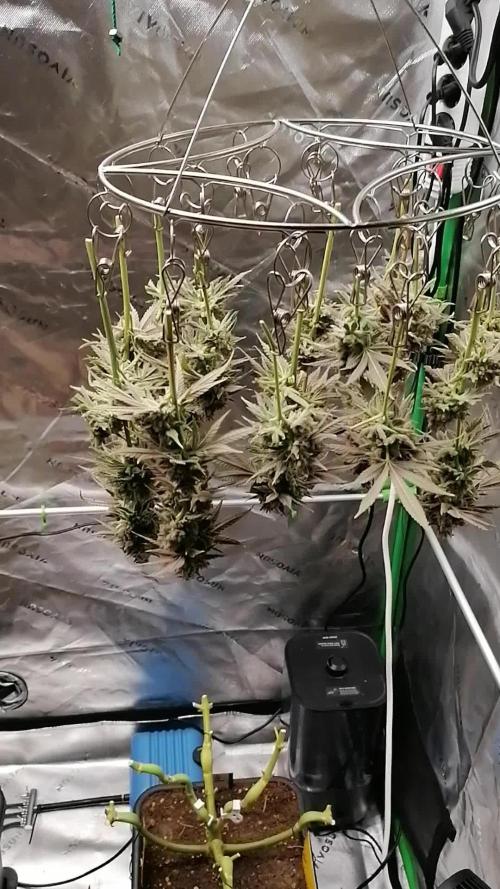
Starting week 9 Nothing to do, expect Trichome checking.. Still needs a few Days, but i think she will finish this week. Day94 She's finally done 👍👍 Tomorrow morning she get chopped
Likes
21
Share
@Purplemed
Follow
D1. Three of them make it to 2cm in three days, the fourth one already rooted but taking it easy, I watered them a bit and covered the lazy one to blackout and see if she can do it 💪 Lighting at 8.5 DLI (100 PPFD@24h) with the lamp dimmed at 57cm from the soil. D2. The lazy seed still struggling to sprout but seems she's so close to make it since she's already out the soil. The three strong ones already grew to 4 cm in 24 hours, +2 cm, a growing rate of 0,83mm per hour. Following the seedling schedule lighting now will be at 12 DLI the whole first week. D3. The seedlings are growing strong except the little lazy one, I had to help her sprouting this morning using tweezers since both leaves were trapped inside the seed not being able to open by itself, unlike the other ones that did it by themselves three days ago. Will she gonna make it? Let's give her time 💪 D5. The red worms look very active but the leaf tips are curling up so I moved from 24h lighting to 20h and let em rest a bit keeping 12 DLI and 80% humidity while lowering temp at night from 25°C to 23°C. The lazy seedling still so small and definitely don't match their sisters growth rate, let's see if there is any progress next days. Also I already installed the Blumat, the parcel arrived missing the final drippers and the 3mm tube but they already send it. I adjusted the system following Michael Box top tip on this Growcast podcast, https://youtu.be/g5YFcxW3kXI?si=tkm6F1fF65CaNruq It consist on adjust the holding drip at atmospheric pressure without the ceramic cone/tube part, then from there screwed the regulator one more carrot (on gravity systems), mark it and put on the locking cap, this way it should provide 80mbar of water tension so there is no need to keep readjusting and you can leave it that way between runs. I use the Tropf max version expecting to keep the bottom of the 25L pots not so moist since 8 days later of the only watering done the moisture is still at 56mbar, looks like it will take some time to start dripping on. Meanwhile I'll keep an eye on the top moisture and if needed just hand water few mililiters a couple inches from the stems. D7. Today I received the missing parts from Blumat and this is the last day of the first week! I think they are looking good despite the little curled up tips from fifth day at 24h but lighting schedule is already changed down to 20h since fifth day midnight. Now they are 6 cm tall and look like they want to start vegging, tomorrow I'll start to daily increase DLI progressively until achieve 16 DLI by the end of the week. The lazy one seems to be doing it, very lazy but growing a little bit every day 💪
Likes
5
Share
@CannDy420
Follow
Die Pflanzen haben sich an die Neuen töpfe gewöhnt und wachsen gut an nächste Woche sind sie denk ich ready für die erste Nährstoff Zugabe .
Likes
16
Share
Aug 29 - Sep 04 (Week 17, day 113- day 119) Thank you to the universe ✨. Thank you to the sun 🌞 for providing this year. Thank you to everyone following. The season is going great as you can see from the pictures 🖼️🖼️🖼️. The caterpillars (las orugas 🐛) have not returned--and if they did then they are gone for now. There's just about 5 to 6 weeks to go according to the information on the seed box. Im super excited--by the way--this weed smells like the peel on a ripe mango mixed with orange peels 🍊--it also has that distinct sweet weed smell 🌿 with a little minty and lemony 🍋 mixed in. Ummm. Delicious. 🤤 Gracias al universo ✨. Gracias al sol ☀️ por proveer este año. Gracias a todos siguiendo el diario. Esta temporada va fenomenal por lo que pueden ver en las fotos 🖼️🖼️🖼️. Las orugas (the caterpillars 🐛) no han regresado--y si regresaron, pues ya se fueron por ahorita. Quedan casi seis semanas para cosechar según la información en la cajita de semillas. Estoy súper emocionado--de por si--esta mota huele a la cáscara de un mango maduro mezclado con cáscaras de naranja 🍊--y también tiene ese olor distinto de la mota 🌿 dulce con un poco de menta y limoncito 🍋 mezclado. Ummm. Rico papi. 🤤
Likes
127
Share
@SwissKush
Follow
Day 71 - she is a monster a. the buds continue to swell larger b. the smells inside the box are of baked cakes and fruit, really amazing smell c. will be increasing the bloom nutrients very hard this week with more FloraBloom. d. I am hoping to have purple buds when we are finished! Day 72 - growing strong a. the buds are growing every day b. the smell is unreal, the oil production is very high, the buds are covered in oil c. added 5L to the DWC of stronger flowering blend, we are at 1240ppm in the DWC d. applied light LST to 2 of the front colas to allow light to hit the smaller buds a bit Day 73 - growth explosion a. exponential growth everywhere, buds are getting very fat. b. not a single hair is turning orange!!!! we are so excited for the long life of this auto, the longer the life the longer the effects. c. the plant is starting to eat the nitrogen out of some of the leaves. Day 74 - buds just keep growing a. added 5L of heavy flowering blend to the DWC b. smells like berry cake Day 75 - exploding a. lightly tied the massive buds back a little to get the little spots more light b. the oil and resin production are very high Day 76 - exploding again a. the buds are just growing huge, the main is insanely large b. we are starting to get our first signs of minor nitrogen deficiency!!!! YES! Day 77 - let the ripening begin! a. switching over to Ripen+Pro Bloom next week, these buds will explode!
Likes
116
Share
Однажды я услышал замечательную фразу: "Если ты думаешь, что уже пора срезать растение - подожди еще неделю, и срезай!" 😁 А если серьезно, мы с моей девочкой никуда не спешили, и теперь полностью готовы, об этом говорит и внешний вид растения, и осмотр трихом в микроскоп - больше половины мутные, слегка переходящие в янтарь. Промыл субстрат я очень тщательно (последний дренаж <200 ррм), сегодня 28.05 оставляю растение на двое суток темноты и засухи, и буду собирать урожай - всё это в следующем репортаже👆 Спасибо, что заглянули, и будьте здоровы! 🙏 Продолжение следует ...😶
Processing
Likes
6
Share
Дальний и ближний левый одинаковой высоты, одинаково хреново зацветают, НО зацветают, позже подзалью фоток температура ночью 19 температура днем 26 влажность 40% световой режим 21/3 высота растих 92см (при последнем замере) ПШ компота 6.5 ppm 1560 кушают по 4-5 литров ppm на выходе 1677 температура компота на выходе 20,4 Просто водой не проливал
Likes
3
Share
@undermink
Follow
She got really purple because of the temperature drop (from about 30 degrees outside to nearly 15 now) I guess. Which looks kinda awesome. The bids are growing and I increased her nutrition again to 2ml one a week.
Likes
34
Share
@RFarm21
Follow
Alimentação: 11 janeiro Cant wait to smoke ir 😌
Likes
6
Share
This thing stinks! Dank smell everywhere in the garden. Happy days;) gave the last feed of terra bloom and now i will flush with 3liters of phd water at a time when the soil is dry. Many leaves started the transformation to red now. I think that will be even more visible after the first flushload
Likes
17
Share
It's been steady so far, I'm excited about this lady right here. I just Transplanted her into the living soil bed!! I'll be giving the plant PH balanced water the next couple days! So today I also decided to super crop her and get this Plant started on some training she's gonna love it! Let's
Likes
Comments
Share
🌸 Week 5 – First Week of Flower ✅ The light cycle has been set to 12/12 since the start of the week, but there are no real signs of flowering on Cherry MAC Muffin just yet. However, she’s already starting to stretch nicely! 📏 Current height: 46 cm The plant looks strong, healthy, and full of energy. 💪 💧 Watering & Feeding ➤ 6 L per plant every 3 days ➤ Feeding at ~50 % of the Advanced Nutrients schedule ➤ Input EC: ~1.3 ➤ Runoff EC (Cherry MAC): 1.0 Still super happy with the substrate mix (Plagron Lightmix + Coco) – runoff values are stable and easy to measure. 👌 Looking back, I probably could’ve flipped a week earlier – the tent’s filling up fast now! 😄
Likes
Comments
Share
I love Mephisto and have anything to say.. 🐽♥️🐽🤝
Likes
2
Share
We become aware at such times of man's wonderful ability to bring seemingly unrelated elements into harmonic balance, and receive a glimpse into a world where everything exists in conscious sympathetic attunement to everything else. When we listen to a piece of music that seems to strike a beautiful chord somewhere inside us, or view a painting that simply glows with harmonic awareness well executed, we probably do not spare much time to contemplate the wonderfully intricate combination of vibrations that our sensors make it possible for us to perceive. We tend to appreciate the relationship between the parts of something by an awareness of the harmony or dissonance of the whole. This ability enables us to say "what a beautiful house!" instead of "analysis has proven that this collection of building materials exhibits certain elements of harmonic proportion." While this ability to instinctively appreciate the beauty of true harmony has an important role to play in evolution, a more analytical understanding of the laws involved can be most useful. This is especially so if we wish to create works of art where each part exists in true harmony, not only with the other part of that particular whole, but with the universe within which the creator and the created exist. Everything vibrates. From the most dense matter to the most subtle cosmic rays, everything which our senses allow our thoughts to become aware of, can be specified in terms of wavelength or frequency of vibration. These two terms define the same thing, but from different points of view. The following are the approximate wavelengths of various energy carriers: Cosmic rays 0.000,000,001 mm Gamma rays 0.000,000,1 mm X rays 0.000,500 mm Ultraviolet rays 0.003 mm Visible light 0.006 mm Infrared 0.01 mm Sound waves 1 meter Radio waves 300 meters Violet light 400 nm to 450 nm Blue light 450 nm to 500 nm Green light 500 nm to 570 nm Yellow light 570 nm to 590 nm Orange light 590 nm to 610 nm Red light 610 to 700 nm 1 nanometer (nm) = 0.000,000,1 cm = 1/10,000,000 cm If a guitar string is plucked and we hear a sound, it is not too difficult for the human mind to associate this sound with the vibration of the guitar string. With color it is quite different. It is difficult for us to conceive that the color of a substance is not an inherent property of the substance itself, but an indication picked up by our senses of that substance's ability to absorb or reflect the light which happens to be shining on it at that moment. Neither the matter nor the light is colored. What happens is that the brain learns to differentiate between the frequencies reflected or transmitted by the substance the eyes are focused on. The same thing happens with sound. When we say "Oh! Listen, they're playing my favorite song," what we really mean is: "My brain has stored within it a particular pattern of frequencies. I have compared the new information being received with this stored pattern and have deduced the answer that the two patterns are similar within certain specified tolerances." The 'pleasure' involved could have something to do with our running the pre-recorded pattern at the same time, in 'sympathy' with the new pattern as it is received. The word sympathy describes very well our ability to appreciate color and sound. It also describes the reason behind certain elements of harmony. For instance, if a substance vibrating at 100 cycles per second (tone 1) is in the proximity of another substance vibrating at 200 cycles per second (tone 2), we could perceive, if we had the right equipment, a certain sympathetic relationship between the two. We will see from this that there is a uniform doubling of the first tone seen in the second. At various points along the waves, the two are the same in amplitude. At other points, they are at opposite poles to each other. This doubled frequency has more points of similarity to the original than any other frequency except the original itself. If the equipment we had available for measuring these two frequencies was a soundboard amplifier and a pair of ears, then we would hear what would sound to us like one tone. If we had the opportunity to hear one at a time, we would hear that although they sound the same, one is higher in pitch than the other. This characteristic of 'the same but different in pitch', musicians have called the octave. Any two tones produced where one has exactly doubled the frequency of the other is called an octave. Speaking in ratios, an octave would appear then as the ratio 2:1 or 1:2, depending on whether we are talking of an octave up or down. A single note produced by almost any instrument will contain more than one wavelength or frequency. It will have a dominant frequency, the wavelength of which we would call the note's 'fundamental' or 1st harmonic. It will also have a varying number of upper harmonics, gradually fading in intensity into infinity or silence. Natural harmonics always have the same pattern of intervals between them. The interval between the 1st and 2nd harmonic is a perfect octave; between the 2nd and 3rd a perfect fifth; between the 3rd and 4th a perfect 4th; and so on, the intervals becoming smaller and smaller until they lose any relationship with the western 12 tone scale as it exists at the moment. Just as an octave has certain elements of sympathy with its fundamental, so some intervals have been noted to be more perfectly in sympathy with the fundamental than others. The ratio of the 'perfect 5th' or interval of 7 semitones, as it occurs in the harmonic series, is 3:2 or 2:3, while that of the 'perfect fourth" is 4:3 or 3:4. All the tones in the western 12 tone scale can be expressed in terms of the ratio between the upper tone and its fundamental. This would seem to be an ideal way of generating a scale from any given fundamental and several attempts have been made to do this, the Pythagorean system being probably the most well known. Although when working with a single tone instrument playing on its own, the Pythagorean formula works wonderfully well, if we had several instruments tuned this way together and asked them to play almost any western music, we would find that at times they sounded quite out of tune to each other. The lack of flexibility of the various scale systems based on the harmonic series has led to what is known as the 'tempered' scale. This uses as its primary unit of interval the ratio of the octave or 2:1. It then proceeds to divide the interval between any fundamental and its upper octave into 12 smaller intervals by applying the ratio: two to the one-twelfth power, to one (21/12:1). This equals 1.059463094, so by multiplying any frequency by this number, we will obtain the tempered semitone next up from our fundamental. We will also find that any tone twelve semitones up from any other tone, in a scale generated in this way, will have exactly double the frequency. If we took the note middle C on a piano and halved the wavelength, we would have the note C one octave above. If we halved this, we would have the C above, and so on. However, within about 6 octaves, we would find that although a 'sound' was being produced, no human ear could perceive it. If we kept on going, halving and producing upper octaves of our fundamental C, we would proceed through the infrared band, into the visible light spectrum. If we happened to be outside during the day, we would, for one octave only, see the note C with our eyes. The next octave above would already be in the ultraviolet band, and outside the eye's sensitivity range. If we can think of color as being an indication of a substance's vibratory rate or wavelength, we may begin to see a relationship that could exist between the color and sound spectrums. The logical extension of what has so far been said is that there exists a scale in the color spectrum that corresponds exactly to the scale in the sound spectrum, each color tone being an octave of the equivalent note in the sound range. This is not the end of the story but only the beginning. If we can for the moment accept that any wavelength in one band has upper and lower octave stretching out to infinity, then the next question is 'fine, but what shall we use as our fundamental? A particular color? A particular sound frequency?' The musicians among us will probably say 'A 440'. This means that the note A should vibrate at 440 Hertz, or 440 times per second. They would tell us that this is standard pitch has been adopted by most orchestras around the world; pianos are tuned to it, instruments are constructed to formulas based on it, and so to them it would probably seem the most appropriate place to begin. Some of these musicians may know of the battle that is still raging with regards to this being the standard, but few would know why A = 440 Hz was chosen except that it worked when it was set to be a suitable compromise between the many different pitches in use at the time. 432 Hz is said to be mathematically consistent with the patterns of the universe. Studies reveal that 432 Hz tuning vibrates with the universe’s golden mean PHI and unifies the properties of light, time, space, matter, gravity, and magnetism with biology, the DNA code, and consciousness. When our atoms and DNA start to resonate in harmony with the spiraling pattern of nature, our sense of connection to nature is said to be magnified. Another interesting factor to consider is that the A=432 Hz tuning correlates with the color spectrum, while the A=440 Hz is off. Audiophiles have also stated that A = 432 Hz music seems to be non-local and can fill an entire room, whereas A=440 Hz can be perceived as directional or linear in sound propagation. Once you adopt the idea that sound (or vibration in general) can have an equalizing and harmonizing effect (as well as a disturbing effect), the science of harmony can be applied to bring greater harmony into one's life or tune to specific energies. There is a form of absolute and relative harmony. Absolute harmony can, for example, be determined by the tuning of an instrument. The ancients tuned their instruments at an A of 432 Hz instead of 440 Hz - and for a good reason. There are plenty of music examples on the internet that you can listen to in order to establish the difference for yourself. Attuning the instrument to 432 Hz results in a more relaxing sound, while 440 Hz slightly tenses up the body. This is because 440 Hz is out of tune with both macro and micro cosmos. On the contrary, 432 Hz is in tune. To give an example of how this is manifested microcosmically: our breath (0,3 Hz) and our pulse (1,2 Hz) relate to the frequency of the lower octave of an A of 432 Hz (108 Hz) as 1:360 and 1:90. It is interesting to note that 432 Hz was the standard pitch of many old instruments and that it was only recently (19th and 20th century) the standard pitch was increased. This was done in order to be able to play for bigger audiences. Bigger audiences (more bodies) absorb more of the lower frequencies, so the higher pitch was more likely to “cut through”. One of the oldest instruments of the world is the bell ensemble of Yi Zeng (dated 423 BC), tuned to a standard F4 of 345 Hz, which gives an A= 432 Hz. The frequency of 345 Hz is that of the platonic year! Similarly, many old organs are tuned in A=432 as well; for example, St. Peter’s Capella Gregoriana, St. Peter’s Capella Giulia, S. Maria Maggiore in Rome. Maria Renold’s book “Intervals Scales Tones and the Concert Pitch C=128 Hz” claims conclusive evidence that 440 Hz and raising concert pitch above scientific “C” Prime=128 Hz (Concert A=432 Hz) disassociates the connection of consciousness to the body and creates anti-social conditions in humanity. The difference between concert pitch A=440 Hz and Concert A=432 Hz is only 8 cycles per second, but it is a perceptible difference of awareness in the human consciousness experience of the dream we share called existence.
Likes
87
Share
2021-12-19 This is the final Week of Vegetation, a few days ago the " Puddin" Plant got ahard training. Today she looks like nothing happened she took the Training like aDarling My dog loved the training too. because she loves to eat the Leaves. Iam not sure if iam able to end this grow in the Urban chili Growbox, because i was not hard enough on er ( I barely cant cut more) we will see, But hey thats life, in " worst Case" she will move into my Floweringroom under the Viparspectras to finish xxxxxxxxxxxxxxxxxxxxxxxxxxxxxxxxxxxxxxxxxxxxxxxxxxxxxxxxxxxxxx Big Shout- Out to @urban_chili For sending this wonderful complete Growbox named „urban Chili 3.0“ for our CHARITY GROWOFF @silky_smooth and me, are using the same Equipment for this entire Grow. We are having space 45x60 cm and 130 cm in Hight. The lights are supereffective 85 Watt Quantum LED, made in Austria. We are using the same Strain, the same Growbox. So it will really just come down to Skill and Mastery of the Grower.... With this Event, we want to be there for Woman in Need of Help. And Support those ,who are less Fortunate than us. We feel like, we are so Blessed for what we have, that we feel Obliged to give a bit back to the Community that we so dearly Love... During the „GROW OFF FOR CHARITY“, @Weedseedsexpress will Donate 100 Euro per Month to our Charity Goal and an additional 500 euro's by the End of he Contest, if we reach at least 2000 Likes on our weekly Posts on Instagram. The other Companies who are Sponsoring our „ GROWOFF FOR CHARITY“ are giving us Products and Merchandise from their Companies. And they help Promote our „ Growoff“ There are coming some AUCTIONS and GIVEAWAYS fort Horticultists The „GROW OFF FOR CHARITY“ is Sponsored by: ( Named in Order of Appearance) @weedseedsexpress @urban_chili @greenbuzzliquids @Herbiesheadshop_com @genoneeleven_nutrients @zamnesiaxseeds @spilffseeds @Inseediousseeds @sgreenlab @viparspectraled @cannabonsai_¬manny · PLS FOLLOW OUR SPONSORS! · LIKE AND SHARE This Posting! · To Reach the 2000 Likes per Week! … #growjournal #instaweed #instaweed420 #trackyourgrow #growsharelearn #cannabissociety #cannabisgrow #growerslife #cannabiscommunity #growersunite #mj #weedstagram #weedart #growyourown #weednation #weedgrower #weeddaily #cannabisinfluencer #cannabisartist #cannabisart
Likes
2
Share
@Dairon
Follow
Hola, van como un tiro se están formando los cogollos a buen ritmo, he realizado una pulverización con leaf coat, ya no pulverizaré más este cultivo, como preventivo contra plagas y hongos, crea una pelicula que impide al bichito morder la planta, la climatologia exterior ha influido esta semana a sido un bajar y subir de todo, tanto temperatura como humedad, pero he conseguido mantener unos parámetros aceptables
Likes
133
Share
@Qutro
Follow
Hi Growmies, So let me introduce you this 4 little gorilla gals who survived the first week of their life in the wild. As I mentioned last week, we needed 4 healthy individual to populate the future forest and it’s succeeded. The one who struggled is also starting to catch up to her sisters.🌱 They got a bit lanky as I was way too careful with the light. One needed help because she fell on the pot. So slowly raised the light intensity first to 220 ppfd and at the end of the week we finished at 350. They seem to like it so will leave it for a few days. The sf1000 is running on 55% at the moment.🌞 Watered twice this week. First with 150ml each and 3 days later with 220ml. No macronutrients have been given to them yet.💦 I’m happy how they look 14 days after the start of germination. See you next week!🙌
Processing
Likes
25
Share
Temperature changes have been swinging upwards of 40 degrees on some days. We are now experiencing 95 degree weather with sustained wind. Plants are recovering nicely though. Plants have grown a lot since last week. I'm considering topping some. I need to measure them.