The Grow Awards 2026 🏆
Processing
Likes
Comments
Share
@w33dhawk
Follow
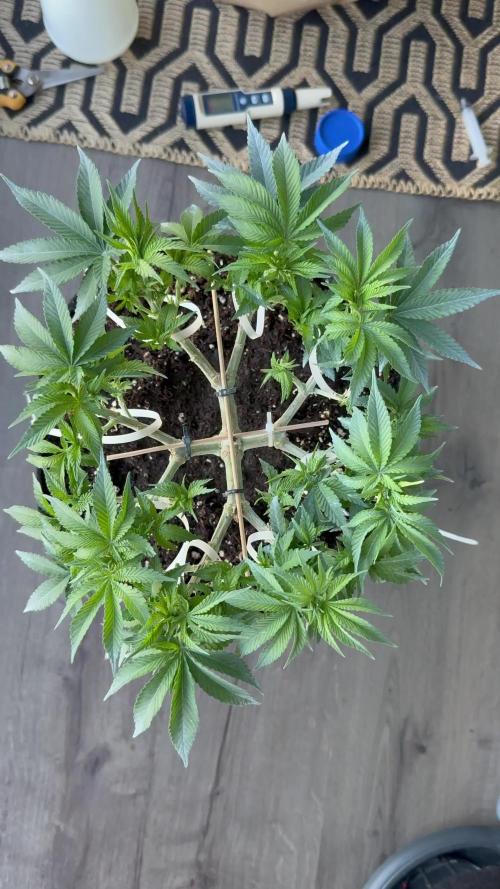
So Woche 6is angelaufen und ich entschuldige mich schon mal in Woche 5 nichts an Bildern hochgeladen zu haben. Hab jetzt die 2 hinteren Sapphire scout zum 2ten mal getoppt die vordere davon nur 1x bei den rqs zz is bis jetzt nur die hintere 1x getoppt und die beiden vorderen noch garnicht hoffe die beiden kann ich wenigstens einmal toppen die machen mir echt Sorgen vorallem die am Anfang stehende zz is recht krüppelig ich denke mal das die wurzeln nicht richtig durch die jiffies kommen (netzt nicht AUFGELÖST) würde in Zukunft die scheiss Dinger weg lassen und mir kleine durchsichtige getränkeflaschen zerschneiden um daraus anzuchtopfe zu machen dann fällt das netz weg und es gibt wohl weniger Sorgen nächste Woche lass ich mein scrog netzt drauf um das ganze zu begrenzen und hoffe das dann die rqs samen noch aufholen können
Likes
47
Share
2nd net is up. Early bud formations are promising. holding up to the extremes pretty well, some leaves taking minor damage, but overall, she is holding up, gave her 1 night at 50F see how she would react, stressful. Not advised as it messes with her metabolism, but I want to see if it triggers any anthocyanin response. Love to see her purp up but no signs yet. Remember, For every molecule of glucose produced during photosynthesis, a plant needs to split six molecules of water. This process provides the hydrogen needed for synthesizing glucose and other organic compounds, while oxygen is released as a byproduct. Homework. If Rubisco activity is impaired and it cannot properly function or regenerate its substrate, the plant's leaves are likely to turn a pale green or lime green, a condition known as chlorosis. Essentially, Rubisco activity is highly regulated and susceptible to various environmental and metabolic factors that can cause it to become inhibited, leading to an apparent failure in RuBP regeneration due to a lack of consumption. Rubisco regeneration is intrinsically linked to nitrogen supply because Rubisco is a major sink for nitrogen in plants, typically accounting for 15% to over 25% of total leaf nitrogen. The regeneration phase itself consumes nitrogen through the synthesis of the Rubisco enzyme and associated proteins (like Rubisco activase), and overall nitrogen status heavily influences the efficiency of RuBP regeneration. RuBisCO is a very large enzyme that constitutes a significant proportion (up to 50%) of leaf soluble protein and requires large investments in nitrogen. Insufficient nitrogen supply limits the plant's ability to produce adequate amounts of RuBisCO, thereby limiting the overall capacity for photosynthesis and carbon fixation. Maintaining the optimal, slightly alkaline pH is crucial for the proper function and regeneration of Rubisco. Deviations in either direction (too high or too low) disrupt the enzyme's structure, activation state, and interaction with its substrates, leading to decreased activity and impaired RuBP regeneration. (Lime/yellowing) Structural Component: Nitrogen is an essential building block for all proteins, and the sheer abundance of the Rubisco protein makes it the single largest storage of nitrogen in the leaf. Synthesis and Activity: Adequate nitrogen supply is crucial for the synthesis and maintenance of sufficient Rubisco enzyme and Rubisco activase (Rca), the regulatory protein responsible for maintaining Rubisco's active state. Nitrogen deficiency leads to a decrease in the content and activity of both Rubisco and Rca, which in turn limits the maximum carboxylation rate, Vmax, and the rate of RuBP regeneration Jmax, thus reducing overall photosynthetic capacity. Nitrogen Storage and Remobilization: Rubisco can act as a temporary nitrogen storage protein, which is degraded to remobilize nitrogen to other growing parts of the plant, especially under conditions of nitrogen deficiency or senescence. Nitrogen Use Efficiency (NUE): The allocation of nitrogen to Rubisco is a key determinant of a plant's photosynthetic nitrogen use efficiency (PNUE). In high-nitrogen conditions, plants may accumulate a surplus of Rubisco, which may not be fully activated, leading to a lower PNUE. Optimizing the amount and activity of Rubisco relative to nitrogen availability is a target for improving crop NUE. Photorespiration and Nitrogen Metabolism: Nitrogen metabolism is also linked to the photorespiration pathway (which competes with carboxylation at the Rubisco active site), particularly in the reassimilation of ammonia released during the process. To increase RuBisCO regeneration, which refers to the process of forming the CO2 acceptor molecule Ribulose-1,5-bisphosphate (RuBP) during photosynthesis, the primary methods involve optimizing the levels and activity of Rubisco activase (Rca) and enhancing the performance of other Calvin-Benson-Bassham (CBB) cycle enzymes. Biochemical and Environmental Approaches: Optimize Rubisco Activase (Rca) activity: Rca is a crucial chaperone protein that removes inhibitory sugar phosphates, such as CA1P (2-carboxy-D-arabinitol 1-phosphate), from the Rubisco active site, thus maintaining its catalytic competence. •Ensure optimal light conditions: Rca is light-activated via the chloroplast's redox status. Adequate light intensity ensures Rca can effectively maintain Rubisco in its active, carbamylated state. •Maintain optimal temperature: Rca is highly temperature-sensitive and can become unstable at moderately high temperatures (e.g., above 35°C/95F° in many C3 plants), which decreases its ability to activate Rubisco. Maintaining temperatures within the optimal range for a specific plant species is important. •Optimize Mg2+ concentration: Mg2+ is a key cofactor for both Rubisco carbamylation and Rca activity. In the light, Mg2+ concentration in the chloroplast stroma increases, promoting activation. •Manage ATP/ADP ratio: Rca activity depends on ATP hydrolysis and is inhibited by ADP. Conditions that maintain a high ATP/ADP ratio in the chloroplast stroma favor Rca activity. Enhance Calvin-Benson-Bassham (CBB) cycle enzyme activity: The overall rate of RuBP regeneration can be limited by other enzymes in the cycle. •Increase SBPase activity: Sedoheptulose-1,7-bisphosphatase (SBPase) is a key regulatory enzyme in the regeneration pathway, and increasing its activity can enhance RuBP regeneration and overall photosynthesis. •Optimize other enzymes: Overexpression of other CBB cycle enzymes such as fructose-1,6-bisphosphate aldolase (FBA) and triose phosphate isomerase (TPI) can also help to balance the metabolic flux and improve RuBP regeneration capacity. Magnesium ions, Mg2+, are specifically required for Rubisco activation because the cation plays a critical structural and chemical role in forming the active site: A specific lysine residue in the active site must be carbamylated by a CO2 molecule to activate the enzyme. The resulting negatively charged carbamyl group then facilitates the binding of the positively charged Mg2+ion. While other divalent metal ions like Mn2+ can bind to Rubisco, they alter the enzyme's substrate specificity and lead to dramatically lower activity or a higher rate of the non-productive oxygenation reaction compared to Mg2+, making them biologically unfavorable in the context of efficient carbon fixation. The concentration of Mg2+ in the chloroplast stroma naturally increases in the light due to ion potential balancing during ATP synthesis, providing a physiological mechanism to ensure the enzyme is activated when photosynthesis is possible. At the center of the porphyrin ring, nestled within its nitrogen atoms, is a Magnesium ion (Mg2+). This magnesium ion is crucial for the function of chlorophyll, and without it, the pigment cannot effectively capture and transfer light energy. Mg acts as a cofactor: Mg2+ binds to Rubisco after an activator CO2 molecule, forming a catalytically competent complex (Enzyme-CO2-Mg2+). High light + CO2) increases demand: Under high light (60 DLI is a very high intensity, potentially saturating) and high CO2, the plant's capacity for photosynthesis is high, and thus the demand for activated Rubisco and the necessary Mg2+ cofactor increases. Mg deficiency becomes limiting: If Mg2+ is deficient under these conditions, the higher levels of Rubisco and Rubisco activase produced cannot be fully activated, leading to lower photosynthetic rates and potential photo-oxidative damage. Optimal range: Studies show that adequate Mg2+ application can enhance Rubisco activation and stabilize net photosynthetic rates under stress conditions, but the required concentration is specific to the experimental setup. Monitoring is key: The most effective approach in a controlled environment is to monitor the plant's physiological responses e.g., leaf Mg2+ concentration, photosynthetic rate, Rubisco activation state, and adjust the nutrient solution/fertilizer to maintain adequate levels, rather than supplementing a fixed "extra" amount. In practice, this means ensuring that Mg2+ is not a limiting factor in the plant's standard nutrient solution when pushing the limits with high light and CO2. Applying Mg2+ through foliar spray is beneficial to Rubisco regeneration, particularly in alleviating the negative effects of magnesium (Mg) deficiency and high-temperature stress (HTS). While Mg can be leached from soil, within the plant it is considered a mobile nutrient, particularly in the phloem. Foliar-applied Mg is quickly absorbed by the leaves and can be translocate to other plant parts, including new growth and sink organs. Foliar application of: NATURES VERY OWN MgSO4 @ 15.0g L-1 in a spray bottle. For those high-intensity workouts when 1 meal a day is just not enough! Foliar sprays are often recommended as a rapid rescue measure for existing deficiencies or as a supplement during critical growth stages, when demand for Mg is high. Application in the early morning or late evening can improve absorption and prevent leaf burn. The plant was getting a little limey yellow in the centre. Shortly thereafter, she was back in business, green mostly regenerated. The starting point [of creativity] is curiosity: pondering why the default exists in the first place. We’re driven to question defaults when we experience vuja de, the opposite of déjà vu. Déjà vu occurs when we encounter something new, but it feels as if we’ve seen it before. Vuja de is the reverse—we face something familiar, but we see it with a fresh perspective that enables us to gain new insights into old problems. Confidence is evidence... nothing more. You are confident because you have driven 10,000 times, you are confident because you have spoken 10,000 times. People think confidence is a feeling, but it's not. If you want more confidence, then you need to create evidence, take more shots, collect more data, build more experiences, take more risks; fail, confidence doesn't come first; it is the reward you get for doing the work. no one else wants to do.
Likes
4
Share
We had some days of hanging leaves after placing them in new pots, probably root stress. After some days they recovered and now they are doing well in their new homes 🌱✨ I topped them on the weekend, let’s see how they’ll react 🧙‍♂️
Likes
34
Share
Day 114 harvest has gone exceedingly well unfortunately the vids of the harvest wont post but i will keep trying thanks for following the grow and i hope to see all of you in the next grow Update a finally got the vids !!! well holy crap its a good harvest again for just 1 plant 9 oz baby
Likes
7
Share
Love using Grow Diaries and the community of people I have met and chatted with along the way ❤️🇨🇦👊 I’ve “grown” so much over the past year from the advice and journals posted! Thanks Growmie’s! 👊❤️
Likes
2
Share
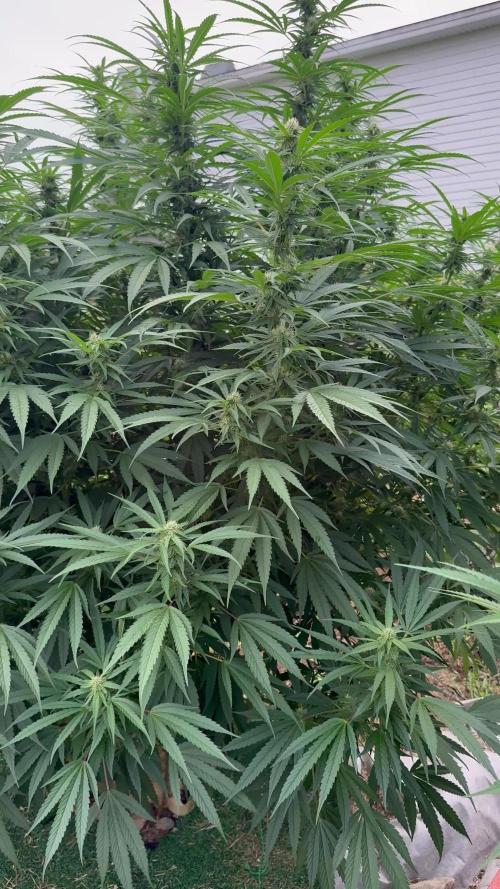
One of the plants grew massive! However the smoke wasn’t the best until a good 4 weeks cure. Very hairy buds too which was interesting 😂 Still a nice smoke
Likes
12
Share
Note: Moisture and Temp readings are done in the mornings. Lights are on an 18/6 schedule on most days. Unless stated otherwise. 📏: AK1: 22 in (55.88 cm), AK2: 26 in (66.04 cm), North: 17 in (43.18 cm) Quick Notes: At the beginning of the week I was tending to the AKs deficiencies, all plants received a lot of extra nutrients this week. I think it was related to being underfed or underwater. Midway through the week, they started to recover and grow taller. North is on the verge of flowering. I also lollipopped all plants to try and clear the lower region so it's easy to water and so the plants can focus growth on the important parts. Overall the AKs have been drinking up a storm (watering almost every day at this point), I'm trying to keep an eye out for overfeeding. I'm feeding every watering for now until I see issues pop up, then I'll slow down. Next week may be the week I start flower (guessing since these are autos). Day 42 (Jul 8) - Plants look the same as yesterday pretty much, AK1 & AK2 are doing less of the 'preparation droop'. The major yellow leaves are starting to crust off and it seems like the mid/upper leaves are not getting paler / translucent. Watering with a lot of Nutrients this morning. 💧: Tap: x pH (Forgot to measure tap) Adjusted with Concentrated Lemon Juice AK1: 1 liter (5.7 pH, 2.5 ml FloraMicro, 2 ml FloraGro, 1ml FloraBloom, 1.5 ml CalMag) AK2: 1 liter (6.1 pH, 2.5 ml FloraMicro, 2 ml FloraGro, 1ml FloraBloom, 1.5 ml CalMag) North: 1 liter (5.6 pH, 2 ml FloraMicro, 2 ml FloraGro, 1 ml FloraBloom, 1.5 ml CalMag) 💦: 41% (36-58) - 🌡️: 28C (25-34) Day 43 - Lights out overnight, starting 7 hrs from 130am. Lights on, AL1 & AK2 perky, surprised AK2 is perky. The yellowing seems to have slowed on both plants. AK2 developed salty spots on random leaves. *AK2 grew 4 inches in 2 days. 💦: 52% (36-65) - 🌡️: 28C (23-31) Day 44 - Lights 24 hours. Watering in the morning, pots are light and the soil is pretty dry. Giving a little less Nitrogen / Micro and more Bloom to North since she's clearly showing some white pistols (and it doesn't seem to be suffering from the same things as the AK's). 💧: Tap: 8.15 pH Adjusted with pH Down AK1: 1.5 liter (6.1 pH, 2.5 ml FloraMicro, 2 ml FloraGro, 1.5 ml FloraBloom, 1.5 ml CalMag, 1.5 ml Voodoo Juice) AK2: 1.5 liter (5.8 pH, 2 ml FloraMicro, 2 ml FloraGro, 1.5 ml FloraBloom, 1.5 ml CalMag, 1.5 ml Voodoo Juice) North: 1.5 liter (6 pH, 1.5 ml FloraMicro, 2 ml FloraGro, 2 ml FloraBloom, 1.5 ml CalMag, 1.5 ml Voodoo Juice) 💦: 41% (35-65) - 🌡️: 31C (23-31) Day 45 - Soil pretty dry, a little damp ¾ inch below surface. Got 3-in-1 pH / Light / Moisture reader in mail, pH is reading pretty alkaline soil (need to investigate, not sure if accurate). 💧: Tap: 7.10 pH Adjusted with pH Down AK1: 1.5 liter (7? pH [forgot to record the exact amount], 2 ml FloraMicro, 2 ml FloraGro, 1.5 ml FloraBloom, 1.5 ml CalMag) AK2: 1.5 liter (6.15 pH, 2 ml FloraMicro, 2 ml FloraGro, 1.5 ml FloraBloom, 1.5 ml CalMag) North: 1.5 liter (6.15 pH, 1.5 ml FloraMicro, 2 ml FloraGro, 2 ml FloraBloom, 2 ml CalMag) 💦: x% (34-37) - 🌡️: xC (28-30) Day 46 - Lights off overnight (9 hrs), with exhaust fan on so watered pots don't humidity tent. Plants look relatively fine, North's bud sites are developing (think I see 2 new sites). Placed Oscillating fan in tent for more circulation, average temps decreased overall. 💦: 62% (34-34) - 🌡️: 24C (23-31) Day 47 - Lights off overnight (~9 hrs). Spent some time Lolipopping the plants, then watered. *North soil wasn't completely dry yet. 💧: Tap: 7.30 pH Adjusted with pH Down AK1: 1.5 liter (5.9 pH, 2 ml FloraMicro, 2 ml FloraGro, 1.5 ml FloraBloom, 2 ml CalMag, 1.5 ml Voodoo Juice) 875 PPM AK2: 1.5 liter (5.75 pH, 2 ml FloraMicro, 2 ml FloraGro, 1.5 ml FloraBloom, 2 ml CalMag, 1.5 ml Voodoo Juice) 1050 PPM North: 1.5 liter (6? pH, 1 ml FloraMicro, 2 ml FloraGro, 2 ml FloraBloom, 2 ml CalMag, 2 ml Voodoo Juice) 💦: 54% (40-64) - 🌡️: 27C (23-29) Day 48 (Jul 14) - Lights dimmed overnight. Not watering North since the soil is still moister than the AKs. AK soils are not completely dry. All plants are beginning to flower, especially North so I'm lowering FloraMicro for now to see the response and upping FloraBloom. 💧: Tap: 7.60 pH Not adjusted AK1: 1 liter (6.2 pH, 1.5 ml FloraMicro, 2 ml FloraGro, 2 ml FloraBloom, 2 ml CalMag, 1.5 ml Voodoo Juice) ~1200 PPM AK2: 1 liter (6.2 pH, 1.5 ml FloraMicro, 2 ml FloraGro, 2 ml FloraBloom, 2 ml CalMag, 1.5 ml Voodoo Juice) 💦: 72% (41-74) - 🌡️: 25C (24-30)
Likes
17
Share
Ok had to keep ph at 7 even after finding out last week of ph burn got it under control all plants lost some sun leaves but are healthy. Cheese 1 is almost done smells like cheese and fruit. Cheese 2 is at 46 inches wouldn’t stop growing she is budding well. Cream 1 is moved is in shock recovering in veg. And cream 2 is about 30 inches and buding up fat been good week cheese 1 about ready in week or two others shortly behind.
Likes
4
Share
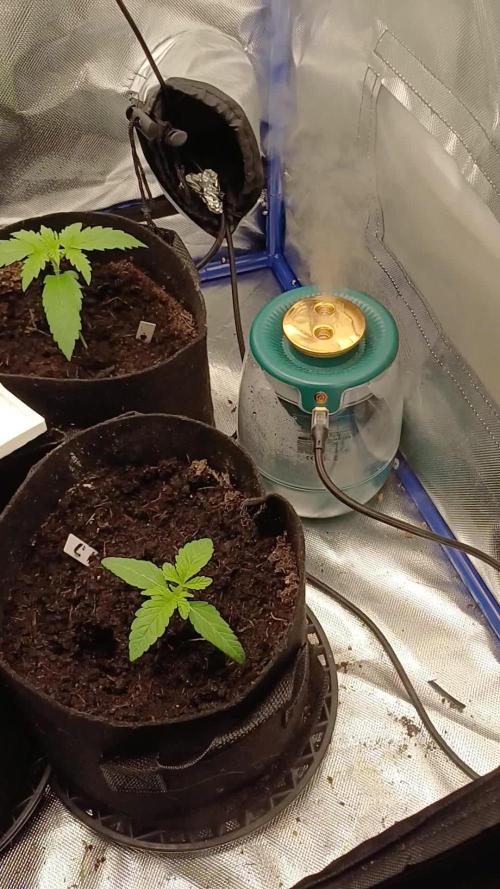
Getting bigger and looking healthy, only around 150 PPFD They seem to be sensitive to strong light, still too little Day 21 - topped the bigger girl, hopefully she catches up since she was already moving faster
Likes
22
Share
Day 69: Watered each plant with 1.5L with nuts 1379 ppm, 2951us/cm, 2.9 EC (1 purple punch, wedding Cheesecake) 1391 ppm, 2959 us/cm, 2.9 EC (gorilla cookies) 1L 319 ppm, 678 us/cm 0.6 EC (3 strawberry banana and 2 purple punch) (2L each) 3 different feedings for the 10 plants Still flushing all the strawberry banana and 2 purple punch with flawless finisher, 2ml per L. (1st week flawless finisher, 2L each, 2nd week clear water, 150L each pH tap water) Day 71: I've been struggling with the humidity, always around 70%, I can't turn the lights off at the moment. I lost one of the main fans during 2 days, and I found mold on all the tops on one purple punch and on the smaller strawberry banana as well. First timing having this issue! High humidity plus not enough air circulation equals this. Mistakes happen for a reason. Need to start rethinking my whole air circulation, exaustor, fans, etc etc. I removed the infected buds, I used a magnified glass to help me do the job better. I did everything like the book. Already have 3 fans on the tent, let's see how it goes. Humidity between 65-75% Day 73: Watered each plant with 1.5L with nuts 1458 ppm, 3101us/cm, 3.1 EC (2 wedding Cheesecake and 1 gorilla cookies) 283 ppm, 602 us/cm 0.6 EC (3 strawberry banana, 3 purple punch and 1 wedding Cheesecake) (2L each) 2 different feedings for the 10 plants Still flushing, 1st week flawless finisher, 2L each, 2nd week clear water, 150L each pH tap water) Everything running smooth, they are starting to show the colors from the flush I've been doing. Day 75: Watered each plant with 1.5L with nuts 290 ppm, 617 us/cm 0.6 EC (3 strawberry banana, 3 purple punch and 3 wedding Cheesecake) (2L each) Day 77: Watered each plant with 1.5L with nuts 1811 ppm, 3810 us/cm, 3.8 EC (gorilla cookies) 253 ppm, 538 us/cm 0.5 EC (3 strawberry banana, 3 purple punch and 3 wedding Cheesecake) (2L each) Still flushing... Going to cut some of them this week.
Likes
2
Share
Took less than a week to get her from seed to 5 gallon pot!
Likes
15
Share
@MG2009
Follow
02/10/2021 I supper cropped the top 4" down toward lower level to promote auxins to redistribute, also starting 12-12 light cycle should be 8-9 weeks of flowering🙏 if she more than doubles in stretch,then I will need to switch to LED lights to finish
Processing
Likes
19
Share
Day 27 from seed: These ladies have not disappointed this week at all. Even poorly girl #2 has got busy and began growing again. I have switched nutes to Mega Crop and they have all been getting a feed of 1g per L and calmag and silica to keep the npk in balance. This stuff is great to work with and its results are brilliant . seeing some of the grows done with it and the low cost of too. This is made for us. The Los girl is doing good with the Mc so far and as it is a mineral nute, the ph is not such an issue to worry over. #3 is still the most advanced and has been topped and her limbs are staked for her lst. Love the results of the silica when training plants. An absolute must !. No signs of any pistils.yet so some growth still to go before the stretch starts and becomes a monster crop.lol I have seen some great Fast Bud autos yield amazing.
Likes
32
Share
19-11-2021: Still 4 weeks left... Buds are starting to swell, I think I have to harvest the Runtz a week earlier. Lowered CO2 to 800PPM. Lowered EC to 1.8. Will replace the water by end of the week. 21-11-2021: Some people suggesting I should use PK13/14... But they are not telling why.. Honestly... I have no clue what it could do for me. Already using Green Sensation from Plagron with clearly says..."When you use Green Sensation you don't need a PK fertilizer, enhancer, booster or enzymes!". So I am just continuing as I do. @Hazeydays... Was just rereading your comment but cannot find any grow diary from you :(. Why do you think I should add PK13/14?You said (3 weeks ago) your ladies are in week 7 and 3 times as big as mine. What do you mean by that? Because I think it is quite normal that plants in week 7 flower are bigger then plants I week 1 flower. Do you have a link to your diary? Thanks in advance 23-11-2021: As you can see some buds seem already to be ready for harvest. Very strange, only 56 days of 12/12 now. (I started counting flower on day 27 of 12/12 so only 29 days of real flower. I was told this might be due to adding Green Sensation too early but I would expect all the ladies would suffer from it then. It is just one. Even the lady which is in the same bin doesn't show any signs of amber trichomes. Very Very strange. 24-11-2021: Buds seem to swell very fast now overnight. Looking and smelling great. Today my fans will arrive so from tonight on they will have some windy conditions I hope.
Likes
3
Share
@Cainb
Follow
The one on the right is still stalling putting bud on. Coming from dry amendments to coco has been fun but back to soil on my next run