Likes
Comments
Share


@Sup3rNov4
Follow
Day 1. Most of the lower fan leaves are now yellowing and the buds are starting to fatten up Approx 2 weeks until harvest
Day 3. Plants looking good very strange thing is happening though the plants are all showing signs of nute burn but I am currently flushing lol
Day 5. Getting close to harvest now thinking 10 - 14 days
Day 7. Fall is very much in the air almost all the fan leaves are dying off. 4 more days of flush followed by 4 days starvation and they are being harvested


Likes
14
Share


@Mr_Dior21
Follow
Last 2 weeks before I put her in a 3 day dark period! I’m no longer giving any nutrients and I’m letting the plant deplete all the nutrients in the soil, I’m also only using water for now own. I have her in a 11.5 hour light schedule. There’s slight nutrient burning too on some parts but it’s nothing drastic.


Likes
21
Share


@Esoteric_growing
Follow
Buds filling out nicely, humidity a touch high but all good apart from that

Likes
6
Share


@Dieselnutz
Follow
Had a slight salt build up flushed the girls w drip clean and adjusted the nutes to 700ppm. Run off was around 1800ppm got it down to 850. So far phenos 3 and 4 seem to be the chunkiest though 1 and 2 are stacking pretty nice. Definitely getting a slightly garlicky gassy smell hoping one leans for towards gmo n less fruity/jelly.

Likes
12
Share


@Hawkbo
Follow
Purple Lemonade , Gelato 1&2, LAK 2&3 are all just about done theyll be coming down over the weekend or early next week. T26, Pineapple Express, Mexican Airlines, LAK 1, 6 Shooter Blue Dreamatic and Cream Cookies are all on the flush but will need a few more before chop. This tent reeks up the whole block it's pretty intense skunk in the driveway right now. There will be one more update I'm guessing for most of these before the harvest update. This was the most successful autoflower crop I've had in a long time I think theres some really good quality buds on some of these. I'll put the video up now and as I go thru the pics theyll be uploaded so if your interested come back tmm for the pics.
Likes
14
Share


@DonPato
Follow
Fin de la semana 5, entrando a la semana 6, fue increíble la forma en que crecieron estas señoritas, sin duda haber renovado la bomba de CO2, por una nueva, completamente hecha a mano y casera (1,5 litros de agua tibia, 500 gr. de azúcar blanca granulada y 15 gr. de levadura fresca, en una botella de refresco, con un hoyo en la tapa), hizo que la fotosíntesis fuese mas apresurada, ideal para las plantas de tipo autoflorecientes, el volumen de crecimiento fue aproximadamente de un 45% y logro que ya empezaran a aparecer los primeros pistilos, estoy muy emocionado como han respondido todos los componentes agregados en este cultivo, desde el sustrato de Canna Terra Proffesional, hasta los nutrientes Top Crop, ademas de mencionar a las semillas Fast Buds y las semillas a granel de Bocanda Growshop en Temuco, Chile.
Una vez dicho eso, las plantas entraron al quirófano para hacerles su única defoliación pesada entrando establemente en floración, para ello, elimine las hojas más grandes y los micro-tallos que no alcanzaron a entrar en flora esta semana, dejando a los más aptos y fuertes, para su engorde con nutrientes orgánicos (Top Bud y Top Candy). Ahora veremos como reaccionan a la defoliacion y al regado con solo agua con PH controlado.
Saludos a todos, buenos humos y gracias por visitar este diario.
Abrazos. Don Pato!
___________________________________________________________________________________________________________________________________________________
(Eng)
End of week 5, entering week 6, it was amazing how these ladies grew up, without a doubt having renewed the CO2 pump, for a new, completely handmade and homemade (1.5 liters of warm water, 500 grams of granulated white sugar and 15 grams of fresh yeast, in a soda bottle, with a hole in the lid), made photosynthesis more rushed, ideal for autoflowering plants, the volume of growth was Approximately 45% and I have already begun to appear the first pistils, I am very excited how all the components added in this crop have responded, from the Canna Terra Proffesional substrate, to the Top Crop nutrients, in addition to mentioning the seeds Fast Buds and bulk seeds from Bocanda Growshop in Temuco, Chile.
Having said that, the plants entered the operating room to make them their only heavy defoliation stably entering flowering, for this, eliminate the largest leaves and the micro-stems that did not reach to enter flora this week, leaving the fittest and strong, for fattening with organic nutrients (Top Bud and Top Candy). Now we will see how they react to defoliation and watering with only water with controlled PH.
Greetings to all, good smokes and thanks for visiting this diaire.
Hugs. Don Pato!

Likes
39
Share


@Mastr
Follow
Day 50 and they are so healthy and bushy I feed them.with
4ml bloom
4ml heaven
4m acti vera
4ml top max
Been done finally defoliation yesterday guy this time I cut all lower branches and just leave top branches just want see what different coz I been speaking to someone with experience he told me you need do defoliation very very aggressive I know you get low yield but its top shelf bud you get let see its work or no
Day 54 and she is in weeks 5 flowering but still bud wont get fatten up but I know mulost sativa start fatten up week 5 to 7 in flowering let see
Likes
41
Share


@KilgoreTrout
Follow
Defoliated IE lollipopped today. Everything is going really well. I backed off on nutes a bit because I was getting a bit of clawing. Otherwise all is super good no complaints.
I did get a bit of dark cycle light exposure a few days ago because I forgot to close the flaps. How much and for how long I'm not sure but I'm now keeping my eyes out for balls and or hermie traits. Fingers crossed.
Processing
Likes
2
Share


@CanadianFillmore
Follow
Smell is increasing, buds are filling in nicely and very sticky too! Compared to the last grow, theses plants are much healthier at this point.


Likes
34
Share


@MrJoint
Follow
✌️🎃 Thank you for checking my cultivation.
✂️ Last defoliation and LST to receive more light on buds.

Likes
2
Share


@Saintvicious
Follow
Going strong. Biggest seed in pack and she's showing. Bout to be Lst time.
Likes
11
Share


@Camo_greenthumb1
Follow
Giving them half a gallon once. Every 4 days now with smaller amounts of added 19-4-23 to every other watering

Likes
4
Share

@Mrdub
Follow
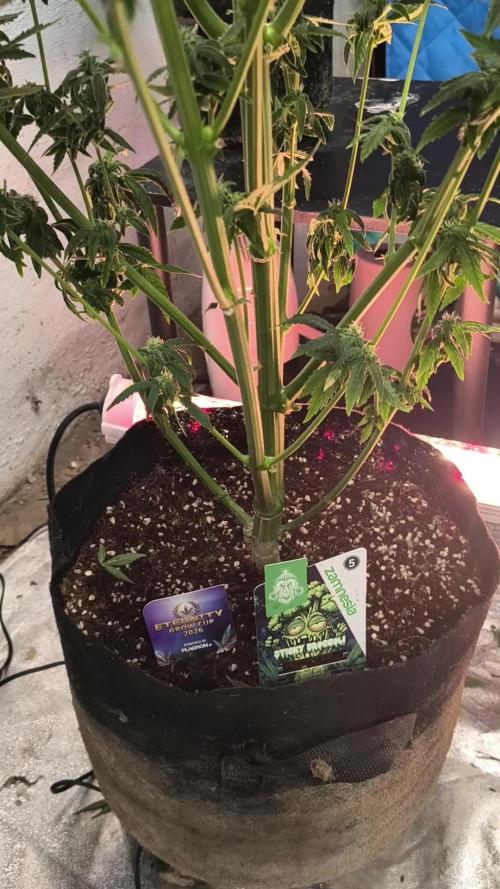
This girl is getting huge colas stacking trichome coverage getting really thick starting to get that sweet smell doesn't have a lot of pistols but the ones pointing out the calaxes she's got nice little crown on her top she jus got a big defoliation to open everything up under canopy lighting rocking you def see it on the lowers running 6.2 pH around 2000 ppm and haven't seen nothing but good results so far upped the calmag cause I noticed that plants in the 5 gallon suck up some calmag when there bulking them flowers out and adding the green sensation is helping alot so far I have some strong branches and a strong stalk cause she's holding herself up really good thanks to the silica running lights at 100 percent rocking a 2 day 24 hr light cycle and then she's off for 8 hrs jus added another fan to bring in some more airflow still adding recharge and bloom city maybe one or two more doses of them then I'll cut them out hit her with a carboload after the microbes and she responds really well she sucks down a gallon of water every couple of days so here's to another week of growing lfg

Likes
38
Share


@GreenHouseLab
Follow
It’s the Final Countdown, 400 ppms to 200 ppms until she is ripe for the taken. Buds looking plump for only 95w of power.
Likes
6
Share


@Nothingbutcolas
Follow
First week of seedlings just about done. Seedlings emerged by March 8th or 9th. Going great so far, 6/6 alive, one sort of okay. Fox Farm Happy Frog base soil. Aiming to keep best 4 for a Scrog, only have max 150cm height in the tent (low basement). Aiming for VPD around 0.6 to 0.7.

Likes
14
Share


@Dunk_Junk
Follow
Wow she's doing great this week. Grew another 20cm. Totally out of headroom now.
She's going to yield a lot in a few weeks 😎