


Likes
Comments
Share


@TokyoStreet
Follow
Plants are cruising through and stacking nicely.
Brewed & fed flowering tea recipe & plants responded with some smell starting to feel up my tent.
Blue Cheese definitely has some funky cheesy & earthy aroma.
Afghan kush smell is the most exciting to smell these days as its aroma is something akin to a perfume.
Can't wait to see what the rest of this week looks like.


Processing
Likes
18
Share


@CRK00
Follow
13th Week Report 09/01/20 - 16/01/20
16/01/20
Filled the reservoir with just 4L solution since probably this will be the last week before flush.
Now CMXL is just fattening and I can see differences in thickness from last week!
You can also see some color changing in her pistils, she's getting beautiful!
I'm checking trichomes color to be sure to harvest at the right time, I tried to take pictures at magnifier, but it doesn't look clear.
However there is any Amber trichomes and there are a lot of clear "mushrooms". They will be checked day by day to harvest when more or less is every trichome is cloudy and to be sure about buds potency.
Hope to harvest next week 😉🍀
Last Update 16/01/20
See you guys ;)


Likes
58
Share

@Kirsten
Follow
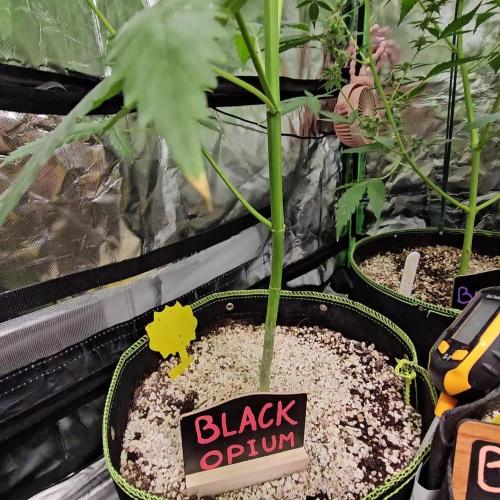
Black Opium has continued flower development and is looking very promising. The buds are fattening up very nicely. Good things to come for this one! 😁
I'm trying to add in some PK boosters at this stage, she's looking beautiful. I'm adding Bud explosion, Seaweed extract, Ecothrive Flourish, and Sea K. To increase the Phosphorus and Potassium, to aid in flower development. Let's see how fat these buds can get!
Here is what I did this week.
4.9.25:
I watered with 3L of dechlorinated water PH'd to 6.4 with;
💜 2ml Trace
PH: 6.4
PPM: 361
9.9.25:
I watered with 3.25L of dechlorinated water PH'd to 6.3 with;
💜 6ml Flourish
💜 1 TSP Sea K(elp)
💜 .5 TSP Bud Explosion
PH: 6.3
PPM: 970
Thanks for checking in this week and hanging out in the comments, Best of luck to everyone in the contest, Happy Growing 😊💚✌️🍃🙏

Likes
36
Share


@ZigkGrow
Follow
ZigkGrow is back in the game😎
Hello to everyone guys. I hope everyone has been growing epic buds since the day I finished my first diary.
My first diary went pretty cool. I enjoyed a lot but knowing myself I knew that I had to learn more about growing cannabis to achieve higher levels and be okay with myself.
So Zigk after many hours of researching, smoking and having fun came up to this day with this diary. Hope everything goes well and what I've learned will bear fruit in this grow (literally😅)
Let's talk a little bit about my setup and the flashy "Automatic-Watering System" to shed some light in the tunnel.
I bought a tent 0.40x0.40x1.40cm so we are pretty tight here but I am hoping for a "one and good" plant. I am going to use for lighting the led panel from Spiderfarmer SF-1000, big upgrade compared to the 250w CFL I had back then.
I will be using coco coir in a 6lt airpot with high fertigation and a RTW/DTW hydroponic system. I've also got some pretty good meters. HM Digital PH-200 for pH and HM Digital COM-100 for EC. There is also a humidifier and a carbon filter from Airontek with a VKO 105m3/h exhaust fan.
So how does the Automatic-Watering System works and how do I achieve high fertigation with that :
There is a reservoir (blue box in my case) out of the tent where I keep my nutes mixed with water. Inside the reservoir is an airstone that provides oxygen and a submersible water pump connected to the pipe.
The water pump plug is connected to a timer which I set when to run and for how much time. When the pump is on is sending nutes to my plant and I can control the flow of it with a valve. Practically I dont have to water by hand and I can achieve high fertigation which means watering with nutes many times a day. My plan is to water 5 times a day.
Now is the time for the big question. Will this work and give me higher and better yields?
I am not going to explain the science behind this theory because I want to keep the diary clean and talking about this would need many rows of words. You can search it on internet tho and find many articles.
I am not capable of answering with confidence now and we will only be sure by watching the results. So let the time show us and have fun!😄

Likes
6
Share


@valiotoro
Follow
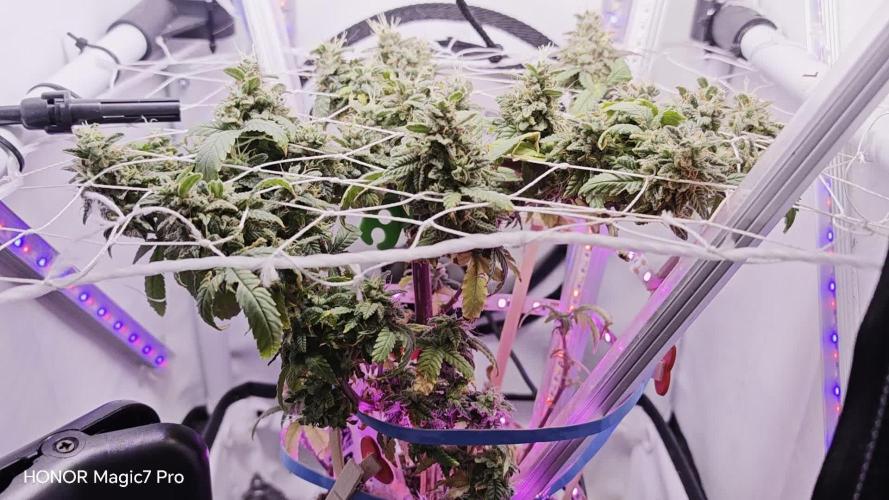
Easy trim the buds are sticky and the smell earthy & fruity very nice 👍
The buds are less dense
7-10 days on the dry racks then smoke report next year
Take care 😎



Likes
2
Share


@Ultraviolet_
Follow
Remember that, however you are played, or by whom, your soul is in your keeping alone. Even though those who presume to play you be kings or men of power, when you stand before God, you cannot say, 'But I was told by others to do thus,' or that virtue was not convenient at the time. This will not suffice. Remember that.
Day:18
84°F and 65% RH (VPD) for the vegetative stage. Approximately 1.15kPa(assuming leaf temperature is about 2°F cooler than the air), which falls right into the ideal vegetative sweet spot (0.8kPa to 1.2kPa). At 1.15kPa, plants can draw water and nutrients efficiently without risking stress or wilting. It keeps the leaf pores (stomata) open, allowing for ideal carbon dioxide intake and maximizing vegetative growth. VPD is determined by the leaf's temperature, not just the ambient air. Because leaves usually run 1° to 3°F cooler than room air under bright grow lights, my actual VPD will be slightly lower, closer to the 1.0kPa mark. As she transitions from vegetative growth to flowering, one can gradually lower the humidity (to around 45–60%) and drop temperatures slightly to prevent disease from settling inside dense buds when they appear.
Night:6
At 70°F and 60% relative humidity, Vapor Pressure Deficit (VPD) is 0.86 kPa. This is right on the cusp of whats optimal for the vegetative stage. During the nighttime, plants generally close their stomata and undergo cellular respiration rather than photosynthesis. Transpiration slows to a near stop, making VPD less critical at night than during the day. However, maintaining a nighttime VPD between 0.8 and 1.0 kPa is highly beneficial in that it ensures the air is dry enough to prevent powdery mildew or bud rot, but moist enough to keep the plant from undergoing unnecessary stress. This range keeps the environment comfortable for cellular processes and prevents large atmospheric swings. Keeping it all flowing.
(Not pushing them yet, these are photoperiods)
The optimal soil (root zone) temperature for cellular root respiration and nutrient uptake in cannabis is between 68F & 72F This narrow range balances biological energy production (cellular respiration) with the dissolved oxygen levels in the soil, maximizing plant growth and health. Warmer soils hold significantly less dissolved oxygen. When soil temperature exceeds 74F oxygen depletion occurs, inhibiting cellular respiration almost entirely, At 68-72F root cells generate optimal adenosine triphosphate (ATP) via respiration to power root-tip elongation and the active transport of water and nutrients.
Too Hot (Above 78F) Root respiration increases, demanding more oxygen, while the water's oxygen-carrying capacity drops. This creates a prime environment for anaerobic pathogens and Pythium (root rot).
Too Cold (Below 60F) Root metabolism and cellular respiration slow to a crawl. This severely impairs nutrient and water absorption, leading to yellowing, wilting, and phosphorus deficiencies.
A lot depends on whether it's automatic or photoperiod; with photoperiod, there is not as much of a need to push "hard" as the real countdown only begins once the flower is initiated. Automatics, on the other hand, the chronological "clock" begins ticking the moment the seed germinates. It is of critical importance that the seedling growth gets off to the races, understanding that early growth is like compound interest, which will pay off come harvest. This reality is why getting autoflowers "off to the races" early on yields such exponential benefits. The "compound interest" is directly related to the surface area of the leaves. Larger, faster-growing seedlings process more light and build bigger root networks early on, which translates into an explosion of vertical and lateral growth during their short vegetative window.
The margins for error are so thin with autoflowers; this early-stage momentum depends on several critical practices. Seedlings exposed to increased atmospheric CO2 levels early in life will develop at an increased rate. To effectively "extend" or optimize the capacity of Photosystem II (PSII) for increased photosynthetic efficiency. In standard oxygenic photosynthesis, Photosystem II (PSII) is naturally limited to the red-light spectrum, peaking at 680nm. Extending its light-harvesting capacity past 700nm into the far-red region requires bypassing the natural limits of standard chlorophyll a. Adding 730 nm (far-red) LEDs alongside standard red/blue lights has been shown to increase canopy photosynthesis by 20–30% in several crops by acting synergistically with shorter wavelengths. However, the limitation is that excessive, pure IR/Far-red light (without accompanying red light) can trigger the "shade avoidance response," causing plants to grow tall, weak, and spindly rather than robust. Utilizing infrared light (specifically the 700-750 nm far-red range) is a viable method to boost photosynthetic efficiency. It acts as a bridge to allow PSII to utilize a broader spectrum of light, breaking the traditional 700 nm barrier. UVR8-mediated signaling (often in conjunction with CRY proteins) triggers protective mechanisms that maintain the stability of the photosynthetic apparatus (including LHCII and reaction center proteins), thus ensuring that the efficiency of Photosystem II remains higher in UV-B-exposed plants compared to plants lacking this receptor. ΦPSII indictates the rate of electron transfer from water to plastoquinone, which drives the production of ATP and NADPH. There is a close link between ΦPSII and the true rate of CO2 fixation (Φ*co2).
ETR stands for Electron Transport Rate. It measures the speed at which electrons are moved through the thylakoid membranes in a plant's chloroplasts during the light-dependent reactions of photosynthesis. Infrared light (particularly Near-Infrared or NIR) improves cellular energy by interacting directly with the electron transport chain (ETC) in mitochondria. This process boosts adenosine triphosphate production, which acts as a metabolic coefficient multiplier by accelerating enzyme activity dramatically.
Extend then multiply.
Far-Red photons interact with plant photoreceptors to accelerate the plant’s biological "clock" or trigger a shade-avoidance response. Autoflowers don't use the plant's biological clock, although the IR will initiate a shade avoidance and make them stretchy. You can just add equal measures of 660nm-680nm to negate the shade avoidance effect. Replacing nights' "darkness" with a combination of IR+ and 660nm. Because autoflowers don't require a dark period to flower, many growers just blast them with light. 18/6 24/0. However, this ignores the plant's metabolic rhythms, where daytime photosynthesis (light reactions) must be perfectly balanced with nighttime carbon fixation and assimilation (Calvin cycle) to avoid bottlenecking plant development. Cellular respiration is a 24/7 process, but it can only function while the plant has the free oxidative capacity to do so. A 100% photosynthetically active leaf cannot perform cellular respiration. The viral trend of defoliation of every leaf that isn't "getting enough light" is of great detriment overall, putting 100% of the cellular respiratory "workload" and responsibility on the 0/4/6 hours of darkness in sub-optimal conditions for enzymatic activity. Photosynthesis captures nearly 100% of the initial energy as carbon, while cellular respiration is the process that unlocks 90% of that captured energy into usable ATP so the plant can use it. Respiration is considered only roughly 30% to 40% efficient. It captures enough of the potential energy in glucose to synthesize around 30 to 38 ATP molecules per glucose molecule. The remaining 60% to 70% of the energy in the sugar is not captured in ATP; instead, it naturally escapes into the environment as heat, which helps regulate plant temperature. In plants, the primary enzymes of the Electron Transport Chain (ETC) and the ATP synthase complexes are typically adapted to function optimally in warmer temperatures (roughly 77°F to 95°F, depending on the specific plant strain). As temperatures rise within this physiological range, molecular collisions increase, speeding up respiration and ATP production. The cannabis plant has a branched respiratory pathway. During heat or cold stress, plants activate Alternative Oxidase (AOX). AOX burns sugars to dissipate energy as heat rather than coupling it to ATP production. This pathway actually functions optimally at elevated temperatures to help protect the cell from the damaging build-up of Reactive Oxygen Species (ROS) during heat stress. Enzyme activity generally scales with heat; there is a strict biological limit. If canopy temperatures in a grow room exceed 104°F, the enzymes and their supporting lipid membranes lose stability. Not saying you need to go crazy, just optimize nights the same as we optimize days.
Phosphorus is the driving force behind early seedling development. It acts as the "energy hub" of the plant, directly driving cell division, robust root growth, and the creation of DNA. Without an adequate, easily accessible supply early on, the plant's overall growth potential and final yield can suffer permanently.
Likes
9
Share


@Luxengrow
Follow
Up on at day 45 of flowering now, and the plants are still doing great. They bounced back super quick from their defol on F35, and are now just slowly fattening up and starting to stink out the tent. Added in some more nematodes and predatory mites (mighty mites) as a purely preventative measure. Starting to ease up on some of the compost teas now as they mature, but they’re still getting some over the next few weeks.

Processing
Likes
Comments
Share


Likes
21
Share


@Staffedition
Follow
Всем привет друзья!
Решил попробывать фотопереодный, поднять от Барни и не только, смотри профиль.
Это будет мой первый опыт с фотопереодными растенями.
#Smail_Seeds
Likes
15
Share


@tokesly
Follow
Everyone says the plants smell amazing but I can't smell them! fml. They're supposed to smell like guava candy. Just gotta rest up more till my smell is back, honestly the worst thing about covid. Started flush this week, going to flush for 10 days including a 48 hour darkness period. The darkness period is when the buds can reproduce the trichome coating. It's normally used as sunscreen for light protection but much is burned off during intense day times. This is why it's best to harvest after a period of darkness.


Likes
16
Share


@NatureSolutions
Follow
Correct weeknumbers are difficult in a perpetual grow lol🙃
Little update with all the strains.
Runtz XL(more xxxx small lol) was drowned as can be seen, no hole in that pot>drilled them today. As small as she is she is the second plant that entered flowering stage.
Red Gorilla girl XL was in my vertical garden system, didnt respond well its leaves started to wilt, the pot got replaced somewhere a little more temperate. The lsd-25 seems to be okay in the vertical wall.
The Purple punch is well into flower ready to develop nugs in next 2 weeks
Happy growing peeps
Likes
2
Share


@Luram
Follow
Going for the final countdown but meanwhile Albinism has appeared in some flowers! I think it must be the panel it was very close to them although it is a bit late now the lights have been distanced a bit more from the canopies.
Starting Week 7 where i will slowly start reducing the dosages from the nutrients up to the final week 8 where they will be flushed with pure water until harvest


Likes
29
Share


@Cheeba_Inu
Follow
As of day 28, the NYC Diesel is growing vigorously and seems healthy. The post LST branching I was hoping for a week ago has occured so I am happy with the width and evenness of the canopy as well. I am regularly removing and tucking foliage which is helping with how dense this plant is (lots of branching with minimal internodal spacing).
I feel like it is on the cusp of flowering, so I am preparing to change up the nutrients over the next week. I will continue with the LST if there continues to be quite a bit of stretch.
Day 29: Switched to GH Flora for nutrients. Starting low and will dial it up.
Thanks for reading!

Likes
19
Share


@Organic473
Follow
Luckily, I got some seeds from this girl before someone in the village stole it.
Processing
Likes
35
Share


@Njaak
Follow
Added 2 videos on preparing a nutrient solution and pH balancing the solution.
This week saw aggressive topping (mid week 4) and some serious leaf damage. Not sure if the leaf damage is from the topping, nutrients, etc. I did a flush and solution swap, cleaned the air stone and inside of the jar etc. Built the trellis and started training. I'll cut away whatever trellis doesn't end up getting used once flowering starts.
Creepy Don Santa is watching this grow closely. That cat of his is trouble.


Likes
38
Share


@ATriggerman
Follow
Alles läuft ohne Probleme 😍
Erst am 08.04.24 gemerkt, dass die Lüfter nicht optimal eingestellt sind.
Eine Cam zu haben, zahlt sich aus.
Mutter und mein erster Grow in Deutschland 😁
Frosty Nightmare estimated day of Harvest around the 27th of may.
Gelato estimated day of harvest around the 25th of may.
Sleepy Joe estimated day of harvest around the 25th of may

