The Grow Awards 2026 🏆 







Likes
32
Share
@BudBoutique
Follow
! this is my current status, gonna upload my last veg weeks within the next week - got a bit busy around Spannabis - thank you for your understanding! 💚
Welcome to Bud Boutique Grow Diary - really appreciate all your love and support :)
Dont forget to check out my other current grows!
🗓️ This Week:
after 48 hours of complete darkness (important for seedlings to make sure all plants switch into flower same time), I finally switched my lights to the 12/12 schedule and sent my ladies into the flower.
- more than healthy and going well
- Day 5: super strong and praying upas u can
- Day 3: Foliar spray with APTUS Regulator and APTUS Nutrispray to give them extra micronutrients and give them a little shell for protection.
! always use APTUS Regulator first and mix well with your water before adding any other nutrients for Feeding or Foliar!
Thank you for still staying with me 💚
___________________________________________
--- 🌱 Strain (Sponsor) ---
🏷️ Stardawg by MSNL
https://www.marijuana-seeds.nl/stardawg-feminized-seeds
--- 🥗 Nutrients and Feeding (sponsored by APTUS: APTUS Ambassador) ---
🍸 APTUS: full nutrient schedule extreme
-- Regulator, N-Boost, P-Boost, CaMg-Boost, K-Boost, Allin1 Liquid, Startbooster, Topbooster, Enzym+ every feeding
-- Fulvic-Blast, NutriSpray as Foliar each once a week
🔗 https://aptus-holland.com/
--- ♻️ Grow Control (Sponsor) ---
TROLMASTER: TENT-X + LM14 Light Adapter to dim/sunrise/sunset lights + Temp & rH Sensor all remote on App
🔗 https://www.trolmaster.eu/
--- 🏭 Grow Setup ---
💡LUMATEK Zeus Pro 600
* 🏠🌿 Indoor: Homebox 120x120x200cm (4x4)
* 📐🌀 PrimaKlima exhausting Fan 1180m3/h (running on 60-80%)
* 🌀 Can Light Filter 800m3/h & 1x Fanbox 1x Dyson fan for Air circulation
🔗 https://lumatek-lighting.com/zeus-600w-pro-29/
🔗 https://primaklima.com/de/shop/ventilatoren-de/ec-ventilatoren/pk160ec-tc/
🔗 https://canfilters.com/products/filters/
All Likes and comments are highly appreciated!!!
👨🌾 don't forget to check out my Instagram for daily educational content: budboutiquee
- Bud Boutique


Likes
490
Share
@Legendaryseedthumb
Follow
Day 69: harvested today will update day after day how the drying goes!
Day 70: dont have a rh meter hahaha so i hope its not to dry in there. Seems like
Day 72: hahahahaha fucked it up today! Had the humidifier on without my controller!!!! So 99%rh in drying tent when I came home… good job..😂🤦♂️🏽🤦♂️🏽🤦♂️🏽🤦♂️🏽
Day 74: still drying but had to take my tent down so had to cut the plants as well! So trimmed them to speed the drying up a bit! The buds look really yummy, but doesn’t smell any good yet hope that change in the upcoming days
Day 77: the buds just taste better and better 😁
This is the light that I’m using for this grow!
Mars hydro SP3000
High PPFD at 2.8 umol/j, average yield at 2.5g/w, increasing your yield 50% or more compared with old blurple and HPS lights, 300 watts output.
Dimmer knob added, more convenient to adjust the brightness. Up to 30 lights can be daisy-chained and control together on just one light, or just have one lamp in 120x60 tent is perfect for light.
https://www.instagram.com/marshydro_aliexpress2/


Likes
4
Share
@UrbanBoer
Follow
Talk about a mission accomplished, dam you Lamby… you had me excited at one point when I thought you were an auto, but to my shock, you are a regular, you just have a long ass flowering window… at least unlike her sisters within the 4th cycle, she did not reveg she just focused on flower, the buds are bulky and firm, scent is amazing, you would mistake her for a cheese strain. I should not be disappointed by the plant’s size! Because I planted her during winter, and all outdoor or greenhouse(unless you have a GH that is climate controlled), do not grow as big as the would during spring or summer season, and due to this factor, I only got 59g of wet bud. But I have faith the other ladies will produce a higher yields.
Last I smoke this strain was earlier late summer or early Autumn, and from smoking to growing now harvest, I wish I am blown out the water with this strain, it’s time to conduct that questionnaire. Or even better go to an established cannabis club, and get them to samples bud, and ask for a review.


Likes
15
Share
@valiotoro
Follow
Hello everyone😎
Week 6 of flower for the LCC🍋🍒🍪
All the top buds harvested✂️
I had a lot of fun growing this strain🤩
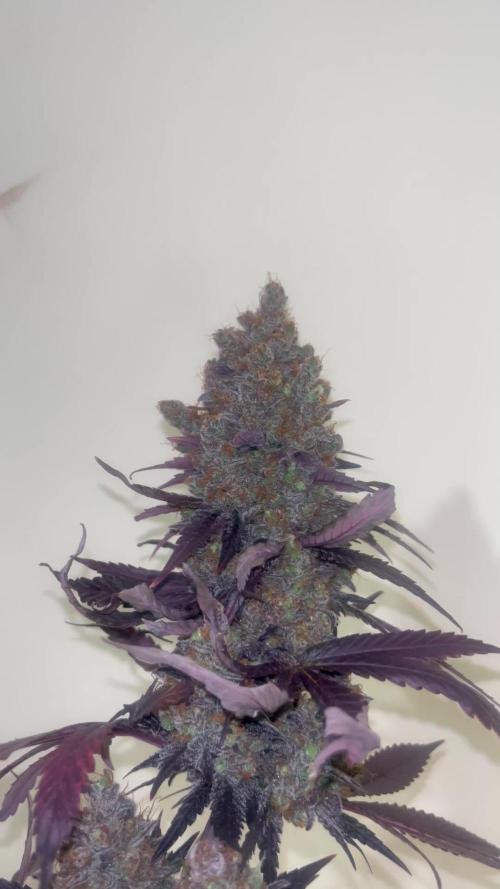
The smell is absolutely out of this world…the colors…💜
I have 3 different pheno,all purple,some smells more citrus and the others more ripe cherries!
One more week for the lower buds and finito I already feel nostalgic😜
*what’s coming out of the yuzu is essentials oil,every year I make Yuzucello feel free to ask me the recipe🍸🍋
Likes
9
Share
@MadeInGermany
Follow
Harvest day 69
since time switch
to 12 / 12 h
Hey guys :-)
Finally it's time 💚
The lady is done the large leaves have been removed and hung upside down to dry in the dark drying room.
You can now stay there for 13-15 days at a temperature of 18-20 degrees and 55-62% humidity.
After 13-15 days it is neatly trimmed by hand and placed in jars with boveda packs 62.
After 4 weeks Boveda 58% come in and are ready for testing ;-).
After everything has been cut cleanly, the last update comes with the smoke report and the finished pictures.
Have fun and stay healthy 💚🙏🏻
👇🏼👇🏼👇🏼👇🏼👇🏼👇🏼👇🏼👇🏼👇🏼👇🏼👇🏼👇🏼
‘Powered by GreenHouse Feeding’
Copy the link for 10% off all Nutrients 👇🏼
http://shop.greenhousefeeding.com/
affiliate/madelngermany_passiongrower/
👇🏼👇🏼👇🏼👇🏼👇🏼👇🏼👇🏼👇🏼👇🏼👇🏼👇🏼👇🏼
Water 💧 💧💧
Osmosis water mixed with Cal/Mag (24 hours stale that the chlorine evaporates) to 290 ppm and Ph with Ph- to 5.8 - 6.4
MadeInGermany

Likes
12
Share
@OGbros
Follow
the plants are fine. for 2 weeks I have increased the fertilizers and they are responding well. the strawberry is about two weeks ahead of the tropicanna. the smell is intense and very sweet👽
Likes
106
Share
@StarLorr
Follow
Welcome to my autø Øpium Diary.
In this Diary:
Seeds: Sponsored by Ðivine Seeðs
Media: Pro~Mix HP *•ns
Nutrients: Remo Supercharged Kit *•ns
*•not sponsored
___________________________
Feeding:
Tue 22Oct: 2L Remo/Recharge pH'd 6.5
Thu 24Oct: 2L Remo/Recharge pH'd 6.5
Sun 27Oct: 2L Remo/Recharge pH'd 6.5
___________________________
Things are going smoothly, had to put her on a pedestal as her roomie moon rock2 is hugging all the lights😄
___________________________
Thanks for stopping by, likes and comments are appreciated!👊🏻😎
Keep on growin!
Keep on tokin!!!
😙💨💨💨💨💨

Processing
Likes
5
Share
@Mr_nugs_lover_David
Follow
This lady is showing beautiful roots and a fast growth pace, let's see how she keeps developing every day guys, finally this beautiful lady was Transplanted on February 2nd after 17 days planted from seed because I thought it was the right time considering her size and also because the pot was completely conquered by those super healthy and strong roots, let's see how this lady keeps performing so far! 💛❤️💚👨🌾💯

Likes
2
Share
@Mr_nugs_lover_David
Follow
This ladies have gone trough a beautiful stretching that has allowed them to achieve a beautiful shape with secondary branches that will develop great nugs! Stay tuned guys, very excited about this 2 autos


Likes
69
Share
@nonick123
Follow
Día 87 (26/08) Aplicación foliar de Bacillus thuringiensis a 1 g / litro para evitar a las temidas orugas de los cogollos!
Hace un día nublado (29 ºC de maxima) y NO es necesario regar
Elimino la malla de sombreado de la cara sur, ya que las temperaturas son más suaves después de la canicula
Día 88 (27/08) Riego con 500 ml H2O pH 6,5
Empiezan a bajar las temperaturas a 29 ºC de máxima, y se nota en la demanda de agua por parte de las plantas!
Día 89 (28/08) Riego con 500 ml H2O pH 6,5
Cada planta empieza a ir un poco a su marcha en la demanda de riego dependiendo de su tamaño y estado de floración
Día 90 (29/08) Riego con 250 / 500 ml H2O pH 6,5
He detectado un gusano de los cogollos muerto sobre una hoja! 💥 Parece que los Bacillus thuringiensis funcionan estupendamente! 😁
Día 91 (30/08) Riego con 250 / 500 ml H2O pH 6,5
Día 92 (31/08) Riego con 1 litro H2O pH 6,5 + 25 ml de Humus de Lombriz Liquido
Día 93 (01/09) Aplicación foliar Bacillus Thuringiensis
No es necesario regar tras el litro de ayer y dia nublado con pequeños chubascos!
💦Nutrients by Lurpe Solutions - www.lurpenaturalsolutions.com
🌱Substrate PRO-MIX HP BACILLUS + MYCORRHIZAE - www.pthorticulture.com/en/products/pro-mix-hp-biostimulant-plus-mycorrhizae


Likes
5
Share
@Momgrowsthechronic
Follow
Welcome to Week 6 of the Fast Buds Lemon Pie Auto grow! These plants seem constantly hungry so I’ve increased the fertilizer again to 3.75 mls per gallon with every feeding. So I water every fourth day- 3 litres per plant which equals 0.75 of a litre per plant per day. But when I water, I air bubble my jugs using a fish pump to dechlorinate my water while adding some bonus oxygen. I use three 1 gallon milk jugs to hold my water and when I feed- I only add fertilizer to two of the three jugs. I use the plain, PH’d water first and then continue with the fertilized water adding up to a 25/75 ratio of plain water to fertilized water with every feeding. So far so good as these hungry ladies seem to be thriving and tolerating the increase nicely. Defoliating as needed. Thanks for stoppin by… 🤓
Likes
4
Share
@DivinePineMan
Follow
I have my Electric Sky 180v2 now in instead of the cheap 40$ for 4 lights i bought on facebook. Which were growing but nothing like this thing has been doing the past week. Im still blown away by the light but back to the plants. Doimg great i took some clones. First time ever so hopefully they root. I been sprayin em 4 -6 times a day. My 3rd g6jetfuel i took out of my tent with es180v2 and put in closet by itself with the 40$ cheap leds. It hasnt grown a whole lot compared to the tent plants g61 and 2...i thought maybe it may of had a male or hermi part but honestly i dont think it did bc i cant find it now. But its still in there bc i decided to throw it on 12-12 in closet to find out sex forsure. Ive been foliar spraying in my tent 3 timez a day. And 2 times a week i get 2 little drops of fox farm grow bif in my 10oz spray bottle of water.


Likes
4
Share
@eldruida_lamota
Follow
Venga familia ya viene la cosecha de estas Runtz de MSNL, que ganas que tenía ya de darles tijera.
Para empezar es buena variedad un poco tardía de lo que dicen pero me encantó cultivarla , aún con la plaga de trips que sufrí las 2 últimas semanas aguantaron y sacaron unas flores alucinantes.
Las flores aparte se ven resinosa y tienen colores llamativos.
La planta pues si creció vigorosa, no es muy frondosa y es resistente.
Fue una genética con la que disfruté bastante y es bastante fácil de cultivar.
Agrobeta:
https://www.agrobeta.com/agrobetatiendaonline/36-abonos-canamo
Mars hydro:
Code discount: Eldruida
https://www.mars-hydro.com/
Hasta aquí es todo , espero que lo disfrutéis, buenos humos 💨
Processing
Likes
10
Share
@CanadianFillmore
Follow
Start of week 6! Week 5 went well, the girls are all very sticky and smell incredible! The super lemon haze continues to need extra feeding, she's a hungry lady! Both blueberry plants are packing on a lot of weight as the branches are bending and twisting, I tried them up to give them extra support.
