The Grow Awards 2026 🏆
Likes
Comments
Share
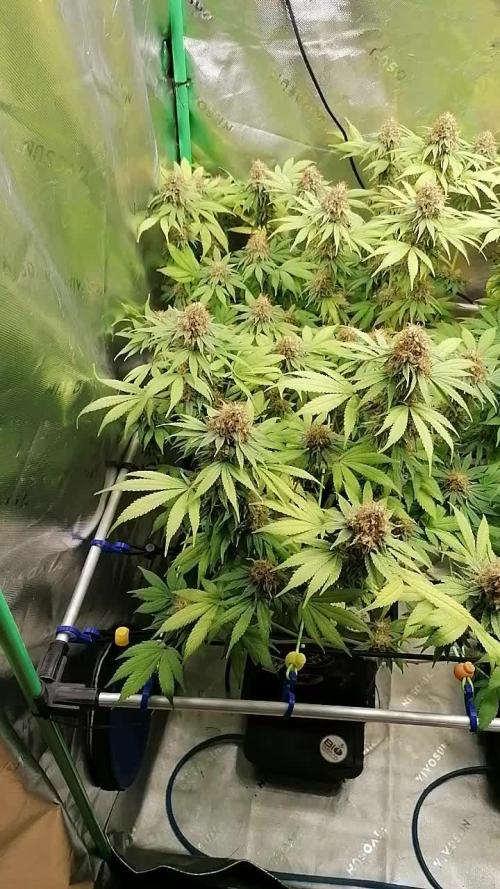
Purple Buds are amazing.I could not be happier with their color, buds are chunky and frosty, the smell is indescribable. It reminds me a certain sweet from the childhood :) and I bet it will taste even better. Later, I will show some more pictures for Industrial CBD which is doing fine. I will move Purple Buds tomorrow out of my tent for two days in the darkness and then - harvest time :) CBD has got one more week to go I think. Happy growing to everyone.
Likes
9
Share
I tried Scrog but I took it off it seem to make my fruit salad unhappy much taller than other plants too .many leaves getting smooshed I should have done a few weeks earlier plus needed good defile and lollipop its my first grow I thought I would slow down. on yhe techniques till next round
Likes
19
Share
Two of the three have been cut. The first one was just a stubby little lady that had just under an ounce of dried flower. The second one was taken last night and her main cola weight 5 wet and was just covered in oily terpenes. This last one while behind the others is by FAR the frostiest and I can’t wait for her to ripen. Therefore I am not calling it a harvest until the trichomes become perfect as the last one did.
Likes
6
Share
@Comfrey
Follow
I missed to take some fotos ore a video. So I chooses to show where the soil is made: in Comfreys garden. Unfortunately I‘m not allowed to grow there my weed. It‘s a community garden with privat owned ground but with a lot of neighbors. The German law allows to grow cannabis in your own garden for private use but not in a private garden situated in a community garden club (Kleingartenverein). But anyway I’m lucky because we have a very sunny balcony, too. Next week more fotos…
Likes
3
Share
Nice start flowering time. Need sunny weather now. Left flower has bigger blooms, it is nice. Edit: The left flower goes faster.. Start nutrients Plagron Green Sensation and Royal Sugar for maximum blooming now.
Likes
27
Share
Vamos familia, esto ya va cogiendo de nuevo forma, me encanta esta variedad do sweet dos de sweet seeds es brutal, cepa cruzada x cookies 🍪, es un híbrido que bien cultivado no falla. . El ph como siempre 5,8 , la temperatura es óptima, en 22/24 grados de media, y la humedad actualmente está entre el 60/70%. . AgroBeta: 0,8 ml x L Piramid , vía radicular. 0,6 ml x L Growth black line , vía radicular. 0,1 gr x L Cancerbero , vía radicular. 0,1 ml x L Tucán , vía radicular. 0,1 ml x L Flash Root , vía radicular. 0,4 ml x L Great Green , vía foliar. 0,05 ml x L Gold Joker, vía radicular. . Esto es todo, espero que os vaya gustando el cómo va avanzando esto se ven con buen porte, es un cultivo que si va todo como hasta ahora , va ser increíble. Muy buenos humos 💨💨💨.
Likes
5
Share
@Jayndre69
Follow
Well think I'm going to start flush tmr ive had several problems with this run but still really happy with the outcome tho there is alot of room for improvement! I believe I will try soil next I had nothing but problems with ph in coco coir I will put up the outcome of the 3 plants it does look promising:)
Processing
Likes
30
Share
2018-04-10 Day 1 I gave the girls water and nutrients yesterday so nothing to drink today. Turned them 90 degrees today, to give my girls as much lightexposure as possible. The flowers get bigger and bigger for each day, Overall the ladies look really good, the colors are very nice, they look healthy. Nr1 is very bushy, and I am curious of what she will become since she had some serious issues right after germination. 😁 Crazy Cookies nr 1 is 69 cm Crazy Cookies nr 2 is 56 cm Added new videos of the girls, go ahead and check them out 😎 2018-04-11 Nothing new to report, the girls are doing great. Turned them 90 degrees, just like every other day, I believe the exposure of light from different directions will increase the yield in the end, so it's definetly worth the effort. Added a video of what I believe heaven looks like 😇 --------------------------------------------------------------------------------------------------- Strain information: The word synergy is a business term first quoted in the early eighties to describe mutual enhancement through interaction or cooperation, where the end result gained is greater than the sum of the parts used. What do synergy and the Crazy Cookies cannabis strain have to do with each other you may well ask? The parents of the forthrightly indica Crazy Cookies are marijuana royalty. OG Kush and Girl Scout Cookies. These strains of contemporary legend have been combined to cerebrum shattering effect. The cured flowers deliver a mouth-watering and couchlocking 24% THC. The initial delectable spacey upbeat onrush compliments of the Durban Poison coursing through the genes of the Cookies soon becomes a lush and rich, inescapably delicious body flux. There should be a picture of a Crazy Cookie nugget in the dictionary next to the word synergy. Crossing the OG back into the Cookies has amplified the psychoactive effects of the notorious lineage of both parents. This is an indica with a capital I. As a breeder it would be fair to assume that injecting more OG into the Cookies would result in an OG-dominant Cookie, or even close to a pure OG, but something else has happened. Some long dormant genetic switch has been flipped and a standalone indica has emerged whose spicy notes and earthy tones, hints of grape and horny pheromone are an absolute pleasure. Paying this breed some careful attention as it grows will reward you substantially, indoors or out. Typical hybrid vigour is shown throughout each grow phase. Stout plants to 80cm can be expected indoors and muscular examples with fluted stalks growing to two metres can be easily achieved outdoors. Good bracing is necessary as the flowers mature. With more than 500g at harvest per robust plant, colas can easily snap and twist branches. --------------------------------------------------------------------------------------------------
Likes
26
Share
Finally time has come to chop down plants 1&2. They look ready and trichomes are mostly cloudy with some embers. Both plants weight 750 grams as whole. I would assume there is around 30-40 grams dry on each, but we would have to dry cure and than return with results. 3rd plant can probably go for another week, she looks like she can get her buds bigger, also still many many white pistils. She is looking very promising with very long buds (: 3rd plant chopped after 1 week, weighs 500 grams wet as whole. Joining the 2 other girls in the closet
Likes
3
Share
Good evening to all grower :D!! Finally I sent these bad girls into bloom, I noticed a very strong elongation in all 3 plants, there are also some very small pistils!!
Likes
28
Share
Week 6 of to a good start! They look happy and healthy. Time to flip to flower soon! 👽👉3/10 Climate is automated and working accordingly to my adjusted VPD settings. Happy and healthy, actually surprised they've grown so much lately. 👽👉4/10 Waiting for their complete recovery, so they can be flipped to flower (Defoliation the 30/9, im giving them about a week) 👽👉5/10 Water day* Plain ph balanced water. Need Runoff PH and EC down a little bit. 👽👉6/10 I applied the SCROG net. 👽👉7/10 Doing some minor tweaks to the setup + VPD settings(from 1.0 to 1.1). Approaching the flip to flower, so VPD Did a bit of defoliation before the flip next week 👽👉8/10 Today, i learned from research on biobizz nutrients https://www.thcfarmer.com/threads/biobizz-nutrients-answers-from-biobizz.78899/ (Direct answer from biobizz) With the answers, my view on feeding biobizz changed a bit, and i was luckily about to switch up the nutes. Good timing. Waterday* PH6.2 Introducing Biobizz CalMag(0.5ml/l) + BioBloom(0.25ml/l)+Topmax(0.25ml/l)+Rootjuice(0.25ml/l) Still 2ml/L Fishmix+BioHeaven(Fishmix will be switched out with BioGrow) 👽👉 9/10 Last day of the week for my plants and last day in veg! They look fantastic and well recovered at lights on! (Look at the before/after lights vids/pics) Raised VPD by 0.1: VPD settings(from 1.1 to 1.2)
Likes
25
Share
ANTHOCYANIN production is primarily controlled by the Cryptochrome (CR1) Photoreceptor ( !! UV and Blue Spectrums are primary drivers in the production of the pigment that replaces chlorophyll, isn't that awesome! 1. Diverse photoreceptors in plants Many civilizations, including the sun god of ancient Egypt, thought that the blessings of sunlight were the source of life. In fact, the survival of all life, including humans, is supported by the photosynthesis of plants that capture solar energy. Plants that perform photosynthesis have no means of transportation except for some algae. Therefore, it is necessary to monitor various changes in the external environment and respond appropriately to the place to survive. Among various environmental information, light is especially important information for plants that perform photosynthesis. In the process of evolution, plants acquired phytochrome, which mainly receives light in the red light region, and multiple blue light receptors, including his hytropin and phototropin, in order to sense the light environment. .. In addition to these, an ultraviolet light receptor named UVR8 was recently discovered. The latest image of the molecular structure and function of these various plant photoreceptors (Fig. 1), focusing on phytochrome and phototropin. Figure 1 Ultraviolet-visible absorption spectra of phytochrome, cryptochrome, phototropin, and UVR8. The dashed line represents each bioactive absorption spectrum. 2. Phytochrome; red-far red photoreversible molecular switch What is phytochrome? Phytochrome is a photochromic photoreceptor, and has two absorption types, a red light absorption type Pr (absorption maximum wavelength of about 665 nm) and a far-red light absorption type Pfr (730 nm). Reversible light conversion between the two by red light and far-red light, respectively(Fig. 1A, solid line and broken line). In general, Pfr is the active form that causes a physiological response. With some exceptions, phytochrome can be said to function as a photoreversible molecular switch. The background of the discovery is as follows. There are some types of plants that require light for germination (light seed germination). From that study, it was found that germination was induced by red light, the effect was inhibited by subsequent far-red light irradiation, and this could be repeated, and the existence of photoreceptors that reversibly photoconvert was predicted. In 1959, its existence was confirmed by the absorption spectrum measurement of the yellow sprout tissue, and it was named phytochrome. Why does the plant have a sensor to distinguish between such red light and far-red light? There is no big difference between the red and far-red light regions in the open-field spectrum of sunlight, but the proportion of red light is greatly reduced due to the absorption of chloroplasts in the shade of plants. Similar changes in light quality occur in the evening sunlight. Plants perceive this difference in light quality as the ratio of Pr and Pfr, recognize the light environment, and respond to it. Subsequent studies have revealed that it is responsible for various photomorphogenic reactions such as photoperiodic flowering induction, shade repellent, and deyellowing (greening). Furthermore, with the introduction of the model plant Arabidopsis thaliana (At) and the development of molecular biological analysis methods, research has progressed dramatically, and his five types of phytochromes (phyA-E) are present in Arabidopsis thaliana. all right. With the progress of the genome project, Fi’s tochrome-like photoreceptors were found in cyanobacteria, a photosynthetic prokaryotes other than plants. Furthermore, in non-photosynthetic bacteria, a homologue molecule called bacteriophytochrome photoreceptor (BphP) was found in Pseudomonas aeruginosa (Pa) and radiation-resistant bacteria (Deinococcus radiodurans, Dr). Domain structure of phytochrome molecule Phytochrome molecule can be roughly divided into N-terminal side and C-terminal side region. PAS (Per / Arndt / Sim: blue), GAF (cGMP phosphodiesterase / adenylyl cyclase / FhlA: green), PHY (phyto-chrome: purple) 3 in the N-terminal region of plant phytochrome (Fig. 2A) There are two domains and an N-terminal extension region (NTE: dark blue), and phytochromobilin (PΦB), which is one of the ring-opening tetrapyrroles, is thioether-bonded to the system stored in GAF as a chromophore. ing. PAS is a domain involved in the interaction between signal transduction-related proteins, and PHY is a phytochrome-specific domain. There are two PASs and her histidine kinase-related (HKR) domain (red) in the C-terminal region, but the histidine essential for kinase activity is not conserved. 3. Phototropin; photosynthetic efficiency optimized blue light receptor What is phototropin? Charles Darwin, who is famous for his theory of evolution, wrote in his book “The power of move-ment in plants” published in 1882 that plants bend toward blue light. Approximately 100 years later, the protein nph1 (nonphoto-tropic hypocotyl 1) encoded by one of the causative genes of Arabidopsis mutants causing phototropic abnormalities was identified as a blue photoreceptor. Later, another isotype npl1 was found and renamed phototropin 1 (phot1) and 2 (phot2), respectively. In addition to phototropism, phototropin is damaged by chloroplast photolocalization (chloroplasts move through the epidermal cells of the leaves and gather on the cell surface under appropriate light intensity for photosynthesis. As a photoreceptor for reactions such as escaping to the side of cells under dangerous strong light) and stomata (reactions that open stomata to optimize the uptake of carbon dioxide, which is the rate-determining process of photosynthetic reactions). It became clear that it worked. In this way, phototropin can be said to be a blue light receptor responsible for optimizing photosynthetic efficiency. Domain structure and LOV photoreaction of phototropin molecule Phototropin molecule has two photoreceptive domains (LOV1 and LOV2) called LOV (Light-Oxygen-Voltage sensing) on the N-terminal side, and serine / on the C-terminal side. It is a protein kinase that forms threonine kinase (STK) (Fig. 4Aa) and whose activity is regulated by light. LOV is one molecule as a chromophore, he binds FMN (flavin mononucleotide) non-covalently. The LOV forms an α/βfold, and the FMN is located on a β-sheet consisting of five antiparallel β-strands (Fig. 4B). The FMN in the ground state LOV shows the absorption spectrum of a typical oxidized flavin protein with a triplet oscillation structure and an absorption maximum wavelength of 450 nm, and is called D450 (Fig. 1C and Fig. 4E). After being excited to the singlet excited state by blue light, the FMN shifts to the triplet excited state (L660t *) due to intersystem crossing, and then the C4 (Fig. 4C) of the isoaroxazine ring of the FMN is conserved in the vicinity. It forms a transient accretionary prism with the tain (red part in Fig. 4B Eα) (S390I). When this cysteine is replaced with alanine (C / A substitution), the addition reaction does not occur. The effect of adduct formation propagates to the protein moiety, causing kinase activation (S390II). After that, the formed cysteine-flavin adduct spontaneously dissociates and returns to the original D450 (Fig. 4E, dark regression reaction). Phototropin kinase activity control mechanism by LOV2 Why does phototropin have two LOVs? Atphot1 was found as a protein that is rapidly autophosphorylated when irradiated with blue light. The effect of the above C / A substitution on this self-phosphorylation reaction and phototropism was investigated, and LOV2 is the main photomolecular switch in both self-phosphorylation and phototropism. It turns out that it functions as. After that, from experiments using artificial substrates, STK has a constitutive activity, LOV2 functions as an inhibitory domain of this activity, and the inhibition is eliminated by photoreaction, while LOV1 is kinase light. It was shown to modify the photosensitivity of the activation reaction. In addition to this, LOV1 was found to act as a dimerization site from the crystal structure and his SAXS. What kind of molecular mechanism does LOV2 use to photoregulate kinase activity? The following two modules play important roles in this intramolecular signal transduction. Figure 4 (A) Domain structure of LOV photoreceptors. a: Phototropin b: Neochrome c: FKF1 family protein d: Aureochrome (B) Crystal structure of auto barley phot1 LOV2. (C) Structure of FMN isoaroxazine ring. (D) Schematic diagram of the functional domain and module of Arabidopsis thaliana phot1. L, A’α, and Jα represent linker, A’α helix, and Jα helix, respectively. (E) LOV photoreaction. (F) Molecular structure model (mesh) of the LOV2-STK sample (black line) containing A’α of phot2 obtained based on SAXS under dark (top) and under bright (bottom). The yellow, red, and green space-filled models represent the crystal structures of LOV2-Jα, protein kinase A N-lobe, and C-robe, respectively, and black represents FMN. See the text for details. 1) Jα. LOV2 C of oat phot1-to α immediately after the terminus Rix (Jα) is present (Fig. 4D), which interacts with the β-sheet (Fig. 4B) that forms the FMN-bound scaffold of LOV2 in the dark, but unfolds and dissociates from the β-sheet with photoreaction. It was shown by NMR that it does. According to the crystal structure of LOV2-Jα, this Jα is located on the back surface of the β sheet and mainly has a hydrophobic interaction. The formation of S390II causes twisting of the isoaroxazine ring and protonation of N5 (Fig. 4C). As a result, the glutamine side chain present on his Iβ strand (Fig. 4B) in the β-sheet rotates to form a hydrogen bond with this protonated N5. Jα interacts with this his Iβ strand, and these changes are thought to cause the unfold-ing of Jα and dissociation from the β-sheet described above. Experiments such as amino acid substitution of Iβ strands revealed that kinases exhibit constitutive activity when this interaction is eliminated, and that Jα plays an important role in photoactivation of kinases. 2) A’α / Aβ gap. Recently, several results have been reported showing the involvement of amino acids near the A’α helix (Fig. 4D) located upstream of the N-terminal of LOV2 in kinase photoactivation. Therefore, he investigated the role of this A’α and its neighboring amino acids in kinase photoactivation, photoreaction, and Jα structural change for Atphot1. The LOV2-STK polypeptide (Fig. 4D, underlined in black) was used as a photocontrollable kinase for kinase activity analysis. As a result, it was found that the photoactivation of the kinase was abolished when amino acid substitution was introduced into the A’α / Aβ gap between A’α and Aβ of the LOV2 core. Interestingly, he had no effect on the structural changes in Jα examined on the peptide map due to the photoreaction of LOV2 or trypsin degradation. Therefore, the A’α / Aβ gap is considered to play an important role in intramolecular signal transduction after Jα. Structural changes detected by SAXS Structural changes of Jα have been detected by various biophysical methods other than NMR, but structural information on samples including up to STK is reported only by his results to his SAXS. Not. The SAXS measurement of the Atphot2 LOV2-STK polypeptide showed that the radius of inertia increased from 32.4 Å to 34.8 Å, and the molecular model (Fig. 4F) obtained by the ab initio modeling software GASBOR is that of LOV2 and STK. It was shown that the N lobes and C lobes lined up in tandem, and the relative position of LOV2 with respect to STK shifted by about 13 Å under light irradiation. The difference in the molecular model between the two is considered to reflect the structural changes that occur in the Jα and A’α / Aβ gaps mentioned above. Two phototropins with different photosensitivity In the phototropic reaction of Arabidopsis Arabidopsis, Arabidopsis responds to a very wide range of light intensities from 10–4 to 102 μmol photon / sec / m2. At that time, phot1 functions as an optical sensor in a wide range from low light to strong light, while phot2 reacts with light stronger than 1 μmol photon / sec / m2. What is the origin of these differences? As is well known, animal photoreceptors have a high photosensitivity due to the abundance of rhodopsin and the presence of biochemical amplification mechanisms. The exact abundance of phot1 and phot2 in vivo is unknown, but interesting results have been obtained in terms of amplification. The light intensity dependence of the photoactivation of the LOV2-STK polypeptide used in the above kinase analysis was investigated. It was found that phot1 was about 10 times more photosensitive than phot2. On the other hand, when the photochemical reactions of both were examined, it was found that the rate of the dark return reaction of phot1 was about 10 times slower than that of phot2. This result indicates that the longer the lifetime of S390II, which is in the kinase-activated state, the higher the photosensitivity of kinase activation. This correlation was further confirmed by extending the lifespan of her S390II with amino acid substitutions. This alone cannot explain the widespread differences in photosensitivity between phot1 and phot2, but it may explain some of them. Furthermore, it is necessary to investigate in detail protein modifications such as phosphorylation and the effects of phot interacting factors on photosensitivity. Other LOV photoreceptors Among fern plants and green algae, phytochrome ɾphotosensory module (PSM) on the N-terminal side and chimera photoreceptor with full-length phototropin on the C-terminal side, neochrome (Fig. There are types with 4Ab). It has been reported that some neochromes play a role in chloroplast photolocalization as a red light receiver. It is considered that fern plants have such a chimera photoreceptor in order to survive in a habitat such as undergrowth in a jungle where only red light reaches. In addition to this, plants have only one LOV domain, and three proteins involved in the degradation of photomorphogenesis-related proteins, FKF1 (Flavin-binding, Kelch repeat, F-box 1, ZTL (ZEITLUPE)), LKP2 ( There are LOV Kelch Protein2) (Fig. 4Ac) and aureochrome (Fig. 4Ad), which has a bZip domain on the N-terminal side of LOV and functions as a gene transcription factor. 4. Cryptochrome and UVR8 Cryptochrome is one of the blue photoreceptors and forms a superfamily with the DNA photoreceptor photolyase. It has FAD (flavin adenine dinucle-otide) as a chromophore and tetrahydrofolic acid, which is a condensing pigment. The ground state of FAD is considered to be the oxidized type, and the radical type (broken line in Fig. 1B) generated by blue light irradiation is considered to be the signaling state. The radical type also absorbs in the green to orange light region, and may widen the wavelength region of the plant morphogenesis reaction spectrum. Cryptochrome uses blue light to control physiological functions similar to phytochrome. It was identified as a photoreceptor from one of the causative genes of UVR8 Arabidopsis thaliana, and the chromophore is absorbed in the UVB region by a Trp triad consisting of three tryptophans (Fig. 1D). It is involved in the biosynthesis of flavonoids and anthocyanins that function as UV scavengers in plants. Conclusion It is thought that plants have acquired various photoreceptors necessary for their survival during a long evolutionary process. The photoreceptors that cover the existing far-red light to UVB mentioned here are considered to be some of them. More and more diverse photoreceptor genes are conserved in cyanobacteria and marine plankton. By examining these, it is thought that the understanding of plant photoreceptors will be further deepened.
Processing
Likes
12
Share
@Buurman
Follow
A really hot week last week, The lamp doesn’t make it any easier but steady at 28 degrees now. OG auto in its final days I think, leaves are starting to turn yellow so I’ve started a flush, it’s a beautiful plant, 80% of the plant is covered in bud, I’ll post some good pics before harvest. Not gonna be a crazy yield but for the size of the plant really decent. The feminized OG are all exploding with bud sites, amazing how fast it’s going the smell is getting better by the day Gorillas are cute! Flowering a little slower but a lot bushier and the leaves are sooooo pretty! Started to give more water and upping the dosage of nutes since I’ve not seen any signs of over feeding might as well try it out Okloveyoubye ❤️
Likes
16
Share
Excited to watch how big her flowers will get! 💮 She's very thirsty - has been the whole grow so far 💦 We'll see if the seeds begin to form soon🌰
Likes
142
Share
Hey everyone :-). The last plants were also placed in the bloom chamber kammer. Everyone has made great progress this week 🙏🏻. There is not much to say about this week, I think videos and pictures say more like words 🙈😎. I wish you all a good start into the week :-) Stay healthy and let it grow 🙏🏻👍
Likes
4
Share
Overall, we are very pleased with the end result of this grow! For the harvesting process itself - once the trichomes on the buds were milky white (see zoomed in photo above), we cut down the branches and hung to dry in the tent. The light was on in the photo to display the hanging to dry method, but the lights were turned off for the duration of the drying process. On the first day the buds were hanging, all large fan leaves were trimmed. Over the course of the next week, day by day, more leaves were trimmed. After 8/9 days of drying, the buds were ready to move into the curing stage (the test for this: the skinny branches would snap when bent, and the thicker branches were near snapping when bent). On day 9, buds were cut from the branches, trimming off the final accessible leaves, without damaging the trichomes, and placed in glass jars with dehumidifier pouches to begin the curing process. For the first 7 days, the jars were opened (burped) for 10 minutes twice daily. After the first week, burping was reduced to once a day and then every few days. Strain first tested after 10 days of curing, but cured for a total of 4 for optimal results. Citrusy flavor, excellent sativa for mellow productivity and a mood boost. Now that I have my first grow under my belt, it's time to move onto the next!
Likes
43
Share
Week 4 of flower and it’s been a week for the books. The males gizzed all over the females and we spent the better part of a week harvesting the males for pollen, then defoliating and spraying the pollinated females, then going full sanitize on the entire tent… (that part always sucks). Either way, they’re off to the seed making and generally showing a brilliant, yet subtle pink across most phenos. Gonna be pretty cool seeing how the colours develop on these👌. The fact that the pinks are prevalent amongst all plants is very encouraging. Still early for sure - but… potential for something special👍. Terp. Profiles are becoming quite pronounced now too. So far, we’ve got one that smells of a very sweet sorta pine in female #3 and a definitive baked berrry scent in female #1. The hope was always to balance out the earthiness of the Kush which is classic to the strain in terms of taste, just not overly tasty. Again, still early but we might’ve achieved that here on crossing🤞👌. All told and as long as we keep ‘em alive to the finish - we should have tons of seed and a well defined set of partially drilled down traits. Counting 3 discernible potential phenos so far and can’t wait to see what the clones reveal🤟. Background This project has been a year in strain selection (and another year in the actual making) to get to this point with a viable potential cross. It’ll be a true polyhybrid with a mix of sativa and indica leaning properties for each. We’ve combined an especially powerful hybrid sativa strain of Strawberry with an equally manageable and hard hitting strain of indica dominant Skywalker OG. The hope has always been to combine them and boil out the best characteristics of each. The strawberry is phenomenal in terms of terp profile and a mix of strong head and body effects while the Skywalker is a mind bending, body butter kind of indica with that earthy Kush profile and flowery undertones. The strawberry is prone to botrytis and fasciation but features excellent terps and yields if grown correctly. She’s Also stretchy and somewhat unruly when she gets going. The Skywalker is a contrast in growth characteristics with a squat structure, medium sized buds and excellent resilience and resistance. The plan is to seed out the available females and take cuts of what we can post-stretch to get a closer look at any differing phenos. Still very much early stages for a stabilized new strain but we’ve got the right foundation of solid genetics. Now we just gotta get it off the ground to the next generation👍. We’re predominantly focused on the plants that demonstrate that hybrid vigour and wasting no time with any problem plants or runts. Stay tuned - with a little luck, this cross is gonna be straight 🔥😎👌.
Likes
8
Share
@Leafy420
Follow
Day 14 After a week from the bottom feed The pots feels light again My finger was dry So i think its time for they first halve dose feed 23c, Ppm 700, ph 6,25 Gave each a dose of 100ml water Day 16 Last night I saw roots so today I transplanted Wich didn't really went as plant because something (Hopefully only soil) dropped right before I placed "Jane" into her new home :( Besides that it went okay Gave them a good dose of water Now wait till it dries and then they get their first full feed dose Day 20 This night they got they first full feed 500ml each 4ml grow A&B 4ml b52, bud candy and voodoo With a low ph to bring down the ph in soil Wich is a lil high I qeuss 22,7c 1000ppm 5,8 ph Day 21 Today we did some LST Now they lay, next up is sit and then we roll So far they are cooperating Day 22 All are now bend and secured and doing well :D Day 23 Soil was dry gave them some calmag 1ml/l each 700ml 6.10ph
Likes
51
Share
Transplant to full soil. No pot involved anymore. Their in contact with mother earth. 🍀🍀🍀 These 2 girls have a bit more stress because of the transit. Still grew like 10 cm. 🍀🍀🍀
Likes
73
Share
@Roberts
Follow
I had a excellent grow of this plant. I didn't have any major issues during the grow. It looks like she provided a good yield. And smelled great when I was able to smell. I am Fighting a cold at the moment. 😒 I am very eager to try this flower once it gets done in the cannatrol, and is ready for its smoke report. This looks like it was a great strain. The harvest video is on my YouTube channel. GD is still having video upload issues on bigger files. Thank you Medic Grow, and MSNL Seeds. 🤜🏻🤛🏻🌱🌱🌱 Thank you grow diaries community for the 👇likes👇, follows, comments, and subscriptions on my YouTube channel👇. ❄️🌱🍻 Happy Growing 🌱🌱🌱 https://youtube.com/channel/UCAhN7yRzWLpcaRHhMIQ7X4g