The Grow Awards 2026 🏆
Likes
Comments
Share
@Regenwurm
Follow
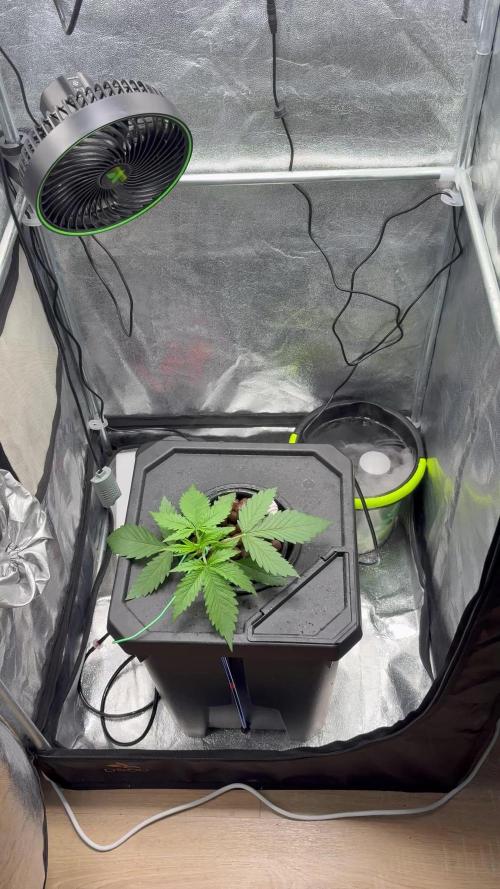
In diesere Woche gibt es nicht viel zu erzählen.....was nicht optimal läuft ist, dass ich wegen der RLF in der Dunkelphase den Luftbefeuchter aus dem Zelt genommen habe und diesen durch ein Entfeuchter ausgetauscht habe. Ich bekomme wegen Platzmangel im Zelt nur 1 Gerät aufgestellt, für mehr ist kein Platz. Das hat zur Folge das meine RLF in der Tagphase auf 34 % sinkt. Hier hätte ich gerne 45 % , bekomme es aber nicht hin🙁. Die Fütterung läuft gut, keine Über oder Unterdüngung. Temperatur fast perfekt.... in dieser Woche kein Flush, keine Entlaubung oder ähnliches....die aktive Zuluft war die ganze Woche an! Aktuell habe ich ein ganz gutes Gefühl! Immerhin sind es noch bestimmt 30 Tage bis zum Harvest Day Peace
Likes
15
Share
@Wilstang
Follow
The grow was a lil unique was able to give it very low strength neits the whole veg. Stayed overall short during vegetation, but boomed once it went into flower. Turning out to be a tall pheno. Flower cycle was a total of 67 days, including a flush of 14 days and lights off for 2 days. Finished product was very long fluffy nugs stretching down the plant. Does not do well in heat at all, ideal temperature is between 60°-70°. Towards the end of flower cycle best to get humidity and temperature as low as possible to bring out the purple hues and bulked nugs. A perfect strain for cold climents or LED lights. Recommended for the connoisseur seeking a sweet change 👏💯
Likes
3
Share
@kdifiori_
Follow
The girls are growing up and doing well, despite the crazy heat we've been having lately. Cheese and Pineapple have turned into two little monsters! I'm really happy with the result!
Likes
25
Share
10/23: I fed today with One, sweet & sticky, signal, superthrive, silica, and a little ca/mg. 10/27: Fed today with one, signal, sweet & sticky, silica, beastie bloomz, kangeroots, and humic acid.
Likes
6
Share
@Yoro33
Follow
Great week. Almost done flowering. Another 2-3 weeks.
Likes
5
Share
Likes
88
Share
🌸🌿 Week 3: Blooms Unleashed! 😁 The stretch has gracefully come to an end, and now, the buds are making their grand entrance! 😁 Standing tall, our Lemon Orange proves to be a formidable presence, prompting the need for some strategic topping and ScrOG to keep its height in check. Growth Management: Given its impressive stature, a little intervention with topping and ScrOG is in order to ensure the plant stays within bounds. It's all about orchestrating the dance of growth. Aromas in Bloom: As the buds unfurl, so do the enchanting aromas. A symphony of citrus notes fills the air, signaling the flourishing flower stage. The pace is exhilarating, promising a delightful harvest in the making. Nutrient Nurturing: In the spirit of balance, I've opted for a mindful approach, utilizing only 80% of the recommended nutrients by Terra Aquatica. It's a careful dance to provide just what our Lemon Oranges needs for optimal growth and flavor development. The stage is set, and our Lemon Orange beauties are gearing up for a floral spectacle. With each passing week, the anticipation for the harvest grows, and the journey unfolds in a crescendo of green and citrusy bliss! 🌼🍊🌿
Likes
32
Share
Welcome to Bud Boutique Grow Diary - really appreciate all your love and support :) Dont forget to check out my other current grows! 🗓️ This Week: After 14 Days drying inside tent with about 60% rh and 18° Celcius ( I know could be even lower). - trimmed all well and put them straight into Grove bags for curing. That is the end of this Diary, thank you all for sticking with me. The next new onces are already up so feel free to check out Thank you for still staying with me 💚 ___________________________________________ --- 🌱 Strain (Sponsor) --- 🏷️ Stardawg by MSNL https://www.marijuana-seeds.nl/stardawg-feminized-seeds --- 🥗 Nutrients and Feeding (sponsored by APTUS: APTUS Ambassador) --- 🍸 APTUS: full nutrient schedule extreme -- Regulator, N-Boost, P-Boost, CaMg-Boost, K-Boost, Allin1 Liquid, Startbooster, Topbooster, Enzym+ every feeding -- Fulvic-Blast, NutriSpray as Foliar each once a week 🔗 https://aptus-holland.com/ --- ♻️ Grow Control (Sponsor) --- TROLMASTER: TENT-X + LM14 Light Adapter to dim/sunrise/sunset lights + Temp & rH Sensor all remote on App 🔗 https://www.trolmaster.eu/ --- 🚿 PetraGrow (Sponsor) --- CannaFogger Foliar Spray 🔗 https://www.petratools.com/product/petragrow-cannafogger-atomizer-new-mini-fogger --- 🏭 Grow Setup --- 💡LUMATEK Zeus Pro 600 * 🏠🌿 Indoor: Homebox 120x120x200cm (4x4) * 📐🌀 PrimaKlima exhausting Fan 1180m3/h (running on 60-80%) * 🌀 Can Light Filter 800m3/h & 1x Fanbox 1x Dyson fan for Air circulation 🔗 https://lumatek-lighting.com/zeus-600w-pro-29/ 🔗 https://primaklima.com/de/shop/ventilatoren-de/ec-ventilatoren/pk160ec-tc/ 🔗 https://canfilters.com/products/filters/ All Likes and comments are highly appreciated!!! 👨‍🌾 don't forget to check out my Instagram for daily educational content: budboutiquee - Bud Boutique
Likes
25
Share
@OZDAOgrow
Follow
So, I've switched to blooming after all. So far so good, except for the fact that I broke my lab PH meter, which is quite expensive. There is also a lot of humidity. In between when the AC is not running, the humidity goes up to 80%, which is no joke at all. I will either buy a dehumidifier or turn on the air conditioner for 24 hours. I don't know what to choose yet, the dehumidifier consumes a lot of electricity, maybe I should just leave the AC on for 24 hours. Yeah, growing in hot countries is not a good idea ^_^.
Likes
15
Share
@MrJones
Follow
MrJones Ztrawberriez Auto 🍓╰⊰🍓´🍓⊱╮🍓╰⊰🍓´🍓⊱╮🍓╰⊰🍓´🍓⊱╮🍓╰⊰🍓´🍓⊱╮🍓 💧 Feeding - Using Gaia Green Grow / Bloom and Compost Teas 🍃Training / LST-Defoliation-Topping TBA 🕷️ IPM - Will be using Green Cleaner" 1 OZ per Gallon, and CannControl from Mammoth alternating between products each month for Integrated Pest 🍓╰⊰🍓´🍓⊱╮🍓╰⊰🍓´🍓⊱╮🍓╰⊰🍓´🍓⊱╮🍓╰⊰🍓´🍓⊱╮🍓 ▶️Sunday 10.29.23 - Going to leave the light cycle alone for another week, these ladies are blowing up pretty well, don't want to mess with the MoJo :) 🍓╰⊰🍓´🍓⊱╮🍓╰⊰🍓´🍓⊱╮🍓╰⊰🍓´🍓⊱╮🍓╰⊰🍓´🍓⊱╮🍓 ▶️Bud Description Ztrawberriez Auto produces long and fat buds with a beautiful light green shade with oftentimes purplish hues and a thick layer of resin that starts at the top of the flowers and continues all the way to the tip of the sugar leaves. It’s the typical bud structure you would expect from hybrid varieties topped with an explosion of fruity terps that’ll hit you in the face with a blend of creamy, fruity, and sweet aromas as soon as you break the buds open. Definitely a must for terp heads and extractors looking for exaggerated flavors and aromas 🍓╰⊰🍓´🍓⊱╮🍓╰⊰🍓´🍓⊱╮🍓╰⊰🍓´🍓⊱╮🍓╰⊰🍓´🍓⊱╮🍓 ▶️SOIL MIX 40% ProMix HP 40% Coco Coir 70/30 15% Worm Castings 05% Malibu Compost 🍓╰⊰🍓´🍓⊱╮🍓╰⊰🍓´🍓⊱╮🍓╰⊰🍓´🍓⊱╮🍓╰⊰🍓´🍓⊱╮🍓
Likes
89
Share
@nonick123
Follow
Esta semana nuestro TrolMaster me ha ayudado mucho con las altas temperaturas que tenemos en mi zona (algo inusual para esta época del año) La VPD está fuera del rango optimo y he tenido algunos momentos de pico con temperaturas por encima de 28 ºC Gracias a tener al TrolMaster he podido reaccionar y dar una entrada de aire más fresco a la sala donde se encuentra mi armario, haciendo que las temperaturas bajen 2 grados centigrados durante los momentos más criticos, incluso dejando toda la noche la ventana abierta para aprovechar el aire fresco de la noche Es genial tener el TrolMaster en mi armario! _________________________________________________ Día 83 (08/04) Riego 1,25 Litro H20 + Wholly Base 2,5 ml/l + Solid Green 1,5 ml/l + Big Bloom 1 ml/l de Gen1:11 TDS 1000 PPMs - pH 6,2 Día 84 (09/04) Velocidad de crucero ON... Las plantas se acercan a su fecha de cosecha teórica (49 días en floración = 13/04/2024) Muestran ligeros signos de senescencia, pero siguen creciendo las flores, el consumo de agua no baja... 😍💥 Día 85 (10/04) Riego 0,5 Litro H20 sin nutrientes. TDS 225 PPMs - pH 6,6 Día 86 (11/04) Riego 1,25 Litro H20 + Wholly Base 2,5 ml/l + Solid Green 1,5 ml/l + Big Bloom 1 ml/l de Gen1:11 TDS 1000 PPMs - pH 6,2 Día 87 (12/04) Empezamos a revisar el color de los tricomas y se encuentran en su mayoría trasparentes con alguno turbio. Va a necesitar unos días más para madurar Wedding Cheesecake FF empieza a no soportar el peso de los cogollos doblando sus ramas 🚀 Lo cierto es que tiene unos cogollos duros como rocas 💪😍 Día 88 (13/04) Riego 0,5 Litro H20 sin nutrientes. TDS 225 PPMs - pH 6,6 Se abre la ventana de la cosecha! 😍 Justo hoy cumplen 7 semanas (49 días) en floración Día 89 (14/04) Riego 1,25 Litro H20 + Wholly Base 2,5 ml/l + Solid Green 1,5 ml/l + Big Bloom 1 ml/l de Gen1:11 TDS 1000 PPMs - pH 6,2 💦Nutrients by Gen1:11 - www.genoneeleven.com 🌱Substrate PRO-MIX HP BACILLUS + MYCORRHIZAE - www.pthorticulture.com/en/products/pro-mix-hp-biostimulant-plus-mycorrhizae 🎚️Controlled by TrolMaster TCS-1 Tent-X System Main Controller - https://www.trolmaster.com/Products/Details/TCS-1
Likes
62
Share
8/23 Fed 2 gallons of nutes to the garden. I'm planning to increase feeding to three gallons as plants look hungry. Ice cream cake isn't as vibrant as it once was. Still losing leaves but I find that is consistent with others in my area according to the local growers page. The hurricane missed us but the rain and humidity are still a problem. It's not raining (plants were soaked so it rained last night) and rh is still 100%. It's outdoor so what can I do? What I NEED to do is spray BT and something to combat PM. Plants are flowering nicely. It's good to actually have some flowers to look at. The smell is great too. 8/24 Didn't water as it rained last night. Defoliated what was dead. Fog was so thick you could cut it with a knife. Everything is in flower. The little ice cream cake flowers don't look like they like this rain. I don't blame them. I don't remember the last time it didn't rain at night. I noticed more damage on plants or maybe old damage. Either way bud shoots are gone on a few lower limbs. I can't pull up my bags as the are firmly rooted. I checked under the five gallon buckets (which were also somehow firmly rooted) and found a shit ton of earwigs underneath. I killed what I could. I tried spraying a bug with dawn but it didn't kill it or at least didn't kill it right off. I stomped on them and tore open the earth. Logic dictates they are probably under the grow bags as well. I'm going to try Spinosid tonight. I'll look up some other methods as well. If anybody has advice please hit me up. UPDATE: Went back down at 6. Super sunny and humid today. Temp was 92 with humidity about 90%. I couldn't spray. I'll have to wait until tomorrow. Found four more moth leaves on the sick isolated plant. They must like the injured ones better. 8/25 Watered and defoliated what needed it. Buds are growing rapidly. Took pictures but have been unable to upload due to slow internet connection. Hopefully the weather will allow me to spray tonight. 8/26 Watered heavy as it's been in the 90s. Couldn't spray as it was to hot last night. Buds are tightening up. Ran out of LCPT so I need to find an alternative. Now that plants are flowering it's easier to see the damage from the earwigs. No buds where they should have been on some low branches. Not many and hopefully the few that got lollipoped will focus growth on the top. I hope I'm able to make it down late tonight to work. I was worried about my plants flowering late but that might be a blessing in disguise. I've seen lots of people losing plants to bud rot. Thanks for stopping by and please leave any thoughts or advice in the comments. 8/27 UPPED MY FEEDING REGIMEN TO THREE GALLONS AND USED TWO TBSP TIGER BLOOM IN PLACE OF KOOL BLOOM AND USED A WHOLE TBSP KELP FOR THE HEAT. This heat is killing me. Yesterday was over 95f with rh in the 90s. My medication makes the heat harder to bare. Defoliated what needed it. I'm in town looking for a fungicide. Planned to use apple cider vinegar this morning but of course I couldn't find it. Buds still rapidly forming. I'll update later. I picked up potassium bicarbonate and citric acid and have the recipe and ingredients for both diy green cleaner and green cure. Once the sun starts going down I'm going to use the potassium bicarbonate recipe. Bought a bunch of potassium bicarbonate and citric acid. I am now able to make diy versions of both green and green cleaner. I mixed 1tbsp potassium bicarbonate with 1/4 teaspoon dawn and sprayed two gallons on the plants last night. Leaves were yellowing more and traveling upward on the blueberry. Bleeding like nitrogen deficiency. I'll monitor. If plants don't improve I'll need to do a flush and an application of Spinosid. Wanted to take pics but the phone died. 8/28 Thoroughly watered today. I also had to defoliate a ton of yellow leaves on my blueberry's. I'm hoping it's not nutrient lockout. I still have three issues that could be my problem 1) the WPM 2) PISSIBLY ph fluctuation or worse w lockout and 3) earwig or inch 🐛/ moth larvae causing damage. I'm coming out of my funk so hopefully I can fix these issues. Smell is amazing and the buds are really starting to develop. They looked bigger in the evening than they did in the morning. It was over 90° f yesterday and I woke up to 50 this morning. I'm sure these big temp swings don't help much. 8/30 Rained last night but I watered slightly as there wasn't much rain. ADDED TWO MORE I.R. CAMERA'S last night. I feel more secure as the area is also protected with motion sensors and a whole bunch of other stuff I'm not going to mention. Anything bigger than a porcupine and things get bright and loud and signals get sent, roads blocked ECT. Not my first rodeo deep in the Maine woods. The grow will not be left alone and hadn't been for a few weeks. Anyway I lifted a 5 gallon bucket and found more earwigs. It jives with some of the damage I've been seeing. I'm thinking of spraying spinosid instead of BT tonight. At least the buds are starting to fill in. They don't seem to bother those as much. They did bite off a bunch of grow shoots though. Either way I have a few issues to deal with. As long as the weather stays alright until October I should be fine. My ice cream cake is barely flowering and it's HUGE. I have another seed that's in a similar state. Others are further along. We shall see how things go. The little ones could be transported inside at night if necessary.
Likes
20
Share
WEEK 12 - 9/10/2021 - 15/10/2021 10/10/2021 - topped up with 10 gallons of water mixed with the following: Liquid Silicon - 1ml/gal - 10ml Cal-Mag - 2.5ml/gal - 25ml Micro - 3.5ml/gal - 35ml Gro - 2.5ml/gal - 25.5ml Bloom - 3.5ml/gal - 35ml Hydroguard - 2ml/gal -20ml pH - 6.06 EC - 1.16 mS/cm T - 23.9 I've decided to remove the plant with genetic disorder. The other 3 plants are in their 4th week of flowering while the deformed one is still vegetating. I'll be changing to mid bloom nute regime soon and it wont be suitable for veg plants anyways. Plus I'll be wasting the nutrients on it. Oh well... At least it was a good learning experience. I really thought it was some plant viral infection and was quite worried about it infecting the healthy plants. Didn't get much response from forums, so I actually asked Lex Blazer (the Youtuber) about it. He thinks its a type of abnormal growth is caused by a rare mutation and it's not some viral infection. 11/10/2021 - I changed the light to Migro Aray 8 since the stretching has stopped. 15/10/2021 - Minor defoliation done.
Likes
16
Share
NOTE: other harvest pics will be in the week before. I can't upload everything into this week so I picked a few but I want to save space for dry bud pictures as well. If you wish to see more harvest pictures. Go to the week previous and look at the end. Chopped at day 63 with about 15% amber on the top buds and then only cloudy on the mids and lower
Likes
6
Share
@B4niTa
Follow
I did some defoliation🌿
Likes
45
Share
2nd net is up. Early bud formations are promising. holding up to the extremes pretty well, some leaves taking minor damage, but overall, she is holding up, gave her 1 night at 50F see how she would react, stressful. Not advised as it messes with her metabolism, but I want to see if it triggers any anthocyanin response. Love to see her purp up but no signs yet. Homework. If Rubisco activity is impaired and it cannot properly function or regenerate its substrate, the plant's leaves are likely to turn a pale green or lime green, a condition known as chlorosis. Essentially, Rubisco activity is highly regulated and susceptible to various environmental and metabolic factors that can cause it to become inhibited, leading to an apparent failure in RuBP regeneration due to a lack of consumption. Rubisco regeneration is intrinsically linked to nitrogen supply because Rubisco is a major sink for nitrogen in plants, typically accounting for 15% to over 25% of total leaf nitrogen. The regeneration phase itself consumes nitrogen through the synthesis of the Rubisco enzyme and associated proteins (like Rubisco activase), and overall nitrogen status heavily influences the efficiency of RuBP regeneration. RuBisCO is a very large enzyme that constitutes a significant proportion (up to 50%) of leaf soluble protein and requires large investments in nitrogen. Insufficient nitrogen supply limits the plant's ability to produce adequate amounts of RuBisCO, thereby limiting the overall capacity for photosynthesis and carbon fixation. Maintaining the optimal, slightly alkaline pH is crucial for the proper function and regeneration of Rubisco. Deviations in either direction (too high or too low) disrupt the enzyme's structure, activation state, and interaction with its substrates, leading to decreased activity and impaired RuBP regeneration. (LIME GREEN CHLOROSIS) Structural Component: Nitrogen is an essential building block for all proteins, and the sheer abundance of the Rubisco protein makes it the single largest storage of nitrogen in the leaf. Synthesis and Activity: Adequate nitrogen supply is crucial for the synthesis and maintenance of sufficient Rubisco enzyme and Rubisco activase (Rca), the regulatory protein responsible for maintaining Rubisco's active state. Nitrogen deficiency leads to a decrease in the content and activity of both Rubisco and Rca, which in turn limits the maximum carboxylation rate, Vmax, and the rate of RuBP regeneration Jmax, thus reducing overall photosynthetic capacity. Nitrogen Storage and Remobilization: Rubisco can act as a temporary nitrogen storage protein, which is degraded to remobilize nitrogen to other growing parts of the plant, especially under conditions of nitrogen deficiency or senescence. Nitrogen Use Efficiency (NUE): The allocation of nitrogen to Rubisco is a key determinant of a plant's photosynthetic nitrogen use efficiency (PNUE). In high-nitrogen conditions, plants may accumulate a surplus of Rubisco, which may not be fully activated, leading to a lower PNUE. Optimizing the amount and activity of Rubisco relative to nitrogen availability is a target for improving crop NUE. Photorespiration and Nitrogen Metabolism: Nitrogen metabolism is also linked to the photorespiration pathway (which competes with carboxylation at the Rubisco active site), particularly in the reassimilation of ammonia released during the process. To increase RuBisCO regeneration, which refers to the process of forming the CO2 acceptor molecule Ribulose-1,5-bisphosphate (RuBP) during photosynthesis, the primary methods involve optimizing the levels and activity of Rubisco activase (Rca) and enhancing the performance of other Calvin-Benson-Bassham (CBB) cycle enzymes. Biochemical and Environmental Approaches: Optimize Rubisco Activase (Rca) activity: Rca is a crucial chaperone protein that removes inhibitory sugar phosphates, such as CA1P (2-carboxy-D-arabinitol 1-phosphate), from the Rubisco active site, thus maintaining its catalytic competence. •Ensure optimal light conditions: Rca is light-activated via the chloroplast's redox status. Adequate light intensity ensures Rca can effectively maintain Rubisco in its active, carbamylated state. •Maintain optimal temperature: Rca is highly temperature-sensitive and can become unstable at moderately high temperatures (e.g., above 35°C/95F° in many C3 plants), which decreases its ability to activate Rubisco. Maintaining temperatures within the optimal range for a specific plant species is important. •Optimize Mg2+ concentration: Mg2+ is a key cofactor for both Rubisco carbamylation and Rca activity. In the light, Mg2+ concentration in the chloroplast stroma increases, promoting activation. •Manage ATP/ADP ratio: Rca activity depends on ATP hydrolysis and is inhibited by ADP. Conditions that maintain a high ATP/ADP ratio in the chloroplast stroma favor Rca activity. Enhance Calvin-Benson-Bassham (CBB) cycle enzyme activity: The overall rate of RuBP regeneration can be limited by other enzymes in the cycle. •Increase SBPase activity: Sedoheptulose-1,7-bisphosphatase (SBPase) is a key regulatory enzyme in the regeneration pathway, and increasing its activity can enhance RuBP regeneration and overall photosynthesis. •Optimize other enzymes: Overexpression of other CBB cycle enzymes such as fructose-1,6-bisphosphate aldolase (FBA) and triose phosphate isomerase (TPI) can also help to balance the metabolic flux and improve RuBP regeneration capacity. Magnesium ions, Mg2+, are specifically required for Rubisco activation because the cation plays a critical structural and chemical role in forming the active site: A specific lysine residue in the active site must be carbamylated by a CO2 molecule to activate the enzyme. The resulting negatively charged carbamyl group then facilitates the binding of the positively charged Mg2+ion. While other divalent metal ions like Mn2+ can bind to Rubisco, they alter the enzyme's substrate specificity and lead to dramatically lower activity or a higher rate of the non-productive oxygenation reaction compared to Mg2+, making them biologically unfavorable in the context of efficient carbon fixation. The concentration of Mg2+ in the chloroplast stroma naturally increases in the light due to ion potential balancing during ATP synthesis, providing a physiological mechanism to ensure the enzyme is activated when photosynthesis is possible. At the center of the porphyrin ring, nestled within its nitrogen atoms, is a Magnesium ion (Mg2+). This magnesium ion is crucial for the function of chlorophyll, and without it, the pigment cannot effectively capture and transfer light energy. Mg acts as a cofactor: Mg2+ binds to Rubisco after an activator CO2 molecule, forming a catalytically competent complex (Enzyme-CO2-Mg2+). High light + CO2) increases demand: Under high light (60 DLI is a very high intensity, potentially saturating) and high CO2, the plant's capacity for photosynthesis is high, and thus the demand for activated Rubisco and the necessary Mg2+ cofactor increases. Mg deficiency becomes limiting: If Mg2+ is deficient under these conditions, the higher levels of Rubisco and Rubisco activase produced cannot be fully activated, leading to lower photosynthetic rates and potential photo-oxidative damage. Optimal range: Studies show that adequate Mg2+ application can enhance Rubisco activation and stabilize net photosynthetic rates under stress conditions, but the required concentration is specific to the experimental setup. Monitoring is key: The most effective approach in a controlled environment is to monitor the plant's physiological responses e.g., leaf Mg2+ concentration, photosynthetic rate, Rubisco activation state, and adjust the nutrient solution/fertilizer to maintain adequate levels, rather than supplementing a fixed "extra" amount. In practice, this means ensuring that Mg2+ is not a limiting factor in the plant's standard nutrient solution when pushing the limits with high light and CO2. Applying Mg2+ through foliar spray is beneficial to Rubisco regeneration, particularly in alleviating the negative effects of magnesium (Mg) deficiency and high-temperature stress (HTS). While Mg can be leached from soil, within the plant it is considered a mobile nutrient, particularly in the phloem. Foliar-applied Mg is quickly absorbed by the leaves and can be translocate to other plant parts, including new growth and sink organs. Foliar application of: NATURES VERY OWN MgSO4 @ 15.0g L-1 in a spray bottle. Foliar sprays are often recommended as a rapid rescue measure for existing deficiencies or as a supplement during critical growth stages, when demand for Mg is high. Application in the early morning or late evening can improve absorption and prevent leaf burn. The starting point [of creativity] is curiosity: pondering why the default exists in the first place. We’re driven to question defaults when we experience vuja de, the opposite of déjà vu. Déjà vu occurs when we encounter something new, but it feels as if we’ve seen it before. Vuja de is the reverse—we face something familiar, but we see it with a fresh perspective that enables us to gain new insights into old problems. Come walk in the enchanted forest.
Likes
6
Share
Quarantesimo giorno tt procede benissimo
Likes
4
Share
At the beginning of week 7 of flower she started to fade. Her leafs started to get dark purple starting at the bottom. At the end of week 7 of flower there were first signs of amber trichomes on the top buds. I will wait until the lower buds are mostly cloudy before harvesting.
Likes
27
Share
First off I just want to say for some reason it’s not letting me change the right temperatures on my diaries ! Each time when I put it in they stay at 50. My day air stays 75 degrees an , night degrees is 70 ! Today is day 58 for all these ladies! This week has been really great ! Girls really progressed a lot , especially for one the Forbiddin Runtz, looks like is gonna finish up in a week or 2 ! Other then that they are coming along well! Keep those eyes peeled for next week! Cheers😶‍🌫️💨💨💨💨