


Likes
Comments
Share


@Stickybudz420
Follow
Nearly time 😄 an smelling lush just need a few of the bud sites to fill out a little more An some more cloudy tri-s with a few amber 😁🌳

Likes
13
Share


@dillande3
Follow
Hello, Day 56, Flower Phase , Gelat.OG, Final week of flower phase is started, Day 63 or week 9 I am planing to harvest the plant, Trichomes still cloudy but in some buds I can see slightly amber color on Trichomes, I ll ask a QUS before I do the harvest anyways.
PS there is BUD ROT Prob just seen it Yesterday 31-12-22 - Seeking answer for that grow QUS, Guys pls help Thanks. Pls check last Video for BUD Rot Problem. Thanks
Day 56 - 29/12/22
Day 58/59 - 31/12/22

Likes
32
Share


@Fatnastyz
Follow
Week 8
10-14 Day 50
She looks, smells and grows well!
Little studdered on drinking.
What else but pics and videos!
10-16
Just water and pictures. Letting her do her thang!
Around 500-700ml water a day.
10-19
Some burn, so I ran some runoff, yep burn!
1200 ppm now 400.
😱 Well 2 weeks from here 🤣 or so.
10-20
Nothing changed.
.

Likes
14
Share


@CanadianFillmore
Follow
Week 6 begins with a 3 liter feeding and removal of a few dead leaves. Buds are developing nicely and frost is present, woo hoo!!
Thanks for stopping by.

Likes
18
Share


@birdmountain
Follow
A warm, sunny week has come to an end, without rain.
Please tell me how it is possible that the two Fractals are so far apart in time. Fractal 2 has almost reached its full bloom, smells incredibly good and strong, while Fractal 1 continues to grow and still has small flowers. They are easy to care for, get flower fertiliser and some wood ash and are watered twice a day. PH value is 7.
Fractal 1: 131 cm
Fractal 2: 108 cm

Likes
60
Share


@MrPlow
Follow
Hey everybody. Day 41. I have been really busy, the garden has gotten out of hands. Tomorrow I will start flowering stage. Just need to go get the flowering nutes. Still havent gotten the hydroguard, my creditcard is locked so cant order shit now. But they still growing and not dead so I take it so that they can still be saved. Hope that they wont freak at the lights swap and scrog training. All the best, yours truely, MrPlow!
Day 42. Today was a BUSY day. It was the last chance to clean the rez. I was a bit worried to put the net over them because it means there will not be a chance to clean them in any case, and there has been a battle with the algae and other root issues but if I want to grow them in scrog then now it is time. And I am a Scrog guy all the way, balls deep. And the shitty thing is that I still dont have the Hydroguard, BUT I bought every freaking root product Advanced Nutriets has ever made and added them to rez, hope that can keep them alive another 60 days. It has to work, I like the Scrog style so much im willing to take the risk of not cleaning the buckets until harvest. I think its a must when growing weed, if you are a commercial grower, it gives you the possibility to use every inch of the tent efficiently.
And today was the time to start the flower phase as well. 42 down, 60 to go. ;) thanks for reading. Please leave a comment if you got improvement ideas or advices or any questions! Have a great day fellas! Plow! ;)


Likes
3
Share

@Nebuloso420
Follow
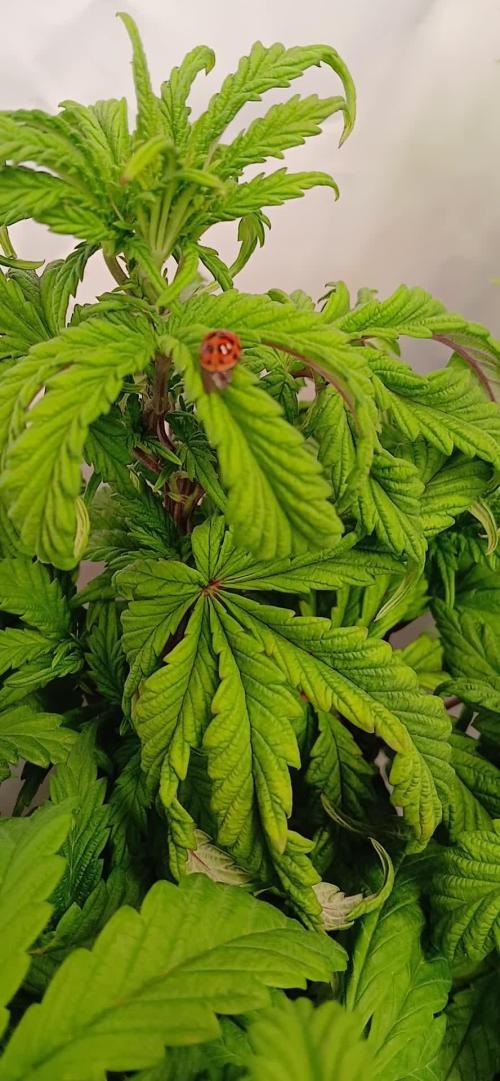
Dear Diary This week was uneventful nothing to write, same treatment as the week before, exept I added some Advanced nutrients " BigBud" to the mix. It contains phosphorus andpotassium and is used during week 2 through 4 of the bloom phase.
EC still around 1.3-1.4.

Likes
4
Share

@Leprechauns_Garden
Follow
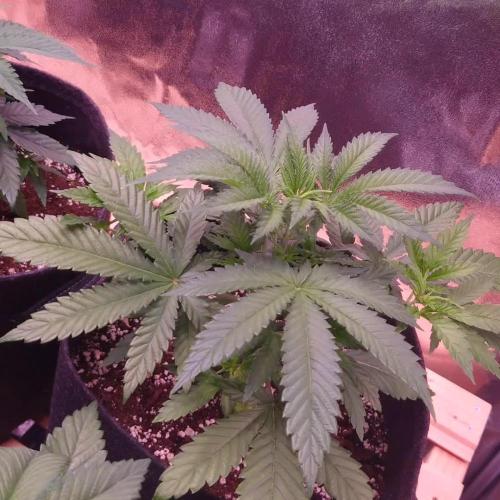
Alle Ladys super gesund und ordentlich am wachsen.
Keine neuen Informationen.
Nächste Woche werden sie getoppt und entlaubt.
Bis dahin haben sie aktuell 450 ppfd und ca 2 Liter Wasser alle 2 Tage.
Ab Woche 6 werde ich mit leichter Düngerzugabe beginnen.
Let IT grow 🌱🌿💚

Likes
7
Share


@Mr_nugs_lover_David
Follow
Beautiful pair of haze berries, both phenos #1 and #2 showing strong healthy roots and big leafs, can't wait to flower this ladies out, I Transplanted the plants after 17 days of being planted on February 2nd because the roots were super well developed and I considered that it was the right time to do so. So now they are in their new 11l house.

Likes
2
Share


@Ninjabuds
Follow
Man, it's been a crazy week. These past few days have been brutal – seriously cold with this crazy humidity. I don't know about you, but I'm sick of the chills and the way my skin feels all sticky. It's been a struggle, but I'm finally getting on top of things. I think I've figured out a good routine to dry things out around here, so hopefully, I'll be feeling a lot more comfortable soon.
My Skunk Apple Runtz plant is finally starting to bounce back. The leaves are getting their color back, and it smells fantastic – all thanks to the Ricky Bobby. It's a shame the plant's shape is a little funky, but honestly, I can live with it if it keeps producing that amazing smell.
Likes
8
Share

@Bread_n_Buds
Follow
Merry Christmas and happy holidays to everyone, and above all, a fantastic new year of growth with monsters, plants, unicorns, and all the magical beings we love.
** This week, mostly just grow tent photos, so you don't miss any updates over the holidays.
Our Nectar Drip #1 has been incredibly potent since birth, which I followed live like a midwife, and you saw in timelapse.
She started out beautifully, grew even better, and was treated very well here too with a main lining without LST. Here, we're at medium internodal spacing, and LST could have been used, but then I let her go, remembering that wonderful Ghost Train Haze trained this way.
We're in the first week of flowering in the large grow tent with some other young ladies who were ready for the classic 12/12.
Selected Techniques - This plant will grow with a classic main lining but without the application of the classic LST that spreads the plant across the pot. This is only because the plant or rather this phenotype has a very short internodal distance and woodifies quickly, risking cracking. So a healthy classic main lining (topping Mainfolding 3 internodes topping x2 and then x 4 perhaps if the plant goes)
We're 100% organic and 1000% Plagron, as always.
The soil we've chosen is the recently launched Plagron Bio LightMix, which will allow us to get our growing process off to a smoother and more reliable start, without the sudden changes that liquid fertilizers can cause. A week is more than enough, so don't overdo it.
We're in the early stages of the vegetative phase, but we're well-equipped with nutrients and additives. We've added:
- Power Roots 1 ml/l
- Pure Zym 1 ml/l
- Silic Rock 1 ml/l
- CalMag Pro 1 ml/l
- Sugar Royal 1 ml/l
- Alga Grow 5 ml/l
Once a week as a foliar spray:
- Vita Race 5 ml/l
Choose your preferred style and calculate the results on the website:
www.plagron.com
Our new 720W Spider King lamp from Vanguard Hydroponics is still set to the lowest setting. Visit the new Growshop area on the Zamnesia website:
Z - https://www.zamnesia.io/it/531-growshop
Crazy, it was sold out, it was a limited edition! Try another one: the shop is full!
Z - https://www.zamnesia.io/it/35-semi-cannabis
T - https://www.zamnesia.io/it/35-semi-cannabis/745-tical
Z - Nectar Drip is a unique cannabis hybrid created in collaboration between Zamnesia Seeds and TICAL. These flowers are pure power, with up to 26% THC and effects that stimulate the mind and stabilize the body. But if you want to try them, you'll have to hurry: only 750 packs are available!
There's nothing better than a good collaboration: we know that better than anyone! For this partnership, we joined forces with TICAL to create a strain packed with flavor and potency. We brought our delicious Apple Fritter, while TICAL contributed its 24K Gold Fangs. After perfecting the result, Nectar Drip was born. This strain produces potent flowers with a THC content of up to 26%, accompanied by delicious fruity and skunky aromas.
Considering one of its parents is Apple Fritter, you can be sure that Nectar Drip has inherited a burst of fruity aromas and flavors. Skunky notes are also noticeable, creating a rich and intriguing profile. When you smoke this beauty, you'll feel relaxed, with a pleasant cerebral buzz accompanying the experience. It's definitely a great evening smoke, perfect for when you want to take a moment for yourself.
You know it, but I recommend it. You'll find so many wonderful things here, essentially "all the best that nature has to offer."
Z - www.zamnesia.com //
Music //
www.radionula.com
+ Feng Shui Music
+ Frequencies 432 Hz
Likes
14
Share


@Madmike88
Follow
03MAY - woke up to a melted fan. Did a quick fix and hooked my intake fan to it, until I am able to replace that fan. Seems to be working for the time being. Updated pics to follow throughout the week.
04MAY - did a little bit of defoliation, think I did good, still debating on doing more, but I'll wait until she recovers from this one.
05MAY - Woke up late and didn't have time to check water this morning, so they are a little dehydrated, watered them, but other than that seem to be doing ok.

Likes
13
Share


@Growyourownathome2x2
Follow
Sunday the 14th of May Day 18 of 12/12 defoliation done still need to clean up the lower part of the plant a bit more I just hadn’t got the time to do them I will get back in on day 21 to clean up the bottom of the plants any branches that haven’t made up past the first trellis will definitely be removed and see how it’s looking all feeding same as previous week looks like the stretch is almost done and buds starting to form front left plant doesn’t look great but the other 3 are looking good nice bud sites for day 18 of 12/12

Likes
5
Share


@Willy_Balls
Follow
21 st day of 12/12. Defoliation.
Try smaller containers or longer veg. Plants should be able to drink at least its pots water holding capacity once a day.
Will try 5 liters of medium.
Somę of them drinking more than 2 liters a day.
Much better to overage and remove branches than not enough root mass.

Likes
16
Share

@GoldenWeedGrower
Follow
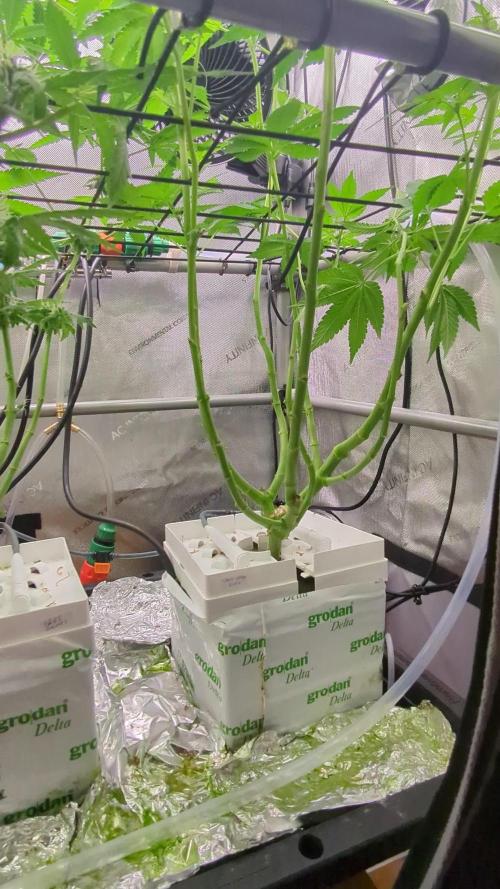
📅 19/05/26
🗓️ D078 (B6 / D1)
🌡️ 1.1
💨 -
💧 -
🥗 -
⚗️ 1.2
🔬 5.8
🛠️ -
📋 -
=============================================================
Legend:
📅 DATE
🗓️ DAY (StageWeek / Day)
🌡️ VPD
💨 CO2
💧 WATER ADDED
🥗 FOOD ADDED
⚗️ EC
🔬PH (adjustements)
🛠️ ACTIONS
📋 NOTES
📅🗓️🌡️💨💧🥗⚗️🔬🛠️📋

Likes
4
Share


@GodZilla_Owner
Follow
Week 9 – Day 65
Flower Day 35
🔄 Looking back:
One of those weeks where everything just runs smoothly… 😎
The BioBizz pH+ is finally making a difference:
📈 Drain pH is now increasing by 0.1 to 0.2 points – a noticeable improvement compared to Canna pH+.
Other than that – just the usual routine: water, observe, and enjoy the view 🙌
🌿 Plant status – Mimosa Evo
📏 Holding steady at 104 cm, stretch is definitely over
🌼 Bud development is progressing steadily – no issues at all
✅ Still the most reliable performer in the tent – strong, stable, and stress-free!


Processing
Likes
18
Share


@KemoSace
Follow
Added CO2 suplimentation and up'd the nutes to 900ppm today; the runoff was 230ppm which means the plants appreciated the additional nutes & drank good; today's feeding of rain water, cal-mag, floraMicro, FloraGrow & FloraBloom was at a pH of 5.5 and the runoff pH was 6.6 (All exceptional numbers IMO).

Likes
34
Share


@Damonkey
Follow
Not finished with the harvest yet will update when I’ve done a second trim on everything and weighed in. The pics so far just a branch from each plant. 3 slightly different phenotypes. The buds I’d swear have a pinkish hue. Very strange colour came through in the end almost has a purple look about it.
Very happy with results and yield. The yeild could be much bigger given space and time for veg but for my needs This was an awesome grow. Really nice sticky hard buds on the most. One of the Phenotypes was a bigger yield and much tighter fatter buds but all look great.✌️🏻
I should also say a big thank you to Barney’s for providing free seeds for this grow. It’s a pleasure growing your girls.
So smoking this stuff properly tonight, yeah it’s good. Very heavy warm stoned feeling after a few spliffs.. my tolerance is quite high but this stuff has rocked my night. Really pleased with the results after curing for a few weeks I think I found a new favourite🤤🤤😂😂well until the next one. The buds are nice and dense and really have a nice firm feel to them. They also had a fairly decent covering of trichomes that sit in the herb well, it’s surprisingly smooth to say it’s not cured yet.
It’s gonna be beautiful stuff oh yass yass yass.
Update/ getting super tight now, it’s going to be very difficult to keep my hands off it for too long🤤😂
So a friend came around to see me yesterday. I let him have a good smoke of Phantom OG. He left with both fists clenched and thumbs pointing skyward.
This cannabis really is top class, and really does have medicinal value. I’d say it’ll make a great stress killer for anyone I think it’ll quash any anxiety issues going on as well✌️🏻😌✌️🏻

Likes
12
Share


@2SeedsToParadise
Follow
Sometimes this happens.. We've all been there... Missed a watering, but all good its weezy. 2nd week of flowering and the blackberry is popping thru Lfg..
Letzgetit