


Likes
Comments
Share


@802FIZ0
Follow
Had to do the first res change, brought the ppm to 620+/- . This week was recorded on morning number 11. Roots are starting to come out of the net pots in all 3 plants. Looking forward to next week with a new res change to 800ppm.
Update. 4/10
Res change to 850 and ph of 6. Day 18.
Will do res change around the 28th to a heavy feed for late veg stage of around 950 to 1000. That will bring me into flower for the 2 blue dreams.

Likes
3
Share


@KushManAdam420
Follow
Phone was out of action , will try and fill up the missing weeks , 3 plants have been harvested
All photos taken day 76

Processing
Likes
2
Share


@MidwestBudz
Follow
With this grow, my germinating has gotten better. This time I water more.


Likes
41
Share


@Hashy
Follow
This is the 2nd MSNL strain I have tried and the genetics are great. She got the longest time in the tent as she is a standard photoperiod and the rest of the grow where fast flowering photoperiods.
I trimmed her after 16 days of drying and got 35g of decent buds and 9g of ok buds.
Power used for whole grow in 114 days.
Lights=201.7Kw (201.7×0.25)(=£50.42)
Rad=212.23kw (212.23×0.25)(=£53.05)
201.7÷114=1.769kw per day light average.
Average 100w for veg
Average 150w for flower.
Light average for grow 125w.
Stats for the grow.
FFNA2410=42g
FFNA2411=45g
FFNA2412=43g
Acapulco Gold=44g
Expected hash from trim 28g
Total=174g
174÷125=1.39g/W
Likes
3
Share


@Farmerbry71
Follow
Day 80 for this AK auto she Is big and fat buds with a sweet smell to her I would say she will go till day dy 95- 100 before she gets harvest

Likes
19
Share


@Tazard
Follow
She supposed to take 8 to 9 weeks but I was playing with my microscope and just decided to look at her trikes and OMG is she ripe. I started a ro water flush as quick as I could. I let her flush out for three or four days and then harvested her.

Likes
19
Share


@TheCannaProphet
Follow
----------------------------------------------
~Sweet Seeds Sweet Zenzation (SWS84)~
----------------------------------------------
Zkittlez is one of the most famous and potent strains found on the west coast of the USA. Sweet Zenzation (SWS84) derives from a cross between an elite clone of Zkittlez combined with a specially selected Grape Ape clone, which is one of the strains used to develop the original Zkittlez.
The result is a predominantly Indica genetic hybrid. It produces a large amount of resin-soaked flowers. It is both relaxing and stress-relieving, yet it also stimulates the imagination and conversation, an effect that is normally associated with sativa strains.
The flowers have a high terpene content, an exquisite aroma and sweet taste, with hints of fruit-flavored candies, hardwood undertones, shades of lemon, cypress and subtle aromatic peppers.
Variety: Sweet Zenzation (SWS84)
Indica: 70%
Sativa: 30%
THC: 16-23%
CBD: 0.2%
Indoor Yield: 450-650 g/m²
Outdoor Yield: 400-700 g/plant
Effects: Creativity, Stimulating, Happiness, Relaxing
Taste: Spicy, Fruity, Citrus, Lemon, Candy, Cypress, Sweet
________________________________________________________________________________________________________________________________________________________________________________________________________________________________________________________________________________________________________________________________________________________________________________________________________________________________________________________
THE SETUP:
~Planted into Jiffy Peat Pellets that were hydrated with de-chlorinated water with SuperThrive added then ph'd to 6.0 @ 80℉
~Grown 100% organic in 10g fabric pots with Mother Earth 70/30 Coco/Perlite medium amended with 2tbs/g of Down To Earth 4-4-4 / 2 cups/g of Earthworm Castings / 1tbs/g of Dr. Earth Flower Girl 3-9-4, 1tbs/g of Dr. Earth Bat Guano, 3/4 cup of Down To Earth Azomite and 1 tsp/g Down To Earth Fish Bone Meal.
~24hr light cycle during Germination / 19/5 light cycle for Vegetation and 12/12 for Flower
~Straight water ph'd @ 6.2-6.8 when needed and weekly Compost Tea's.
__________________________________________________________________________________________________________________________________________________________________________________________________________________________________________________________________________________________________________________________________________________________________________________________________________________________________________________
Weekly Updates:
9/27- Week Seven of flower here we go! She's looking good to go with her flowers stacking and her trichome production continuing to coat her flowers!
Today she was given 1.5g of de-chlorinated water which was ph'd to 6.2 @ 72℉ which I gave her half through her drip pan (bottom chuggin), the remainder trough the medium. I also gave her pot a 1/4 turn.
9/29- Yesterday I didn't water her, only turned her pot and checked her over... Wow! She's really ramping up the trichomes making her flowers look like their sugar coated! 🤩
I watered her today with 1.5g of de-chlorinated water with 1 tsp/g of unsulfured molasses added which was then ph'd to 6.4 @ 72℉, The molasses will give the microbial colony some additional food as well as supplying micro-nutrients to the plant. I finished out the daily maintenance giving her a check over and turning her pot 1/4 turn to ensure she gets light to every inch of her.
10/1- Yesterday was a 'no water' day as her pot was still fairly heavy to lift. Today she was watered with her usual of 1.5g of de-chlorinated water which was ph'd to 6.2 @ 72℉.
Her flowering continues to impress me with her trichome production covering her flowers with 'frost' she's a sight for sore eye's! 😍
The end of next week will be the beginning of her wrapping up with the 'Finish Line' approaching by Week 9 or 10!
10/3- With Week Seven coming to a close we're going into the last 2-3 weeks for this lady and she's right on track, looking like a Rock Star! 🤩
I watered heavy yesterday and added 1 tsp/g of Unsulfured Molasses to the 1.5g of de-chlorinated water which was then ph'd to 6.6 @ 72℉.
Her pot had some weight to it when I checked today so I'll skip watering her until tomorrow. I finished up today by checking her over and giving her pot a turn.
~Thanks for stopping in! This epic run will be wrapping up in the coming weeks...Stay lifted and be Blessed! 😎🙏~

Likes
74
Share


@AsNoriu
Follow
Day 82. First of two is down.
Day 88. Second down. Both will be decent by weight and structure, but smell and taste .... maybe after cure ? ;)))
Day 92. First went to jars. Will be hard to keep fingers away ... ;)))
Day 98. Both in jars ! 170 g of my very likeable smoke ;)
Will update later
Happy Growing !!!


Likes
Comments
Share

@Rogel
Follow
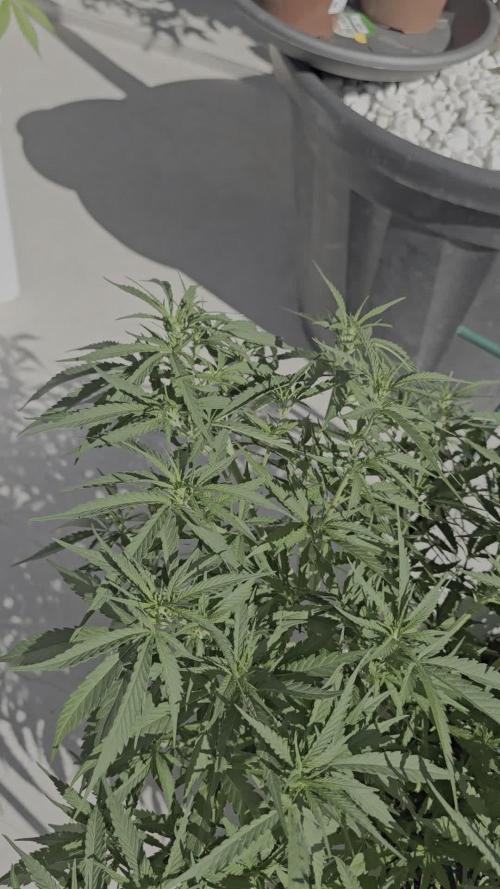
Seguímos una nueva semana guiando hacia abajo y los lados, estoy creando una estructura en forma de cubo alrededor de la maceta para controlar el espacio y poder abrir aún más la planta, mi objetivo es que no supere el 1,5de altura pero sea un arbusto abierto. Es mi primer lst, cualquier ayuda es bienvenida. Estoy germina do otra semilla más y una doble oreoz para practicar en maceta de 25 litros poda apical y probar

Likes
22
Share


@m0use
Follow
***Sponsored Grow*** = Medic || https://medicgrow.com || Grow = ***Sponsored Grow***
Plants still looking good from last week, the yellowing has seemed to stop spreading, still some dull green in some leaves, I think I was under feeding them, but runoff says otherwise. Noticed some more pink/purple stems on the plants and decided to increase the phosphorus content in the feed by mixing in half grow and half bloom from the nutrient lineup. I'd use the PK booster I have but its to high in K for my liking. The entire lineup is very high in K. mixing grow and bloom gives a NPK ratio of 7-7-14 then done 1:1 equal parts.
Grow=8-4-15
Bloom=6-10-14
Boost=1-15-30
Run off was a bit high for my liking but only seeing minimal signs of nutrient burn. Still watering once with feed and runoff and then later in the week with water and no/little runoff for my watering cycle.The number in the nutrient section are wrong but the EC and ratio are correct. Also impressed the roots have started popping out the bottom of the container already after only being transplanted for a week. Good root growth on these ones.
Lights doing well. The V1 spectrum is good on the medic grow mini sun-2's 240w. No issues so far, dimmed at 80%
.
Till next week.
***Sponsored Grow***
Official Website:
https://medicgrow.com/
+
https://www.kannabia.com/en
Facebook:
https://www.facebook.com/medicgrowled
+
https://www.facebook.com/kannabiaseed/
Twitter:
https://twitter.com/medicgrow
+
https://twitter.com/kannabiaseeds
Instagram:
https://www.instagram.com/medicgrow420/
+
https://www.instagram.com/kannabiaseedsint
YouTube:
https://www.youtube.com/channel/UCNmiY4F9z94u-8eGj7R1CSQ
+
https://www.youtube.com/c/KannabiaSeedCompany
Growdiaries:
https://growdiaries.com/grower/medicgrowled
https://growdiaries.com/grow-lights/medic-grow
+
https://growdiaries.com/grower/kannabia
https://growdiaries.com/seedbank/kannabia

Likes
29
Share


@JeyGanesha
Follow
Inizio Terza settimana di fioritura 💪🕉️💚.. tutto procede come deve .sono sicurissimo che questa layer cake, sarà fantastica....perfetta per la mia patologia...la meglio medicina per me

Likes
7
Share


@Ieiogrow94
Follow
Eccoci qui…
Questa settimana ho eseguito la defogliazione e il lollipopping per sfoltire la parte bassa di tutte le piccole…
Da questa settimana inizio a dare i fertilizzanti e vediamo cosa ne esce, ci sono piante che vogliono mangiare ed è ora di accontentarle!!!
Grazie a tutti per il supporto!!! ❤️🔥🌲
IN CANNA
Likes
9
Share


@Dark_Shadow_420
Follow
Fue una exelente cosecha, esta planta en un principio se tuvo en imddor y posteriormente sacada al exterior. Es mi primera experiencia plantando en suelo.
La planta llego a un gran tamaño de la cual se cosechó una gran cantidad superando la cantidad promedio.

Likes
95
Share


@Ferenc
Follow
Day 58, 11th of November 2020:
I set the lamp 15 minutes shorter to switch off earlier so she receives 11:45 of darkness. I would like to imitate the nature when longer nights come with time till the 4th week (when she will receive 13 hours darkness a day 15 minutes minus 4 times = 1hour) so every week 15 min longer darkness for 4 weeks and then back to 12/12 to have bigger buds from the 4th week....
Tropicanna poison... Nice plant well done Sweet Seeds....
Little beauty sex appears by the pistils are coming out so I assume strech is ending soon :)
All good look at her fertilization happnes every 2nd day by the mix above and the ratio.
Let's see....
She is promising haha :)
Likes
74
Share


Likes
39
Share


@BlackDragon22
Follow
😱😱😱 mostruosa questa runtz,ecco che mostra i segni di pre fioritura è sono sbalordito. Continua a crescere a vista d'occhio. Piena di siti di gemme che presto saranno ben visibili e come voi, li attendo follemente. Non so come sarà appena ci sarà il boom durante la fase di fioritura.. Ma sono sicuro che sarà mostruosa 🤤💣💚

Likes
31
Share


@BioGrowBayer
Follow
Die ersten 4 sind schon im 11 Liter Topf mit Bio Bizz All Mix
1 mal wöchentlich gibt es Wurmtee

Likes
Comments
Share


@Growfather1
Follow
Hello everyone.
Here is the week zero germination update for my new Peyote Critical diary from Barney's Farm.
Strain Information
Peyote Critical is an indica-dominant hybrid created by crossing Peyote Purple with Critical Kush. It is known for being an exceptionally hardy, mold-resistant, and high-yielding strain with an earthy, sweet profile.
Grow Setup & Environment
* Tent Size: 240x120x200 cm
* Pot Size: 21 Liters
* Temperature: 22°C – 26°C
* Humidity: 65%
There is not much else to report just yet as we are just getting started.
Looking at the upcoming weather for the next four months, I figured the best way to keep warm this winter was to start at least 10 new seedlings dedicated entirely to the month of October. Who needs a space heater when you can just turn your tent into a tropical jungle?
Thank you for stopping by and have a nice day.
Best regards,
Growfather


Likes
8
Share


