Likes
Comments
Share
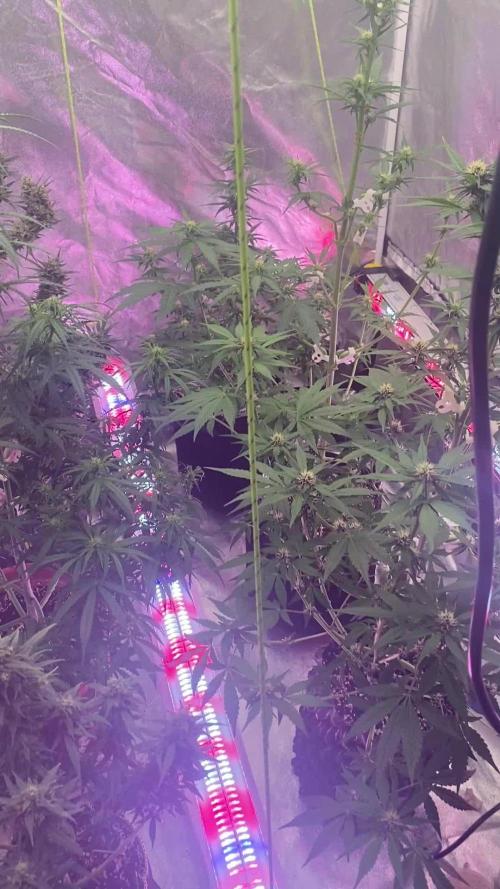
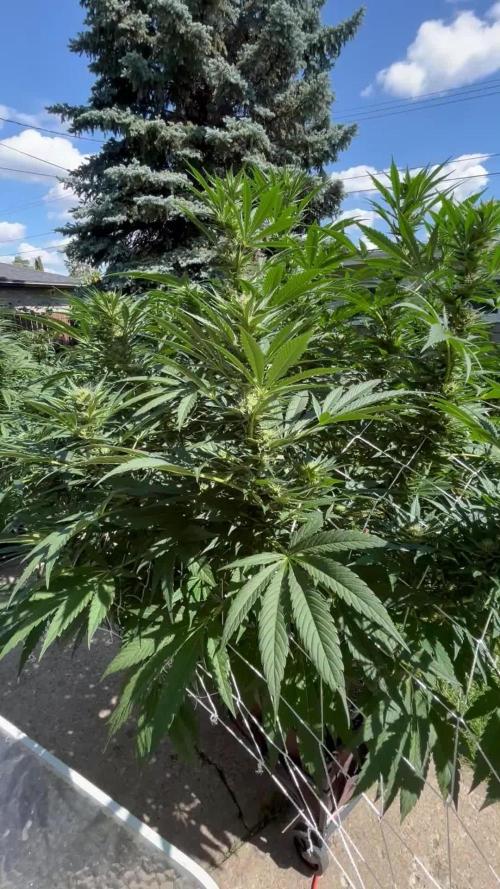
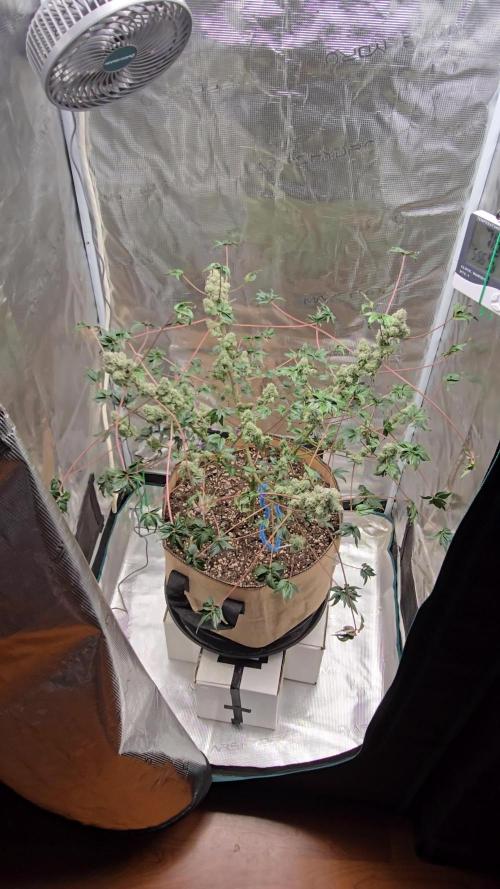
Did some defoliation 3-4days earlyer 🤘🏾 looking good, no bugparty or any mold (yet)🤪 Waterd them with the good good n we out 🤘🏾
Likes
3
Share
Girls resting in their final home getting settled in before the decor
Likes
4
Share
@Chucky324
Follow
Hello. This is the end of week 4 and the beginning of week 5 of veg. They have got over their repotting shock and are taking off. Getting some good sized leaves coming out now. Hoping to get them out in the greenhouse by the end of the month, but it's too cold out there overnight. I've been using essential oils for a few weeks now, and I'm liking it. I had a recurring spider mite thing going for the last few months. In my cloning box, I would find a small patch of them and I would buy good bugs to combat pest bugs. But they keep coming back. I was just trying to keep my medical grow clean. No insecticides no pesticides no fungicides no herbicides. And I would buy more bugs. I saw it as never ending... So I was looking into something different to combat the pest with. The site I got those pages from seems to be gone. But I was look up essential oils to see what other sites said about them. Like I said, I'm liking it. I feel like I've got a sense of control back over the pests and don't mind the smell either, and the plants seem to don't mind it. There no awful smell or messy greasy feeling I find after I've sprayed insecticidal soap, and the essential oils aren't poisonous either. I can put a drop in my mouth with no effect. It evaporates off the leaves in a few days and it's pleasant to use There's some for pests and others for mold and fungus. I find 8 to 10 drops is enough unless you've got an infestation. Anyway... Like I said... I feel like I've got my sense of control back... Feels Good.... Look into it.. Give it a try...! I'll be using it in my garden this year. I was in contact with UKHTA Seeds last week and they said they don't mind if I give away my contest winnings of a 50% off code. Is anyone interested in a 50% off code, has to be used before May 1st 2026 though, Just privet message me if your interested, so I can see how many are interested. I'll post it on the questions page next week, if no one is interested. OK Have Fun. Chuck.
Likes
35
Share
@Njaak
Follow
Added 2 videos on preparing a nutrient solution and pH balancing the solution. This week saw aggressive topping (mid week 4) and some serious leaf damage. Not sure if the leaf damage is from the topping, nutrients, etc. I did a flush and solution swap, cleaned the air stone and inside of the jar etc. Built the trellis and started training. I'll cut away whatever trellis doesn't end up getting used once flowering starts. Creepy Don Santa is watching this grow closely. That cat of his is trouble.
Likes
52
Share
Lacewings seemed to have mostly killed themselves by flying into hot light fixtures. I may have left the UV on which was smart of me :) Done very little to combat if anything but make a sea of carcasses, on the bright side its good nutrition for the soil. Made a concoction of ethanol 70%, equal parts water, and cayenne pepper with a couple of squirts of dish soap. Took around an hour of good scrubbing the entire canopy. Worked a lot more effectively and way cheaper. Scorched earth right now, but it seems to have wiped them out almost entirely very pleased. Attempted a "Fudge I Missed" for the topping. So just time to wait and see how it goes. Question? If I attached a plant to two separate pots but it was connected by rootzone, one has a pH of 7.5 ish the other has 4.5. Would the Intelligence of the plant able to dictate each pot separately to uptake the nutrients best suited to pH or would it still try to draw nitrogen from a pot with a pH where nitrogen struggles to uptake? Food for stoner thought experiments! Another was on my mind. What happens when a plant gets too much light? Well, it burns and curls up leaves. That's the heat radiation, let's remove excess heat, now what? I've always read it's just bad, or not good, but when I look for an explanation on a deeper level it's just bad and you shouldn't do it. So I did. How much can a cannabis plant absorb, 40 moles in a day, ok I'll give it 60 moles. 80 nothing bad ever happened. The answer, finally. Oh great........more questions........ Reactive oxygen species (ROS) are molecules capable of independent existence, containing at least one oxygen atom and one or more unpaired electrons. "Sunlight is the essential source of energy for most photosynthetic organisms, yet sunlight in excess of the organism’s photosynthetic capacity can generate reactive oxygen species (ROS) that lead to cellular damage. To avoid damage, plants respond to high light (HL) by activating photophysical pathways that safely convert excess energy to heat, which is known as nonphotochemical quenching (NPQ) (Rochaix, 2014). While NPQ allows for healthy growth, it also limits the overall photosynthetic efficiency under many conditions. If NPQ were optimized for biomass, yields would improve dramatically, potentially by up to 30% (Kromdijk et al., 2016; Zhu et al., 2010). However, critical information to guide optimization is still lacking, including the molecular origin of NPQ and the mechanism of regulation." What I found most interesting was research pointing out that pH is linked to this defense mechanism. The organism can better facilitate "quenching" when oversaturated with light in a low pH. Now I Know during photosynthesis plants naturally produce exudates (chemicals that are secreted through their roots). Do they have the ability to alter pH themselves using these excretions? Or is that done by the beneficial bacteria? If I can prevent reactive oxygen species from causing damage by "too much light". The extra water needed to keep this level of burn cooled though, I must learn to crawl before I can run. Reactive oxygen species (ROS) are key signaling molecules that enable cells to rapidly respond to different stimuli. In plants, ROS plays a crucial role in abiotic and biotic stress sensing, integration of different environmental signals, and activation of stress-response networks, thus contributing to the establishment of defense mechanisms and plant resilience. Recent advances in the study of ROS signaling in plants include the identification of ROS receptors and key regulatory hubs that connect ROS signaling with other important stress-response signal transduction pathways and hormones, as well as new roles for ROS in organelle-to-organelle and cell-to-cell signaling. Our understanding of how ROS are regulated in cells by balancing production, scavenging, and transport has also increased. In this Review, we discuss these promising developments and how they might be used to increase plant resilience to environmental stress. Temperature stress is one of the major abiotic stresses that adversely affect agricultural productivity worldwide. Temperatures beyond a plant's physiological optimum can trigger significant physiological and biochemical perturbations, reducing plant growth and tolerance to stress. Improving a plant's tolerance to these temperature fluctuations requires a deep understanding of its responses to environmental change. To adapt to temperature fluctuations, plants tailor their acclimatory signal transduction events, specifically, cellular redox state, that are governed by plant hormones, reactive oxygen species (ROS) regulatory systems, and other molecular components. The role of ROS in plants as important signaling molecules during stress acclimation has recently been established. Here, hormone-triggered ROS produced by NADPH oxidases, feedback regulation, and integrated signaling events during temperature stress activate stress-response pathways and induce acclimation or defense mechanisms. At the other extreme, excess ROS accumulation, following temperature-induced oxidative stress, can have negative consequences on plant growth and stress acclimation. The excessive ROS is regulated by the ROS scavenging system, which subsequently promotes plant tolerance. All these signaling events, including crosstalk between hormones and ROS, modify the plant's transcriptomic, metabolomic, and biochemical states and promote plant acclimation, tolerance, and survival. Here, we provide a comprehensive review of the ROS, hormones, and their joint role in shaping a plant's responses to high and low temperatures, and we conclude by outlining hormone/ROS-regulated plant-responsive strategies for developing stress-tolerant crops to combat temperature changes. Onward upward for now. Next! Adenosine triphosphate (ATP) is an energy-carrying molecule known as "the energy currency of life" or "the fuel of life," because it's the universal energy source for all living cells.1 Every living organism consists of cells that rely on ATP for their energy needs. ATP is made by converting the food we eat into energy. It's an essential building block for all life forms. Without ATP, cells wouldn't have the fuel or power to perform functions necessary to stay alive, and they would eventually die. All forms of life rely on ATP to do the things they must do to survive.2 ATP is made of a nitrogen base (adenine) and a sugar molecule (ribose), which create adenosine, plus three phosphate molecules. If adenosine only has one phosphate molecule, it’s called adenosine monophosphate (AMP). If it has two phosphates, it’s called adenosine diphosphate (ADP). Although adenosine is a fundamental part of ATP, when it comes to providing energy to a cell and fueling cellular processes, the phosphate molecules are what really matter. The most energy-loaded composition for adenosine is ATP, which has three phosphates.3 ATP was first discovered in the 1920s. In 1929, Karl Lohmann—a German chemist studying muscle contractions—isolated what we now call adenosine triphosphate in a laboratory. At the time, Lohmann called ATP by a different name. It wasn't until a decade later, in 1939, that Nobel Prize–-winner Fritz Lipmann established that ATP is the universal carrier of energy in all living cells and coined the term "energy-rich phosphate bonds."45 Lipmann focused on phosphate bonds as the key to ATP being the universal energy source for all living cells, because adenosine triphosphate releases energy when one of its three phosphate bonds breaks off to form ADP. ATP is a high-energy molecule with three phosphate bonds; ADP is low-energy with only two phosphate bonds. The Twos and Threes of ATP and ADP Adenosine triphosphate (ATP) becomes adenosine diphosphate (ADP) when one of its three phosphate molecules breaks free and releases energy (“tri” means “three,” while “di” means “two”). Conversely, ADP becomes ATP when a phosphate molecule is added. As part of an ongoing energy cycle, ADP is constantly recycled back into ATP.3 Much like a rechargeable battery with a fluctuating state of charge, ATP represents a fully charged battery, and ADP represents a "low-power mode." Every time a fully charged ATP molecule loses a phosphate bond, it becomes ADP; energy is released via the process of ATP becoming ADP. On the flip side, when a phosphate bond is added, ADP becomes ATP. When ADP becomes ATP, what was previously a low-charged energy adenosine molecule (ADP) becomes fully charged ATP. This energy-creation and energy-depletion cycle happens time and time again, much like your smartphone battery can be recharged countless times during its lifespan. The human body uses molecules held in the fats, proteins, and carbohydrates we eat or drink as sources of energy to make ATP. This happens through a process called hydrolysis . After food is digested, it's synthesized into glucose, which is a form of sugar. Glucose is the main source of fuel that our cells' mitochondria use to convert caloric energy from food into ATP, which is an energy form that can be used by cells. ATP is made via a process called cellular respiration that occurs in the mitochondria of a cell. Mitochondria are tiny subunits within a cell that specialize in extracting energy from the foods we eat and converting it into ATP. Mitochondria can convert glucose into ATP via two different types of cellular respiration: Aerobic (with oxygen) Anaerobic (without oxygen) Aerobic cellular respiration transforms glucose into ATP in a three-step process, as follows: Step 1: Glycolysis Step 2: The Krebs cycle (also called the citric acid cycle) Step 3: Electron transport chain During glycolysis, glucose (i.e., sugar) from food sources is broken down into pyruvate molecules. This is followed by the Krebs cycle, which is an aerobic process that uses oxygen to finish breaking down sugar and harnesses energy into electron carriers that fuel the synthesis of ATP. Lastly, the electron transport chain (ETC) pumps positively charged protons that drive ATP production throughout the mitochondria’s inner membrane.2 ATP can also be produced without oxygen (i.e., anaerobic), which is something plants, algae, and some bacteria do by converting the energy held in sunlight into energy that can be used by a cell via photosynthesis. Anaerobic exercise means that your body is working out "without oxygen." Anaerobic glycolysis occurs in human cells when there isn't enough oxygen available during an anaerobic workout. If no oxygen is present during cellular respiration, pyruvate can't enter the Krebs cycle and is oxidized into lactic acid. In the absence of oxygen, lactic acid fermentation makes ATP anaerobically. The burning sensation you feel in your muscles when you're huffing and puffing during anaerobic high-intensity interval training (HIIT) that maxes out your aerobic capacity or during a strenuous weight-lifting workout is lactic acid, which is used to make ATP via anaerobic glycolysis. During aerobic exercise, mitochondria have enough oxygen to make ATP aerobically. However, when you're out of breath and your cells don’t have enough oxygen to perform cellular respiration aerobically, the process can still happen anaerobically, but it creates a temporary burning sensation in your skeletal muscles. Why ATP Is So Important? ATP is essential for life and makes it possible for us to do the things we do. Without ATP, cells wouldn't be able to use the energy held in food to fuel cellular processes, and an organism couldn't stay alive. As a real-world example, when a car runs out of gas and is parked on the side of the road, the only thing that will make the car drivable again is putting some gasoline back in the tank. For all living cells, ATP is like the gas in a car's fuel tank. Without ATP, cells wouldn't have a source of usable energy, and the organism would die. Eating a well-balanced diet and staying hydrated should give your body all the resources it needs to produce plenty of ATP. Although some athletes may slightly improve their performance by taking supplements or ergonomic aids designed to increase ATP production, it's debatable that oral adenosine triphosphate supplementation actually increases energy. An average cell in the human body uses about 10 million ATP molecules per second and can recycle all of its ATP in less than a minute. Over 24 hours, the human body turns over its weight in ATP. You can last weeks without food. You can last days without water. You can last minutes without oxygen. You can last 16 seconds at most without ATP. Food amounts to one-third of ATP production within the human body.
Likes
1
Share
Hab mir leider etwas mehr ertrag erhofft, aber für die Bedienung die sie hatte hat recht Okay abgeworfen. Der Geruch und die Größe der Buds sind sehr gut.
Processing
Likes
2
Share
Hello growers. Power kush is doing great! Nice thick buds at the moment and it is still so soon. A long way to go. So i think this one will be worth it. On the bad side Ive had some troubles with 2 herma’s in my tent. I removed them I hope on time. So i will check every 2 days now. See you next week!
Processing
Likes
11
Share
Last week of flower. Flushing plants this week with 150 to 200ml water ph 7.0 to 8.0each day Day 76 plants are pretty much ready for harvest. Buds have fattened up a abit. Day 77. Alot more orange hairs. Buds fattening up still by a little. Plenty of milky trichomes. Harder to spot orange trichomes but can see them.
Likes
4
Share
@Selkot
Follow
Despite the return of some rain (finally! 😊), temperatures are still high, once again reaching close to 30°C around midday. This weather seems to suit my Strawberry, whose stretch is slowing down, while her buds are now visibly starting to develop. The leaves in the greenhouse are becoming supple again. I kept the feeding very light throughout the week, and the substrate feels more aerated today. I’m still keeping things modest for a few more days before increasing the P and K.
Likes
5
Share
@Sativa763
Follow
Day 28 after switch. Looks good to me, stopped stretching and bud develeopment is doing well. This week watering only water maybe a little bit melasse together with Bactrex.
Likes
7
Share
Environment: Temperature: ~26 °C Humidity: ~60 % RH Light intensity: increased to ~850 PPFD. ☀️ Watering / Feeding: Watered every 2–3 days, based on pot weight, using RO water + CalMag. 💧 Additionally, 1x BioTabs Bio PK was applied during this week. Observations: Week 5 marked the clear stretch phase for Amnesia Skittlez. 🌿 The plant began elongating, although it remained more compact in structure compared to the Apricot Autos. The first proper bud sites are forming, and pistil production increased noticeably. 🌸 Overall plant health looks stable and clean. Leaf color remains a healthy green, with no visible deficiencies or stress reactions. 🙂 Training / Work Done: No training or defoliation was applied. The plant was left untouched to allow a natural stretch and smooth transition into flower. Notes: Week 5 shows a solid progression into flowering. While stretch is visible, the structure remains relatively compact. The plant is now clearly entering the main bud development phase. 🌱💪
Likes
12
Share
Die bis jetzt dickste Lady von allen. Sehr viele starke Triebe. Das Stretchen geht aber auch schon los.
Likes
2
Share
I'm not applying any type of training to this lady,she has performed a big stretch in her first week of flower,looks absolutely gorgeous,sometime she es tress a little with heat. However the super soil she's living in and the lactobacillus liquid I make homemade is helping her so much,it's a pleasure to see her every morning
Likes
14
Share
Skipped a week so that the weeks in the diary were the same age as the new plants also took over my wife's aquaponics ak auto flower that is 4 weeks old so ill add that into the grow. The aquaponics plant was in rough shape it was showing huge signs of cal mag def. So I went to the local fish store and bought a cal mag substitute that's safe for fish also dropped the ph to 6.1 she had it at 7+ (not her fault ph metre broke )now plant looks great 1 week later after pulling off all affected leaves. Nothing new with the girl sco8t cookies except I fed today 1 gsc starting to lighting up
Likes
5
Share
@CalGonJim
Follow
3/3 MONDAY 12 am. They are doing great, the supplemental lights are helping. they cost about 60 for the AC Infinity germination kit. I think the 2 lights are enough so it’s cheaper to get another Germination setup with the lights for my 2.8x2.8 tents. 3pm they all took quite a bit of water. feeding into the bottom of the container is very beneficial to the plants. Wish I would’ve known about that sooner I made a video of how I do it. 3/4 4am looking good. 130pm
Likes
20
Share
Started to see the buds develop early at the end of last week. This week I put my rebuild-able scrog net in. This thing will really let the room fill out nicely.
Likes
8
Share
Hey guys that’s my first diary. So don’t be so hard with me 😅
Likes
44
Share
**Encontrarás la traducción a español al final de la descripción** From/Desde: 22/03/19 || To/Hasta: 28/03/19 From day/Desde día: 29 || To day/Hasta día: 35 You can find the Money Maker Diary here: ** Podéis encontrar el diario de las Money Maker aquí:** https://growdiaries.com/diaries/25667-gorillamakingmoney-gorilla-vs-money-m -----IMAGES & VIDEOS----- Video 1: Exactly the same video as 2 but accelerated +400% to fix it to 1 minute for instagram. Video 2: 7 days (29~35) TimeLapse, 1 image each 60 secs @ 30 fps Video 9: An overview video not as awesome as it's music 😂💪 Video 10: Myself working on the babies, lowering tops, topping & training. Video 12: Full working on the secondary Gorilla, twisting some branches, topping & training. -----WEEK SUMMARY----- Well, now i'm getting a bit scared as i adventured myself into Photoperiod, high training, full topping... in indoors at once. I feel that plants are going good, but i really don't know what am i doing, and if i'm doing well. Also i don't know how much time should i give them of vegetation stage, because i don't want to eternalize myself with this tent, so i'm planning to leave this upcoming 6th week and maybe the 7th of vegetation, but no more. Anyway they look pretty atm 😻. In video 10 the main-linning Gorilla suffered an accident as i grabbed the main left branch from a weak point and it has broken (sec 39 aprox.) so it has one less node than the right branch. -----WATERING CALENDAR----- 24/03/19 - 1.000 ml with all week nutrients @ 0.9 E.C. PH5.8 *****ESPAÑOL***** -----IMÁGENES & VÍDEOS----- Vídeo 1: TimeLapse, exactamente el mismo vídeo que el 2 pero acelerado a un poco más del 300% para ajustarlo a 1 minuto para Instagram. Vídeo 2: 7 días (29~35) TimeLapse, 1 imagen cada 60 segundos @ 30 fps. Vídeo 9: Un vídeo general no tan increíble como la música de fondo 😂💪. Video 10: Trabajando en las pequeñas, rebajando las alturas, haciendo topping y entrenando. Video 12: Trabajando a pleno en la segunda Gorilla, girando algunas ramas, haciendo toppings y entrenándola. -----SUMARIO SEMANAL----- Bueno, ahora estoy empezando a estar asustado. Me he aventurado a probar con fotodependientes, entrenamiento fuerte y super topping, todo a la vez. Siento que las plantas van bien, pero realmente no se lo que estoy haciendo ni si lo estoy haciendo bien. También tengo dudas sobre cuanto tiempo más dejarlas en estado vegetativo ya que no me quiero eternizar con este armario, por lo que estoy planeando dejar esta sexta semana de crecimiento y quizás una séptima, pero no más. Aun así y con todo, las nenas se ven preciosas 😻. En el vídeo 10 sufro un accidente en la Gorila con main-linning ya que amarré el final del tallo principal izquierdo por un punto débil y este se partió (sec 39 aprox.), por lo que tiene un piso de topping de más en comparación con tallo derecho. -----CALENDARIO DE RIEGO----- 24/03/19 - 1.000 ml con todos los nutrientes semanales @ 0.9 E.C. PH5.8