




Likes
38
Share


@Bigdaddyblue
Follow
Day 65 (12/31): no change.
Day 66 (1/1): I'm thinking the plant on the left will be finished before the plant on the right. The leaves seem to be fading and the trichomes seem to be more mature on that plant also.
11pm: just watered the plants nutes. Same as last time. Left plant 6mL micro 12 mL bloom. Right plant 8mL micro 16 mL bloom
Day 67 (1/2)
Day 68 (1/3)
Day 69 (1/4): just got home from a trip. Plants seem to be doing fine. Nearing the end I assume. Plants will probably need water tonight
10pm: just fed my plants nutes again. Both plants received 8mL of micro and 16 mL of bloom.
Day 70: (1/5)
Day 71 (1/6): plants look good this morning. The left plant is definitely nearing the end of its life. The plant on the right still could have another week or more.
Just posted a video: plant on the left definitely doesn't have very large or dense nugs but it has a lot of them. The plant on the right has some super dense nugs. I'm excited to see what they both yield.
Likes
120
Share


@Themythicalchristine
Follow
They have jumped again in height quite a bit this week; they are big plants to say the least.
Each plant is approximately 5 ft (60inches) tall (2 are a little taller than that) and they are all about 4 ft (48inches) wide.
They drink like horses do!
I didn’t expect these plants to fill out their 10 gallon pots so quickly, but they are pretty well root bound.
All in all these ladies are doing pretty well; this week I gave them a 70/30 mix of Gaia greens all purpose and power bloom, amongst a few other Gaia green products to boost phosphate and potassium, and continue to supplement with advanced nutrients additives once a week.
I defoliated this week; and actually got quite violent with them to try to allow some more light to penetrate the canopy; you wouldn’t even know it 😑
Slowly they are changing their growth patterns; we are also loosing daylight in my hemisphere at the rate of about 2.5 minutes a day, hopefully that helps continue to ease them comfortably into flower 🌺

Likes
7
Share


@JoseTodoLoco
Follow
I didn't get that much yield and the buds were too fluffy do I decide to use all the buds and trim to do bubble hash, I really enjoyed the entire process.

Likes
19
Share


@Joeycrack9
Follow
Lemon Mandarin 1 & 2 09/17 5 weeks
Orange Sherbet 1 09/17 5 weeks
Papaya Sherbet 1 & 2 09/25 4 weeks
Gorilla Melon 1 & 2 10/04 3 weeks
Lemonpaya 1 10/04 3 weeks and 2 10/14 2 weeks
Processing
Likes
9
Share


@LittleBigTrees
Follow
Popped direct in the soil after 24 hrs.
Nice looking start.,


Likes
12
Share


@603grower
Follow
Girls are going great!they are starting to frost up nice and putting on weight slowly. They all got a top dress and a tea this week with terp tea. I believe this will be there final feeding maybe one more tea
Likes
10
Share


@Froggman
Follow
I’m still not sure about the FIM job on the LSD, and the purple haze is looking a bit runtish, but we’ll see how they go. I cut some leaves on the PH today to give the bud sites beneath them more light. All in all, they are doing well I think.

Likes
21
Share


@Trickybis82
Follow
Hi all,
Finally at that stage and I am so excited to be able to write this out.. have been Flushing these 2 beautiful girls since Friday just passed.
They have also been flushed for 2days with flashclean so I just cannot wait now :)
Will have a harvest next week with some weights to follow early after that...
Good luck growmies.. stay tuned 😉 🌿🌱

Processing
Likes
28
Share


@Bud_E_grows
Follow
Slowly starting out, dialed in temp and humidity. Was jumping from 68-82 degrees Fahrenheit
And humidity from 38%-52%
Only watering with cal mag and occasional misting.
Likes
4
Share


@Artemis
Follow
This week was an absolute scorcher with daytime temps in the low 30C, but we had no rain so I had to water more frequently. Seen a lovely burst of growth after last week's nutrients. Decided to bend and secure today to learn new technique. I'm fairly happy with the results. Think I might need to book up a scrog net worth all my girls after this training.

Likes
4
Share

@AKGorillaGrow
Follow
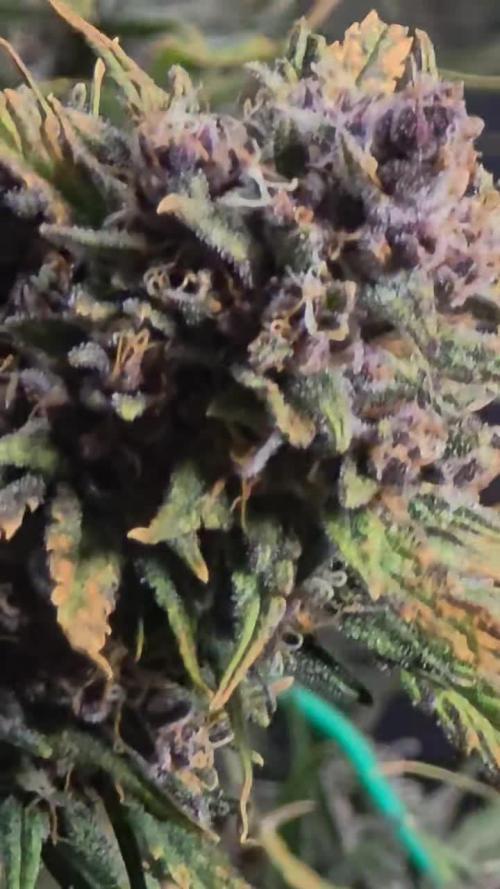
Well I'm sad and excited at the same time. Sad they got chopped but happy to see what all my work and dedication was for that sweet sweet marijuana. I know I'm just a beginner but damn with these genetics and love it is truly shocking what they can do in such a short time frame.
Likes
42
Share


@rhodes68
Follow
1/4 Week 8
Vids and Pics here is a run down:
In Flower tent
Full Bloom nuets
Pussy Galore (FF7) stretch has slowed
Octopussy(LSD) As tall as Pussy she hopefully is slowing
Plenty (GC) growing really nicely stretch is very manageable
Half n' Half
Solitaire (CC) Love it
Chew Mee (F2) Ditto
Bambi (F6) just arrived
In veg -
big girl feed 20ml/g grow + Kangaroots
Dink(FF2)
Tiffany Case - Gold Leaf
Thumper - FB FFT-8
Holly Goodhead - FB FFT-7
Mary Goodnight - ILGM Gold Leaf
Kissy Suzuki - Fast Buds Wedding Cheese Cake
Strawberry Fields - Fast Buds Strawberry Pie
Wedding Ch Cake still in recovery getting same as clones.
Clones:
All planted but three and two of those will be today
... and those were planted do not think the last one is going to root looks bad
1.5ml/L Grow + low kangaroots with a weak 1/4 str nuet foliar (no kanga)
12/5
GD wont let me add more than 8 strains (f them) so will be cranking up the Bond auto fire grow for the wedding ch cake and Straw Pie
Giving my wife those to raise so she will be growing them. I got enough to do
Soon as the plant stands get in be moving Dink into the flowering tent
Entire veg tent now on 20ml/gal of Grow A/B 2 ml/gal kanga except clones and the seedling they remain as is
Will be flipping this tent to 12-12 sometime in about a week after the clones are moved
12/6
Looking at the Flowering tent and thinking forward there is no way for me to put another plant in it without hurting the grow.
These last three that went in are going to get large-ish just like the others I hope we flipped small enough. Think so was pretty small
Reduced Bloom 2ml increased PK same think its wanted
So topped Dink to slow her down and let her widen a bit so the rest can get a bit larger, she will remain in the 4x5 and flip with the rest.
Things pretty good in the veg tent today. refuse to give up on Honey she looks like she is turning a corner. Increasing nuets a bit on her
Gold Leaf is growing great classic indica may regret not cloning them but have no way to deal with it now.
1/7
Fighting a bit with tall plants and lights think its worked out Pics with labels posted
1/8
Dropped PK back to 2.5ml/g
Pussy and Plenty doing great nice building already but Octopussy is lagging behind so may be too much PK real possible thus the cut.
Went to a high {K for the GC and F7 they burn right through it
Good progress on the plants flipping keeping them on half-half till full flower
Veg is just gorgeous only issue so far is getting too much light on some plants, she working on that.
Honey has picked up her leaves I give her a 3 of 4 chance and increasing to make it now just up to her.


Processing
Likes
6
Share


@Stevodidge
Follow
Still just plodding on slowly. Topped this week. Have also installed a CO2 bag.

Processing
Likes
15
Share


@ThePotFactory
Follow
The buds have gotten a bit fatter since last week 😼Im very happy so far. I did over feed them a bit a couple of days ago, probably for the excess PK13/14. You can see some of the leaves have burnt tips. Well now ive ran out of CANNABOOST and decided to replice it with Canadian Xpress Headmasta, ive read great things about this booster and its also much cheaper :))
Peace
Processing
Likes
4
Share


@ReelEyezEnt
Follow
Welp she started dying in her 2 gal pot so I moved the light back up and put her in a new 5 gal pot then she went into flower mode lol
the lights will stay 18 hrs on for another week to let some of the other plants catch up
Likes
14
Share


@LokalGrenz
Follow
Had some humidity issues been watering with spring water until I get something to filter the tap water
Jan.8th amnesia haze 1 got bit taller so I did some more LST

Likes
6
Share


@Chucky324
Follow
Hello This is the end of week 9 and the beginning of week 10 of veg.
Got my 4 year cancer checkup... got the nose and throat camera.. And the Dr. couldn't find anything wrong.
I get 1 more checkup in a year before they can give me a... all clear for cancer.
I'm going to beat it... Thanks Rick Simpson...
Picked up this magazine a few days ago and just wanted to share the adds and articles.
There's a Cheech and Chong interview and story in my Captain Future diary this week if your interested.
Everything is going good in here. I've seen some fungus gnats flying around
But I've also seen some very small spiders starting webs, and they will grow, and take care of the gnat problem.
The plants are just getting rainwater for now. There's is lots of compost in each pot... the roots just have to find it.
I'll give some food in a week or two. Going to be turned to flowering by June 1st, so there is still another month of veg to go.
OK. Have Fun.
Chuck