


3M ◥◤ Lady Poison (2nd)



FLO
Light Emitting Diodes/125W
Custom


Soil
Custom

Coco Coir
Custom

Minerals Other
Custom
Compost Other
Custom

Perlite
Custom

Vermiculite
Custom
River sand Other
Custom
Earthworm humus Other
Custom
Rice husk Other
Custom


Indoor
Room Type
weeks 3
Topping
weeks 5
LST
weeks 7-8
Defoliation
weeks 7-8
15 liters
Pot Size
0.65 liters
Watering
Start at Harvest
G
Germination3y ago


Nutrients 3
Agua de montaña
1000 mll
Miel
3 mll
Bio Coco EM
10 mll
deFharo Welcome clandestine marijuana growers, and also to those lucky enough not to be one!✋👨🌾
NEW FALL WINTER SEASON OF ORGANIC SELF-SUFFICIENT EXPERIMENTAL GROWS... I COME FROM A STRANGE WORLD!
New opportunity for this strain, last time the seed turned into an unexpected and robust male, which copulated with all the females in my grow tent, but since the name of this strain brings me good memories from long ago, I’m repeating this grow with the hope of cultivating a great poisonous female. The seed peeked through the substrate 3 days ago, during the day I keep the seedling in the light of a window, without direct sunlight, I maintain the humidity of the small pot with a plastic dome until it sheds the seed shell, during the night I have all the new seedlings under the light of an LED panel with blue diodes at 450nm, this light frequency promotes root creation and compacting, as the first true leaves appear I will gradually decrease the distance of this upper panel and add other side panels with spectrums to maximize vegetative growth (7700 and 6400K), all this while the seedlings are in the small pots, my intention is to transplant to the final pot within two weeks at most, as I want to work on root development in the final pot as soon as possible, once the transplant is done I will distribute the plants across the two grow tents.
For this fall/winter season I have several techniques I want to improve, especially related to root development, watering, and light space, when I emptied the pots from the previous season, I wasn’t happy with the root development I saw, I also didn’t like the small fabric pots I used for germination, it was very difficult to remove the seedling at the time of transplant and the process wasn’t clean and surely there were broken roots, for this season I have germinated the seeds in small square pots with grooves on the inside to help prevent the roots from spiraling, I’ve also made a light substrate mix, where I used substrate, coconut fiber, and bokashi in equal parts, plus I added a bit of azomite and homemade auxins in powder, also a good amount of zeolite, this season I want to try several things, the efficiency of zeolite compared to vermiculite, I also want to compare different substrate mixes in the final transplant, and finally a different watering technique for the first weeks of cultivation.
To moisten this first substrate where I put the seeds to germinate, I used a mix of mountain water, homemade honey, gibberellic acid, and my coconut bio-fertilizer with Effective Microorganisms (EM), this preparation provides the presence of many minerals, sugars, and the cytokinin hormone, ultimately I capture all the energy contained in the water from green coconuts, energy designed to germinate and grow a coconut plant... let’s play!
Also, for this new season, I will debut new specialized Bio Fertilizers that I have been fermenting anaerobically for at least 6 months.
Finally, this season I’m going to cultivate eight strains, so far five seeds have germinated, three others have not made it, the seeds rotted because I buried them too deeply, two days ago I put another 3 seeds from the same strains to germinate, I hope they peek through the substrate as soon as possible, I had a ninth seed in reserve that also hasn’t made it. I’m going to grow 6 plants in the main tent, two less than last season, in exchange I’ve increased the size of the pots and the distance between pots, plus, two other plants in my homemade cabinet, with this cabinet I have the possibility to light it from all sides, in the end, the seedlings will have to strive to get the biggest pot and the best cabinet for each one, according to their morphology. Really this season I’ve achieved a harvest similar to what I got in the second to last season, the difference is that in the first I grew four large plants and in the previous season 10 smaller ones, this difference means more work and expense, but I take on the effort to have more variety of weed in my stash... all for the cause!
For this season I seek inspiration with enough excitement to enjoy my females and the publication of the grow diaries... let the journey begin!
================================
Strain info Durban Poison: https://www.marijuana-seeds.nl/durban-poison-seeds
"A pure sativa plant that has never been hybridized..." MSNL Seeds
- Genetics: Original African variety x Dutch Skunk
- Pure Sativa: 100%
- Flowering Time - 8-10 Weeks
- Massive Yield: up to 600 g/m²
- High THC - Up to 20%
==============
7 likes
9 comments
Share
Used method
Directly In Substrate
Germination Method
1
Week 1. Vegetation3y ago


5 cm
Height
22 hrs
Light Schedule
26 °C
Day Air Temp
7.5
pH
150 PPM
TDS
60 %
Air Humidity
24 °C
Solution Temp
25 °C
Substrate Temp
23 °C
Night Air Temp
15 cm
Lamp Distance
Nutrients 1
Agua de montaña
1000 mll
deFharo Welcome clandestine marijuana growers, and also to those lucky enough not to be one!✋👨🌾
Second week of life, the seedling is striving to establish itself in the small pot, for now, it's the crop showing the most vigor.
Yesterday I added an LED panel, on one side, with diffuse light and a color temperature of 6400K.
Until next time...
REGARDS TO ALL!!
================================
Info on the strain Durban Poison: https://www.marijuana-seeds.nl/durban-poison-seeds
"A pure sativa plant that has never been hybridized..." MSNL Seeds
- Genetics: Original African variety x Dutch Skunk
- Pure Sativa: 100%
- Flowering Time - 8-10 Weeks
- Massive Yield: up to 600 g/m²
- High THC - Up to 20%
==============
7 likes
5 comments
Share
2
Week 2. Vegetation3y ago


7 cm
Height
22 hrs
Light Schedule
26 °C
Day Air Temp
7.0
pH
150 PPM
TDS
60 %
Air Humidity
24 °C
Solution Temp
25 °C
Substrate Temp
23 °C
Night Air Temp
10 cm
Lamp Distance
Nutrients 2
Agua de montaña
1000 mll
Purín de ortigas
150 mll
deFharo Welcome, clandestine marijuana growers, and also to those lucky enough not to be! 🙋♂️👨🌾
Third week of this mythical and poisonous strain, so far the most vigorous, during the day it’s exposed to direct sunlight, and at night in the grow tent, very short internodes are already noticeable, but not everything is happiness, yesterday my dog did a "defoliation" on all my seedlings, my fault for putting them within reach, the little nibbled leaves, the seedlings lying on the substrate, a disaster I'm trying to fix, I've had to put supports to keep the stems upright, in the end I think all the seedlings will survive, and not only that, because if this doesn't kill them, they will end up being stronger... let’s play for life!
To compensate for the trauma, today I've prepared a watering solution made from mountain water and nettle tea, this will provide nutrients and minerals, mainly silicon to strengthen the whole plant, it will also promote rooting and favor microbial life.
Until next time...
GREETINGS TO ALL!!
================================
Info on the Durban Poison strain: https://www.marijuana-seeds.nl/durban-poison-seeds
"A pure sativa plant that has never been hybridized..." MSNL Seeds
- Genetics: Original African variety x Dutch Skunk
- Pure Sativa: 100%
- Flowering Time - 8-10 Weeks
- Massive Yield: up to 600 g/m²
- High THC - Up to 20%
7 likes
4 comments
Share
3
Week 3. Vegetation3y ago




7 cm
Height
18 hrs
Light Schedule
25 °C
Day Air Temp
6.5
pH
225 PPM
TDS
60 %
Air Humidity
21 °C
Solution Temp
22 °C
Substrate Temp
21 °C
Night Air Temp
15 liters
Pot Size
10 cm
Lamp Distance
Nutrients 3
Agua de montaña
1000 mll
Bio Coco EM
10 mll
Aminoácidos
5 mll
deFharo Bienvenidos cultivadores de marihuana clandestinos, y también, a los que tienen la fortuna de no serlo!🖐️👨🌾
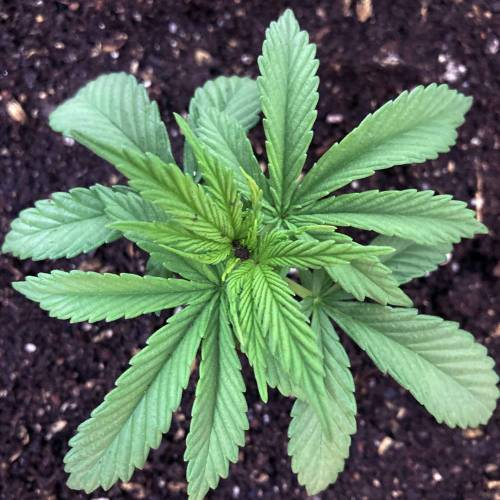
Cuarta semana de esta sativa mítica, hoy comienza el gran juego, he hecho el trasplante a la maceta definitiva, una maceta textil cuadrada de 15L con base de piedras!
Hoy toca hablar un rato sobre el sustrato que he preparado para esta plántula, en esta temporada de cultivos voy a comparar dos mezclas de sustrato, éste, compuesto en su base por componentes comerciales y otro con sustrato y nutrientes caseros, visita otros diarios de hoy para ver la diferencia..
En este caso como base he usado sustrato reutilizado de mi anterior temporada y sustrato comercial grow light a partes iguales 27%, he añadido un compost de caballo comercial (20%), Fibra de Coco previamente inoculada, hace 15 días, de Microorganismos de Montaña (MM) y Bio nutrientes (20%), también un 10% de Humus de Lombriz, Perlita 7%, Vermiculita 3%, Graba de río 3% y por primera vez voy a usar cascarilla de arroz en la mezcla de sustrato (7%), espero que este material haga la función de la perlita aireando el sustrato, con la diferencia que la cascarilla es materia orgánica rica en silicio y cuando se vaya descomponiendo pasará el silicio a las plantas, finalmente añado 17 minerales en polvo (3%) a razón de 1g por cada litro de tierra, mezclo todo y lleno la maceta.
Yo diferencio tres grupos de componentes en este sustrato:
- Una base nutritiva, estructurada y aireada preparada para recibir y reproducir microbiología: Sustrato, coco, humus y compost.
- Más aireación con perlita y cascarilla, aireación retención de humedad y nutrientes con la vermiculita.
- Y finalmente la mineralización del sustrato para compensar su naturaleza vegetal y garantizar la presencia de toda la gama de elementos inorgánicos de la tabla periódica, también gracias a la mezcla de 6 arcillas consigo un rendimiento mejor en la asimilación de nutrientes por el intercambio catiónico de las arcillas... todo por la causa!
La tarea de preparar estos sustratos es laboriosa pero a mi me motiva mucho, considero la tierra de cultivo como sagrada, me gusta amasar la mezcla de sustrato, ir añadiendo componentes, y sintiendo como con cada nuevo componente cambia la estructura, el tacto o el olor del sustrato.
Antes del trasplante he humedecido bastante la pequeña maceta, el cepellón de raíces salió bastante bien, he enterrado el cepellón, hundido el tallo y no riego hasta mañana, quiero que el exceso de humedad que trajo la pequeña maceta se expanda por el sustrato circundante, mañana la planta tendrá sed y comenzaré con los primeros riegos, en temporadas anteriores hacía un riego profundo a todo el sustrato, esta temporada voy a regar al inicio con menos agua, intentando expandir las raíces de manera eficiente y ordenada, de momento voy a regar procurando no humedecer el centro de la maceta que tiene suficiente humedad con la que ha traído el coco hidratado y el compost de caballo principalmente, de esta manera quiero conservar la aireación de todo ese sustrato y que las raíces lo tengan fácil para expandirse, observé en la temporada anterior que el centro de algunas macetas no estaba suficientemente poblado de raíces, al tiempo voy a humedecer la base de la maceta para que las raíces recorran rápidamente la maceta llamadas por esa humedad en la base, tengo pensado comenzar con 500ml arriba y 500ml abajo, cuando antes cultivé en esta misma maceta comencé con un riego de 3L que tardó casi 10 días en consumirse, creo que fue contraproducente porque el agua invadió todo el sustrato desplazando el oxígeno durante demasiados días, las raíces crecieron mayormente hacia y por los lados de la maceta, es donde más oxígeno encontraron!
Una vez que haga este primer riego cubriré el sustrato con una buena capa de mulch que proviene del Mulch rescatado de cultivos anteriores, mucha materia orgánica semiprocesada y humificada y mucha microbiología latente, también tengo una caja muy preciada con todos los restos de hojas, ramas y raíces de los cultivos anteriores y los palitos de la marihuana que me fumo, comida para los microbios del sustrato, para que empiecen a reproducirse muy felices, para mi la recopilación de materia orgánica seca es casi un ritual, aprovecho todo de las plantas que cosecho, sólo me deshago de los tallos más gruesos y devuelvo a la tierra lo que de la tierra nació y genero un ciclo vital con el que pretendo, no sólo imitar los procesos del bosque sino también avanzar más, en el camino de la auto suficiencia, la rebeldía o la independencia, la gran limitación y condiciones de los cultivos de interior en macetas supone un gran reto para conseguir esto, pero creo en lo que hago, me entretiene mucho y no paro de jugar y comprender... simplificando lo complejo!!
En este rato hablando de sustrato, me he fumado un buen cogollo cola de zorro de la Colombia Punto Rojo de la temporada pasada, es la mejor hierba que he probado en mucho tiempo, me encanta!
Hasta la próxima...
SALUDOS A TODOS!!
================================
Info de la cepa Durban Poison: https://www.marijuana-seeds.nl/durban-poison-seeds
"Una planta sativa pura que nunca ha sido hibridada..." MSNL Seeds
- Genética: Variedad africana original x Skunk holandesa
- Sativa pura: 100%
- Tiempo de Floración - 8-10 Semanas
- Rendimiento masivo: hasta 600 g/m²
- THC Alto - Hasta 20%
================================
5 likes
4 comments
Share
Used techniques
0
Technique
4
Week 4. Vegetation3y ago


12 cm
Height
19 hrs
Light Schedule
24 °C
Day Air Temp
6.1
pH
450 PPM
TDS
60 %
Air Humidity
21 °C
Solution Temp
22 °C
Substrate Temp
20 °C
Night Air Temp
15 liters
Pot Size
0.3 liters
Watering Volume
10 cm
Lamp Distance
Nutrients 5
Agua de montaña
1000 mll
Bio Coco EM
10 mll
Calabaza MMA
7 mll
deFharo Welcome, clandestine marijuana growers, and also to those who are fortunate enough not to be one!🙋♂️👨🌾
Fifth week of life for this mythical South African sativa, so far this plant is the most vigorous and lush among all the crops this season... don't stop!
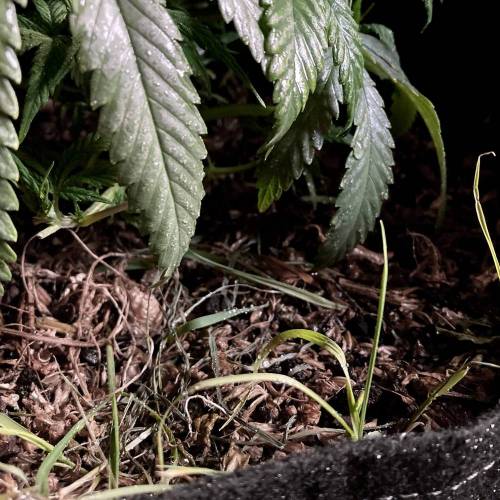
Five days ago, I completed the pot setup, added a thin layer of a mix of pre-cooked amendments with microorganisms and mulch remnants from previous crops, moistened the mix with mountain water, molasses, and Lactic Acid Bacteria (LAB), covered it all with a good layer of dry organic matter from defoliations and branch remnants from last season's crops. For me, collecting organic matter for mulch is an essential practice in my growing style, to speed up the decomposition of this organic matter (OM), I moistened it all with LAB, particularly effective for decomposing OM and molasses, and I also did a foliar application with the same mix.
The day after, I did a watering with a mix of Bio nutrients with MMA and hormones from various sources (auxins, cytokinins, and gibberellic acid), with this I aim to enhance root and cellular development. It also seems that my use of a smaller amount of watering mix is helping with a quick establishment in the pot. Now, I'm mainly trying to develop roots in the center of the pot and downwards, because later, with the advancement of the crop and the amount of watering, the plant will naturally expand roots towards the sides of the pot, but I will only be able to confirm all this when I harvest.
Until next time...
REGARDS TO ALL!!
================================
Info on the strain Durban Poison: https://www.marijuana-seeds.nl/durban-poison-seeds
"A pure sativa plant that has never been hybridized..." MSNL Seeds
- Genetics: Original African variety x Dutch Skunk
- Pure Sativa: 100%
- Flowering Time - 8-10 Weeks
- Massive Yield: up to 600 g/m²
- High THC - Up to 20%
================================
8 likes
7 comments
Share
5
Week 5. Vegetation3y ago


14 cm
Height
19 hrs
Light Schedule
25 °C
Day Air Temp
6.1
pH
500 PPM
TDS
60 %
Air Humidity
20 °C
Solution Temp
21 °C
Substrate Temp
20 °C
Night Air Temp
15 liters
Pot Size
0.3 liters
Watering Volume
10 cm
Lamp Distance
Nutrients 6
Agua de montaña
1000 mll
Bio Coco EM
10 mll
Ormus
1 mll
deFharo Welcome, clandestine marijuana growers, and also to those lucky enough not to be! 🙋♂️👨🌾
It's the sixth week of life for this mythical South African sativa, and she's competing in vigor and growth with 3M ★ African Sun, although the morphology of both plants is completely different.
Four days ago, I did an apical cut on all my advanced crops, plus two waterings with the first soluble Bio nutrients, and a foliar application with my enzymatic hydrolyzed fresh blood (Hidro Blood) and my Lacto fermented seaweed. I'm doing a foliar application once a week; this time I'm making the right mix because in other seasons I've gotten carried away by the efficiency of foliar applications, getting too excited and ultimately damaging the crops with too many consecutive applications.
After the first watering at the beginning of the week, I did a second one two days ago where I wanted to give the plant a boost. I used my potassium hydrolyzed humic and fulvic acids and 33% Hydro Blood (Humato Blood). The plants loved it! The amino acids from Hydro Blood stabilized with my leonardite Humate provide a great energy boost and contribute enormously to the nutrition and structure of the substrate!
Three days ago, I added two side LED panels to the main tent, one at 7700K and the other blue at 450nm. This way, I can bring the canopy lamps closer to the plants and compensate for the missing lighting on the sides. For now, I have 150w in 3 canopy lamps plus 66w from the two side panels and 14w for ventilation. The truth is that all the plants are very compact with very short internodes.
This season, to make the most of all the horizontal space in the grow tent and have good air circulation at the tips, I installed two 22cm fans that are only 3cm thick and hung them from the support bars on opposite sides. Last season, since I filled the grow tent too much, I had 4 fans, all above the lamps, which took up a lot of space, but I didn't end up liking it. I had bud rot issues in some plants, so this season I'm going to solve it with these new fans. Plus, I'm going to save a bunch of watts because the 4 fans last season consumed 72w. Now, the new fans, which operate at 12v, are connected to a voltage regulator and are working at 7.5v with a consumption of 8w and excellent airflow. Besides these, I'm only going to have one more fan above the lamps to disperse the heat from the dimmers. Additionally, I installed an extra extractor with two 12cm PC fans placed in series; they are very quiet, and I regulate the voltage, currently working at 7.5v and consuming 6w. The main extractor, which is very noisy, I keep off during the winter seasons because, for me, noise is important since I live with the grow tent in my workroom.
Until next time...
REGARDS TO ALL!!
================================
Info on the strain Durban Poison: https://www.marijuana-seeds.nl/durban-poison-seeds
"A pure sativa plant that has never been hybridized..." MSNL Seeds
- Genetics: Original African variety x Dutch Skunk
- Pure Sativa: 100%
- Flowering Time - 8-10 Weeks
- Massive Yield: up to 600 g/m²
- High THC - Up to 20%
================================
6 likes
2 comments
Share
Used techniques
Topping
Technique
6
Week 6. Vegetation3y ago




16 cm
Height
19 hrs
Light Schedule
25 °C
Day Air Temp
6.3
pH
525 PPM
TDS
60 %
Air Humidity
20 °C
Solution Temp
21 °C
Substrate Temp
20 °C
Night Air Temp
15 liters
Pot Size
0.3 liters
Watering Volume
10 cm
Lamp Distance
Nutrients 8
Agua de montaña
1000 mll
Bio Coco EM
5 mll
Ormus
2 mll
deFharo Welcome, clandestine marijuana growers, and also to those who are lucky enough not to be! 🙋♂️👨🌾
Seventh week of life for this mythical South African sativa, the apical cut from last week has slowed down vertical growth, and the high brightness I subject my crops to since the beginning of their life also plays a big role. On the other hand, the trunk has thickened considerably, as have the lateral branches, which for me is indicative of a strong root system. So far, I've been very cautious with the watering, trying not to saturate the substrate and keeping it very loose and aerated for better root expansion. I've been watering with a third of the water compared to what I used in previous grows, and I think it's working; the roots are already eagerly peeking out from the base. Now it's time to develop the aerial part... let's play!
Yesterday, during the last watering I did for this plant, I increased the percentage of water in the pot and added Bio Stimulants mainly to the watering mix. From the next waterings, I'm going to increase the concentration and type of nutrients to give a boost to the aerial part before switching to the flowering schedule.
Until next time...
REGARDS TO ALL!!
================================
Info on the strain Durban Poison: https://www.marijuana-seeds.nl/durban-poison-seeds
"A pure sativa plant that has never been hybridized..." MSNL Seeds
- Genetics: Original African variety x Dutch Skunk
- Pure Sativa: 100%
- Flowering Time - 8-10 Weeks
- Massive Yield: up to 600 g/m²
- High THC - Up to 20%
================================
6 likes
comments
Share
7
Week 7. Vegetation3y ago


24 cm
Height
20 hrs
Light Schedule
25 °C
Day Air Temp
6.2
pH
375 PPM
TDS
65 %
Air Humidity
19 °C
Solution Temp
20 °C
Substrate Temp
20 °C
Night Air Temp
15 liters
Pot Size
0.4 liters
Watering Volume
10 cm
Lamp Distance
Nutrients 4
Agua de montaña
1000 mll
Bio Algas EM
20 mll
Enzimas
2 mll
deFharo Welcome, clandestine marijuana growers, and also to those lucky enough not to be one! 🙋♂️👨🌾
Eighth week of life for this mythical South African sativa, the plant is advancing powerfully, standing out among the other crops!
I'm growing this plant in a 15L fabric pot with commercial substrate mineralized with horse compost. The plant maintains a constant growth, strengthening immensely, and has shown no signs of problems unlike most of my current crops. I must also say that the waterings I've been doing have mostly been very nutritious without worrying about anything. This week, after the last two waterings, the plant, fully established in the pot, is showing strong and healthy growth. The lateral branches are striving to stand out, the trunk is very thick, and the current morphology is bulbous thanks to the light compression I'm subjecting all my crops to.
In the last watering, I made a mix with bio-stimulants from algae and enzymes. In this deep watering, I reached 100% moisture in the substrate for the first time. This season, I won't exceed 15% moisture in the pot according to the liters of substrate. In the case of this 15L pot, the total watering amount is 2200ml. Last season for this type of pot, I reached 4200ml per pot. The concept was different this season; the substrate was much lighter in nutrients, and I was trying to emulate with soluble bio-nutrients crops in coco or something similar. The result wasn't bad, but when I opened the pots, I observed scarce root development in the center, and I didn't like it. So this season, I'm going to allow, with less water, for air to take the place it deserves in the substrate and thus try to improve the root development this season. This week, I also did two gentle foliar applications with my fruit bio-stimulant, blood amino acids, and nettle tea... let's play! 🤓💃
I'm thinking of reaching 10 weeks in vegetative growth. If the height allows, I'm going to do gentle waterings so the plant consumes the nutrients from the substrate and releases EC load, so that in the flowering stage, I can feed mercilessly with my specific soluble bio-fertilizers for this stage. I have several flowering formulas that I'll be trying out this season.
Finally, a few days ago, I added the last side LED panel (60x30cm, 4000K) to complete the light box 😁😁😁 for the vegetative growth period. When I switch to flowering, I will change the 4 current side panels (6400K, 7700K, 4000K, and 450nm) for others with warmer color temperatures. This season, I'm pushing the amount of light in vegetative growth to the extreme, and the truth is that I'm achieving compaction in all the plants like never before. The thickness of the stems is considerable, and when I switch to flowering, these crops are going to explode!... let's play!
Until next time...
REGARDS TO ALL!!
================================
Info on the strain Durban Poison: https://www.marijuana-seeds.nl/durban-poison-seeds
"A pure sativa plant that has never been hybridized..." MSNL Seeds
- Genetics: Original African variety x Dutch Skunk
- Pure Sativa: 100%
- Flowering Time - 8-10 Weeks
- Massive Yield: up to 600 g/m²
- High THC - Up to 20%
================================
6 likes
4 comments
Share
Used techniques
LST
Technique
Defoliation
Technique
8
Week 8. Vegetation3y ago


26 cm
Height
20 hrs
Light Schedule
25 °C
Day Air Temp
6.4
pH
535 PPM
TDS
65 %
Air Humidity
19 °C
Solution Temp
20 °C
Substrate Temp
20 °C
Night Air Temp
15 liters
Pot Size
0.5 liters
Watering Volume
10 cm
Lamp Distance
Nutrients 6
Agua de montaña
1000 mll
Purín de ortiga
80 mll
Calabaza MMA
4 mll
deFharo Welcome, clandestine marijuana growers, and also to those lucky enough not to be one! 🙋♂️👨🌾
Ninth week of life for this mythical South African sativa, the healthy and greatly strengthened plant is advancing unstoppable, with strong branches tied down, bending the tips towards the light in a competition to occupy the best spot.
Water consumption is increasing, watering every four days, this week two deep waterings, the first gentle with Nettle Purée and my bio-fermented pumpkin and Activated Mountain Microorganisms (MMA), the intention of this watering (EC: 0.65) was to give a boost to the crop both in the aerial part and in root expansion, the second watering with Humate Blood, a new formula where I chelate the humic and fulvic acids from leonardite Humate (60%) with the amino acids from my enzymatic hydrolyzed fresh blood (30%), I complete the formula with bone meal (10%) which through this process becomes calcium triphosphate that the plant can assimilate, the whole mix is an important contribution of Ca, P, and K, to finish the mixture I added 1% of my Lacto fermented auxins from black beans with minerals to distribute energy to the lateral branches and tips, finally a bit of Ormus from the Cantabrian Sea to regulate the pH and mainly provide Mg and many other minerals.
Next week will be the last in vegetative growth, the plant is currently 26 cm tall, by the end of the week it will have a few more centimeters but surely won’t reach 40 cm, because I have intense lights above this and the other plants in the grow tent to flatten them as much as possible, at the same time, with this type of lighting strategy, the trunk and branches are getting stronger and thicker every day, well, according to the behavior of previous crops, after switching to flowering schedule the plant can stretch up to 75% more than the initial height, for me, plants of 80 cm in height are ideal to give them lots of photons from all sides and grow thick buds throughout the height of the plant, plus unlike previous crops I will maintain the current configuration of side lights, panels with a lot of white and blue light, to try to slow down the vertical stretching of the plants in flowering, once the plants stop stretching, which usually occurs between the second and third week after switching to flowering schedule, I will change all the side panels for others with warmer color temperatures and will set the canopy lamps to 100%... let’s play! 🙋♂️😁
Until next time...
REGARDS TO ALL!!
================================
Info on the strain Durban Poison: https://www.marijuana-seeds.nl/durban-poison-seeds
"A pure sativa plant that has never been hybridized..." MSNL Seeds
- Genetics: Original African variety x Dutch Skunk
- Pure Sativa: 100%
- Flowering Time - 8-10 Weeks
- Massive Yield: up to 600 g/m²
- High THC - Up to 20%
================================
4 likes
2 comments
Share
Used techniques
LST
Technique
Defoliation
Technique
9
Week 9. Vegetation3y ago


32 cm
Height
20 hrs
Light Schedule
25 °C
Day Air Temp
6.5
pH
725 PPM
TDS
65 %
Air Humidity
18 °C
Solution Temp
19 °C
Substrate Temp
18 °C
Night Air Temp
15 liters
Pot Size
0.6 liters
Watering Volume
10 cm
Lamp Distance
Nutrients 7
Agua de montaña
1000 mll
Bio Guanos EM
10 mll
Lacto Harinas
10 mll
deFharo Welcome, clandestine marijuana growers, and also to those lucky enough not to be!🖐️👨🌾
Tenth week of life for this mythical South African sativa and the last day of vegetative growth... let’s play!
Tomorrow I switch to flowering schedule 12/12h, the plant is ready, the leaf mass is dense, and for now, I'm going to leave it un-defoliated because I want the plant to capture maximum light energy, the tips are peeking out eagerly, the water consumption is huge, today it’s 32cm tall, although it could double in size, I don’t mind because I’m prepared for plants up to 80cm, but if they’re smaller, that’s even better, to help the plant not stretch too much while I switch to flowering schedule, I’m going to set the canopy lights to 100%, until now it’s been at 70%, also until they stop stretching (2-3 weeks) I’ll keep the white light spectra on the sides... let’s play!
As a farewell to the growth stage, I’m going to keep the plants under light for 40 uninterrupted hours, I intend to give the plant a shock with the difference in light hours, from 40 to 12h, maybe this will make them flower earlier? I don’t know, that’s why I’m going to try!
This week, two deep waterings, the plant is a big drinker, today a foliar application to give extra energy to the crop with my fruit lacto-ferment (vitamins...) and my hydrolyzed amino acids extracted from fresh blood (Hidro blood). In the next two weeks, the waterings I do will be with low concentration and mainly bio-stimulants, the big hormonal change that happens in the plant with the transition to flowering needs peace, for me, it’s not the time for macro nutrients. 🤷♂️
Until next time...
REGARDS TO ALL!!
================================
Info on the strain Durban Poison: https://www.marijuana-seeds.nl/durban-poison-seeds
"A pure sativa plant that has never been hybridized..." MSNL Seeds
- Genetics: Original African variety x Dutch Skunk
- Pure Sativa: 100%
- Flowering Time - 8-10 Weeks
- Massive Yield: up to 600 g/m²
- High THC - Up to 20%
================================
6 likes
5 comments
Share
10
Week 10. Flowering3y ago




41 cm
Height
12 hrs
Light Schedule
25 °C
Day Air Temp
6.6
pH
275 PPM
TDS
65 %
Air Humidity
17 °C
Solution Temp
18 °C
Substrate Temp
18 °C
Night Air Temp
15 liters
Pot Size
0.65 liters
Watering Volume
10 cm
Lamp Distance
Nutrients 5
Agua de montaña
1000 mll
Bio Guanos EM
15 mll
Ormus
2 mll
deFharo Welcome clandestine marijuana growers, and also to those lucky enough not to be one!✋👨🌾
Eleven weeks into the life of this mythical South African sativa and one week since switching to the flowering schedule 12/12h... let’s play!
A few days ago, I did a foliar application with horsetail extract as a preventive measure against fungi, since the temperatures have dropped a lot and the humidity has risen too high. There have been days when I've had a dehumidifier inside the grow tent; with plants that have a lot of foliage, I don't want to take any risks. Plus, I maintain good ventilation over the plants. So far, everything is good; I don't let the humidity rise above 70%. With the lights on, the humidity drops a lot without needing a dehumidifier.
This season, I'm experimenting with two substrate mixes, also watering with less water, almost half of what I used last season, in order to aerate the substrate and facilitate root expansion, as I wasn't happy with this aspect last season. Additionally, I'm pushing the light intensity to promote compaction, leaf mass, and the strengthening of branches and stems. Lastly, I'm testing my patience by letting the plants express themselves and evolve with minimal intervention. For this plant, just one apical cut and a bit of LST; otherwise, I'm still trying to mimic the forest, albeit speeding up the natural decomposition processes of raw and organic materials with my soluble Bio Fertilizers.
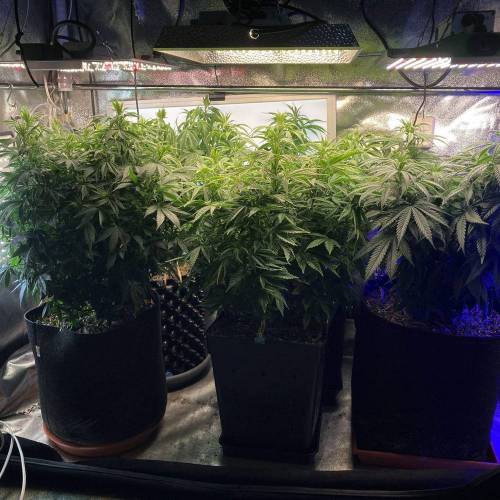
• First week since switching to flowering 12/12h, the plant is lush, with four branches standing out, each in a cardinal direction, and in the center, a cluster of buds is striving to stand out. The trunk is immense and still hidden behind the dense foliage. I'm doing two things in this transition stage:
- In order to slow down as much as possible the significant vertical stretching that occurs at this stage, which according to previous grows lasts between 2 and 3 weeks, I increased the power of the 3 canopy lamps to 100%; they were at 70%. I'm going to keep the 4 side LED panels for vegetative growth with very white color spectrums (7700K, 6400K, 4000K, and 420 nm) until the stretching stops. After that, I'll change them all for warmer ones with greater penetration. The plant was 32cm tall a week ago, today it's 41cm; I still have plenty of room!
- I'm watering during these 2-3 weeks of transition with EC: 0.5/6. I don't want to disturb the plant by forcing it to eat at this stage. Once the plant stops stretching and concentrates all its energy on flower formation, I will feed it and give it light without mercy or hesitation. The substrate, the roots, and I are ready... all for the cause!
Until next time...
REGARDS TO ALL!!
================================
Info on the strain Durban Poison: https://www.marijuana-seeds.nl/durban-poison-seeds
"A pure sativa plant that has never been hybridized..." MSNL Seeds
- Genetics: Original African variety x Dutch Skunk
- Pure Sativa: 100%
- Flowering Time - 8-10 Weeks
- Massive Yield: up to 600 g/m²
- High THC - Up to 20%
================================
7 likes
comments
Share
11
Week 11. Flowering3y ago




45 cm
Height
12 hrs
Light Schedule
25 °C
Day Air Temp
6.6
pH
425 PPM
TDS
65 %
Air Humidity
17 °C
Solution Temp
18 °C
Substrate Temp
18 °C
Night Air Temp
15 liters
Pot Size
0.6 liters
Watering Volume
10 cm
Lamp Distance
Nutrients 4
Agua de montaña
1000 mll
MMA Ultra
20 mll
Ormus
5 mll
deFharo Welcome, clandestine marijuana growers, and also to those lucky enough not to be one!✋👨🌾
Twelve weeks into the life of this mythical South African sativa and two weeks since switching to the 12/12 flowering schedule... let’s play!
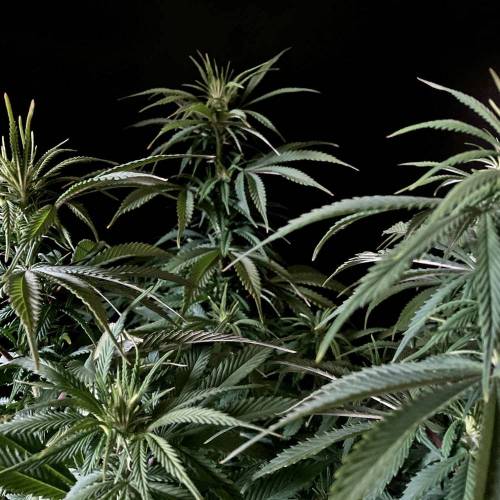
The plant hasn't started flowering yet; I'm keeping an eye on it because a sister seed of this one turned male! This week it has grown 5cm, and next week will be the last of stretching. The final size is going to be fantastic for me because I'll be able to light the plants from the substrate to the top with intense lights. I’ll continue this week with the white growth lights, and next week I’ll make a drastic change from the side LED panels to others with warmer color temperatures. Additionally, I’m going to reinforce the canopy with two more lamps, one with diodes of 2700K+660nm (50w) and a COB of 2800K with lens (50w). I don’t want any corner without good light!
Also, starting next week, when the stretching stops, I’ll begin feeding the plants with specific bio fertilizers for flowering and in larger quantities. At this stage, more variety of minerals is needed compared to the vegetative growth stage. Now the plant will direct all its energy towards flower formation; it will consume the nutrients from the useless leaves, and I will feed it and give it light without mercy... all for the cause!
Until next time...
HELLO TO EVERYONE!!
================================
Strain info for Durban Poison: https://www.marijuana-seeds.nl/durban-poison-seeds
"A pure sativa plant that has never been hybridized..." MSNL Seeds
- Genetics: Original African variety x Dutch Skunk
- Pure Sativa: 100%
- Flowering Time - 8-10 Weeks
- Massive Yield: up to 600 g/m²
- High THC - Up to 20%
================================
5 likes
comments
Share
12
Week 12. Flowering3y ago


52 cm
Height
12 hrs
Light Schedule
25 °C
Day Air Temp
6.5
pH
Normal
Smell
875 PPM
TDS
65 %
Air Humidity
17 °C
Solution Temp
18 °C
Substrate Temp
17 °C
Night Air Temp
15 liters
Pot Size
0.6 liters
Watering Volume
10 cm
Lamp Distance
Nutrients 8
Agua de montaña
1000 mll
Bio Blood EM
20 mll
Humato Bones
10 mll
deFharo Welcome, clandestine marijuana growers, and also to those lucky enough not to be one! 🙋♂️🌱
Thirteen weeks into the life of this mythical South African sativa and three weeks since switching to the 12/12 flowering schedule, on the day of the switch, the plant measured 32cm, today it's 56cm, perfect, because I don't think it will stretch much more, as the flowers are showing strong and ready to fill the sturdy branches with monstrous buds... let’s play! 🌲🌲🌲🌲
Two days ago, I changed all the side LED panels, swapping the 6400K panel (60x30cm, 32w) for another one at 2800K, I also replaced the two side panels of 30x30cm, 32w (7700K and 450nm) with two others featuring diodes of 3000K and 660nm. Additionally, I replaced a 60x30cm and 32w panel with 4000K for two 50cm and 23w TLED bars from Secret Jardin for flowering, with fantastic diodes of 2100k, 3000K, and IR. To finish off, I completed the light canopy with two new lamps to cover the sides of the tent very well, as having the lights too close to the tops reduces lateral reach. I added a 2800K COB with a 90° lens and 50w, and on the other side of the canopy, I added a high-brightness LED panel (20x20, 50w) with 2700K and 660nm diodes... let’s play!
I’ve started to take advantage of this light change to switch up the Bio Fertilizers. I began the week with a deep watering and a boost of energy based on amino acids, humic acids, and other macro and micro Bio nutrients. Gradually, I will be watering with mixes where I will mainly enhance phosphorus and potassium.
During the vegetative growth period, every 10-15 days, I have been adding dry amendments to the substrate at a rate of 1g per liter of soil. I have used, in temporal order: Blood meal, Mealfrass, and feather meal. I also regularly replenish dry organic matter to the mulch; this week, a good handful of chopped dry leaves from defoliations, a fair return to the substrate that completes the life cycle, making the most of the waste generated by my crops, the defoliations, etc.
At the moment, the plant shows very strong main branches, the buds on these are going to be monstrous. The large leaf mass will help me transform light into energy, and the plant will take care of getting rid of the useless leaves. In fact, it has already started sucking nutrients from some old leaves; I’m not going to do any defoliation.
Until next time...
REGARDS TO ALL!!
================================
Info on the strain Durban Poison: https://www.marijuana-seeds.nl/durban-poison-seeds
"A pure sativa plant that has never been hybridized..." MSNL Seeds
- Genetics: Original African variety x Dutch Skunk
- Pure Sativa: 100%
- Flowering Time - 8-10 Weeks
- Massive Yield: up to 600 g/m²
- High THC - Up to 20%
================================
3 likes
comments
Share
13
Week 13. Flowering3y ago




57 cm
Height
12 hrs
Light Schedule
25 °C
Day Air Temp
6.6
pH
Normal
Smell
690 PPM
TDS
65 %
Air Humidity
17 °C
Solution Temp
18 °C
Substrate Temp
17 °C
Night Air Temp
15 liters
Pot Size
0.6 liters
Watering Volume
10 cm
Lamp Distance
Nutrients 9
Agua de montaña
1000 mll
Harinas MMA
15 mll
Humato PK
15 mll
deFharo Welcome, clandestine marijuana growers, and also to those lucky enough not to be! 🙋♂️👨🌾
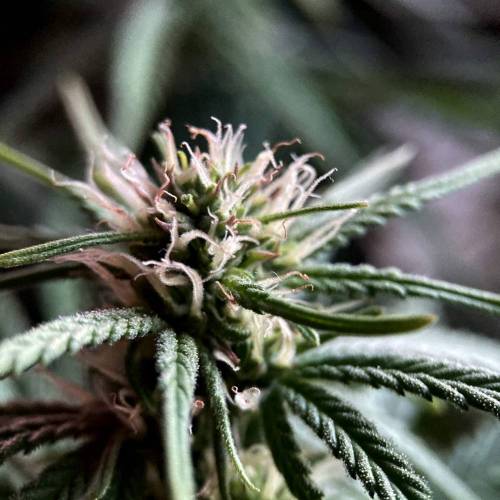
Fourteen weeks into the life of this mythical South African sativa and four weeks since switching to the 12/12 flowering schedule, on the day of the switch, the plant measured 32cm, today it's 57cm, now the stretch has concluded and the plant is fully focused on flower formation! 🌲🌲🌲🌲
The strength of the grow is impressive, the leaf mass is almost intact, the powerful branches are showing immaculate flower buds all along their length, and at the end of each branch, a massive bud will emerge... I promise! 🤓😁
I've started using new watering formulas aimed at enhancing flowering, on the other hand, the plant has begun self-defoliating useless inner leaves, the plant absorbs all the nutrients and moisture from the old or hidden leaves, then it throws them onto the mulch to complete the natural cycle.
Remember that this season I haven't done any defoliations; I've greatly enhanced the development of the leaf mass to capture the maximum light/energy, the intelligence of the plants will now do their own defoliation, now the plants are focused on flower formation and are getting rid of the useless leaves, but first, they cannibalize them to recover the nutrients and minerals they grew with.
This week, I've also completed the lighting strategy, I've added a new 3000K COB with a 120° lens (50w) to the canopy so that there’s powerful light on all sides and nothing is left in the shadows, now with 6 lamps in the canopy (500w) and 5 side LED panels and bars (148w) covering the 4 corners, I total 648w, if I divide that among the 6 plants in the grow tent, that gives 108w per plant, I think that will help me achieve maximum yield from these crops.
Until next year...
CHEERS AND HEALTH TO ALL!!
================================
Info on the strain Durban Poison: https://www.marijuana-seeds.nl/durban-poison-seeds
"A pure sativa plant that has never been hybridized..." MSNL Seeds
- Genetics: Original African variety x Dutch Skunk
- Pure Sativa: 100%
- Flowering Time - 8-10 Weeks
- Massive Yield: up to 600 g/m²
- High THC - Up to 20%
================================
5 likes
2 comments
Share
14
Week 14. Flowering3y ago


60 cm
Height
12 hrs
Light Schedule
27 °C
Day Air Temp
6.5
pH
Normal
Smell
700 PPM
TDS
65 %
Air Humidity
17 °C
Solution Temp
18 °C
Substrate Temp
17 °C
Night Air Temp
15 liters
Pot Size
0.75 liters
Watering Volume
10 cm
Lamp Distance
Nutrients 9
Agua de Montaña
1000 mll
Bio +Bones EM
15 mll
Bio Mealfrass EM
20 mll
deFharo Welcome, clandestine marijuana growers, and also to those fortunate enough not to be! 🙋♂️👨🌾
Fifteen weeks into the life of this mythical South African sativa and five weeks since switching to the 12/12 flowering schedule.
The plant continues its journey to the zenith of its glory, the cultivation remains very healthy and extremely strong, the leaf mass captures light, converts it into energy, and the flowers keep growing and growing. The metabolism is very high and is reflected in the water consumption. Little by little, the plant is shedding the exhausted leaves and the inner ones that hardly receive any light, but first, the plant cannibalizes the nutrients, minerals, and moisture from those leaves. I help with this cleanup by removing the yellow leaves that come off with a gentle push, then I use them to add organic matter to the mulch.
These days, I'm feeding the plant with various mixes of Bio Nutrients while also feeding the soil with new layers of mulch that I bring from the leaves discarded by the plant itself. I shred them and add them to the substrate. These still-green leaves have proven to be an excellent habitat for the proliferation of aerobic microbiology. Currently, all the mulch in my crops has a greasy feel, which is the unmistakable sign of the humification of the organic matter in the mulch. Additionally, this week I've added dry amendments like bone meal (Ca, P...) and worm guano or mealfrass (P, K, Mg...). This guano is excellent for me, as it promotes microbiology proliferation like no other and is easier to digest than classic bird or bat guanos. I also have a formula where I've solubilized this guano with Activated Mountain Microorganisms (MMA) and Fermented Grass, proving to be a fantastic compound to revive lazy crops.
Until next year...
CHEERS AND HEALTH TO ALL!!
================================
Info on the strain Durban Poison: https://www.marijuana-seeds.nl/durban-poison-seeds
"A pure sativa plant that has never been hybridized..." MSNL Seeds
- Genetics: Original African variety x Dutch Skunk
- Pure Sativa: 100%
- Flowering Time - 8-10 Weeks
- Massive Yield: up to 600 g/m²
- High THC - Up to 20%
================================
3 likes
comments
Share
15
Week 15. Flowering3y ago


60 cm
Height
12 hrs
Light Schedule
27 °C
Day Air Temp
6.6
pH
Normal
Smell
950 PPM
TDS
65 %
Air Humidity
17 °C
Solution Temp
18 °C
Substrate Temp
17 °C
Night Air Temp
15 liters
Pot Size
0.85 liters
Watering Volume
10 cm
Lamp Distance
Nutrients 12
Agua de Montaña
1000 mll
Bio Guanos EM
35 mll
Bio Bones+ EM
15 mll
deFharo Welcome clandestine marijuana growers, and also to those who are fortunate enough not to be! 🙋♂️👨🌾
16 weeks into the life of this mythical South African sativa and six weeks since switching to the 12/12 flowering schedule.
As is traditional at this time, the plants and I are having big feasts with home-cooked products—no overindulgence! And we’re all getting healthier and happier... let the party continue! 💃🕺
This plant is the biggest eater in the garden, this week 3 very varied and concentrated waterings. Average EC: 1.9... let’s play!
••• Well, despite the low activity on GD and to avoid dying of boredom, I continue my organic experimental process, and this time taking advantage of the dark and rainy day and having my marijuana cellar well stocked, I’m going to explain with a joint in hand a new practice framed in the concept of "feeding and protecting the soil" that I started trying this week with all my pots.
This practice is especially useful for those who have soil and space for outdoor crops; I don’t have that space, I can only currently do indoor crops in pots, but that doesn’t mean I give up on these types of techniques.
If I had soil and outdoor space, I would do this practice every year during the soil's resting season. This practice consists of covering the soil with fresh green grass and immediately provoking the proliferation of certain lactobacilli, Bacillus subtilis, and a multitude of enzymes that only exist when the grass is freshly cut. Once dried, the grass becomes pure organic matter rich in silicon that will also serve as food for the microbiology.
In this diary: https://growdiaries.com/diaries/134104-grow-journal-by-defharo/week/782852
You can read about the practice of making fermented grass for use in creating Soluble Bio Fertilizers, as the bacteria and enzymes from fermented grass are particularly efficient in chelating minerals.
"Fermented grass is the viable alternative for those organic growers who do not have access to fresh cow manure to create Bio Fertilizers. Fresh grass contains Lactobacillus and a multitude of enzymes, and in conjunction with Mountain Microorganisms, I create a Bio ferment with a high population of Microorganisms very efficient in: decomposing organic matter, chelating minerals, and reducing the incidence of pests and diseases in crops, as this type of fermentation presents antagonistic and competitive relationships with different phytopathogenic microorganisms."
What have I done and how?
Yesterday I went for a walk in the countryside to look for fresh grass, but there are hundreds of types of grass that I don’t know, so the first choice to get the optimal grass is to choose those fields where cows or ruminants in general usually graze. I chose yesterday to collect the grass because the day before it had rained quite a bit, which ensures the cleanliness of dust and impurities in the process.
I collected a good amount of recent grass, still without seeds, mainly cutting the green leaves but also taking some roots that contain trichoderma.
On the same day, when the grass is still fresh, I chop it up; this is important because the microbiology of this material is lost very quickly as the grass dries. Once chopped, I mixed it with chopped marijuana leaves that I had accumulated. After that, I raked the mulch from my pots, where I already have a lot of microbial activity, humified organic matter, and remnants of dry amendments in the process of disintegration. I added a good layer of grass and mixed it all on the surface.
Having done the above, I concluded the process with a practice that will allow me to capture and proliferate the lactobacilli, Bacillus subtilis, and trichodermas in record time, before all that living material is lost with the dehydration of the grass.
Finally, I sprayed the entire surface of the grass mixed with the mulch with a solution of mountain water, molasses, and fresh yeast. I want to provoke an accelerated fermentation in the grass that will allow the capture of all living elements, enzymes, and minerals, although I think this practice would have been better during the vegetative development stage; it’s still valid now, especially to observe the behavior of the practice.
This practice arose from the reflection on the care and feeding of outdoor cultivation lands; for me, it’s a whole theoretical development that I now apply in my pots.
In reality, if I had farmland and thinking about the rotational resting of the plots, I would do it as follows: For the land that will rest that year, I would plant grass and let it grow even until it produces seeds, then I would cut it and leave it on the land. In this case, the solution with molasses and yeast would not be necessary since the soil where the grass was planted already contains all the microbiology that would take care of turning the grass into organic matter and then into humus. However, if we want to accelerate the process, we can also use the solution with molasses and yeast, but in this case, we spray the grass before cutting it to immediately cut it and leave it moistened with the mixture on the ground. In a year, I could at least have two harvests of grass in these resting lands.
As in all my practices and organic solutions, what I try to do is accelerate all the natural decomposition processes of the forest through the management of waste, raw materials, and native microbiology, in order to obtain high-yield crops and above all independence from the industry... for me today, there’s nothing more subversive than having a self-sufficient organic farm!
Until next time...
REGARDS AND HEALTH TO ALL!!
================================
Info on the strain Durban Poison: https://www.marijuana-seeds.nl/durban-poison-seeds
"A pure sativa plant that has never been hybridized..." MSNL Seeds
- Genetics: Original African variety x Dutch Skunk
- Pure Sativa: 100%
- Flowering Time - 8-10 Weeks
- Massive Yield: up to 600 g/m²
- High THC - Up to 20%
================================
2 likes
comments
Share
16
Week 16. Flowering3y ago




60 cm
Height
12 hrs
Light Schedule
27 °C
Day Air Temp
6.6
pH
Strong
Smell
675 PPM
TDS
65 %
Air Humidity
17 °C
Solution Temp
18 °C
Substrate Temp
17 °C
Night Air Temp
15 liters
Pot Size
0.85 liters
Watering Volume
10 cm
Lamp Distance
Nutrients 8
Agua de Montaña
1000 mll
Bio Algas EM
10 mll
Bio Guanos EM
15 mll
deFharo Welcome clandestine marijuana growers, and also to those lucky enough not to be one!✋👨🌾
17 weeks into the life of this mythical South African sativa and seven weeks since switching to the 12/12 flowering schedule.
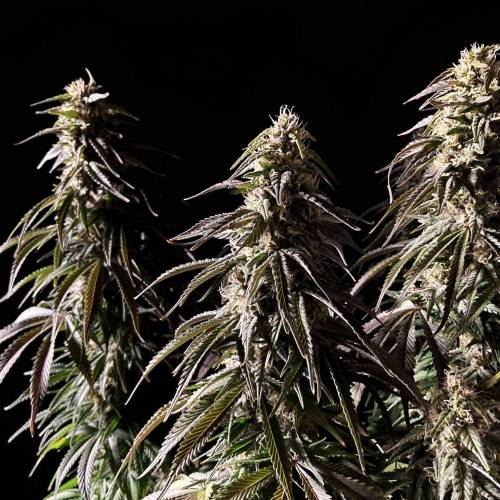
The big girl of the garden welcomes you, magnificent and proud, this great plant showcases monstrous colas that promise immense buds reaching up to 40cm long. There's still a lot of game ahead; the plant constantly demands food, light, and warmth. I give it all because I'm enchanted by the charms of this toxic strain!
The leaf mass remains while the plant devours the old leaves hidden from the light in an act of self-defoliation and survival. The exhausted leaves fall to the substrate to complete the cycle of life in the forest, thus returning the rest of the minerals they used to grow, and ultimately this organic matter serves as food for the substrate's microbiology to live and work joyfully and energetically. Meanwhile, the water consumption is brutal; I water deeply every 3 days... let the games begin!
Until next time...
CHEERS AND HEALTH TO EVERYONE!!
================================
Info on the strain Durban Poison: https://www.marijuana-seeds.nl/durban-poison-seeds
"A pure sativa plant that has never been hybridized..." MSNL Seeds
- Genetics: Original African variety x Dutch Skunk
- Pure Sativa: 100%
- Flowering Time - 8-10 Weeks
- Massive Yield: up to 600 g/m²
- High THC - Up to 20%
================================
3 likes
comments
Share
17
Week 17. Flowering3y ago


62 cm
Height
12 hrs
Light Schedule
27 °C
Day Air Temp
6.5
pH
Strong
Smell
800 PPM
TDS
65 %
Air Humidity
17 °C
Solution Temp
18 °C
Substrate Temp
17 °C
Night Air Temp
15 liters
Pot Size
0.85 liters
Watering Volume
10 cm
Lamp Distance
Nutrients 9
Agua de Montaña
1000 mll
Coco Bloom EM
20 mll
Bio Fish EM
10 mll
deFharo Welcome, clandestine marijuana growers, and also to those lucky enough not to be one!✋👨🌾
18 weeks into the life of this mythical South African sativa and eight weeks since switching to the 12/12h flowering schedule.
The venomous strain is moving towards its glory, the upper leaves tinted by the low nighttime temperatures give an exotic touch to the grow, the enormous buds seem limitless, the density is huge, and the aromas released by the buds are already invading the space with their own personality.
This plant consumes a lot of water and nutrients and always wants more! It's a sign of the great metabolism driven by the intense light surrounding it. Currently, this grow is a whole, a living organism in perfect symbiosis and harmony between light, substrate, and microbiology. The enormous buds crowning the plant and the leaf mass are the true reflection of the health and efficiency of everything in the substrate.
Two days ago, after a week without seeing my garden, I organized a big feast with all my plants, a fraternal meal where I cooked new recipes, we drank, ate, and danced to the music, wrapped in the smoke of my best marijuana!
According to the producer, there are at most 2 weeks left of cultivation. At the rate this plant is going, the result is going to be monstrous, although I have to say that this season I am applying a technique, which I will explain if I see results, where I try to delay the senescence of the plant, extending the flowering period, and thus giving more time for the buds to swell, a kind of Elixir of Life. I also want to remind everyone that I feed my plants with every watering until the end of their life; I don’t water with pure water, and until the end, I always feed my plants whenever I water, as if it were for myself... let’s play!
In nature, this plant would be experiencing autumn, the light during this time is softer and reddish. I have moved the lights a bit away from the canopy; I don’t want to stress the upper tips!... we’re on the way to glory!
Until next time...
CHEERS AND HEALTH TO ALL!!
================================
Info on the strain Durban Poison: https://www.marijuana-seeds.nl/durban-poison-seeds
"A pure sativa plant that has never been hybridized..." MSNL Seeds
- Genetics: Original African variety x Dutch Skunk
- Pure Sativa: 100%
- Flowering Time - 8-10 Weeks
- Massive Yield: up to 600 g/m²
- High THC - Up to 20%
================================
5 likes
comments
Share
18
Week 18. Flowering3y ago




62 cm
Height
12 hrs
Light Schedule
27 °C
Day Air Temp
6.5
pH
Strong
Smell
1075 PPM
TDS
65 %
Air Humidity
17 °C
Solution Temp
18 °C
Substrate Temp
17 °C
Night Air Temp
15 liters
Pot Size
0.7 liters
Watering Volume
10 cm
Lamp Distance
Nutrients 8
Agua de Montaña
1000 mll
Coco Bloom EM
20 mll
Lacto Algas
10 mll
deFharo Welcome clandestine marijuana growers, and also to those lucky enough not to be one!✋👨🌾
19 weeks into the life of this mythical South African sativa and nine weeks since switching to the 12/12h flowering schedule.
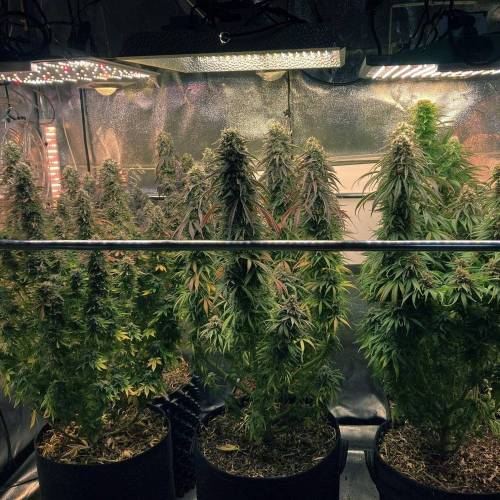
The plant continues to define the enormous buds breaking away from the surrounding leaves, there’s a lot of vigor and strength to keep the flowering game going, the aromas are intoxicating!
This week, two concentrated waterings with varied components, the plant is asking for more!
Until next time...
CHEERS AND HEALTH TO EVERYONE!!
================================
Info on the strain Durban Poison: https://www.marijuana-seeds.nl/durban-poison-seeds
"A pure sativa plant that has never been hybridized..." MSNL Seeds
- Genetics: Original African variety x Dutch Skunk
- Pure Sativa: 100%
- Flowering Time - 8-10 Weeks
- Massive Yield: up to 600 g/m²
- High THC - Up to 20%
================================
5 likes
3 comments
Share
19
Week 19. Flowering3y ago




62 cm
Height
12 hrs
Light Schedule
27 °C
Day Air Temp
6.5
pH
Strong
Smell
650 PPM
TDS
65 %
Air Humidity
17 °C
Solution Temp
18 °C
Substrate Temp
17 °C
Night Air Temp
15 liters
Pot Size
0.75 liters
Watering Volume
15 cm
Lamp Distance
Nutrients 7
Agua de Montaña
1000 mll
Humato Bones
20 mll
Bio Plus EM
11 mll
deFharo Welcome, clandestine marijuana growers, and also to those lucky enough not to be one! 🙋♂️👨🌾
20 weeks into the life of this mythical South African sativa and ten weeks since switching to the 12/12 flowering schedule.
The great poisonous female refuses to age, consuming a lot of water, and the grateful buds are growing and fattening in the warmth of home.
The last watering of this week was with low EC: 0.5, I intend for the plant to feed off the substrate and take a little break from soluble fertilizers while waiting for the final push in the last weeks of cultivation.
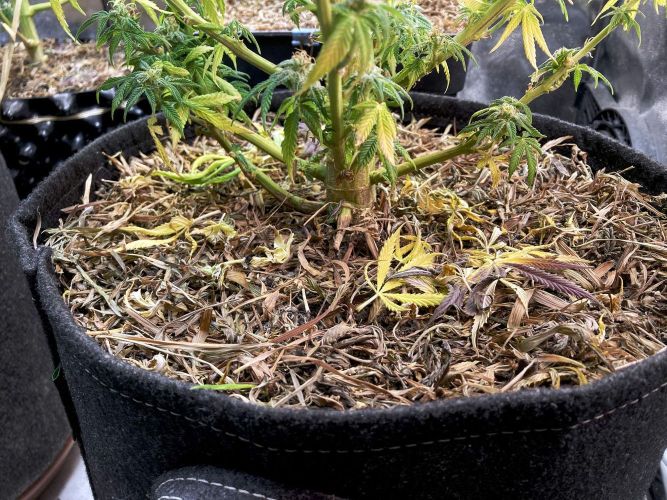
Two days ago, I detected the beginnings of bud rot, so I immediately cut a few centimeters off it, which I will smoke calmly, and applied palm ash to the cut and the surrounding area, I didn't have anything better on hand, the ash will absorb the excess moisture and being an alkaline material, I hope it will stop the spread of the fungus there. Plus, I have that branch in front of a fan; for now, the rest of the branch and the other buds look healthy. To avoid risks, I'm putting a dehumidifier on during the night hours when the humidity rises a lot.
Until next time...
CHEERS AND HEALTH TO ALL!!
================================
Info on the strain Durban Poison: https://www.marijuana-seeds.nl/durban-poison-seeds
"A pure sativa plant that has never been hybridized..." MSNL Seeds
- Genetics: Original African variety x Dutch Skunk
- Pure Sativa: 100%
- Flowering Time - 8-10 Weeks
- Massive Yield: up to 600 g/m²
- High THC - Up to 20%
================================
5 likes
2 comments
Share
20
Week 20. Flowering3y ago





62 cm
Height
12 hrs
Light Schedule
27 °C
Day Air Temp
6.5
pH
Strong
Smell
825 PPM
TDS
65 %
Air Humidity
17 °C
Solution Temp
18 °C
Substrate Temp
17 °C
Night Air Temp
15 liters
Pot Size
0.65 liters
Watering Volume
15 cm
Lamp Distance
Nutrients 9
Agua de Montaña
1000 mll
Humato PK
20 mll
MMA FK
15 mll
deFharo Welcome, clandestine marijuana growers, and also to those lucky enough not to be! 🙋♂️👨🌾
21 weeks into the life of this mythical South African sativa and 11 weeks since switching to the 12/12 flowering schedule.
The end of this great plant is approaching; I’m going to wait just one week or two waterings, the last one I’ll do with only pure mountain water, I’ll let the substrate dry and cut it without mercy.
At the beginning of this week, I detected signs of rot on another main branch. Since I didn’t want to harvest early for this reason, I performed some operations to stop the stem rot so I could continue growing without risk. So far, it’s working; the first thing I did was cut the apex, about 7cm, then I made another cut below the next buds down to a point where the stem was healthy, sprinkled wood ash, and covered the stem cut. A few hours later, I applied a few ml of a solution of water and 10% hydrogen peroxide to the stem. Once it dried, I sprinkled sulfur powder all over the area. After a few days, everything has returned to normal, and the secondary buds from the two affected branches are fattening and growing.
The rest of the buds continue to swell; the plant stinks when touched, and the buds have a very sticky feel. It’s going to be some brutal weed, and I say this because I smoked some of the buds I cut last week, and the effects are very strong.
Until next time...
CHEERS AND HEALTH TO ALL!!
================================
Strain info for Durban Poison: https://www.marijuana-seeds.nl/durban-poison-seeds
"A pure sativa plant that has never been hybridized..." MSNL Seeds
- Genetics: Original African variety x Dutch Skunk
- Pure Sativa: 100%
- Flowering Time - 8-10 Weeks
- Massive Yield: up to 600 g/m²
- High THC - Up to 20%
================================
3 likes
2 comments
Share
21
Week 21. Harvest3y ago
Happy Harvest Day!


9/10
Rated
Gran planta que ha destacado en mi jardín de la alegría. una joya sudafricana que despierta todos mis los sentidos. Desde el principio ha sido una planta vigorosa y generosa, regalándome momentos sublimes de sus colas monstruosas cargadas de resina.
Sus cogollos, densos y duros como rocas, están cubiertos de un manto de tricomas que brillan bajo la luz, como si estuvieran bañados en la escarcha de una mañana fresca. Al tacto, son una delicia esponjosa, pero lo suficientemente pegajosos como para recordarte la potencia que llevan dentro, además acompañados de una mezcla de intensos aromas que me transportan a un bosque húmedo tras la lluvia, donde el eucalipto perfuma el ambiente y una nota de especias picantes se enreda en el aire. El primer toque en la lengua ofrece un sabor terroso profundo, que evoca el olor de la tierra después de una tormenta, y un delicado matiz a hongos frescos que añade una capa umami inesperada pero exquisita.
En definitiva, un cultivo excepcional donde casi he triplicado las previsiones de rendimiento del productor... repetiré!
Show more
Translate
Spent 142 days
Ger Veg Flo Har
630 g
Bud wet weight per plant
200 g
Bud dry weight per plant
1
Plants
0.12 m²
Grow Room size
Easy
Difficulty

Uplifted, Happy, Creative
Positive effects

Pungent, Earthy, Pine
Taste
Height
Day air temperature
Air humidity
PPM
PH
Light schedule
Solution temperature
Night air temperature
Substrate temperature
Pot size
Lamp distance


deFharo Welcome, clandestine marijuana growers, and also to those who are fortunate enough not to be! 🙋♂️👨🌾
22 weeks into the life of this mythical South African sativa and 12 weeks since switching to the flowering schedule of 12/12h.
159 days since I planted the seed in the substrate, and today, I have executed and raided this great poisonous plant; now, the enormous buds hang like spoils in front of the extractor of my main tent, hot and dry air to speed up moisture loss. But the final step of this ruthless grow is still pending, because once the plant is dry, I will still take it to the bonfire, I will smoke it!
===========================================================
My whim to grow this plant has been rewarded with a very decent yield of magnificent buds that smell like sweet forest and spices... my marijuana stash is enriched with this strain!
Durban Poison is a wild South African variety. Its buds, dense and hard as rocks, are covered in a cloak of trichomes that shine under the light, as if they were bathed in the frost of a cool morning. To the touch, they are a fluffy delight, but sticky enough to remind you of the potency they carry within. After more than 3 months of curing, opening the jar of Durban fills the air with an intense mix of aromas that transport you to a damp forest after the rain, where eucalyptus scents the air and a note of spicy herbs weaves through the atmosphere. The first touch on the tongue offers a deep earthy flavor, evoking the smell of the ground after a storm, and a delicate hint of fresh mushrooms that adds an unexpected but exquisite umami layer.
However, it is in its effects where Durban Poison truly shines. With undeniable potency, this strain hits hard, elevating the mind and clearing the fog of any monotonous day. It’s an energetic, almost electric experience that awakens creativity and focus, leaving a vibrant sensation in the body that lingers for a long time. In summary, Durban Poison is not only a delight for the senses but a complete experience that merges the power of nature with the craftsmanship of the organic grower.
Until next time...
CHEERS AND HEALTH TO ALL!!
================================
Info on the Durban Poison strain: https://www.marijuana-seeds.nl/durban-poison-seeds
"A pure sativa plant that has never been hybridized..." MSNL Seeds
- Genetics: Original African variety x Dutch Skunk
- Pure Sativa: 100%
- Flowering Time - 8-10 Weeks
- Massive Yield: up to 600 g/m²
- High THC - Up to 20%
================================
6 likes
5 comments
Share
Equipment Reviews


56 comments
Sort by
popularity
popularity
newest
oldest

SPRAMOAH commentedweek 03y ago
New grow!
Exciting!
Fingers crossed this time gonna be a girl!
Taking experimental organics on new level!
likes 5

deFharo commented3y ago
@@SPRAMOAH, yes 🙏, this is not a garden for dudes! 😈
likes 5
SPRAMOAH commented3y ago
@deFharo, Thats true unless to keep them for breeding BUT it is a different story!
likes 5
deFharo commented3y ago
@@SPRAMOAH, what I want are hermaphrodite plants so they can cross with each other, those crosses only produce feminized seeds. I want to grow seeds from my crops next season; I already have a small collection!
likes 5

Jobbie commentedweek 03y ago
Awesome stuff bud! I understood about half of it, your diaries are amazing as they remind me of how much I am still to learn. Keep on growing! 💚
likes 5
deFharo commented3y ago
@Jobbie, thanks for the support! doing is understanding! 👍
likes 5
Jobbie commented3y ago
@deFharo, Thank you my Guru!
likes 5

Northern_Ent commentedweek 13y ago
Good luck. Durban Poison is on my ‘to grow’ list. Maybe next year.
likes 5

XII_XII_MrGreen commentedweek 13y ago
Good luck mate😎👊
likes 4
deFharo commented3y ago
@XII_XII_MrGreen, thanks, I hope it doesn't turn into a fierce male! 🙏
likes 4
XII_XII_MrGreen commented3y ago
@deFharo, I don't know what you mean with that? I turn into a fierce male?
likes 4
deFharo commented3y ago
@XII_XII_MrGreen, no, I said that because last season a sister seed of this one turned male after 10 weeks of growing! growdiaries.com/diaries/168816-grow-journal-by-defharo
likes 4

Lemonhazelover commentedweek 43y ago
Your girl is so hot bro ☘️
likes 4
deFharo commented3y ago
@Lemonhazelover, yes, I'm determined to grow this strain!
likes 3

BudBoutique commentedweek 43y ago
as always love your shots buddy 💚
likes 4
deFharo commented3y ago
@BudBoutique, 😁 thank you! playing and growing is all one! 🙋♂️🤓
likes 3
BudBoutique commentedweek 33y ago
looking pretty healthy & amazing report and effort you are putting in !!
likes 4
deFharo commented3y ago
@BudBoutique, thanks again! Let's see how the crops progress. 🙏😌
likes 2

420DeepGrow commentedweek 23y ago
Pets love vegetables 😄, how clever they are!
likes 4
deFharo commented3y ago
@420DeepGrow, yeah, and I was thinking that the pups are carnivores! 🤷♂️
likes 4
420DeepGrow commentedweek 13y ago
So far it's going really well, good genetics.
likes 4
deFharo commented3y ago
@420DeepGrow, for now it's the most vigorous, I hope it’s not another impetuous male!
likes 4

Golden commentedweek 73y ago
Absolutely banging strain choice, keep up the great work and happy growing 🌲🌲🌲
likes 3
deFharo commented3y ago
@Golden, thanks mate! 🙋♂️👨🌾
likes 2

Green_Man_420 commentedweek 53y ago
Love the photos! Loooong great. Good job ✌️
likes 3
deFharo commented3y ago
@Green_Man_420, thanks mate! 🙋♂️👨🌾
likes 2
420DeepGrow commentedweek 43y ago
A legendary one that will someday be in my grow, things are going well.
likes 3
deFharo commented3y ago
@420DeepGrow, let's see if I don't end up with a male!
likes 3
420DeepGrow commentedweek 33y ago
You are like a witch.
likes 3
deFharo commented3y ago
@420DeepGrow, the witch Piruja! 😁😁😁
likes 3
420DeepGrow commentedweek 03y ago
Good luck with your grow bro 😌😊
likes 3
deFharo commented3y ago
@420DeepGrow, thanks mate!
likes 4

KingSalomonsWeed commentedweek 193y ago
A very good Portrait of your plant. I Like it much.
likes 2
deFharo commented3y ago
@KingSalomonsWeed, Thank you so much! The strain helps!
likes 2

MiyaguiOkPolilla commentedweek 183y ago
Cooonio
The baby has some tremendous arms, all from the gym and good food.
likes 2
deFharo commented3y ago
@MiyaguiOkPolilla, watch out for Lady Poison!
likes 2
420DeepGrow commentedweek 133y ago
There are going to be some really long lines 🚂
likes 2
deFharo commented3y ago
@420DeepGrow, I'm going to try to fill them from the bottom up... all for the cause! Happy New Year 2024!
like 1
420DeepGrow commentedweek 83y ago
The photos are really good, and the plant is great too, of course!
likes 2
deFharo commented3y ago
@420DeepGrow, this plant is standing out, it's going to be a beast! 👽 🖐️
like 1

Herbie101 commentedweek 43y ago
Awesome diary, great photos, happy plants! Great work buddy! That durban is gonna be great!
likes 2
MiyaguiOkPolilla commentedweek 93y ago
Excellent experience and work 😍
Hidro Blood sounds perfect 💥 I’ll buy it! 🤭🤭
Well thought out about the macronuts in the change, purely hormonal ✨
like 1
deFharo commented3y ago
@MiyaguiOkPolilla, Whenever you want, I'll teach you how to make Hydro Blood, you just need fresh blood, you can get it at butcher shops, and a small mix of 3 fruits. With one liter, you have enough for years, it's very strong!
like 1
MiyaguiOkPolilla commented3y ago
@deFharo, I would love to! It makes a lot of sense what you do by focusing on bio-stimulation.
like 1
deFharo commented3y ago
@MiyaguiOkPolilla, ask at the butcher for fresh blood, it can be from pig, cow, or any other animal, that blood contains about 70% protein which we convert into directly assimilable amino acids through enzymatic hydrolysis, then you'll need very ripe pineapple, green kiwis, or very green papaya, you don't need all 3 but if you can get them it's better, you'll need a bit of molasses.
like 1

the end.
Enjoying this diary? Follow for more updates!

Prefer the old Diary view?
Go back to the old Diary view