


Best results organically?

Jasonarchystarted grow question 4y ago
How do I get the most out of a soil grow using gavita pro 1000 watt hps

Open
Techniques. Other
likes
Answer

crimsonechoanswered grow question 4y ago
fit as many 5-12 liter plastic pots as you can into your tent with 5cm inbetween each pot. transplant directly into those, flip after a week. since you already germinated them go sog.
likes
Complain

SeedlockHolmesanswered grow question 4y ago
@GreenOrganicGermany said it all... go for bennies!!! (beneficial microbes). They are your regulators peacekeepers, healers and farmers in that underground community ;).
Let me only add that for that light I would go with at least 25L pots and like only 5 - 6 plants in a 4x4 tent.
Take your time and have a big harvest.
likes
Complain

GreenOrganicGermanyanswered grow question 4y ago
To get the best out of the soil, it needs to contain both those useful microorganisms and, of course, enough food for them. Common microorganisms would be, for example: Bacillus amyloliquefaciens, B. brevis, B. cirulans, B. coagulans, B. firmus, B. halodenitrificans, B. laterosporus, B. licheniformis, B. megaterium, B. mycoides, B. pasteuri, B. polymyxa, B. subtilis, and so on...
Where do they come from?! Compost and worm humus are a great source. So, it's highly advisable to use compost or humus in the soil mix. These microorganisms need food. Sugar in the form of molasses is very suitable for this. Bacteria love molasses. So, it's advisable to regularly feed with molasses-containing fertilizers. Additionally, the soil should contain Trichoderma. Trichoderma is a large genus of the crust fungus relatives from the division of sac fungi. Trichoderma species are filamentous fungi that are widely distributed in soil, plants, decaying plant debris, or even wood. There we are again with compost =D And last but not least: Mycorrhiza
Mycorrhiza is the community of soil fungi that live in symbiosis with plant roots. If you consider this when mixing your soil, you've already done a lot of good for your soil, and of course, your plant. This is all very simplified, but maybe these bullet points will help you =D Oh, and lastly, I personally would agree with Jalbit's statement. It could really get a bit tight for you =D
2 likes
Complain

GoldenWeedGroweranswered grow question 4y ago
your plants are too close.. As they grow you will get a big mess. Consider to eliminate some of them or replant in a more large space...
1 like
Complain
Similar Grow Questions
Solved

Erasmus
Any recommendations for cloning?I just topped a second time and am trying cloning for the first time.
Any tips or suggestions?
I have them in a cloning chamber and I used clonex cloning agent. I raised the humidity of the tent and tried standing them up as much as possible.
Week 4
Techniques. Other
6y ago
2
4


Solved

Bigg_B
How does she look?I'm still new to growing, this is my second grow. Just wondering how does she look to some more experienced growers, so I can gauge my progress. Any helpful information is always appreciated!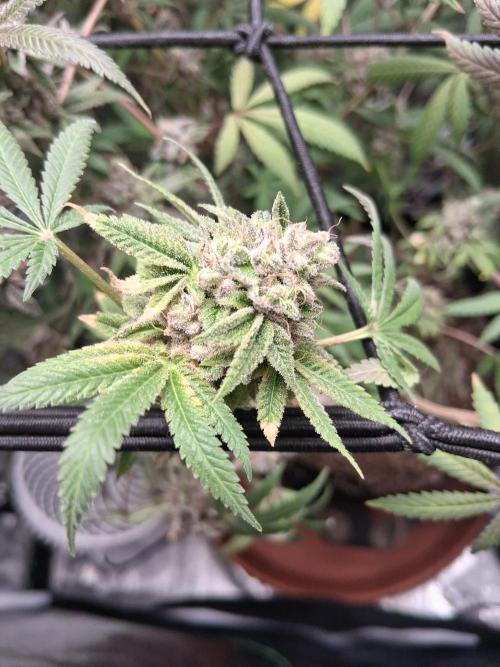
Buds. Other
Plant. Other
Techniques. Other
13d ago
3
3

Solved

cheetah844
Colloidal silver spray on female to force pollen - what time, day or night?I'm about to start spraying females with colloidal silver, I can't find what time is best to spray. Lights on or lights off? Is it best in the morning, midday, night, is there a difference?Techniques. Other
4y ago
1
2
Solved

RJP17
Can I snip the end of leaves at 3 weeks?Is it okay to snip the end of 3 week old leaves off? Reason I ask is because I have seen it done on a diary where the point of the leaves are snipped straight. Also one plant has suffered from light burn on the end edge so was thinking I could do it here if it will help growth.
Techniques. Other
6y ago
5
5


Solved

JS100
Pruning during 4th week of flowerThese four girls are filling the tent. I think I should be okay with height however they are getting dense in the tent. Would it make sense to thin out some of the shorter branches at this point or better to just leave alone?
Week 9
Techniques. Other
6y ago
4
4
Solved

PapaBaer
LollipopHello
Which parts should I cut to get a good lollipop? The ladies are getting too warm and the leaves are overlapping and sweating. That's why I installed the net today and I'm trying to make even more space. I've already done 10-12 cuts every day.
Techniques. Defoliation
Techniques. Other
6y ago
3


Solved

Rusticbuds
Musical plantsDo you pump music for your plants🎶🌱 I know there is some science behind this, but have you actually noticed any difference!? I've read they prefer classical or heavy metal 🤘
Plant. Other
Setup. Other
Techniques. Other
7y ago
8
8

Solved

masterofsmeagol
Using pH down to lower soil phHow much pH down can I add to water to safely lower the pH of my soil? It's h frog and I've only watered a couple times. They were rootbound when got in 1g and I transplant to 3g. Ph is like 7.5-.8.5 with a soil gauge. Any other ideas? Thanks folks.Week 2
Techniques. Other
4y ago
7
5
Solved

HAPPY91
Strange Growth Please HelpIt’s internodes are not growing side by side they are uneven and curving is this bad? This is my first sativa and not sure if it’s safe to top it or to let it grow with training? What are some ideas please and thanks. Good luck stay safe happy growing cheers!!!!!!
6y ago
3
3
