




Likes
6
Share


@FumateAlgoo
Follow
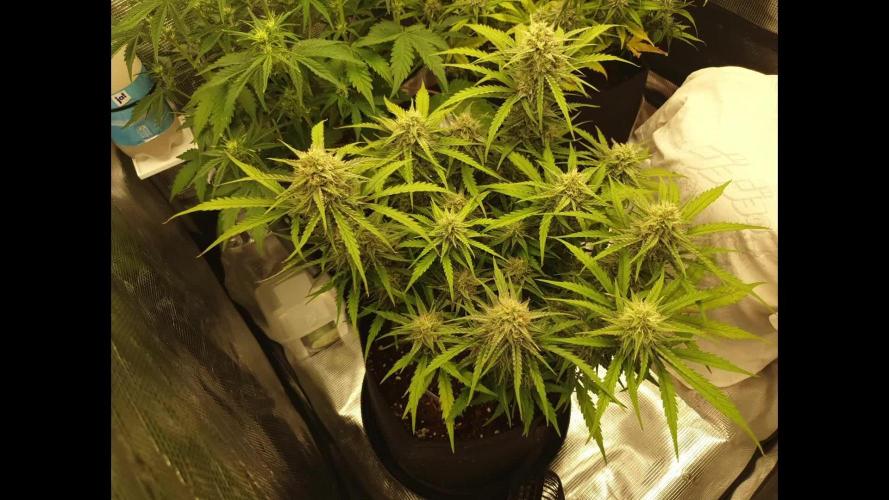
🌱 Terminando la semana 4 y las plantas se ven vigorosas 💪
Después del trasplante, las niñas se han mostrado bastante fuertes y adaptándose muy bien al cambio. Se nota que el trabajo previo dio resultado.
Detecté una pequeña carencia de nitrógeno, así que en el próximo riego voy a incorporar unos mililitros extra de Bio Grow para corregirlo. Por ahora, todo marcha excelente y las plantas están respondiendo de maravilla. 🌿
Dato útil: Unos días antes del trasplante (semana 3), a las macetas de 11 litros les apliqué al menos 1 litro de agua con una dosis mínima de Root Juice. Esto fue para preparar y humedecer el sustrato, lo que facilitó mucho el trasplante y evitó la necesidad de regar en exceso esta semana.
¡Seguimos dándole con cariño y atención al cultivo! 🌞🌱

Likes
16
Share


@SeshHouseCannabis
Follow
This is the final week of feeding, hopefully the plants will be ready to harvest in a few weeks. After flushing only Purpinator and Fulltilt will be used in this week.


Likes
20
Share


@DeepRootsGrowTrees
Follow
KRITIC AUTO ORGANIC GROW KANNABIA
This grow was easy she's a really a beautiful plant to watch grow her buds are dense and sticky covered in trichomes she fills the room with her aroma and has the ability to change your mood with her sweet smoke!!!
Thank you to KANNABIA!!!
Thank you FOOP!!
THANK YOU GROW COMMUNITY 🙏 APPRECIATE THE views, comments and likes 👍 👌!!!

Likes
39
Share


@J_diaz420
Follow
Se hace defoliación extrema 5 días antes del corte para intentar hacer madurar la planta de forma mas pareja.✌️👨🌾🏻

Likes
13
Share


@IQuSX
Follow
Hi, topman!
This week report is add-the next week, and this happened, because between 10 and 11 weeks, i didn’t can reloading media-content!
System KiT 1:
Delivering Efficiency To Growers Everywhere.
Compatible with all 8" rockwool cubes; also used with smartpots and fabric pots.
26 flower-designed louvers.
Stakes on the bottom add extra stability.
Holes in all four corners allow for leftover water drainage.
Made from BPA and lead-free plastic.
Dishwasher safe, stackable and reusable.(c)
KiT2 System:
With the FloraFlex Matrix System water and nutrients travel into the Circulator, hit the slope of the Matrix and are pushed outward into eight maze sections that have individual holes dripping the water and nutrients onto the Wicking Pad. The Circulator has two barbed nozzles to attach 1/4" OD FloraTubing that allows you to automate the Matrix System.
Place the Matrix Pad on the surface of your plant, the Matrix Unit on top of it, press down, fit the Circulator into the center holes, and connect your 1/4" OD tubing to the Circulator.
(C)
Check next week now, because there are will be continuous!
Likes
13
Share


@Rangaku
Follow
Changed to 12-12 a week ago and she’s into the stretch fully , I’ll need to defol and remove some lower branches and tie it down some more next week . Very stable genetics handling hot temps in her stride . You can already taste the orange when chewing on the leaves , can’t wait for this one to be getting smoked


Likes
11
Share


@Mo_Powers
Follow
it has grown 5 cm in the last week. the weather has been very changeable and it has rained a lot. so far it makes a good and stable impression. the next week will be very sunny and i think it will make a good leap in growth.

Likes
27
Share


@adam_pawloski87
Follow
Over all was an amazing grow, super sticky dense nugs with smell of berries, highly recommended for everyone!!
Likes
132
Share


@rhodes68
Follow
12/7
Week 4 still in strong veg no flowering signs.
Reduced feed to 600ppm and upped amount to 0.5 gal to control runoff PPM/EC as it was just too high at 1400-1700 ppm and seeing some tiny white tips on new grow growth.
Still on all Grow will add some bloom when I see some hairs multiplying.
Increase nuets when runoff checks out ok
Ended ponytailing and just doing some leaf tucking as always
After some thought and a bit of reading I decided to do this as a root drench and fertilized flush to remove all salts from the pot.
@0.5 gal ea 5.8PH CT Grow AB / Kangaroots /Fish Sh!t with @50% runoff at 900ppm (unadjusted 700ppm adjusted) in / and 985ppm out.
See how things look in 24 hours.
12/11
Hooked up a reptile heater (60w) in a reflector directed at plant area on 24/7 to level out heat in lights off and give them more IR.
They are really taking to it
12/12 Feed adjusted to 850 watching for white tips
Likes
36
Share


@TaterheadJohnson
Follow
7/14: Watered her today. Just plain water. Filled up half gallon jug of water. Filled reservoir back first line.
7/16: Bumped light intensity to 45%. Topped off reservoir at night.
7/18: Watered her today with the the leftovers of some treated water with Rapid Start from her half gallon jug. Prepping for new nutrient schedule next week.
I am happy to say it seems like the WCC is responding well to the environment and feeding schedule. So Far So Good!!! 😁
Thinking of possibly starting LST next week.
Please Comment if anybody sees anything wrong in the pics!?!?!? 👍 Also any tips on how-to/when to start LST would be greatly appreciated!
***** For this Grow******
“Day Air Temperature” will be the max temp of tent for the week.
“Substrate Temperature” will be the average temp of tent for the week.
“Night Air Temperature” will be the lowest temp of the tent for the week.
Likes
Comments
Share


@Appalachia_bucket
Follow
Clones, week 2. Transplanted into 5 gallon self watering buckets
Likes
29
Share


@Hasard
Follow
HELLO ALL, I HAVE ONE OF MY PLANT WHICH LOOKS LIKE READY TO HARVEST, SHOULD I CUT HER NOW ??
Day74 Based on all advises I had, I will let them another 2 weeks

Likes
13
Share


@Divs_darkroom
Follow
She is still drinking heavy and bulking up. Smells very fruity with the bigger sun leaves starting to fade to purple. Still a ways to go. Probably another 2 weeks or so.

Processing
Likes
45
Share


@Kelseyheart
Follow
Hi fam!! So week 6 started out great but then Anchorage , Alaska got hit with a pretty massive earthquake. Roads broken, houses callapsing, etc.. I thought my plants were going to be completely destroyed.. BUT they survived. A few broken leaves and stems.. they were set back a little but that's better than I expected. If these FastBuds can survive a light falling on them, then they deserve some credit. Quality seeds. Great genetics.
Happy growing
Sending love xoxo
Likes
14
Share


@FourVentiFarms
Follow
pics from 20th and 22nd October
26th for lemon
It's the second year ever for me, and I talked to some people because I still get 8g per plant, and it's because of the mainlining and toppings I do at wrong times, and also because an outdoor plant doesn't always get the perfect sunlight and energy to repair itself enough. so the stress might be it.
next year I'll try bending the main stem and never doing topping
Likes
33
Share

@Purrple_Haze
Follow
Moon Rock Finale – Harvest Time! 🍃🔥
And so, the journey with my Auto Moon Rock by Divine Seeds comes to a close – and what a ride it has been! This week marked the final days before harvest, and she truly impressed me in every way.
The trichomes have matured beautifully, showing around 20–25% amber, while the rest remain milky and glistening. Exactly the balance I was hoping for! As you can see in the pictures, the buds developed a perfect structure – dense, frosty, and with that ideal balance of size and aesthetics that makes trimming (and later smoking) such a pleasure. 🌿💎
Unfortunately, I wasn’t able to take a wet weight, but the structure alone tells me this will be a very satisfying yield. The aroma is unbelievable – rich, layered, and unique. It’s hard to put into words, but Moon Rock has a terpene profile that I would happily grow again just for the smell alone.
This strain has exceeded my expectations and solidified my trust in Divine Seeds. They consistently deliver genetics that are not only vigorous and easy to handle, but also full of character and quality in the final product. 🌟
🌱 Feeding & Care (Final Week)
🔸 BioBizz Grow – 2 ml/L
🔸 BioBizz Bloom – 3 ml/L
🔸 BioBizz TopMax – 1 ml/L
🔸 CalMag – 0.5 ml/L
🔸 Dechlorinated tap water
🔸 EC: 2000
🔸 pH: 6.1
🔸 VPD: 1.0–1.4
Now it’s time for drying and curing – where the real magic begins. A full harvest report will follow once everything is properly dried and jarred. For now, I can only say I’m absolutely thrilled with how this Moon Rock turned out. 🌙✨🌸


