


Likes
Comments
Share


Likes
21
Share


@DeeDeeKushner
Follow
Day 57 of flower, we’re on the home stretch now. I’ve been flushing them out for the past week or so now. I like to flush for 21 days. IMO, I think the buds taste better and smoke smoother when you flush longer than usually but that’s just me! No specific pics/vids of the white widow but I thought I share my entire garden with you guys. I said I would harvest on day 70 but I might harvest on day 63-65 because I’m seeing more amber trichomes every day. My next update will either be harvesting or I’ll be letting them go for another week. Until next update! 🙏🏾

Likes
12
Share


@UK420hydrogrow
Follow
Ok had a long week various problems with humidty and temp issues led me to upgrade tent from 1.2 x 1.2 to a new 2.4 x 1.2 x 2.0 also changed the flower lights to the x 2 viparspectar 450 reflectors along with the new white lighting 315 watt cdm all in one light with there 4k flower pro bulb the plants are loving the new space and abundance of lights any tips comments etc feel free to msg

Processing
Likes
5
Share


@Andres
Follow
..We will see what she offers outdoor ... starting the fall ... with previous crops in the fall winter ... they are not very productive harvests ... so I will help them grow. If it were summer ... thanks royal queen ....


Likes
11
Share


@Organic473
Follow
This week was extremely hot. No heat stress on the girl. I love the progress so far.
Likes
14
Share

@pHilosophy420
Follow
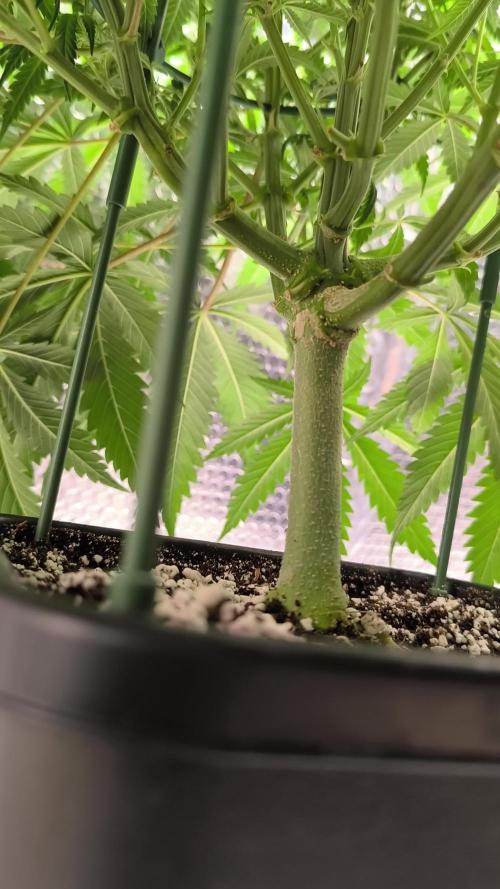
Day 56 - she is drinking water like dragon and will be a monster. 5cm stretch this week and everything is well so for, looking forward to see future weeks.

Processing
Likes
39
Share


@DjDaveAtHome
Follow
Plants are acclimating to the flower area and new 5 gal buckets. DinaMed's leaves were damaged by the Diatomaceous earth dusting. The colouring is mottled green and growth is twisted slightly. Defoliated both plants a bit. Now, a week to let them grow.


Likes
8
Share


@Hempcules
Follow
WEEK 11 (Day 71-77)
I harvested all my Dos-si-dos on Day 73. The plants remained very small and compact, which was partly intentional. The pot volume was set quite low, which I wasn't entirely happy with. Splitting the pots also turned out to be less practical, as the plants ended up too close together.
Despite that, the harvest turned out quite respectable. Visually, I really like it the dark tone and the many trichomes make for a fantastic look.
The aroma is also quite special. First and foremost, I find it has a strong, sweet note in its scent.
As for the cultivation, the Dos-si-dos were very easy to care for and handled all training exceptionally well. Due to the short distance between the shoots, I might even recommend LST or just a single, simple topping.
I fertilized almost exclusively organically, except that I added a bit of Plagron Green Sensation during the flowering phase.
I continuously defoliated well to ensure good air circulation, which worked quite well. In the last two weeks, I kept the lights on for 24 hours straight to avoid fluctuations in temperature and humidity. By the end, I settled at a DLI of around 60—it was a bit more than desired but still worked fine.
In the last week, I only watered with plain water and dimmed the lights a bit. Some of the tips developed a purplish hue. The buds appear very firm and voluminous, sparkling thanks to the dense, white layer of trichomes.
I would absolutely grow this strain again since it has a truly great and robust growth pattern, though next time, I would choose larger pots. I'm now drying my harvest at around 60% RH and 21°C until the smaller stems become brittle, then I'll store them in my hygrometer jars for curing.
I'm satisfied with the yield as well. Based on my calculations, I reached about 400g/m². A good result for such small bonsai-like plants.
For small grow spaces, this strain is really perfect. I've never grown such small yet productive plants before, and I found it to be a great change of pace.
A huge thank you to Zamnesia for the support—it was, as always, an honor.

Likes
92
Share


@DogDoctorOfficial
Follow
Week 7 Flower Report – The Masterpiece Garden Unfolds
🌱 Introduction
Welcome back to the most thrilling chapter of our journey yet! Week 7 of flower is here, and the garden has transformed into a paradise of unique beauty and diversity. Every plant has its own personality, showcasing the results of all the hard work, dedication, and love poured into this run. Let’s dive into the details and celebrate these girls like never before—because they deserve it!
🌸 Plant-by-Plant Breakdown
Papaya Zoap
The rebel queen of the garden, aiming for the stars with her towering structure. Her dense, frosty white nugs sparkle like diamonds, and her leaves are fading to a stunning yellow hue—a clear sign she’s ready to shine. Her aroma is captivating, leaving no doubt she’s going to be a showstopper.
Gorilla Melon
Standing tall as the second in command, this beauty is all strength and vigor. Her vibrant green foliage cradles thick, frosty buds that exude a fragrance worthy of her name. A true contender for the title of MVP.
RS11
This one’s a frost factory! Long, elegant buds dripping in trichomes, with leaves gracefully fading to yellow as she transitions toward the finish line. Her balanced stature and impeccable structure make her a dream to cultivate.
Green Papaya
The frostiest of them all, her sugar leaves are curling under the weight of so much resin. Every glance reveals a shimmering coat of trichomes that’s hard to believe. If frost were a competition, she’d already have the gold medal!
Mandarin Squeeze
Dark and mysterious, this beauty stands out with her rich, deep green tones and impressively dense buds. Her flowers feel like rocks, and her aroma hints at a citrusy explosion waiting to happen.
Punch Pie
What can we say about this heavyweight? Her large, dense buds are jaw-dropping, and her presence in the tent is commanding. She’s proving to be a genetic masterpiece, delivering beyond expectations.
🌞 Environmental Mastery
This week, we’ve begun the slow decline of PPFD to 750, keeping reds and UVs strong while easing back on whites—a calculated move to guide these girls into the final stages. The room’s stats speak volumes:
• Temps: 27.8°C with RH at 64.8%.
• CO2: 800 ppm for consistent growth energy.
• Reservoir: PH 6.16, TDS 791, temp 21°C.
• Soil Stats: TDS 669, temp 22°C.
Even the fun facts are worth noting: leaf temps are ranging between 26.6°C and 24.2°C, while the LED bars are holding steady at 38°C, and the ICL-300 at 35.6°C. Aero Fan at 23°C and the filter output at 24.7°C highlight the precision and control in this room, all thanks to the incredible TrolMaster ecosystem.
💧 Feeding and Nutrient Update
Our transition from organic minerals to a solo mineral approach has been a game-changer. These girls are thriving! Here’s the recipe this week:
• System Clean: 0.25 ml/L.
• RO Water Conditioner: 0.8 ml/L.
• All-in-One Liquid: 1.75 ml/L.
• K-Boost: 0.5 ml/L.
• Regulator: 0.15 ml/L.
This blend is bringing out the best in each plant, delivering unparalleled frost, density, and aroma. The stability of the pH, thanks to minerals, has made life simpler while pushing the plants toward peak performance.
🌟 Reflecting on Progress
It’s a joy to walk into this room and witness the results of months of effort. Each plant is delivering on its promise, and the smells, colors, and trichome production are truly next-level. The journey has been demanding, but the rewards are sweeter than ever. The curiosity to see how they finish is at an all-time high!
💬 Shoutouts and Community Love
As always, massive gratitude to the sponsors that make this possible:
• TrolMaster for precise environmental control.
• Aptus Holland for top-tier nutrients.
• Cannakan for their unwavering support.
• Pro-Mix Soil for a robust foundation.
• Seed Banks for the incredible genetics.
To the Grow Diaries community, our followers, lovers, haters, and everyone in between—thank you for being part of this journey. Your engagement fuels the passion to keep growing, learning, and sharing.
📣 Call to Action
If you haven’t already, check out our YouTube and Instagram for exclusive content and updates. Don’t forget to hit that like button, subscribe, and ring the bell so you never miss a beat. Join us for the next episode, where we’ll dive into super-cropping and give the room another round of defoliation as these girls keep reaching for the finish line.
Let’s keep growing, learning, and celebrating this beautiful process. 🌱✨
Growers Love,
Your Grateful Gardener
Discount Codes so you can save big on your next check out 💚💚💚
Kannabia - DOGDOCTOR 30% off
SeedsmanSeeds - DOGDOCTOR 10% off
CannaKan- DOGDOCTOR 15% off
terpyz.eu - DOCTOR 15% off
The Neutralizer - PORKIT5-DOG 15% off
Fast Buds - DOGDOCT 15% off
As always thank you all for stopping by, for the love and for it all , this journey of mine wold just not be the same without you guys, the love and support is very much appreciated and i fell honored and so joyful with you all in my life 🙏
With true love comes happiness 💚🙏 Always believe in your self and always do things expecting nothing and with an open heart , be a giver and the universe will give back to you in ways you could not even imagine so 💚
Friendly reminder all you see here is pure research and for educational purposes only
Growers Love to you all 💚💚💚


Likes
15
Share


@Nookandplant42o
Follow
Water + nutrients pH 5.6 solution temperature at 20 °. water every 2 days or if the WOOL is already wet / dry, but this plant is not limited to strong ppm doses and has been drinking plenty of water throughout its cultivation without high flow maintaining the balance between entry / exit. Check all the Ph and ppm of watering in and out of something important for the balance of things and you can increase or decrease the ppm at the desired time which is why the WOOL is already among my favorites. ZKITTLEZ OG AUTO 11L Vase / GRODAN rock wool and granulated wool cube high stability in terms of ph. Line of nutrients, something mixed as you can see throughout the cultivation, is just something beautiful to see. I loved relatively the growth in rock wool something recommendable without problems of watering the water runs perfectly the root area thrives as crazy mycorrhizae are indispensable in any harvest. ° -> Greetings to everyone in this incredible community! Thanks to this fantastic genetics And by Barney's work, I can only say that I am satisfied so far and it really is something that is easy to grow resistant all the time she ate well fulfilling a beautiful flower her flower buds are no longer visible due to clusters of high sugary activity a high potential in THC huge glands seen with the naked eye they gradually go to coloring I want this without a doubt a mixture of body and mind will block ready for a beautiful reading or work, speaking in flowers the tent is an incredible smell this genetics thanks in beautiful tones an incredible smell in its christmas tree shape its huge glue from above accompanied by beautiful sprouts that are more in times of snow 😁 the view and something to put on a song and enjoy the gift that life in us brings nature. ->

Likes
Comments
Share


@eldruida_lamota
Follow
Que pasa familia, vamos con la primera semana de floración de estas Pink Sunset feminizadas de silentseeds.
Vamos al lío ,se trasplantaron en macetas de 7 litros definitivamente.
El ph se controla en 6.0 , la temperatura la tenemos entre 24/20 grados y la humedad ronda el 50%.
El ciclo de floración puse 12h de luz, el foco está al 50% de potencia.
De momento van creciendo a buen ritmo y tienen un buen color.
Agradecer Agrobeta por el envío de un kit para la temporada, son unos jefes.
- os dejo por aquí un CÓDIGO: Eldruida
Descuento para la tienda de MARS HYDRO.
https://www.mars-hydro.com
Hasta aquí todo, Buenos humos 💨💨💨

Likes
6
Share


@Skunkstar
Follow
Flipped the girls fed ec 1.5 runoff was 1.7 coco drying back to half the weight of pot every feeding and started with the shogun boost hung the gavita 1000w se pro about 3 ft high and added another fan to the mix ph is around 6.2 on runoff im using a wet vac to clear all the runoff temps are around 26 day 22 night im looking to keep night time temps closer within 10 degree's diffrence for tighter intonode space there on a stretch looking to do some defolation usually I like to right before the flip and day 21 but I'm going for week after flip and end of week 3

Likes
14
Share


@CANNASIM
Follow
Girls are developing well, i have a minor issue but is making me uncomfortable, a bug for the third time something that by research seams to be a lace bug, basically is like little drops of black oil in the leafs this develops in to a little static larvae then it becomes black, is tiny. And apparently does nothing on the surface to the plant, but man this bastards are imortal, I’m in the point of dropping a nuke or using a flame tower in the grow room.
I’m deep in to flower...
Besides that fir the third time, all good...

Likes
1
Share


@ladyjane
Follow
9/15 - I missed my 4 week feeding of my Purple Microdots 😑 Didn't catch that mistake until I noticed some yellowing. Ugggh. But, I gave them each another feeding of Bad Bunny Nutrients, as well as some @rootsorganics Uprising Bloom & Foundation for that added boost now that they are well into flowering. I also watered them with my Roots Organics Terp Tea Bloom Compost tea that I brewed for the ladies in Flower in the 8x4 tent! So, now they are bouncing back and becoming green and lush again.
9/18 - All four are coming along nicely. They are very low maintenance and are well into flower now. These Purple Microdots continue beat all my other autos to the punch and she continues to hit EVERY milestone weeks before the others as well. She's quickly becoming my favorite auto to grow. I've decided to pop a few more seeds, identify the female, then plant one in a 3 gallon pot to see what she can really do!
9/19 - Did a lot in the garden yesterday. Since everyone is in flower, I top fed the ladies with @rootsorganics Elemental for calcium and Seabird Guano for phosphate. Followed this with some RO water and molasses.
Likes
5
Share


@Naujas
Follow
I came back after vacation, the girl is ready for cutting, the rainy weather has started, so there is a threat of rot, you can say I managed to find just a few small pits in time and removed them and threw them away, the big and stiff flowers look fantastic:) but after a long trip I was tired, so I didn't take quality photos :( no everything else, I am very satisfied with the result I got:) its smell already lets me know that it will be good:) a lot of sugar leaves from which I will make bubble hash:) I will update the weight when it dries.
Likes
50
Share


@Ferenc
Follow
Day 96, 15th of December 2020:
Hi! A bit late I was on holiday I usually start the week with the first day but now with the last one.
She is one of the most calm plant I have ever grown.
I like the easy growing style as she is an issue free lady.... not much strech... no craving for nutritients just being there and grow, flower and looking good.
Buds are nice she is a little bushy player... ;)
I am sure the smoke will be amazing.
I am going on holiday again and back on 28th of December so after harvest starts.
She is ok to be cut now but no time as I leave but nk problem to be a bit longer....
The 7th weeks starts with tomorrow 16th of December....
Only flushing and no more nutritient will be used.
Soon full report comes. Lamp is the same 11 hours on and 13 off....
The last 4 days she will get 4 days darkness and only ventilation will be working no even more water ;)
Likes
69
Share


@JohnnyBlaz3
Follow
😍😍😍 Everyones favorite time has arrived. The flowers have started plumping and the frost caking on. The trichs are so long its crazy!! Like hair on tarantula legs!!! The flowers look great and appear to be getting nice and dense. I do want to see peoples opinions on when they remove added co2 from the tent. I should be about 14-21 days away from harvest with my guess closer to 21. I was told to take out the co2 two weeks before harvest by one person. Another says they leave it til the end, he has some damn nice flowers so its hard to argue lol what do you do?? Heres to a smooth finish!!
One thing that i think happened was phosphorous toxicity in the one plant. I think thats what i read awhile ago for why it has the brown hairs like that compared to the other 5 plants. is that corrrect?
Likes
7
Share


@Krissci
Follow
Day 3
1st bit of training this week.
Looking healthy.
My aim is to allow lowest bud sites to keep up with the main heads..
LST LST LST LST LST
During this stage is most important to train Ur plant into the shape u want.
Processing
Likes
6
Share


@Dartagnan
Follow
Started the first week of flower so I've added the needed nutrients for this phase at 50%. Still going strong, drinking 2l of water+nutrients every other day. No signs of pests but there are some mosquitoes flying about.
