


Likes
Comments
Share


@LaGrassaFarm
Follow
Muy buenas gente, espero que hayáis pasado una buena semana, otra más estamos por aquí, mostrando como van cogiendo peso nuestras flores, y ya exhibiendo sus intensos olores!😍
Hemos rebajado la dosis del fertilizante Basis, y empezado a aportarle el fertilizante Ultimate PK (proporciona a la planta todos los nutrientes que necesita durante la maduración para una mayor cantidad de fruto, una estructura celular fuerte y el mejor sabor y aroma posibles).
Espero que este trabajo sirva para ayudar a alguien, y mejorar esta comunidad de growner!
Un abrazo y espero veros la semana que viene!🙌🙌

Likes
2
Share


@CalGonJim
Follow
5/5 MONDAY Took out the AC Infinity lights and just went with the 2 cheap blue and red lights. Samsung 301B.. H?....great lights but so powerful and no blue red combo. I noticed the plant grow towards the red spectrum LED than the whiter ones on the AC system. There are 2 on each bar. I use the AC lights as auxiliary when I get need it for taller plants with lots of vegetation. 2pm looking great.
'"Sir, I have seen nae deerskin treaty, nor have I seen fairies or water sprites. But what I do have are Malay coins, enough to bury you. Prayer beads, not enough to get you to heaven. And hashish, enough to ease my grieving when the East India Company slit your throat, which, of course, they will."
― Brace in a conversation with James.
5/5 11pm Monday night, MORNING for me.....WHAT IS THIS?????
CONKEY IS ALIVE!!!!!!
CONKEY IS ALIVE!!!!!!
CONKEY IS ALIVE!!!!!!
CONKEY IS ALIVE!!!!!!
CONKEY IS ALIVE!!!!!! HOLDY SHILT I CANT BELIVE IT, NOW WHAT THE FUCK DO I DO???? I GOT OUTSMARTED BY A SEED!!!!!! A-FUCKING-GAIN!!!! HOW CAN I NOT BE SMARTER THAN A SEED....??????🚨
5/6 1230am..... ALL OF THIS IS SOMEONE ELSE FAULT....... Now I have a freakshow Siamese twin plant, PERFECT.
When Im not flying off in a rage about things I break....it's a fucking comet of disaster.... I typed comedy you stupid ficler.... Maybe I keep them in the same pot and call them Cory & Trevor!!!
2am They are getting a little humid so I have to open the top for a while. The cheaper lights work better. and are less than 15w
5/7👍🚨Looks like Cory & Trevor are fighting 😂😂
5/8 looks good. 8am getting great photos on small iPhone by pulling back a little bit so it doesn’t focus too far behind.
5/10 2am. I was able to empty my disgusting body of toxic shit...these plants are rebuilding by digestive tract and systems. A multi-year painful endeavor I have achieved through weed. so fuck you if you dont like it. I will defend my rights with overwhelming force. if you try and take it. you know exactly what I mean and yes this means you badgey mc fafo.
5/11 12 pm


Likes
13
Share


@DeepRootsGrowTrees
Follow
PABLO ESCOBAR / DIVINE SEEDS
WEEK#11 OVERALL
WEEK #10 VEG
This week was another good week of growth she hasn't had any issues in veg She's been a champ and she's starting to get bigger and a little bushy from her training looking good overall about another week before we flip due to some autoflowers finishing up. Stay Growing!!
Thank you for stopping by and taking a look it's much appreciated!!
Thank you DIVINE SEEDS!!!
BUDTRAINER.COM BUD CLIPS
PABLO ESCOBAR / DIVINE SEEDS

Processing
Likes
14
Share


@SunshineBud
Follow
So, this is my first grow, just starting out. After NJ passed recreational weed, I was like you know what... Went on an amazon spending spree and got some seeds from cropkingseeds and this is it!
I let the seeds soak for 18hr in deer park spring water w/ 1 drop of Organic Liquid Seaweed and Kelp Fertilizer Supplement by Bloom City.
At the end of soakage, it didn't look like any had cracked maybe one did not so sure. So I did up the papertowels according to the video and have to say I feel a little nervous/anxious that there is too much water/weight on the seeds and feer drownage. I'm going to keep it on there though. I check the towels a few times throughout the day and am surprised they're very moist throughout the day and next morning still somewhat damp.
24 hours in the towels I check my babies and one had cracked but the rest were still sealed up tight, unwilling to share the goodness that we all so desire, cmon babies crack that shell for papa!
11/12 looked like 1 seed popped, yay! I remoistened towels a bit but didn't wanna soak them. I also put some rapid rooters in water to soak overnight gunna throw the seeds in them in AM... I was going to do it tonight but figured I should wait see if some pop out more.
11/13 OMG upon checking seeds at 07:10 I found the papertowels like bone dry OMG WTF!!! Panic sets in but I just set up the little terrarium with 6 plugs and put the seeds in and tore some plugs off bottom of a plug to cover seedhole with.
11/14 Got a sprout! YES!! The plugs look nice and moist just going to let it go!
11/15 Woke up this mornin, saw a new sprout peeking thru and then another about to! I got ansy and took off the little top plugs and found all the sprouts were coming up! Leaving the top plug off, hopefully thats not a bad idea.

Likes
8
Share


@Random80
Follow
She was left alone for 10 days but it turns out that I managed to leave just the right amount of water in autopot. She used all the water and dried out her root just at the same time when I was back. She recovered nicely from overwatering and went pretty high witch was expected for part of sativa genetics in her. She was already in flowering phase but I still I decided to apply some heavy LST to lower her down and spread around the grow tent since she is the only one in. She has now covered 70% of my 80x80cm grow tent. Also I used BOOM BOOM spray twice to save her from LST shock.
First added bactrex 1 gr, orgatrex 20ml in 1 lit (BIO TABS) . After that I was using combination of 2ml orgatrex and 2ml of BIO PK 5-8 in 1 lit water with each watering. And she really started to use loads of water, 1,5 lit per day.
No photos during week 5 so I added early week 6

Likes
4
Share


@TheSurfBud
Follow
Nice sweet smell... could say what strain it is because its from sweetseeds sweet auto mix 10 pk of the best..
Definitely going to enjoy this one ...
Grow went well and fast 62 days flat...
Likes
16
Share


@LivingOrganics
Follow
Week 11, Flower
( Day 36 from flip)
So this week..... nothing really to report she's drinking plenty per day around the 8ltrs mark.
Giving her a little coconut water I find it's a real health boost for the plant during flower. At the end of the week I added a mung bean seed sprout tea which may have been a tad too strong as after putting that down I started to see a very very tiny tip burn. I also put the pea mush as a top dress with bokashi.
The flowers are already starting to show some colours and the terpen profile is loud with the scent of pine. Trichomes everywhere and I can't believe how sativa she now looks.
Going to clear out the middle of some vegetation throughout this week to even out the stress rather than hitting in one go. Continue to fill up on just water.

Likes
Comments
Share

@Stacy_smokez
Follow
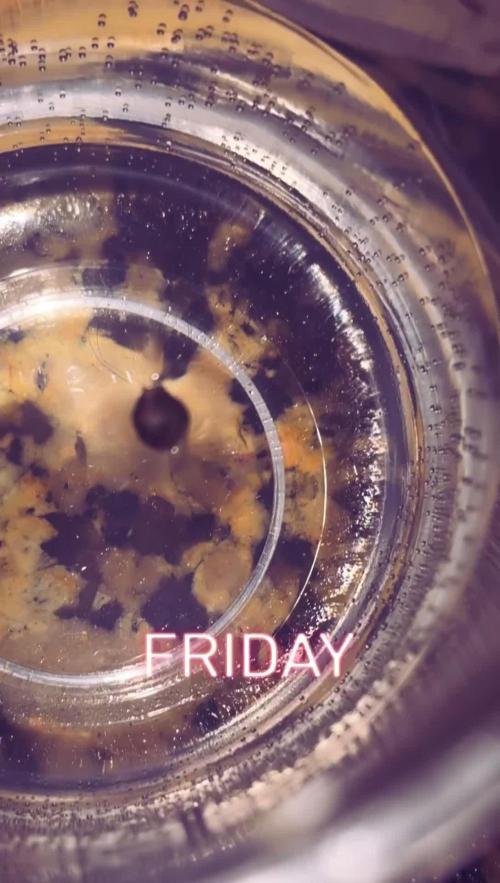
Soaking water for 34 hours and then placed it on a cotton pad for four more hours just for the Tail sprout a little bit more germination wants to complete success then place them into soil
Likes
5
Share


@RastaRick
Follow
Keeping natural form. Blackberry gum is huge as I heard from others. Did some heavy defoliation.. first time ever so it's an experiment. Flooded my tent with no tray... Needed to redo connections on the tubing... Then flooded with a new tray, needed to secure the AQUAVALVES on one autopot base.... Looking good. Still running 24 hrs... Rock and roll 🤘

Likes
14
Share


@Squaregrouper
Follow
I am so stoked about the mystery sativa that ended up being Cinderella 99 last year's favorite crop of mine. The rest of the garden is doing awesome just need to thin out a few more plants for the final stretch.. I am so looking forward to harvest this year with the varieties that I chose... I would be remiss if I did not mention the fact that red cherry berry and tangerine dream were added to the outdoor crops, they reside in the 20 gallon bucket.. I don't have the exact date when I propagated the red cherry berry and the tangerine dream from seed but it was when the other plants were already in the ground..I gave myself a challenge to see if I'd be able to do tangerine dream and red cherry berry outdoors with the other plants.. I pondered putting them in ground but I settled with the 20 gallon pot.


Likes
12
Share


@Mrs_Larimar
Follow
2023-09-19
I had to cut them a little earlier, than planned, because of one Plnat in the Room, that hermied.
Trichomes were milky/ some were amber.
So for me fine.
In the end of the Grow, the Plants had structureproblems, Buds went to heavy for the stems, and they needed
a corsage.
But MSNL mentioned that, i just underestaminated it.
Budswise iam very fine, Buds look crumbely but are dense and frosty.
UPDATE
october, 18th
I harvested the Outdoor Plants, that were finalising Indoors( last 4 Weeks.
and they were perfect!
super structure, solid branches ans stems
Buds HUGE dense and crusted with Trichomes
10 of 10 Points

Likes
71
Share


@Roberts
Follow
Everything is going good with Quebec blast. The roots have just cleared the basket. So hopefully good growth from here out. I am using a Spider Farmer SE5000. I am growing her in a New Level hydro 5 gallon bucket links below. Thank you again Quebec Seeds, New level hydro, and Spider Farmer. 🤜🤛🌱🌱🌱
SE5000
https://amzn.to/3qFpAML
Spider Farmer Official Website Links:
US&Worldwide: https://www.spider-farmer.com
UK: https://spiderfarmer.co.uk
CA: https://spiderfarmer.ca
EU: https://spiderfarmer.eu
AU: https://spiderfarmer.com.au
Coupon Code: saveurcash
Thank you grow diaries community for the 👇likes👇, follows, comments, and subscriptions on my YouTube channel👇. ❄️🌱🍻 Happy Growing 🌱🌱🌱
https://youtube.com/channel/UCAhN7yRzWLpcaRHhMIQ7X4g
www.newlevelhydro.com
www.hygrozyme.com


Likes
7
Share


@Susquihanna
Follow
This week has been sunny, hot and wet. I have not done a thing except to keep an eye on Miss Dancing Dosidos. It has been a hot and rainy week and I did not feed this plant this week. That is why I did not record Ph levels and PPM, etc this week. I have really wanted to give this diary an honest, straight up review of Miss Dancing Dosidos growing in whatever Mother Nature threw her way. We have braved the elements of nature thus far. She is tall and thin but has a lot of bud growth. I am eager to see how big her buds will get.
One thing that I have not been super pleased with is using Miracle Grow as a nutrient. This outside grow was an experiment using Miracle and not my typical Fox Farm nutrients. At this point in my grow, Miracle Grow needs to remain for garden vegetables and flowers NOT cannibas.
As a result, I have made an Executive Decision and will going add some @Advance Nutrients Jungle Juice for the remainder this grow.
Stay tuned to next week and comments are always welcome. Thanks for visiting--susquihanna

Likes
22
Share


@Naujas
Follow
well, that day dawned :) growing in a suitcase was really difficult, temperature, humidity, plant growth, everything was very difficult to control, but I managed something, it was an extremely interesting experience :) 119 gr wet, I think it will be between 25-30 gr dry , which I think is really good from the suitcase :) it was something different than usual, and now I'm going to grow another begina, which is much bigger than this one :) good luck to everyone, and thank you.:)


Likes
Comments
Share

@DogDoctorOfficial
Follow
🍮 Chem Brûlée – Pheno B
Week 7 | Stealing the Spotlight
Welcome back to another chapter of the 8×8 Adventure!
This week belongs to Chem Brûlée Pheno B.
Some plants quietly move through each stage without drawing too much attention.
Others somehow make you stop every time you walk into the room.
This girl has become one of those plants.
She isn't the biggest in the room, nor is she trying to compete for height alone, but everything about her feels... right.
She's growing with elegance.
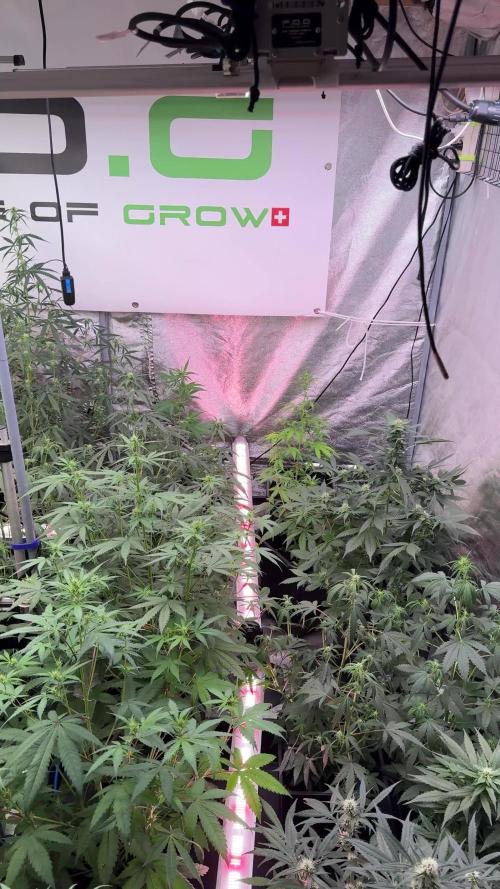
Every internode is spaced beautifully, every branch has found its place, and from the base of the plant all the way to the main top, the leaf formation is simply gorgeous.
She's entering the fourth week of flower exactly where she should be.
Not behind.
Not ahead.
Just perfectly on schedule.
If plants carried calendars, she'd be checking every box.
🌿 A Phenotype Finding Her Rhythm
One of the goals of this project is seeing how twelve different cultivars express themselves while sharing exactly the same environment.
Chem Brûlée Pheno B is becoming one of my favourites to observe because she's making everything look effortless.
Standing around 130 cm tall, she has developed into a beautiful, elegant plant with long, healthy branches and excellent internodal spacing.
The open structure allows light to reach deep into the canopy while maintaining fantastic airflow between the branches.
It's the kind of architecture growers hope for but can't always create through training alone.
Sometimes genetics simply do the work for you.
🌼 Buds Beginning to Tell the Story
This week the flowers have taken another noticeable step forward.
Every growing tip is now covered with fresh white pistils, and the individual bud sites are beginning to connect into what will soon become long, stacked colas.
The stretch is gradually slowing down as more energy is redirected into flower production.
The main top has become more defined, while the secondary branches are quickly catching up, creating a very balanced canopy from top to bottom.
She's no longer just showing flowers.
She's beginning to build them.
Watching this transition happen is always one of my favourite parts of the flowering cycle.
🌱 Letting Genetics Shine
Very little intervention has been needed this week.
Apart from a little leaf tucking and allowing the branches to spread naturally, she's been left to do what she does best.
The AutoPot system continues doing an outstanding job, delivering consistent moisture and nutrition around the clock.
It's amazing how relaxed plants become when they never have to wonder when their next drink is coming.
Combined with the stable environment inside the room, this phenotype has been able to focus entirely on growing instead of recovering from unnecessary stress.
Sometimes the best technique is simply creating the perfect conditions and stepping back.
🍽️ Feeding
This week's feeding consisted of:
• Terra Bloom – 2 ml/L
• Green Sensation – 1 ml/L
• Sugar Royal – 1 ml/L
• Power Buds – 1 ml/L
• Pure Zym – 1 ml/L
Along with small pH adjustments using Lemon Kick and pH Plus whenever required.
The nutrient increase made this week was applied to the entire reservoir, and Chem Brûlée Pheno B has responded exactly as hoped, maintaining beautiful colour and healthy, vigorous growth throughout the canopy.
🌡️ Environment
Stable conditions continue making all the difference.
• Day temperature: 29°C
• Night temperature: 25°C
• Relative humidity: 60%
• pH: 5.8
• EC: 1.95 mS/cm
• Solution temperature: 24°C
• Root zone: 21°C
• CO₂: 639 ppm
Keeping these parameters consistent allows every phenotype to express its full potential without unnecessary environmental stress.
The room is working exactly as intended, and this plant is making the most of it.
📸 Behind This Week's Photos
Looking through this week's photographs, it's impossible not to appreciate how naturally elegant this phenotype has become.
The close-up images highlight fresh clusters of white pistils forming at every node, while the wider shots reveal a beautifully symmetrical plant with outstanding spacing from the bottom branches all the way to the top cola.
One of my favourite details is the leaf structure.
Every fan leaf seems perfectly positioned without overcrowding the canopy, creating a plant that's not only healthy but incredibly photogenic.
Sometimes a plant doesn't need to shout to stand out.
She simply grows beautifully.
🔮 Looking Ahead
Over the coming week I expect the vertical stretch to come to an end as Chem Brûlée Pheno B shifts her full attention toward flower production.
The individual bud sites should begin merging together, the pistil count will continue increasing, and the first real signs of bud stacking should become much more noticeable.
The plan remains exactly the same.
Maintain the environment.
Keep the AutoPot reservoir stable.
Continue observing.
And let this beautiful phenotype keep telling her own story.
So far...
She's absolutely stealing the spotlight.
💚 Thank You
A huge thank you to everyone following this 8×8 Adventure.
Whether you're here to learn, compare phenotypes, improve your own garden, or simply enjoy following along, I'm incredibly grateful to have you sharing this journey.
Special thanks to:
💚 GrowDiaries for providing a home where growers from around the world can share knowledge and inspire one another.
🍮 Zamnesia for the outstanding Chem Brûlée genetics making this phenotype hunt possible.
🌱 Plagron for providing the nutrition supporting every stage of this grow.
💡 Future of Grow LED for delivering powerful, consistent lighting from seed to harvest.
🌿 LumiFlora for helping illuminate the lower canopy and ensuring every potential flower site receives the light it deserves.
🌡️ TrolMaster for maintaining a stable environment around the clock.
💧 AutoPot for making irrigation effortless and allowing these plants to grow at their own natural rhythm.
And finally...
Thank you to every grower, supporter, silent reader, friend, and curious visitor who follows these diaries week after week. Your encouragement and conversations make sharing this journey incredibly rewarding.
I'll see you all next week as Chem Brûlée Pheno B continues showing exactly why phenotype hunts are so fascinating.
Sometimes perfection isn't about being the biggest plant in the room...
It's about growing exactly as nature intended.
Growers Love, and happy growing everyone. 🌱🍮💚

Likes
35
Share


@Mega420
Follow
Day 22 :
First day of flowering phase ! I watered her (without nutrient) at Day 21.
Day 23 :
Give her nutrient today, and I noticed one branch folded 😟 I made it hold with a "prothesis" during the time it repair... Despite this the branch seems to be healthy for the moment !
Day 24 :
The first pistils are here ! Can't wait to see the bud flowering 😁
Day 27 :
The folded branch hold alone now even if there is a big scar, so I prefer left the "prothesis" for some days...
Day 28 :
She continue to grow (+10cm ~7 days)
Processing
Likes
14
Share


@kevgrow
Follow
Hey Friends, end of week 5 from seed
- Installed New Grow Tent @CoolGrows 36x36x72
- After Adjusting the light, I decreased the wattage and plant #2 is looking much healthier and is growing in height :)
- Still can't detect Plant #2 gender
- Will flip to Flower next week, 12 hrs of light 12 hrs of darkness
- I am glad I transplanted to a 5 gallon pot, each day the leaves are looking better.
Hopefully its a female, see you guys next week!