


Processing
Likes
Comments
Share


@Frosty_farm
Follow
Nothing much to say about my grow this week. Gave he a flush with pH 6.0 to kick off the week. Day 86..... Gave her a feeding today a whole gallon. Ive been doing some research and maybe I'm feeding my plants a little too much nutrients. So from now on I will be feeding a lot less and the next day I will feed just plain water. So my plants will get nutrients every 3 or 4 days. I also bought a few advanced nutrients supplements which I'll be experimenting with. Day 87... Gave her a feeding today of advanced nutrients Nirvana and voodoo juice and pH to 5.9.
Day 88.....gave her a 2l feeding today of nutrients. Also defoliated some of her big fan leaves.

Likes
26
Share


@PedroAndHisPlants
Follow
Day 79 (First Grow, Flowering Phase):
Hey everyone!
It's the start of a new week, and we're now on day 79 of our first grow. The flowering phase is progressing beautifully, with the buds getting bigger and frostier day by day. 🌸✨
We've started to see the formation of orange hairs, which is a promising sign of the buds maturing. The plants are looking healthy and vibrant, and the SCROG net is helping to keep everything well-supported and evenly exposed to light.
Humidity issues from last week are still being monitored, and we're considering adding a dehumidifier to ensure optimal conditions as we move closer to harvest.
Thanks for all your support and suggestions. Any tips for these final weeks of flowering are always welcome!

Likes
7
Share


@GrowingFlavour
Follow
Flowering – Day 21 | End of Week 3
Day 21 since the flip to 12/12, and today was finally cleanup day!
The stretch is already over. There was barely any vertical growth during the last week, and the girls have clearly started focusing on flower development. Honestly, I think they’re looking pretty far along for just day 21. The buds are already forming nicely!
Today I gave both plants a proper cleanup underneath, removing weak branches, lower shoots and anything that wasn’t getting enough light.
I actually left quite a bit more on the plants than I normally would. Since this run is going to be washed, I’m not really worried about perfect-looking buds or bag appeal. This time it’s all about biomass, so even the smaller flowers are welcome.
Right after the defoliation, I also switched off the AutoPot system for a little controlled dryback. I’ll leave it off for up to 48 hours, depending on how quickly the pots use up the remaining water.
This is something I’ve had good experiences with back when I was hand watering. I used to time my defoliation so the next watering would be about two days later, instead of watering right after cutting everything back. The plants always seemed to handle it better that way.
The idea isn’t to stress the plants or let the soil dry out. With BioTabs, I want to keep the microbial life happy and active. It’s more about giving the root zone a little breathing room after removing so much leaf mass, especially now that the plants temporarily need less water.
With 20L AutoPot FlexiPots and a 50/50 mix of Lightmix and perlite, the substrate is already pretty well aerated. This short break is just my way of managing moisture and keeping the roots healthy. I’m not trying to push yield through crop steering here.
Apart from that, everything is going really well. The plants are looking super healthy, the leaf color is great, and the flowers are developing faster than I expected. The BioTabs setup is doing its job, and I’m really happy with how things are going.
Three weeks into 12/12 and we’re already looking good. Now it’s time to let the girls do their thing and stack some flowers! 🌱

Likes
5
Share


@Mr_nugs_lover_David
Follow
This lady hasn't stretched up so much during pre flower, she has a nice size anyways and I cannot smell any terpenes yet on day 23 of flower, I cannot wait to see how this lady develops some big and sticky flowers! Stay with me on this journey guys! Let's keep on growing!, 💛💚❤️👨🌾🔝

Likes
19
Share


@LittleBigTrees
Follow
This plant grew strong with great vigor , the buds are compact covered in trichomes and smells really good , like car polish carots and parsnips with a nice funk to it.
Very reminiscent of the feminised kalimist from serious seeds smell wise but unlike kalimist the effects are relaxed and sleepy !
I will grow this again for sure


Processing
Likes
23
Share


@HanzGrowz
Follow
Well they definitely made progress in the flowering dept over the weekend! I came back home to find a nice amount of bud sites and pistil growth all around.
Bubba ya gotten so big it can’t fit under my lights in the tent with fan & filter, so it’s now been moved to the other tent. Kind of fucks with my auto grow I had planned, but not much I can do

Likes
16
Share


@Ultraviolet
Follow
Terpenes are aromatic compounds that give cannabis some of its most distinct aromas from citrus and berry, to more earthy tones. Many species of plants produce and emit terpenes in a diurnal, or daily cycle that is regulated by a complex web of signaling. There are also many plants that emit terpenes at night to attract nocturnal pollinators (Marinho et al., 2014346). Regardless of when the terpenes are produced or emitted, these processes are often dependent upon cues derived from natural light/dark cycles via a native circadian clock (Dudareva et al., 2004). Several light-sensitive pigments are involved in these processes of production and emission, and the different photoreceptors are dependent upon different wavelengths of light to be activated or deactivated. Emission of terpenes is a process that is entirely dependent upon phytochromes and red/far-red light cues in most plant species (Flores and Doskey, 2015). For example, repeated light/dark phytochrome signaling is necessary for the emission of terpenes in tobacco plants (Roeder et al., 2007). Based on previous findings, we hypothesized that a lack of red light and phytochrome-mediated light/dark signaling on the part of the plant is responsible for an increase in terpene content in cannabis. The plant continues to synthesize terpenes, but a lack of red light to trigger the Pr-Pfr shift results in a lack of terpene emission by the plant, thus causing the terpenes to accumulate in the maturing flowers.
REFERENCES
Dudareva N, Pichersky E, Gershenzon J. Biochemistry of Plant Volatiles. Plant Physiology. 2004;135(4):1893-
1902.
Flores, R.M., Doskey, P.V., Estimating Terpene and Terpenoid Emissions from Conifer Oleoresin Composition.
Atmospheric Environment. 2015. 113, 32-40.
Marinho, C.R.; Souza, C.D.; Barros, T.C.; Teixeira, S.P.; Dafni, A. Scent glands in legume flowers. Plant Biology ,
Volume 16 (1) – Jan 1, 2014
Roeder S, Hartmann AM, Effmert U, Piechulla B (2007) Regulation of simultaneous synthesis of floral scent terpenoids by the 1,8-cineole synthase of Nicotiana suaveolens. Plant Mol Biol 65: 107-12
Abstract
Sound waves technology has been applied to different plants. It has been found that sound waves were at different frequencies, sound pressure levels (SPLs), exposure periods, and distances from the source of sound influence plant growth. Experiments have been conducted in the open field and under greenhouse growing conditions with different levels of audible sound frequencies and sound pressure levels. Sound waves at 1 kHz and 100 dB for 1 h within a distance of 0.20 m could significantly promote the division and cell wall fluidity of callus cells and also significantly enhance the activity of protective enzymes and endogenous hormones. Sound waves stimulation could increase the plant plasma-membrane H+-ATPase activity, the contents of soluble sugar, soluble protein, and amylase activity of callus. Moreover, sound waves could increase the content of RNA and the level of transcription. Stress-induced genes could switch on under sound stimulation. Sound waves at 0.1–1 kHz and SPL of (70±5) dB for 3 h from plant acoustic frequency technology (PAFT) generator within a distance ranged from 30 to 60 m every other day significantly increased the yield of sweet pepper, cucumber and tomato by 30.05, 37.1 and 13.2%, respectively. Furthermore, the yield of lettuce, spinach, cotton, rice, and wheat were increased by 19.6, 22.7, 11.4, 5.7, and 17.0%, respectively. Sound waves may also strengthen plant immune systems. It has been proved that spider mite, aphids, gray mold, late blight and virus disease of tomatoes in the greenhouses decreased by 6.0, 8.0, 9.0, 11.0, and 8.0%, respectively, and the sheath blight of rice was reduced by 50%. This paper provides an overview of literature for the effects of sound waves on various growth parameters of plant at different growth stages.
https://doi.org/10.1016/S2095-3119(13)60492-X





Likes
19
Share


@MadeInGermany
Follow
Hey guys .
A wonderful week goes by with a super growth :-).
After I topped it for the first time last week, it recovered very quickly and showed great growth.
I don't think I will use topping again on the lady because I should slowly blossom with a few other women :-)
think it will be ready in the next 7-14 days for Flowering 👍.
This week it was poured 3 times with 1 l each time
(for nutrients, see table above).
The tent was cleaned and the health of all women was checked :-).
After the photos she was sprayed again with neem oil so that the last little tripse disappeared.
Even if you can't see any more trips I will spray it one last time next week to make sure :-).
I wish you all a happy new year 2022 ☺️.
Stay healthy 🙏🏻
👇🏼👇🏼👇🏼👇🏼👇🏼👇🏼👇🏼👇🏼👇🏼👇🏼👇🏼👇🏼
You can buy this Nutrients at :
https://greenbuzzliquids.com/en/shop/
With the discount code: Made_in_Germany you get a discount of 15% on all products from an order value of 100 euros.
👇🏼👇🏼👇🏼👇🏼👇🏼👇🏼👇🏼👇🏼👇🏼👇🏼👇🏼👇🏼
You can buy this strain at :
https://gardenofgreenseedbank.com/candyland/
Water 💧 💧💧
Osmosis water mixed with normal water (24 hours stale that the chlorine evaporates) to 0.2 EC. Add Cal / Mag to 0.4 Ec Ph with Organic Ph - to 5.8 - 6.4
MadeInGermany

Processing
Likes
12
Share


@ThatoneAKguy
Follow
Now this side of the tent seems to be doing great. At first I thought it was the air circulation with the other side so I’m still digging into that. Either way this is about these two ladies and I see the forming of pistils and can’t wait to see what kind of stretch they get into in the upcoming weeks. As for the coco vs. the rockwool way I’ve done it in the past I’m leaning towards the rockwool way. It’s easier and thus far the plants I get from it are larger. It consumes about the same amount of water although less nutrients.

Likes
Comments
Share


Likes
52
Share


@xbabybitchx
Follow
January 5/2021
Whadddup everyone.
A meh week, the one has me feeling down due to its brown/rust leaf.. I don't know whats the issue since the other two are totally fine, everything i've done for them has been the same.
Just waiting for time to keep on ticking.. I'm excited to harvest these gals when the time comes.. hopefully just a few more weeks.
Getting smelly when the light is off, I can smell it from upstairs which is nice! Kind of skunky but the profile develops every day!
Anyways, short and brief as this is just more time out of my day to do the updates.. not sure if im going to keep up with them, but I do like the progress for myself to review.
Stay safe and keep it sleeeezy.
Likes
5
Share


@Tipper23
Follow
Most pistils on the upper buds have turned orange started flush on the 9th April 2023 due to be ready on the 15th April but will check the trichomes before chopping
Likes
Comments
Share

@DogDoctorOfficial
Follow
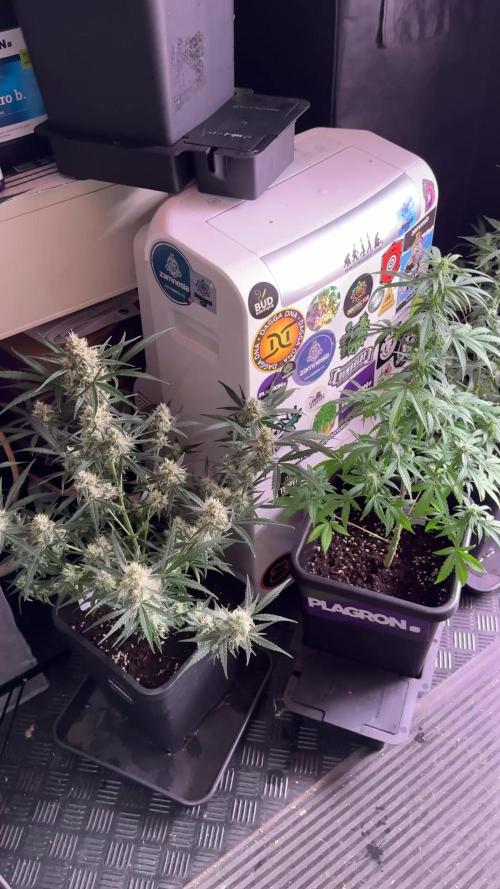
💜 Purple CousKush Auto by Zamnesia | Pheno A | Week 8 (Flower Week 5) 🌱
She Bent. She Bounced Back. And She Kept Building.
There are weeks in a grow where everything goes exactly according to plan.
And then there are weeks where life happens.
The room is busy.
The outside world keeps moving.
There are a thousand things happening at the same time...
And occasionally, one of the plants reminds you that even the best plans still require us to pay attention.
This week, Purple CousKush Pheno A taught me that lesson.
I underwatered her.
Nothing catastrophic.
Nothing that caused lasting damage.
But enough that when I looked at her, the leaves had completely dropped.
She was thirsty.
Very thirsty.
And this is actually an important distinction for anyone following the diary:
A controlled dry-back is not the same thing as allowing a flowering plant to become so dry that she starts wilting.
The first can be part of an irrigation strategy.
The second is simply me missing the watering window. 😂
So we corrected it.
She received her water.
We gave her time to recover.
And by the following day...
She was back.
And not only was she back...
She was ready for her next chapter.
💧 The Underwatering Lesson
When a plant becomes this thirsty, the first thing I look for isn't panic.
I look at the plant.
Leaves dropping dramatically from a lack of available water is usually a very different visual story from nutrient toxicity, heat stress or a root-zone problem.
In this case, the explanation was simple.
She needed water.
After watering, she recovered beautifully.
That quick recovery was reassuring and also a good reminder that plants can be remarkably resilient.
Still, during this stage of flowering, it's something I want to avoid repeating.
I personally prefer being slightly more conservative with irrigation rather than keeping the root zone constantly saturated.
But there's a difference between allowing a healthy dry-back and pushing the plant far enough that she has to start waving a little white flag.
This week, Purple CousKush definitely waved it.
Message received. 😂
I will do my best not to make her wave it again.
✂️ From Recovery Straight Into Defoliation
Perhaps the most impressive part was what happened next.
Once she had recovered and returned to normal posture, I gave her another day and then performed the flowering defoliation.
This was part of the broader room strategy we've been following.
The objective wasn't to strip her.
It wasn't because she suddenly looked unhealthy.
And it wasn't because every leaf needed to disappear.
The goal was simply to clean up the canopy and remove foliage that was no longer contributing much to the plant's structure.
Some of the interior and lower areas had become crowded, and selectively removing those leaves created more open space between the flowering sites.
More room for air.
More room for light.
More room for the plant to breathe.
And with the Lumiflora under-canopy lighting now part of the system, we're also able to observe which lower flowering sites are actually worth keeping.
The plant herself will tell us.
🌿 She Took It Like Nothing Happened
This is probably my favourite part of the entire week.
After being underwatered...
She recovered.
After being defoliated...
She didn't miss a beat.
She's standing there looking beautiful, healthy and completely ready to continue flowering.
No prolonged setback.
No dramatic reaction.
No hesitation.
Just...
Back to work.
And honestly, that's exactly what I love about this phenotype.
She has been one of the more energetic plants in this room from the beginning.
She stretched.
She branched.
She built an impressive framework.
She started stacking flowers.
And now she's moving deeper into the part of flowering where that structure needs to start paying for itself.
💜 Week 5 Flower – The Structure Is Paying Off
At approximately 125 cm, Purple CousKush Pheno A has become one of the taller and more distinctive plants in this room.
Her Christmas-tree-like architecture has become even more obvious.
A strong central leader rises through the canopy while numerous side branches form their own flowering towers around her.
And now, after defoliation, that architecture is even easier to see.
The plant has space.
The branches are separated.
The flowering sites have room around them.
And the entire structure feels much more open.
This is exactly what I want at this stage.
We're no longer trying to build the plant.
We're trying to help the plant finish what she already built.
🌸 Flowers Are Taking Over
The flowers continue developing along virtually every major branch.
Those bright pistils that were appearing last week are now becoming part of increasingly defined flowering clusters.
The buds are beginning to gain substance.
The calyxes are stacking.
And the first layer of frost that appeared earlier is becoming increasingly visible.
This is the beautiful transition where the plant starts looking less like a collection of flowering sites and more like an actual flowering plant.
She's not finished.
Not even close.
But the direction is very clear.
She's building.
And she's building everywhere.
💡 Photons, Air & Open Space
This is another reason I decided to clean her up.
Defoliation isn't about magically creating more light.
The photons are already there.
What we're trying to do is improve how effectively that light can travel through the canopy.
Every unnecessary leaf sitting directly above another flowering site can intercept some of that light.
Every dense pocket of foliage can also interfere with airflow.
By selectively removing some of those leaves, we create pathways.
Light can travel deeper.
Air can move more freely.
Humidity has fewer opportunities to become trapped between dense layers of foliage.
And the under-canopy lighting can interact with the lower structure more effectively.
It's a little like opening windows in a house.
We're not creating more air.
We're simply giving the air better places to go.
🌱 Same Genetics. Different Story.
One of the most rewarding things about this 8×8 Adventure continues to be the diversity happening inside one room.
Twelve different genetic expressions.
Same general environment.
Same cultivation philosophy.
Same room.
Yet every plant writes her own story.
Purple CousKush Pheno A has always been one of the plants that seems to have somewhere to go.
She's taller.
She's more energetic.
She keeps producing structure.
And even after a little reminder from me this week that she needed a drink...
she's right back there doing her thing.
That's genetics.
We can guide.
We can train.
We can manage the environment.
We can manage irrigation.
But ultimately, the plant decides what she's going to be.
💧 Feeding & Root Zone
The flowering feeding program continues with the Plagron lineup:
Terra Bloom — 2.2 ml/L
Pure Zym — 1 ml/L
Sugar Royal — 1 ml/L
Power Buds — 1 ml/L
Green Sensation — 1 ml/L
pH Plus / Lemon Kick — as required for pH adjustment
The target remains around:
pH: 5.8
EC: approximately 1.95 mS/cm
After this week's watering mistake, I'm particularly paying attention to irrigation timing.
Not because the plant is struggling.
Quite the opposite.
Because she's growing beautifully, and I don't want a preventable watering mistake interrupting that momentum again.
A healthy dry-back is part of irrigation management.
A wilted plant is my reminder to look at the clock. 😂
🌡️ Environment
The room continues providing a stable environment for the entire 8×8 Adventure:
Light schedule: 12/12
PPFD: approximately 850–1,000 across the canopy
Day temperature: 29°C
Night temperature: 25°C
Relative humidity: 60%
Solution temperature: 21°C
Root-zone temperature: 21°C
CO₂: approximately 639 ppm
The stability of this environment is what allows a mistake like underwatering to remain just that:
a mistake.
Not a disaster.
The plant was healthy before it happened.
The environment remained stable.
The root zone was given water.
And she recovered quickly.
That's one of the reasons I put so much importance on the entire ecosystem rather than chasing one individual number.
🔮 Looking Ahead
Now that the defoliation is complete and she's recovered, I'm expecting Purple CousKush to put her energy where we want it most.
Into the flowers.
The vertical stretch should continue slowing down.
Flower clusters should continue stacking along those long branches.
The calyxes should begin swelling more noticeably.
And resin production should become increasingly obvious as she moves deeper into bloom.
I'm particularly interested in watching how the cleaned canopy performs over the next couple of weeks.
More airflow.
Better light movement.
Less unnecessary foliage.
And hopefully...
no more thirsty ladies waving their leaves at me. 😂
💭 Final Thoughts – A Little Reminder From The Plant
This week wasn't perfect.
And I'm actually glad it wasn't.
Because growing isn't about pretending everything goes perfectly every day.
It's about learning to read the plants.
Purple CousKush told me she was thirsty.
I listened.
She recovered.
Then she let me clean her up.
And now she's standing there looking absolutely beautiful, waiting for the next chapter.
I still genuinely prefer a slightly cautious approach to watering rather than constantly keeping the root zone saturated. But there's a lesson here:
Dry-back can be intentional. Wilting is communication.
And this girl communicated very clearly. 😂
I'll do my best not to make her repeat herself.
For now, she's healthy.
She's recovering beautifully.
She's been defoliated.
She's producing flowers.
She's getting frosty.
And she's continuing to prove why she earned her place in this 8×8 Adventure.
Sometimes the plant teaches us through perfect growth.
Sometimes she teaches us by dropping every leaf in the room and saying:
"Hey, Doctor... I need a drink." 😂💜
A huge thank you once again to Zamnesia for these fantastic Purple CousKush genetics, Plagron for supporting the nutrition throughout this journey, Future of Grow for the incredible Black Series lighting, Lumiflora for bringing additional light beneath the canopy, TrolMaster for keeping the environment under control, and of course everyone following this crazy 8×8 Adventure here on GrowDiaries.
Every phenotype has a story.
Every week adds another chapter.
And Purple CousKush Pheno A?
She's still writing hers.
She bent.
She bounced back.
She got cleaned up.
And now she's shining again. 💜🌱
Until next week...
Growers Love and happy growing! 💚
Likes
5
Share

@TyRun
Follow
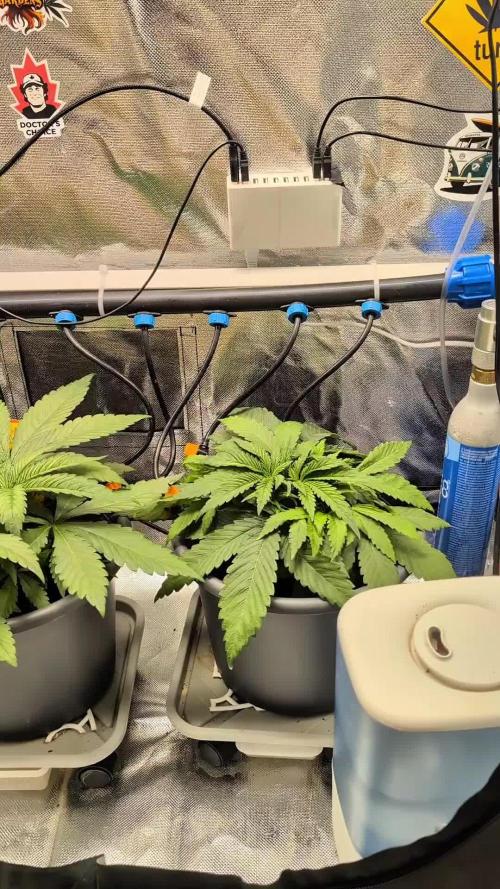
Plants at the end of week 4. #4 start to recover its vigour, #3 perfect growth, #6 slow vertical growth, side branches are suffocating.
Little bonus - how different Ca lockout looks depending on the pH level.
Got new drainage trays, from @DrainMasterDE thats awesome, big volume, convenient access. Many thx!
Likes
148
Share


@BioBuds
Follow
Gorilla, gorilla, my problem child. The only one popping out of 5 but she is weaker than her roommates. She stays behind compared to them. But what can I do other than TLC, she has the best conditions, which are optimal in this grow room, also judging by the other two plants. Until I have a bigger operation, which in the current political climate, is not soon, where I can make mothers and clone them, breed my own strains, and root out runts like this, we do it like life. We play the hand as it is dealt to us and we love all our children the same... although this one is special.
So not a genderfluid Silverback yet, but it ain't over till the voluptuous lady sings. We shall nurse this little runt until adulthood, who knows she might surprise us, she should have the mighty Gorilla Glue Number Fouh genes in there somewhere. Now come on out here and show daddy what you're made of...
This week we spread out the leaves and branches, some leaf tucking and gentle LST, to prepare for some higher stress and super cropping today. Two days back we made the switch and set the lights to 12/12. Now the flowering stretch will begin, thus we bend the branches further outward in preparation for the canopy. When I do this I notice the branches are thick and sturdy, with no breakage at all unlike my previous grow, the gelato 33. I snapped some branches applying the super cropping and just normal bending with those. It seems like the fan (I didn't have a good option previous grow, hence the flimsier branches there) but also this lighting and soil regime are topnotch, asides from outdoor I haven't seen such lush bushiness yet, even on a more runt-like plant.
This MarsHydro SP3000 is still performing great, such controlled temperatures, such an ocean of light. I only wish I started growing with this earlier. Thanks again @MarsHydroLED for trusting us to test your mighty flagship light. It is so well made, it oozes quality, I just want to touch it every time (also to check if it stays cool) and it is just sexy, slender, and compared to my other 300 watt light, a completely different spectrum and clarity. If you are looking for new lights, look no further. At www.mars-hydro.com they have excellent and unbeatable deals on tent and light combinations where you practically get a tent for free, it is ridiculous.
I was afraid the light wouldn't cover the sides of my tent with my 4.5-foot space. Penny at MarsHydro had to laugh at this a bit, said not to worry. What an understatement. This light could signal to other galaxies. I sincerely recommend good sunglasses with this light.
Only thing I'm adding is an infrared light Sunshine found. With this I'm going to simulate sunrise and sunset and try to prevent stress by easing the light in and out, like in nature.
We are in flowering now, very excited to see what she will do here. What can she perform? Will she cover the net? Will she deliver gorgeous buds, like she is known to do? On these cliffhangers I hope you will tune in next week for more gorilla-related plantporn... go on... you know you want it.
Hug Bud!!

Likes
7
Share


@HegauHillsFarmers_M11
Follow
Tag 63 - Beginn der 10 Woche.
Die Blätter haben sich diese Woche leider weiter verschlechtert, Blätter vertrocknen und sterben ab, zudem kommt, dass ich an den einzelnen Blättern Anzeichen von Stickstoff oder Eisenmangel wahrgenommen habe. Deshalb habe ich den ph-wert weiter gesenkt um der Pflanze die Aufnahme der Nährstoffe zu erleichtern. Seit dem ich Mitte letzter Woche den pH-wert gesenkt habe, habe ich den Eindruck, dass das Blattsterben sich verlangsamt hat. Ich werde das weiter beobachten.
Leider kann ich nach wie vor nichts gegen das übermäßige Licht und die Hitze an der Pflanzenspitze machen. Jedoch bin ich beeindruckt wie viele Fehler die Pflanze einem verzeiht, denn die Buds einwickeln sich weiterhin super, sind frostig und duften wahnsinnig süß!
Ich bin weiterhin gespannt wie sie sich die nächste Zeit macht und werde weiterhin mein bestes geben um ihr den Stress zu reduzieren.
Gedüngt wurde an Tag 58 der letzten Woche.
Nährstofflösung:
1 ml/l - Sensi Cal-Mag Xtra Advanced Nutrients.
1 ml/l - Big Bud Advanced Nutrients
1 ml/l - Bud Candy Advanced Nutrients.
1 ml/l - B-52 Advanced Nutrients.
2 ml/l - pH Perfect Sensi Bloom Part A.
2 ml/l - pH Perfect Sensi Bloom Part B.
Likes
11
Share


@FumoGrande
Follow
Hi guys!
For this run i got some nice looking clones. Really looking forward for this one.
11x Gelato Sorbet (Dna Genetics) left side in the box
13x Cookies&Cream (Exotic Genetics) middle of the box
8x French Macarron (T.H. Seeds) right side of the box
My setup got a nice update with the Sanlight Evo 5 100 with 320w. Aim to upgrade all of my S1 Q6w soon. All together with 985watt now.
I use Biobizz-Lightmix and started to add Nutrients at week 3 after i planted it in the 8l pots.
For this run ill use Hesi Nutrients because i use them for years and worked most of the time pretty well for me.
I fimmed some plants and trained most of them with LST-Training.
I will send them into flower in the middle of week 5
---‐-------------------------
Week 4: Plants are looking ok. I wanted a higher humidity and tried to increase it with a humidifier.
Week 5: The fimming worked quite well on the plants i used it on and i got a nice increase in height and strength
Aiming to send them into flower in the next few days. :)
Week 6: Day 3 of Flowering plants look nice and healthy. Some gelato sorbets had issues from stress but they catched up ok.
Week 7: End of week 2 of flowering plants look ok most of them. After i saw some nice results at tents from friends and had some own nice experience with the terpinator i start giving "purpinator" this run a go and start mixing it into my feeding schedule every watering
Week 8: it looks ok so far but i would be a bit more satisfied if the plants would be a little taller... :)
Hope u like the diarie and follow with this run!


Likes
6
Share


@CanadianFillmore
Follow
Start of week 3 of flowering. Bud site development over the last week was impressive! This girl is starting to smell and is already sticky to the touch. Hopefully this girl will stretch a bit more this week.

Processing
Likes
33
Share

