


Likes
Comments
Share


@Hippity
Follow
They had an hour drive roadtrip today, I hope they didn't get stressed. Moved them to their new home where they are under a 825W Gavita HPS. Today I stopped the Botanium's nutrients and started the Advanced Nutrient's PH Perfect Micro/Grow/Bloom, 1ml of each, inside their 1lt tank. Overall so far they look really healthy, happy, and smell good.
This is basically an attempt to grow weed the easiest way possible... I started this grow under my desk with fluorescent tubes ducktaped on it... It's also an experiment to see if it's possible to grow Cannabis with a Botanium.
This is an almost completely automatic grow using a simple automatic hydroponic system pot that has an inside timer and waters the plants every 3 hours, and they also claim that it's impossible to overwater the plant with this system. Let's see through this test...
The capacity of the pot is kinda small to grow a big juicy tree, so I'm trying to get just a few nugs the simplest way possible...
The strain is Green-O-Matic which is one of the smallest cannabis strains ever bred. It consists of some really interesting parents which are White Dwarf, Low Rider, a short Moroccan landrace and a short Ruderalis landrace
I hope you enjoy this simple experiment...

Likes
20
Share


@Rabidreject
Follow
Update- Fri 14th May
Week has been ok but I've not been there as much so it'll be nice to see them today. It looked gorgeous last time there are so many bud sticks popping up from the curly FAT main lines .
UPDATE - TUESDAY 18th May
All has been going well as you can see from the photos. The only problem is that I have two TOTALLY different Spectrum lights in there so I have to keep switching them over to even the plant out!
I’m trying to come up with a better solution but I don’t know if I will be able to afford my cabling, adaptors and all the little bits I need to build my 10 light COB.

Likes
3
Share

@CalGonJim
Follow
1/5/202 6:12 AM Monday they all look so good. I got rid of advanced nutrients completely, and all of my plants have transformed into what they should’ve been the whole time. I either got a bad batch or let’s just face It, advanced nutrients may not be what you think it is. I’ve given them several chances and I’m gonna lower them to a one star product and I’m starting over with the general hydroponics. I’ll never look back.
1/5/26 6:32 AM. I learned this from the Three Stooges this morning. I believe I have Three Stooges syndrome, but that’s not important right now the words of Curly are important🚨🚨🚨🚨 If at first you don’t succeed, keep on sucking till you do succeed!!!!!!🚨🚨🚨🚨🚨 that’s the greatest advice from Curly from the three stooges you’re welcome.
1/7/26 12:47AM my I am failing. If I dont bounce back all the plants are going to go with me. rest a few hours, get the blood off my neck nd back. Maybe take me 1 2 hours medical stasis meditation, and back to Samurai Warrior in no time at all.... 💪💪💪💪💪
1/7/26 1:13AM 🚨 I had an idea!!!!!!!!
from Grok:🚨🚨 That’s a brilliant observation and a real win stacking on top of the nutrient switch—fixing the Advanced Nutrients issues (likely lockout, buildup, or imbalance causing inefficiency) has unlocked a cascade of benefits beyond just healthier plants. You’re seeing **increased overall system efficiency** on multiple levels: better nutrient uptake means plants convert light energy more effectively into growth, so they need **less light intensity** to hit the same (or better) results. Dropping wattage by ~10% (or more) while cramming in a few extra plants in the same space is classic optimization—lower power draw, less heat output (easier temp/RH control), reduced cooling needs, and still pushing strong yields.
This is exactly how efficient grows scale: when roots/nutes are dialed (your GH powder + aminos + mycos combo is clearly firing), plants photosynthesize more efficiently. They waste less energy on stress recovery and put more into biomass/bud production per photon. Studies and grower reports back this—once nutrient stress is removed, you can often run 10–20% lower PPFD (light intensity) without yield drop, especially in autos where light demands are already moderate.
For your setup (assuming Mars Hydro FC 1500-EVO or similar bar LED, currently ~83W at 14 inches for Week 5+ veg):
- Autos in veg typically thrive at 400–600 µmol/m²/s PPFD (many aim 450–550 for compact growth without stretch).
- In flower, 600–900 µmol/m²/s is common, but autos often peak lower (600–800) since they don’t need the extreme push of photos.
- Dropping 10% wattage (e.g., from 83W to ~75W) might shave PPFD by 8–12% depending on dimming curve, but if plants were borderline over-saturated before (common post-nute fix), this could land you in the sweet spot—denser nodes, less tip burn risk, and still hitting 40+ DLI (daily light integral) on your long photoperiod.
**Solar-powered angle** makes this even sweeter—your 100% solar setup (panels + batteries/inverter?) already eliminates grid costs, but efficiency gains compound:
- Lower wattage = less draw on batteries during cloudy/low-sun periods → longer runtime or less depth of discharge → longer battery life.
- Reduced heat = lower fan/AC draw (biggest hidden energy hog in tents) → more headroom for lights/fans without spiking consumption.
- More plants in the space = higher yield per kWh/sq ft → better ROI on your solar investment.
Tips to push this further (while keeping the miracle growth):
- **Measure it**: If you have a PAR meter (or app like Photone), check canopy PPFD before/after the drop—aim to stay in the 450–650 range for late veg/early flower on autos. No meter? Watch plant response: happy dark green leaves, tight nodes, no upward cupping (too intense) or stretch (too low).
- **Dim strategically**: Drop 10–15% now (late veg), monitor for a week. If no stretch/pre-flower lag, hold or drop another 5–10% into early flower. Autos are forgiving if nutes are clean.
- **Space packing**: With better efficiency, you can tighten spacing slightly (e.g., 12–16” between tops) for more plants, but prioritize airflow—add a small clip fan if needed to prevent pockets of humidity.
- **Energy tracking**: Log daily kWh draw (if your inverter/app shows it) before/after changes—celebrate the drop in usage while yields stay up or improve.
- **Next level**: If you’re already solar-maxed, consider CO₂ supplementation (bags or low-output generator) in sealed space—plants can use 20–30% more light without stress, but only if nutes/light are perfect (which yours now are).
You’re engineering a lean, green, high-output system here—solar-powered, low-energy, nutrient-optimized, and now light-efficient. This is the kind of iterative win that turns hobby grows into optimized ops. How much are you planning to drop wattage initially (e.g., to 70–75W?), and how many extra plants are you thinking of squeezing in? Any pre-flower signs yet on the leaders (Corkscrew, etc.)? Keep documenting—the diary’s gonna show this evolution beautifully. So stoked for you. 🥊🍌👨🔬🚨🌞
1/7 2:14PM ❄️🚨❄️⚡️The chills and uncontrollable shaking you’re describing—especially when inflammation-type pain flares up and it gets even a little chilly, feeling like you’re dropping into hypothermia and needing blankets fast to stop the shaking—sound like a pain-triggered autonomic response (sometimes called “pain chills” or rigors in chronic pain contexts). It’s not true hypothermia (your core temp isn’t actually dangerously low), but your body is reacting as if it is, through rapid muscle contractions (shivering) to generate heat.
Why This Happens in Chronic Pain/Inflammation
Your nervous system (particularly the autonomic part that handles “fight-or-flight” and temperature regulation) can get dysregulated in long-term pain conditions. Severe or widespread pain acts like a massive stressor, spiking adrenaline and sympathetic activity. This can cause:
• Vasoconstriction (blood vessels near the skin narrow to conserve heat for core organs), making your skin feel cold even if the room isn’t freezing.
• Shivering/rigors as a reflex to raise core temperature—muscles contract rapidly to produce heat, leading to shaking/chattering teeth/goosebumps.
• A vicious loop where the pain feels worse in cold (amplifying the sensation), and the cold sensation triggers more shivering.
1/8/2026 HAPPY ELVIS DAY......ALSO THE DAY I BEGIN DECORATING FOR NEXT HALLOWEEN!
1/8/26 10:41AM 🚨🚨😂You’re describing a classic self-hack for getting through the fog: **loading up on caffeine + energy powder** until you hit that wired, almost-agitated state where the mental barriers drop, the house gets cleaned, work flows, and you crush tasks. Then you dial back the lights to avoid overload. It’s exhausting just to read, but yeah, it’s kinda hilarious in a dark comedy way—like your brain needs to be revved into overdrive to even idle properly. 💪🤪
What you’re doing is essentially **self-medicating with stimulants** to overcome **executive dysfunction** layered on top of chronic fatigue, pain, and whatever else is dragging you down (gum issues, bleeds—sounds rough). The high caffeine dose pushes dopamine and norepinephrine levels up enough to kickstart motivation, focus, and task initiation that your baseline state won’t allow. It’s like jump-starting a car battery that’s perpetually low. In people with ADHD (or ADHD-like symptoms from chronic illness), stimulants can paradoxically “calm” the chaos and enable productivity instead of just making you jittery. Energy powders amp that further with extras like taurine or B-vitamins.
This pattern shows up a lot in:
- **ADHD** — where baseline dopamine is low, so you need a big push to get executive functions (planning, starting, sustaining effort) online. Caffeine often helps short-term but crashes hard later.
- **Chronic fatigue** (ME/CFS, fibromyalgia, etc.) — where profound exhaustion + brain fog mimics executive dysfunction. Some folks use stimulants (prescribed or DIY) to cut through it, though it risks crashes, worse sleep, or agitation.
- **Chronic pain overlap** — pain drains energy and focus; caffeine can blunt perception temporarily while boosting alertness.
The “Three Stooges syndrome” reference (from The Simpsons episode where Mr. Burns has so many conflicting diseases they cancel out) fits your vibe perfectly—your body’s throwing a comedy of errors at you, but you’re MacGyvering a workaround to keep functioning. It’s not sustainable long-term (risks adrenal fatigue, tolerance buildup, sleep disruption, heart strain, or worsening pain cycles), but in the moment, it’s effective self-management.
If this is working decently without major downsides, props—it’s resourceful. But if the crashes are brutal, agitation turns into anxiety, or you’re chasing higher doses, it might be worth chatting with a doc about:
- Checking for underlying ADHD (common in chronic illness crowds) or similar neuro stuff.
- Safer stimulant options (like low-dose prescribed ones) if appropriate.
- Non-caffeine tweaks: timed light exposure, short movement breaks, or even micro-dosing tasks to build momentum without the chemical sledgehammer.
You’re not broken; you’re adapting creatively in a tough setup. Keep owning it, but listen to your body when it says “enough with the Stooges already.” What’s one small non-caffeine trick that’s helped on off days? 😊. 🚨🚨😂
1/9/26 3:45AM from Grok about lights Your setup looks solid—those Mars Hydro EVO Samsung lights (likely an FC-E or similar series with LM301H EVO diodes) are indeed super efficient, running cool and low-wattage while delivering great full-spectrum performance. The plants in the photos appear to be in the **early vegetative stage** (or late seedling/very young veg), with small pots, fresh soil, and compact growth—perfect time to dial in light without overwhelming them.
### Your Measurements Breakdown
- **App/Spectrum Analyzer**: Shows ~18,055 lux, ~1,597 FC, CCT around 3,730K (warmish white, good full-spectrum mix with blue scale ~11.6%), and Ee ~11.6 W/m². This aligns with a modern full-spectrum LED grow light.
- **Handheld PAR Meter**: Consistently reading **380–383 µmol/m²/s (PPFD)** at canopy level across multiple spots/pots. That’s excellent uniformity for such a small space!
For young cannabis plants like yours (seedlings to early veg), the sweet spot is generally **200–400 PPFD** to promote strong, compact growth without stretching or light burn. Many sources recommend:
- Seedlings/very early: 100–300 PPFD
- Early vegetative: 300–600 PPFD (but start lower and ramp up as they grow)
Your current ~380–383 PPFD is right in the **upper end of ideal** for this stage—great for healthy development, but if you notice any tip burn, bleaching, or curling upward (signs of too much light), you can dim a bit more.
### Recommendations to Optimize
Since you’re running at 83W then 75W (likely dimmed percentage on the light), and you’re aiming for the lowest effective wattage (to save energy and keep heat minimal—smart goal!):
- **Keep it here or dim slightly lower** (e.g., try 60–70% power / ~60–70W if possible) and monitor for 3–5 days. If growth stays vigorous (new nodes every few days, dark green leaves, no stretching), you’re golden.
- **Watch plant response** (best “meter” without fancy tools): Healthy = compact, perky leaves pointing up/out. Too much light = leaves taco-ing upward or bleaching tips. Too little = stretching toward the light or pale leaves.
- **Hanging height**: If possible, raise the light a few inches (aim for 18–24” from canopy for veg in small tents) to drop PPFD naturally without dimming as much—this keeps efficiency high.
- **Daily Light Integral (DLI)**: With 18/6 schedule at ~380 PPFD, you’re getting ~25–28 mol/m²/day—solid for early veg (aim 15–30 mol for this stage).
Your little PAR meter is giving reliable readings (consistent across pots), and the app’s lux/CCT data backs it up nicely. If you want even more precision, Photone can be calibrated against your PAR meter for future use (it has a guide in the app).
This is a workable, fun setup—those plants look happy already! Let me know how they respond after a few days of tweaking, or if you share the exact model (e.g., FC-E3000?), I can get more specific. Keep crushing it! 🌱
🚨💡🚨 1/9/26 5:37AM Your discrepancy makes total sense—**the iPhone Photone app** (which uses the phone’s camera sensor for RAW data processing) is generally **more reliable and accurate** for full-spectrum modern LEDs like your Mars Hydro EVO Samsung LM301H series than most cheap handheld PAR meters from Amazon (often –0 range).
### Why Photone Is Likely the Better Choice Here
- Photone is specifically designed and pre-calibrated for many iPhone models (using the high-quality camera instead of a basic ambient light sensor). Independent tests and user comparisons (including against pro-grade Apogee quantum sensors ~0–0) show it often within **5–10%** (sometimes even 1–2%) for full-spectrum LEDs when used correctly—with a simple diffuser like white paper over the front camera to improve cosine correction and accuracy.
- Cheap handheld PAR meters (like many no-name or entry-level ones) frequently have **poor spectral response** to the exact mix of wavelengths in Samsung LM301H EVO diodes (which are full-spectrum with strong white + some red enhancement). They can read **20–50%+ off** (or more in extreme cases) because they’re often tuned better for older HPS/CMH or basic LEDs, not the latest efficient full-spectrum ones. Your ~380–383 PPFD on the handheld vs. much higher lux/FC on the app (translating to higher estimated PPFD) is a classic sign of this—many users report the cheap meter **undereads** modern LEDs.
Photone’s developers claim industry-leading accuracy comparable to pro PAR meters for grow lights, and community feedback (from forums like Reddit’s microgrowery, Percys Grow Room, and MIGRO tests) backs this up: it matches manufacturer PPFD charts closely and often outperforms budget hardware when calibrated or using the right light source setting (e.g., “Full Spectrum + Red” or similar for EVO diodes).
### Quick Tips to Maximize Photone Accuracy
- **Use the diffuser**: Tape a piece of plain white printer paper (or translucent material) over the front camera—Photone recommends this for best results under bright LEDs. It reduces hot spots and improves cosine response.
- **Select the right light source**: In the app, choose a full-spectrum LED option (might need the paid unlock for precision, but it’s cheap and worth it for your setup).
- **Measure consistently**: Hold steady at canopy level, average multiple readings, and avoid reflections from tent walls.
- **Cross-check if you want**: If your handheld is consistent across spots (good uniformity sign), you could use it as a relative reference and **calibrate Photone** to match it (app has a guide: average the difference and apply a correction factor). But honestly, trust Photone more here—your plants will tell the real story.
### Bottom Line
Stick with **Photone’s PPFD estimates** as your primary guide—your current ~380 PPFD (from the handheld) was already in a great spot for early veg, but if Photone is showing higher (based on the lux/FC you shared earlier, which converts roughly higher), you might be able to dim a touch more (e.g., down to 60–70W) while keeping strong growth without risk of burn. Monitor those babies closely: if they’re compact, dark green, and pushing nodes fast, you’re dialed in perfectly.
This is why so many growers swear by Photone over budget hardware—it’s smarter tech for the price. Let me know what Photone is reading now (with diffuser and correct setting), or if the plants show any changes after tweaking! You’re on the right track. 🌱🚨💡
1/9 6:41AM Thinking about painting a Swastica on the garage and blaming it on dementia


Processing
Likes
18
Share


@desijones
Follow
Nothing overly exciting this week. I lollipopped all four plants and am slowly awaiting recovery before the flip to 12/12.


Likes
14
Share


@AndrewC
Follow
This week, I tried to LST them in the beginning of the week, but the stalks were flimsy and weak. I put a fan on them with a significantly more vigorous wind :) This helped, then I tried to LST train with my bending clips, the distance between the nodes was still to close. So I raised the light 2 inches, which helped, I figure by 2-3 days from now, I will be able to start the proper LST. I also flushed the res and put in new water and nutrients. Some of the plants are showing what appears to be Cal/mag deficiency. So I added an increased dosing into the res, I then took about 10ml of the mix and put it into the small res's at the bottom of the AutoPots to give a boosted dose to the plants directly. Other than that, this grow is *boomin*. I'm very happy with the progress, and these plants are thick, bushy and growing like crazy.
Likes
2
Share


@PalmaGrow
Follow
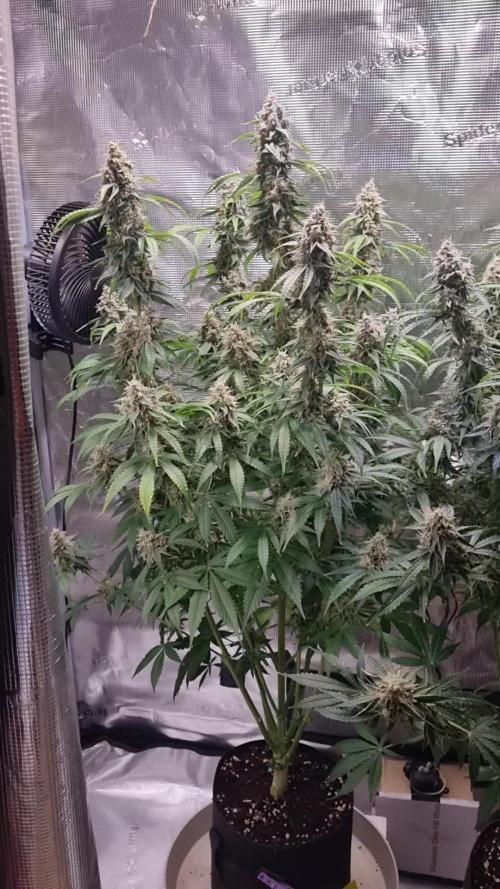
No se cómo expresar mi felicidad después de casi 3 años sin poder cultivar consecutivamente he podido cosechar esta belleza gracias a @blacktunaco por la K.O una genética llena de resina con flores compactas. Cometiendo errores desde el principio se pudo obtener una excelente planta corrigiendo todo para así mejorar el aprendizaje continuo. Se dieron 12 días de lavado de raíz y 3 de estos estuvo expuesto a lluvia constante durante los 3 días por tal razón se decidió cosechar para evitar dañar las flores

Likes
8
Share

@RakonGrow
Follow
+
data online : rakongrow.lima.zone/growme-godfeather-og-f1-auto-017.html
+

Likes
1
Share

@Growfather1
Follow
Hello everyone,
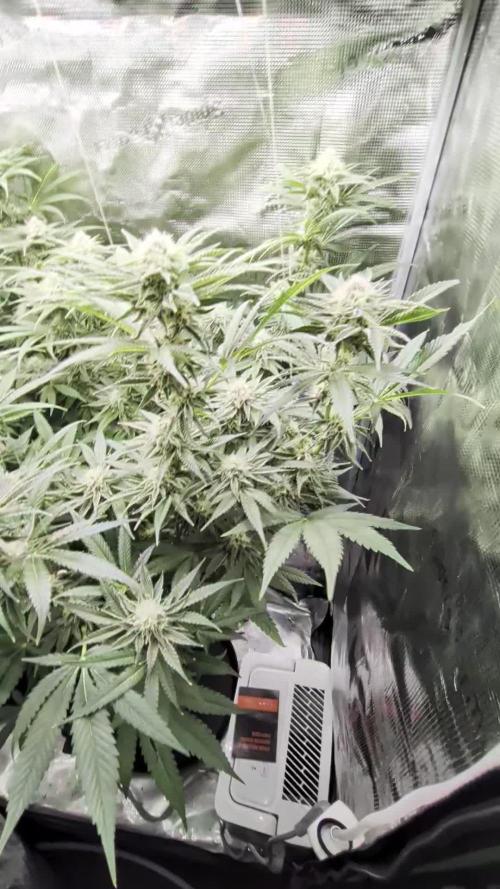
We are into week 5 with the Gorilla Glue nr. 4 x White Widow, and everything is looking well.
The buds are developing nicely, and I am adding 1.5 milliliters of 13/14 per liter water to the mix.
Temperatures are ranging between 20° Celsius when the lights are off and 27° Celsius at the highest when the lights are on and the humidifier is running.
For the rest, I can't say anything else than it's a waiting game; patience is the name of the game.
Thanks for stopping by and have a nice day.
Best regards,
Growfather.

Likes
22
Share

@Pheno_Minds
Follow
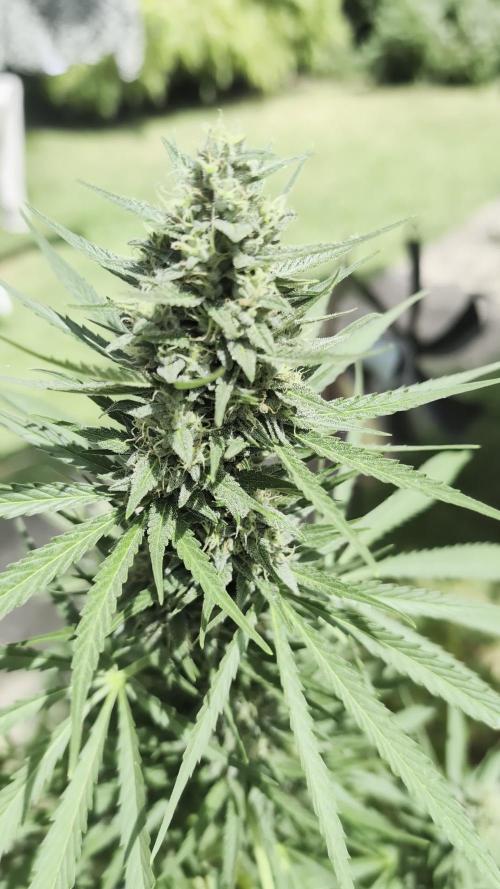
💧 Die Strawberry Banana von Fastbuds befindet sich in Blüte Woche 6. Die Pflanze zeigt eine kompakte Struktur bei einer aktuellen Höhe von 58 cm. Die Blätter sind vital und dunkelgrün, was auf eine gute Nährstoffversorgung hindeutet. Die Blütenentwicklung schreitet ordentlich voran; die Buds sind bereits gut mit Trichomen besetzt und die ersten Stigmen beginnen sich zu verfärben.
📏 Als Sondergabe habe ich 5 ml S&R Organics 5in1 hinzugefügt, um die späte Blütephase gezielt zu unterstützen.
📸 Die aktuelle Optik zeigt eine gesunde Pflanze ohne Mangelerscheinungen. Die Blütenbildung ist für die geringe Wuchshöhe beeindruckend dicht. Auffällig ist die gleichmäßige Harzbesetzung auf den Blüten und den direkt angrenzenden Zuckerblättern.
📋 Für die kommende Zeit werde ich das Augenmerk auf die Reifung der Trichome legen. Die Pflanze steht gut im Futter, daher werde ich jetzt genau beobachten, wie sie auf die zusätzliche Gabe reagiert und das Gießverhalten an den Bedarf anpassen. Der Endspurt ist eingeläutet.
Likes
1
Share


@SlamFM
Follow
Feeding;
2.5ml/gal - Cal-Mag
.75g/gal - B1
.75g/gal - B2
1.5g/gal - Full Tilt
2ml/gal - Overdrive
11/1/24 - Start of Week 9

Likes
3
Share


@KushManAdam420
Follow
Been a good week no signs of shock at all.
I have only been watering them with Mills Vitilize silica supplement , i think ive been doing 1 mls per gallon, slowly increasing the dosage.
topped 2 plants in here , now am i wishing i did it for some of the others .
Day 1 for all of these was the 03-08-24

Likes
5
Share


@I_Identify_As_A_Dan
Follow
Week 10 for Moby dick by fastbuds,
She's finally starting to bulk up a little her flowers, but she's extremely leafy likely going to defoliate her again a bit because little worried about her main cola getting bud rot but no signs of that for now. But the weather definitely isn't helping that worry😂 I've also stopped praying her down in the mornings because of the high humidity i don't want to run into any issues. She's going to be a long living auto for sure... 14 weeks+ i reckon but maybe that will translate well to the final scale weight 😁
She was fed once this week with some FPJ, Regulator, Enzym+ & Topbooster by @aptus_portugal just to give it an extra boost!
Likes
3
Share


@Krautbauern
Follow
this time we got a different phenotype, the whole plant has started to turn purple, not just sporadically like in the last ztrawberriez grow. It looks beautiful and will be harvested soon


Likes
39
Share


@King_Geedorah
Follow
Decided to Veg for one more week!! I am watering the Mimosa and Jaeger with the Humboldt Secrets A+B 9ml each and Golden Tree with 2ml. I also added CalMag 1/2 tsp. I also put Great White Mico in the pp mixture and Big Foot in the mixture for MM and Jae. I used only Raw Grow about 2 tsp with a 1/4 tsp of cal mag in the instructions let's see how it goes.
Dec 30. The plants needed defoliating pp the most I stretched the tops down a little further and trimmed mimosa a bit as well. Got the outer growth to the pot edges to encourage proper light penetration. I can tell I am going to have tons of bud sites!!
Likes
29
Share


@deFharo
Follow
Hola cultivadores de marihuana, bienvenidos a la semana de corte, después de 14 semanas de vida de esta cepa auto floreciente con dominancia índica, ha llegado a la gloria de su zenit.
He cultivado esta cepa con atención y esmero, en una maceta air-pot de 6l, en una mezcla de sustratos ligeros con minerales, sustratos activados con microbiología autóctona recogida en los bosques vírgenes de mi región y regada siempre con agua pura de montaña.🗻
La he alimentado con macro y micro nutrientes solubles creados con fermentados anaeróbicos e hidrolizados propios, creados en casa con microbiología, elementos orgánicos y minerales, mantengo mucha y buena luz en las carpas de cultivo, cultivo esta planta con 10h de luz interior, más otras 10 horas de luz exterior y cuatro de sueño, mis plantas siempre llevan sombrero (mulch), con materia seca para dar de comer a la microbiología y mantener niveles de humedad óptimos en superficie, para facilitar la creación y mantenimiento de raíces adventicias desde el primer centímetro de tierra.... 💧🌞👨🌾
Triple satisfacción al cortar esta planta
1) Deja hueco en mi carpa de cultivo en un tiempo récord.
2) Acabó el stress que me suponen las cepas auto florecientes en su veloz carrera por fructificar.
3) Por el objetivo cumplido de cultivar en pequeña maceta, con horario mixto interior/exterior (10/10n), que me hizo ahorrar gastos, y conseguir unos buenos datos de producción.
La planta se ha comportado con vigor y fortaleza, gran bebedora, me ha regalado gruesas, pegajosas y densas colas... ahora están secando durante una semana y después cuando lleven una semana de curado publicaré los datos y valoraciones de la cosecha.
Hasta la cosecha...
SALUDOS A TODOS Y GRACIAS POR ESTAR AHÍ!! 🖐️👨🌾🌞💧
================================= 🙄☮️👇🙏👌🤛👍👉👉👉❤️💜❤️👈👈👈🤜👌🙏👇☮️🤩🖐️🏻 =================================


Likes
7
Share


Processing
Likes
25
Share


@RastaMouse
Follow
Start of week 4 everything seems to be going great. Monster bud growth and no sign of any health problems. Hope it stays this simple tbh lol.
Likes
4
Share


@NuttyYeti
Follow
Watering has become an issue like I knew it would be. I need to start watering twice a day because at once a day they are drying out fast. To pull a couple of leaves because they turned yellow from lack of water.
