


Likes
Comments
Share


@Reyden
Follow
Purtroppo le 4 gorilla 🦍 hanno delle carenze importanti e anche dei moscerini che girano nella terra e nelle radici, penso siano i moscerini dei funghi e se tengo le piante senza annaffiare più tempo loro soffrono perché gli piace l umidità e materiale organico di cui nutrirsi, ho sbagliato due settimane fa a preparare quella soluzione forse un ambiente troppo dolce gli ha richiamati…spero di non avere ancora più danni ormai le piante


Likes
41
Share


@TheBulldozerSicily
Follow
Venerdì 20 luglio Aggiungo 50 lt acqua e il doppio dei nutrienti, vediamo che succede. Ho dato anche una bella deformazione e pulizia rami inferiori
Martedì 23 luglio
Inizio controllo ec 3999 ph7
Cambio soluzione parto da 75 lt acqua osmosi inversa + 5lt acqua rubinetto ottenendo ec 473 ph 8.4
Aggiungo tutti I nutrienti ottenendo ec 1489 ph 6.5




Likes
13
Share


@igrowtomatoes
Follow
week 4ish.
the supercropping failed. the branches insisted on just coming back up no matter how much i pinched them back down ,probably had to tie them but.... fuck it.
so some burnt leave tips from being too close to the light.
Likes
Comments
Share


@PW216
Follow
Update in progress...
11/23/24 - Chopped and hung whole in closet.
11/29/24 - Trimmed and jarred. Early samples detect incredible taste and smell. The high is immediate and very energetic. Felt up front and in the face. Very pleased with the initial weights, although I will make certain they are accurate and final before posting numbers.
12/11/24 - No clue why it only gives me an option to log the wet bud weight but I put 3.55 oz for my final weight and that is dry.

Likes
8
Share


@MountainFlowers
Follow
Vegetative week 4 -->
I finally cleared the fungus gnats infestation😁. There are no more gnats flying around or on the soil surface.
Unfortunately, the plants have not yet recovered from the stress. The plant in the fiber pot looks like the one that is recovering faster than the one in the plastic pot that seems to have stalled.
I hope they recover fast beacuse the branches still small and the ladies start to flowering.
I waterd the plants only one time this week with 2Lt of 6.5 pH water for plant.
Temperature grow box---> 22-26 °C
Umidity grow box ---> 45 - 55 %
Total water of the week ---> 2 Lt/plant
Likes
1
Share


@InTheSmallSpace
Follow
pungent odour, full of ditricomas, even the sugar leaves, I think it is a genetic that is well suited to concentrates or extractions
Likes
2
Share

@Splint
Follow
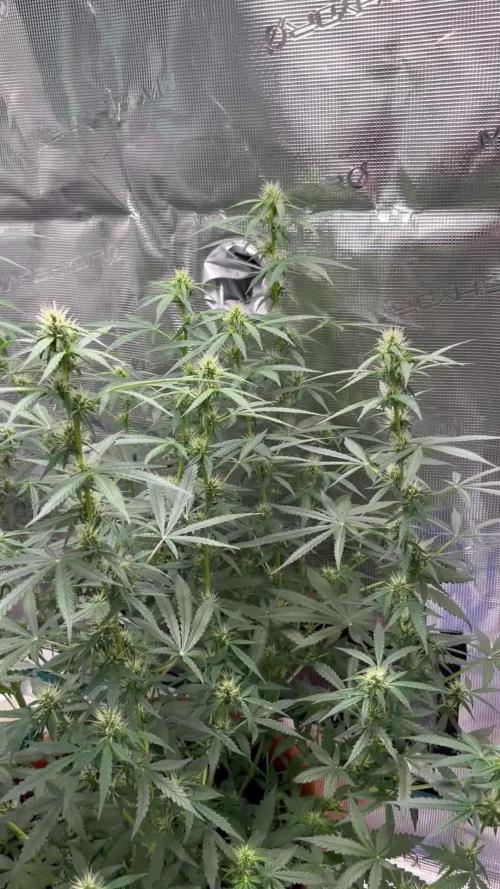
I’m still removing some leaves everyday, I prefer only removing a few leaves but instead of taking just the lowest ones I pick some from every part of the plant. I’ve had good results so
far with giving the lower buds a bit more light through this “method”.
I’ve seen a lot of online tutorials recommend exclusively removing leaves from the lowest 2-5 sections and a lot in one setting but rarely instead.
What’s your experience with defoliation? Do you prefer one or another method?
I’m currently watering once per week, giving her 5-7 liters with fertilisers over a few hours. She’s only getting watered again when the substrate is dry in the first few inches. I’m thinking about getting a cloth-pot for the next grow for better oxygen supply.
Also, it’s way too early to take a look under the microscope but I think I’ll take one anyways.
see ya

Processing
Likes
12
Share


@Dutch_Grower
Follow
Everything okay, sprayed some Silicum Boost again this week.

Likes
13
Share


@Yiyis_Grow
Follow
MrHide Seeds Test
BESTAVA Quantum Board 2000W (SAMSUNG LM301B LED)
Muy feliz ! Cero plagas con la tierra diatomea , se las tiro por todo lado.
Se me dañó el deshumidificador y el porcentaje está en 80%, pero aún están en vegetación entonces no estoy preocupado.
Crecen super fuertes, sin deficiencias aparentes o daños.
Las Kritical Red ya están empezando a dar signos de floración, vamos a dejarlas que den sus primeros pasos solas y en unos días le empezamos a dar de comer y estimular nuevamente.
Esta semana les he ido haciendo defoliación fuerte y ha dado resultados. Los brotes inferiores han subido bastante y se les ve mejor estructura. Esperemos den buenas flores.
Buenos Humos para todos los cultivadores !
¡cerotes, gueyes, culiados, pizados, boludos, jodidos, maes, patas, parces!

Likes
32
Share


@FlynnRyder
Follow
ugh just hate myself right now lol. I feel like it would have done AMAZING had I flipped sooner and SCROG way better. I was timid and had a lot of personal obligations preventing me from staying in the garden as much as I would have liked. Its a grower! and stretches so much in early flower. Stay on top of her but I think she may make some amazing bud based on what I did have drying recently. I wish I didnt mess up the timing but I just couldnt have the second wave be held up by these mistakes and felt it best to let it go

Likes
6
Share


@Groweedo
Follow
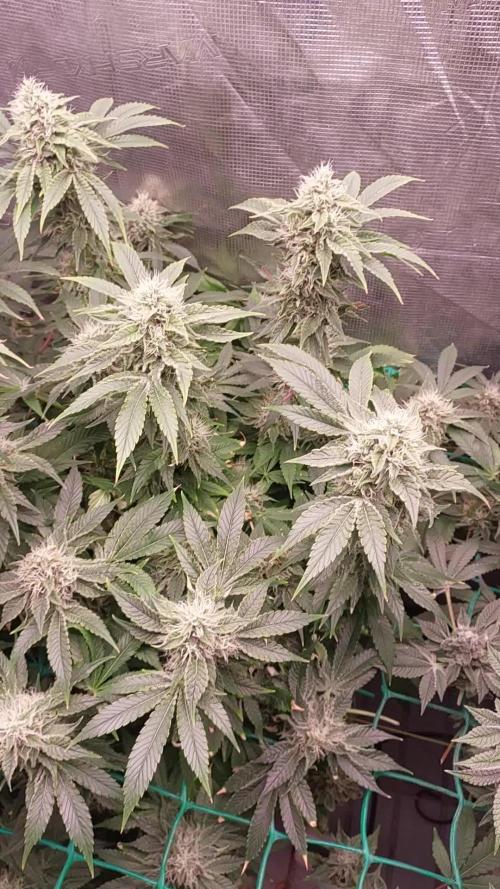
3 dernier jours avant rinçage, demain je met pour la dernière fois les nutriments, l’odeur est à tomber par terre surtout la runtz qui sent le bonbon 🍬 🍭

Likes
38
Share

@BlaKX
Follow
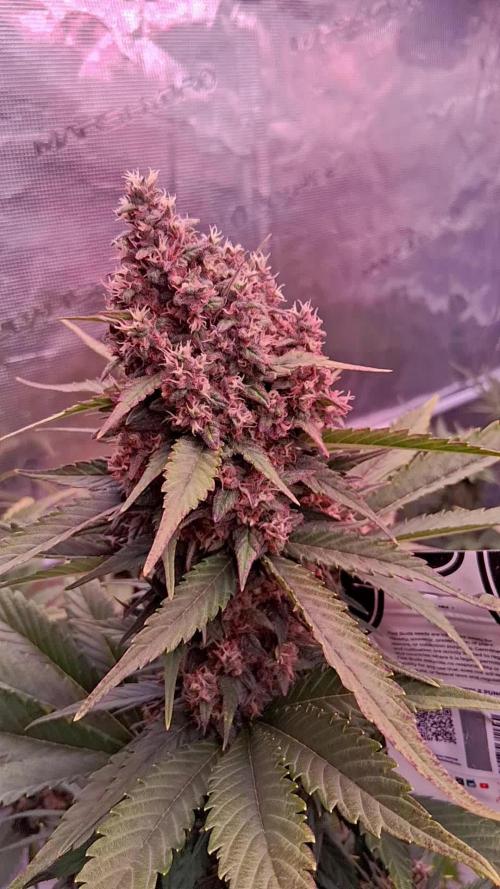
Ai Gude Growmies und Willkommen zur Woche 8!
Der Main Bud hat ordentlich noch an Volumen zugenommen wie auch die anderen Seitentriebe. Mittlerweile kommt sie richtig in Herbst Farbe und wird immer bunter 💜❤️💚



Likes
27
Share


@Salokin
Follow
Hi Growmies,
She is becoming a monster. This plant is only 18 cm tall and basically consists of stems an buds, by now she has overtaken her mother in terms of bud production, quality and bud volume. I like to believe that the one feeding of pk 13/14 stimulated it even more. As of now the feeding will get less end less, preparing her for ripening. I am a super proud of this little project and it’s outcome and looking forward to cut this beauty down in roughly 3 weeks. Not much more to do but wait.
Likes
25
Share


@Jessemon1106
Follow
Day 141 from start and this will be the last week in flower. Buds have gotten so heavy they split the stem. So I had to repair her because of that. But it looks like i will have a great yield from this one. I have 3 clones off her doing good. I definitely am proud of her and can't wait to get her cured.
Thanks everyone and I'll update some after harvest then drying.

Processing
Likes
19
Share


@Luv2Grow
Follow
Day 36 - The start of week 6 and things couldn’t be going better. Overnight, she stretched almost 2 inches. Gave her the first feeding of the week today. Still tying down a few branches here and there to try and get more light to the middle of her.
Day 37 - No feeding or water today, not quite dried out yet. Stretched another half and inch overnight. Did a little leaf tucking to open her up more.
Day 38 - Stretched another inch overnight and she’s now up to 15”. Gave her a full gallon of pH’d water with Calmag. Just waiting for the bud sites to start filling in and fattening.
Day 39 - Still stretching, another inch from 15 to 16 now. No water or feed today, just a few pics for progress. Hoping these next couple weeks, she’ll start filling in.
Day 40 - Gave her the second and final feeding of the week and looks like she’s starting to fill in a little. Only grew about a half inch overnight so maybe the stretching is slowing down and she’ll start packing on now.
Likes
3
Share


@BudBrewerz
Follow
These mystery beans were a gift from a friend who knows I grow a little bit.
He claimed they are either blue cheese or NY Diesel, however I take this info very lightly 😅
*******************************************
Day0-1: I threw them all in a shotglass, to my surprise the all seemed to be popping. So I took them out for a better view and put them in a container with wet paper towels.
They all seemed, some better than others tho.
I've planted them all out together in a big rectangle pot, I will put this one under the blurple light in the small closet to see which ones actually grow up, I will probably make a selection then and plant some of them out.
*****************************************
Day3: 7 or 8 of the 20 keemed seeds allready developed into little plant, they just dropped the their shells completely and are starting to open up.
I will make a selection of 3 to 5 lucky ladies to continue in a bigger personal pot, the rest will be eliminates or given away.