Likes
Comments
Share


@EyeMKing
Follow
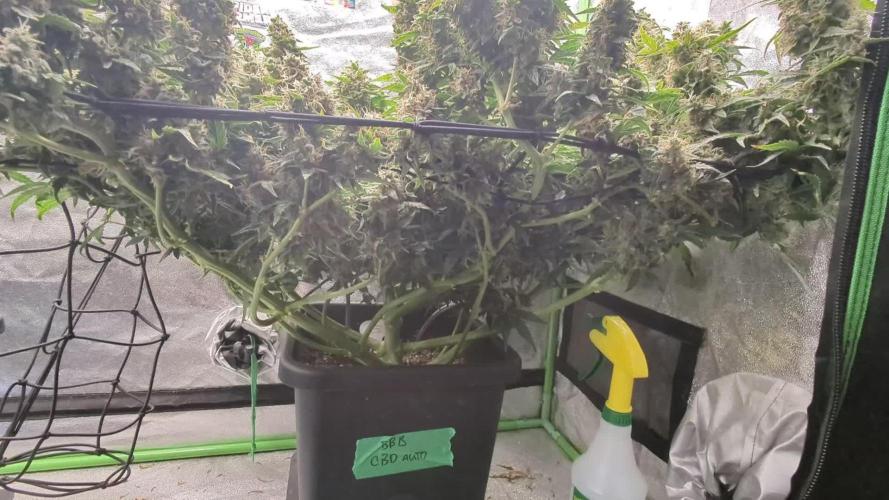
Started the first top dressing of Gaia Green All Purpose and Power Bloom at a 50/50 ratio of 1tbsp/gal each.

Likes
28
Share


@PrairieFrostGrow
Follow
*
***************** Week 3 of Growth From Seed, April 25 to May 1, 2020 - Days 15 to 21 from germination **********************
*
Started the head scratching more this week and wondering what is going on with the slower growth she has experienced the last 4 days or so. She is looking good and not dark....environment is good.....what the heck is the pH so high when been given feed well inline and below 6.0......why runoff numbers in low 7's so early in the run?? A number of heavy feedings this week so that I can read the runoff numbers for her. Going to keep staying the course with feeding but lower the pH because she is still progressing and its still pretty early in the run........not much veg time for an auto though so I need to get this figured out pretty soon.
Gave her some Epsom salts this week as well as I have been battling Magnesium deficiency the last run or two. Always just used CalMag but I don't think the girls always want as much Calcium as they are given this way though. Fed at a rate of 1tsp/gal in a two litre feed early on in the week.
Little more Detail...........
Apr 25/20, Day 15
- 500ml feed - VitaThrive and Dual Fuel @ 1.5ml
- 700ppm and 6.0pH
- small feed of base nute to try and perk her up.
- noticed the lower leaves are droopy while the upper leaves are perky still.
- Still working on dialing the light for these girls as they are happier at 30" away from canopy.
Apr 26/20 - Day 16
- 500ml feed - AN Sensi Cal @ 1.5ml, Sensyzime @ 2ml, Epsom Salt @ 1tsp/gal
- 700ppm and 6.0pH
- The Epsom Salt alone shot the ppm to 500
- Only have the veg switch on for the UnitFarm light.
- feeling some of the other girls are showing some magnesium deficiency with the yellowing perimeter of the leaves.
Apr 27/20 - Day 17
- dry out day
- Cut slits in the bottom of the bag today to let more water out, more quickly when feeding.
- Wondering if the root zone is staying too wet and therefore causing some stunted growth.
- She has been falling a sleep too early in the day so either too much light or getting root bound?
Apr 28/20 - Day 18
- needing some runoff numbers to see what the hell is going on
- fed 3L - Piranha @ 1ml, VooDoo @ 2ml, Dual Fuel @ 1ml
- going in was 575ppm and 5.3pH
- runoff numbers were 1450ppm and 6.9pH
- WTF......bring it down......next feed at only 500ppm and 5.0pH to lower her??
- leaf colour is perfect. Stems are a little immature yet, but side branching is coming out stronger.
Apr 29/20 - Day 19
- 8L feed - Dual Fuel @ 1.5ml = 325ppm and 5.0pH
- runoff after the watering was 500ppm and 7.0pH
- WTF.....expected it to be more in the 6.5pH range and not that high still?
- KK looked worse off, still droopy, after this than the other girls did. Lack of oxygen in root zone with so much water? Its coco though shouldn't be for too long.
Apr 30/20 - Day 20
- dry out day
- KK likes it a little dryer in her medium.....she perked up more today and looking a lot better.
- She has had more vertical growth the last day and she is spacing out some of her nodes.
- Her stem is thicker and she is getting stronger.
- Still a week behind though in my opinion and they should have been this size a week ago.
Apr 31/20 - Day 21
- dry out day
- she has done very well the last two days and going to keep riding that wave, didn't water today.
- She has certainly gotten taller and wider.......getting her back on track?
That will wrap up this puzzling week........pH is not staying low after being brought down......shoots back up over 7 in only 24 hours idea. Working on it Growmies. Have a great week and thanks for checking out the girls🙏👌

Likes
153
Share


@DogDoctorOfficial
Follow
I love this community and the way its like a big family, thank you all for your love time and dedication, keep it up, growers love to you all 💚💚💚


Likes
35
Share


@ReinDeer
Follow
It is a day one of the 6th week. I watered the plants and started adding B’cuzz Silic Boost. Also made some beautiful photos under a white light and I am really happy with the plats progress. 👍
Two days after watering and spraying with the fresh water added with vita race the plants are super gorgeous and they are growing in size acchieving 60 cm in height. Buda are getting bushier as well. 😻
I am a little worried by the fact that some of the plants tend to curl their leaves down just before the light turns off. After six hours of night plants look healthy again. Could that be connected to the distance between te lamp and the plant which is diminishing as the plants grow? Thanks for suggestions😊

Likes
16
Share


@Mrg7667
Follow
I finally feel like we are getting some good vertical growth! And all cut spots have put on at least 2inches. So i flipped into flower this is day 1-0


Processing
Likes
18
Share



Likes
24
Share


@TheGourmetWeed
Follow
Hello my dear friends! Hope you’re all as good as I’m feeling 😎
This was the last week for the plant.
After a intense 14 weeks, she came to an end, and this week was more to get it ready for the crop.
Since the flush last Friday, didn’t give it any feedings at all, to have it as dry as possible.
Now it’s time to chop, trim and hang it to dry.
Hopefully in 10-14 days she’ll be ready for the first test smoke.
The bud is solid and compact like I’ve never had it before, really good quality in that field.
EDIT - already cut, 225g green after trim. Let’s see how it’ll turn out after drying it.
Likes
3
Share


@Hitthejuan
Follow
August 17th 2026
Mix Pack Auto RF3
This week has been average. Temperature highs around 79°F to 81°F and lows around 57°F to 66°F. Conditions were mostly clear, foggy at times in the early mornings, and generally dry with minimal precipitation. Humidity was average. Looking forward to smoking the small plant and getting pollen from the big (male) plant now. STS spray worked perfectly 👌.
Temperature: 57°F - 81°F
Humidity: 50% - 63%
Daytime: 14 hr 11 minutes
Tall: (A. 2 feet 5 inches ) (B. 1 foot )
Smell: yes
Water: rain water and nutrients for flowering
Plant A is a male finally. The pollen sacks are showing very excited to collect it ans start breeding. Ive sprayed it 4 time already was going to do one more bit not sure i think the STS silver thiosulfate spray worked perfectly. I would definitely recommend it put i pictures of the bottom.
Plant B has about two more week before I chopper down. Not sure what strain it is yet but hopefully within this week or next week. Its smells really good. Lemme and bubblegumy and futiy. 😋
.


Likes
2
Share


@PalmaGrow
Follow
No se cómo expresar mi felicidad después de casi 3 años sin poder cultivar consecutivamente he podido cosechar esta belleza gracias a @blacktunaco por la K.O una genética llena de resina con flores compactas. Cometiendo errores desde el principio se pudo obtener una excelente planta corrigiendo todo para así mejorar el aprendizaje continuo. Se dieron 12 días de lavado de raíz y 3 de estos estuvo expuesto a lluvia constante durante los 3 días por tal razón se decidió cosechar para evitar dañar las flores

Processing
Likes
41
Share


@Enki_Weed
Follow
Our beautiful girls have plant louses 😱
So yesterday we made a brew of garlic and sprinkeld all of the plants, also the
ground of the growbox - after cleaning up everything.
So we hope this works.
Have anyone experience with the small green monsters?
We would be grateful for some suggestions.


Likes
23
Share


@Gromorethailand
Follow
So, into day 9 of 12/12 and the girls have responded quickly. Bud sites appearing everywhere. Top dressed with some more nutrients, have had daily manicuring, i prefer little and often rather than 1 massive blast. I have turned the lights up to 85%, and will work it to 100 over the next week or so.
Likes
7
Share


@TheSpoonieCrone
Follow
I failed so badly on the LST with this girl. Me and Sour Diesel are having a rough start. I nearly killed her on my very first grow, and this time I neglect to properly do her training. It's ok, I'm trying, she knows it, and she is going to be in the next grow. Nothing worth something is ever easy. We got this SD <3

Likes
44
Share


@GODSGIFT_2005_JM
Follow
For LIQUIDS ******GREEN BUZZ LIQUIDS***** organic.
Also i’m using their LIVING SOIL CULTURE in powder form!
MARSHYDRO ⛺️ has large openings on the sides which is useful for mid section groom room work. 🤩
☀️ MARSHYDRO FC 3000 LED 300W
💨MARSHYDRO 6” in-line EXTRACTOR with speed-variation knob, comes complete with ducting and carbon filter.


Likes
2
Share


@MT_Farmer
Follow
The plant rose above the ground on the 24.6., this is Time Lapse ends on the 13th day of vefetation.
I started the grow in my old cupboard grow sed up. I opted to upgrade the the Home Box Q80+ in the coming week.
As i was using the Pro Mix i dont need to ad any nutrients for about 4 Weeks. Therefore for now I am only monitoring the amount of water i give them. As I decided to give Air Pots a try for this grow, I am intersted to see how much i can water, relative to my previouse grow with a fabric pot.
Likes
2
Share


@7circleshg
Follow
Como era de esperarse el ScrOG no detuvo a estas cracks y crecieron su ultimo estiron, ya que cambiaremos el ciclo al de 12-12. Si bien, es logico, aun no vemos los pistilos pero como ya hemos echo nuestro cambio de ciclo, procedemos a darle la produccion enzimatica a nuestras chicas para tener un buen desarrollo de esas preciadas flores, cambiando nuestros nutrientes a los adecuados y con una aplicacion foliar de Delta-9 en su HORARIO DE NOCHE. Si se replica lo de vegetacion..... uff mejor ni me adelanto.