




Likes
16
Share


@valiotoro
Follow
Hello everyone 😎
Week 2 for my girl it’s time for Topping & some LST
She is doing very well,growing at fast pace and with a beautiful green colour on the leaves.
Have a nice day 😎

Likes
199
Share


@CRiSPrGrow
Follow
So i decided to experiment with the smart protein in a foliar spray recently and unlike other nutrients (this is not a nutrient or an additive!!!) well saturation is not desirable, in other words for other foliar sprays you want a saturated solution more or less, but with the smart protein you want to lighter... i think the leafs are really good at absorbing it, but it's so rare they end up "stained" and end up 'burnt', if you look closely it looks similar to Mg deficiency... but it's not and it's interesting lol. Nothing else to report, not feeding anything this week, i'll try to update as regularly as i can from now on aswell. Hope you enjoy these testers as much as I do ! 🚀

Likes
59
Share

@SwabianMadness
Follow
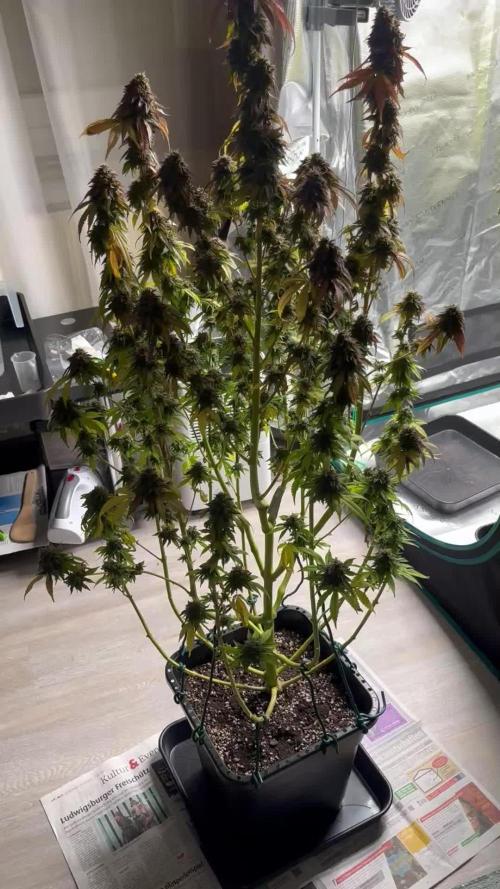
Overall good Strain. Tryed as medical Weed and was blown away. Cannamedical delievers 😃🏼
The Terps are nice well balanced
Thats why i choose this Strain

Likes
5
Share


@Toughpuff
Follow
Have had a battle with these ladies from thieves , powdery mildew , and now bud rot. These pictures are from my lowest branches on the plan and let’s just say I’m already going to get roughly 6 oz or more just from two of the lowest branches.
The rest of the plant is starting to take off and flower should be done in about 2 kore weeks or so 😁 overall I’m pretty happy with my ladies as they’re just hitting 12 feet 🤯
Likes
27
Share


@DeepRootsGrowTrees
Follow
Week #16 Gelato-K By Kannabia
Week #5 Flower
She's about mid way through 🌼 covered in trichomes and you can smell her aroma it's strong 💪!! Great 👍 genetics at Kannabia Seeds!! Thank you for checking the diary much appreciated!!

Likes
5
Share

@Coman
Follow
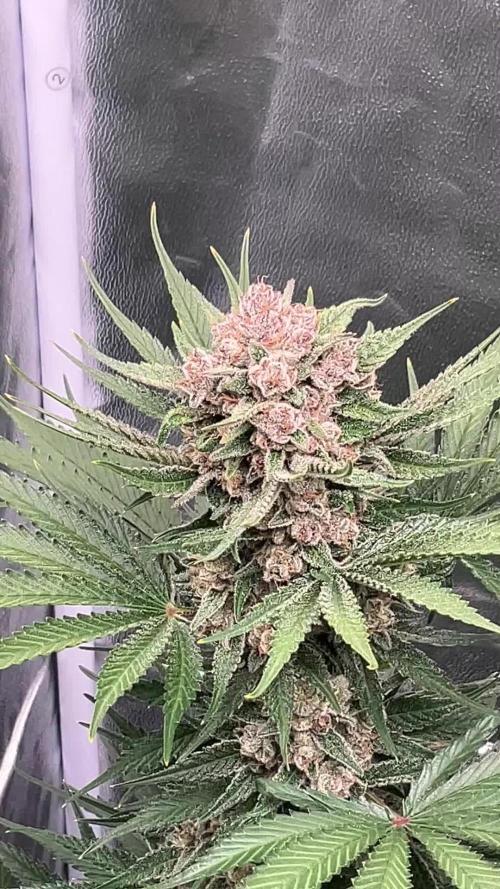
Ass already said, strawberry Gorilla and Cherry Cola staid compact and didn’t stretch ass expected. I probably will chop both in a few days. Crystal Meth looks perfect, stretched a lot, a lot of flowering spots, big buds, but she might need one or two more weeks. Have no idea why the 3 plants developed so differently one from the other, as they received exactly the same attention.
Likes
3
Share


@Ganajalane
Follow
Hit my 20-25% initial dry back.
They’re getting 3% or 30 mL every 15 minutes until rolloff between the first one to two hours and then will monitor The dry back Trying to aim for 10% by tomorrow morning
So every morning I’m hoping to hit a 10% dry back and working on wrapping them up with 3%
Until I get a decent amount of runoff nothing crazy 10-20% of my ramp up total feedings

Likes
5
Share


@Canadian_Bud
Follow
26-11-2022
Off to a good start, She is a little high in the cube but I'll fixer up once she getts further on in her cycle.
Starting off with a small deep water culture 2 gal with airstone. Going to make it a lot easier to just pass her into the Aeroponic envirnment. Less shock and gives me a chance to put her in a 5 gal bucket with clean fresh temperater adjusted water prior to her switch in a few weeks.
She's got her first wings!😎
1-12-2022
This one is getting a little stem strength help for now. increased light intensity to 80%. Showing her first wings with a little dance. 😎

Likes
17
Share

@cultivars
Follow
OCTOBER 11th to OCTOBER 17th
Sunrise: 08:20| Sunset: 19:03 | Total Daylight: 10:43
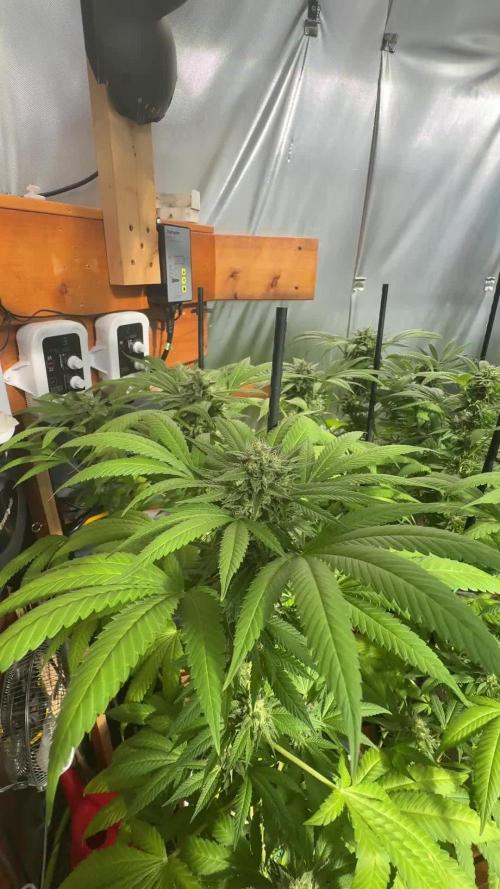
This was another pretty good week for weather, however the last couple of days have been cloudy with rain, causing some spikes in greenhouse humidity. Temperatures for the most part have been good, with one overnight low in the greenhouse of 13C.
Both Lemon Orange specimens are doing well, with Lemon Orange #1 nearing full ripeness for harvest, and Lemon Orange #2 slightly behind.
Greenhouse is emitting very strong smells now, mostly a sweet skunk scent.
Weather forecast appears as though it will be adequate and manageable temperature wise for the next week.
DAY 155
Greenhouse 13C in the morning, with outdoor temperatures down around 3C (frost evident on rooftops in area). 500mL drip of plain rainwater to all specimens.
DAY156
1L hand water BTI treated rainwater (no additives); Lemon Orange #1 showing some signs of purpling. Lemon Orange #2 fading nicely; Greenhouse held to 18C overnight, humidity a little high (51%) but dropped as sun rose; Overcast day;
DAY 157
Beautiful sunny day, with warm temps; Greenhouse was 18C in the morning.
DAY 158
-1C in the morning outside, 13C in the greenhouse, which is fine. Nice sunny day, drip watered 500mL of plain rainwater (cold) at 12:00 to Lemon Orange #2.
DAY 159
Overnight low outside 5C, 17.5C in greenhouse, which is ideal. Humidity in check, at 41%. Cloudy, overcast day, with greenhouse heater working to maintain day-time temps of 21C (no solar energy to drive heating).
DAY 160
Greenhouse 14C in the morning, 3C outside. Humidity at 41%; Clear morning, with some sun, turning cloudy with light rain in the afternoon, resulting in a humidity spike in greenhouse to 50%.
DAY 161
Lots of rain overnight, causing spike in greenhouse humidity to over 60%; Will require monitoring; Temps in the morning 18C in the greenhouse, mild outdoors.

Likes
77
Share

@Smoking_Joe_Frazier
Follow
Flowering Week 25: Structural Support & Purple Progress
Update: 29.08.2025 | Day 17
Hey Growmies,
Week 25 brought some clarity – and a little intervention. Remember those yellow leaves up top I mentioned last week? Lower leaves were totally fine, so I knew it wasn’t nitrogen. I posted pics and you guys came through – most of you called it: lack of potassium and phosphorus.
So, I did something I rarely do: gave the ladies a mild dose of mineral fertilizer. Mixed a 2L bottle with normal dosage into a 10L watering can filled with rainwater, then split it evenly between both plants. It felt like a small gamble, but sometimes you gotta trust the process – and the community. I didn't want to spend money on organic fertilizers as long as the Tripart bottles are still full from last year.
Biggest lesson this year? My compost needs more power. Next season, I’m amping it up with extra horse or pigeon manure to keep those nutrients steady deeper into flower.
Strain Check
Durban Poison:
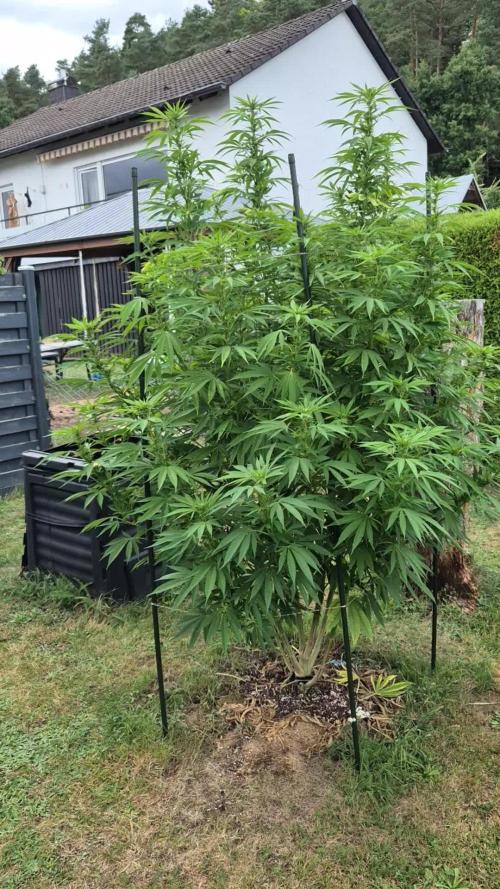
This girl’s gettin’ heavy. I’m constantly tying branches to my support structure to keep ‘em from snapping. She’s bulking up nicely, and the colors keep deepening into that gorgeous purple she’s becoming known for. The smell? Still pretty moderate – not overpowering yet, which is kinda surprising. Still not seeing much resin on the sugar leaves, but she’s a beauty through and through.
Blueberry:
She’s still reaching for the sky – definitely wants to be the tallest girl in the garden. Bud sites are becoming more defined now, and she’s slowly starting to form proper buds. Her colors are even more striking than Durban’s, deep and vibrant. Still no real smell to speak of, though. I’m thinking she’ll need until at least the first week of October to fully finish up.
Next Steps
- Keep a close eye on how they respond to the mild dose of mineral fertilizer
- Stay vigilant for pests – especially as buds develop further
- Check daily for branches that need extra support and tie them up as needed
That’s it for this week, folks.
Catch y’all next time.
– Smoking_Joe_Frazier

Likes
41
Share


@negrowsoil
Follow
Second week of flower has started
They really grew after a heavy feeding
Had to move my lights way up . LEDs tooo bright ..leaves were slightly curling
Likes
38
Share


@Ukfarmer420
Follow
Hi guys
So end of week 4 and entering week 5 now.
Few issues this week with the feeding of the plants.
Dark phoenix are hungry well half of the plants are anyway 🤔🤷♂️ so I upped the feed to 1200ppm the dark phoenix didnt mind it as it needed it but my blue cheese suffered and has significant burnt tips on every leaf 😅 I will disconnect this from the auto feeder and flush and add half nutes by hand in a few days.
Othere than that the plants buds are growing and getting frosty.
Thanks for looking and happy growing guys👌💪💚
Day 37 flower
I changed the marshydro tsl2000 to a 400watt hps to finish the job on the scrog along with the bloomplus bp2500 250watt led light.
So cheese got burnt quite bad I totally disconnected it from auto pot system and feeding ph 6.5 water only for a week. Dark phoenix is really frosty now still loads of pistils standing on end and filling out now and smells amazing. The next 2 weeks I will keep feeding bloom and top max then I will start the flush on them.
Happy growing guys.

Likes
72
Share


@MiyaguiOkPolilla
Follow
Hola amigo!
🤜💐🤛 Octava semana para las Green Crack F1 Automatic. Simplificando muchísimo el trabajo con la increíble controladora TrolMaster TentX 🤜💐🤛
🌄El clima se establece como una simulación de día real, con salida y puesta de sol más el pico de mediodía donde todas las lámparas se encienden llegando a temperaturas de 28-30 C⁰ y una baja humedad, no lo veo negativo para las plantas, el clima se siente bastante natural aquí adentro.
Hice un nuevo artefacto para distribuir la humedad de manera homogénea en toda la carpa.🌅
_ FLORES GRUESAS Y PEGAJOSAS _
Plantas verdaderamente rápidas y con un aroma dulce afrutado y diésel .
La línea de @xpertnutrients en el orden adecuado sigue siendo épica! Trabaja a la perfección. Ahora ellas beben cantidades increíbles, 1 litro al día para las dos plantas, intercalando dos riegos con nutrientes y uno de enzimas para no generar sobrecargas.
Ph: 6.4 - 6.6
EC: 1000 PPM 100+/100-
HR: 55% 10+10-.
C⁰: 20 - 29
. !! 20 hs 2 x TS600 + 19 hs TS 1000 led max dim !! . En medio del ciclo 4 horas de CMH 315watts
Los soportes laterales se encienden antes y se apagan más tarde que la iluminación central en el ciclo lumínico diario 🤜🤛 🌅🌄🌌


Likes
19
Share


@Mikado
Follow
05/13 - added Big bud and B-52 on 05/10.
PPM is over 1400 - plants show zero sign of over fertilizing.. I'm impressed. I've always found AN to be pretty hot - where I can run it slightly below recommendation, but Im tempted to increase with these gals. I won't, but I'm tempted.

Likes
31
Share


@420DeepGrow
Follow
Gracias al equipo de AnesiaSeeds, Marshydro, XpertNutrients y Trolmaster sin ellos esto no sería posible.
💐🤯 39%Thc Wham Boom:
Sube al ring con WHAM BOOM de Anesia Seeds, donde la energía electrizante de Wham choca con las vibraciones frías de RS54, creando una variedad que es todo equilibrio, potencia y sabor. Este peso pesado feminizado ofrece una mezcla perfecta de 50% Sativa y 50% Indica, proporcionando una experiencia que te hará flotar de euforia mientras tu cuerpo se sumerge en una serena relajación.
WHAM BOOM es una productora prolífica, con rendimientos en interior de 600g/m² y en exterior que alcanzan la asombrosa cifra de 900 - 1200g por planta. Con una floración de entre 65 y 70 días, esta variedad está lista a principios de octubre, lo que la convierte en una competidora ideal para los cultivadores que aspiran a una cosecha de campeonato. Con una imponente presencia de 100-140 cm en interior y 160-220 cm en exterior, WHAM BOOM se alza como testimonio de su destreza genética.
🏠 : Marshydro 1.50 x 1.50 x 1.80, carpa 100% estanca con ventanas laterales para llegar a todos los lugares durante el grow
https://marshydro.eu/products/diy-150x150x200cm-grow-tent-kit
🌬️💨 Marshydro 6inch + filtro carbon para evitar olores indeseables.
https://marshydro.eu/products/ifresh-smart-6inch-filter-kits/
💻 Trolmaster Tent-X TCS-1 como controlador de luz, optimiza tu cultivo con la última tecnología del mercado, desde donde puedes controlar todos los parametros.
https://www.trolmaster.com/Products/Details/TCS-1
🍣🍦🌴 Xpert Nutrients es una empresa especializada en la producción y comercialización de fertilizantes líquidos y tierras, que garantizan excelentes cosechas y un crecimiento activo para sus plantas durante todas las fases de cultivo.
Consigue aqui tus Nutrientes:
https://xpertnutrients.com/es/shop/
📆 Semana 4:
Aparecieron un monton de erizos esta semana, el temporal ha hecho algo de mella en la carpa al bajar las temperaturas aunque todo sigue correcto.
Continuamos con las dosis de nutrientes recomendadas por el fabricante.


Likes
34
Share


@Grey_Wolf
Follow
Original Sensible seeds GIRL SCOUT COOKIES 8th Week Of Veg December 30th 2019
Firstly ignore the white residue on the leaves as it's only Diatomaceous Earth that I mixed in with the Worm casting and Mollasses tea that I brewed up and sprayed on all my Plants. I did it after dark to alleviate any stress from sunshine or heat. The Diatomaceous Earth should hopefully deter some of the insects that are taking the odd bite out of some of my plants leaves. I suspect grasshoppers are the culprit and I know that they do not like the DE.
The Cookies plant is looking really healthy and as you can see from the above pics I topped her to make the plant bushier.
Cheers for Looking in on my Diary update Have a Safe and Happy New Years Celebration and I will be back Next week in 2020 💪💪

Likes
9
Share


@MG2009
Follow
01/19/2022
She was a he.
And he will be used for some pollination.
Not sure what both parents were, but growing nice, stem rubs stinky and definitely has fuzzy Melon smell.
Kinda reminds me of Tangie and model glue. Hopefully a good breeder will hit some choice branches on
Blue Matter F2 and test the offspring.
If interested Fuzzy Mellon is
Forbidden Fruit x Watermelon Zkittlez bred by Dying Breed Seeds & 3rd Gen Family.
Which is good genetics imo. But the wild card is who is th daddy?... Jerry springer show lol
According to leafly both parent are heavily on indica side so his stretch and node length points to a sativa daddy?
I never seen an indica with such large internodal spacing.
I know males will be stretching out more but still large compared to other males I've grown out.
So hope you follow along to see how his offspring will develop,
I will pollinate one branch of my favorite Blue Matter F2, and save some pollen for my Biscotti Skunk, Grape Skunk,and lemon og.