


Likes
Comments
Share


@PromethPWN
Follow
I hate growdiaries resizing😡 uploaded in 108Mp foto and 4k60fps video


Likes
24
Share


@Mrs_Larimar
Follow
2023-03-15
Please add one more Week in Flowering!- i was in Holidays here
This one is kinda perfect strain for me
growing vigor and sweet, getting great Strucutr, no Training needed
Just love , water and nutes
and good Conditions in Light and VPD, made her outstanding
I LOOOOVE her Colors in the End, and she smells fbulous, quite Zkittley with alovely Piny undertone, and some
Kush Notes. Iam very courious to her taste and effects

Likes
6
Share


Likes
17
Share


@Mr_Pgrow
Follow
What can i say, a fantastic plant, responding well to this organic grow with no hiccup so far.
This week i tied down the lower branches using LST method and also tucked in (not removed) some leaves that where blocking good bud sites
Thinking i might apply a Scrog in the next week or two for added support.
Again watering when needed, 2L every second day or so.

Likes
5
Share


Likes
25
Share

@Chubbs
Follow
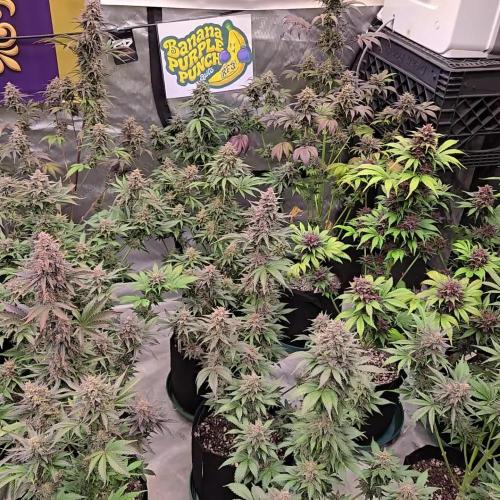
What up fam. Weekly update for these purple beauties. They have grown absolutely phenomenal, I really couldn't of asked for an easier grow. Giving them the basics and watching them thrive has been a blast to watch. A few got pulled out that finished a little earlier then the others but the rest will most likely be harvested this coming week. Love the colors and smell it produces as it's truly intoxicating.
Happy Growing
Likes
144
Share


@DevilsBud
Follow
New start of a week FLOWERING
From 120cm to 55 cm i gots it all 🤣
It's my 3rd full grow and can definitely see the extra nutrients doing there job they are at beginning of week 3 and the hedgehog 🦔🦔🦔🦔 are exploding and the pineapple dream edition and the banana punch are already giving a light aroma
I definitely got more of the lower Bud side gone there still some there but hey i say in every diaries i am here to learn to fuck up and to understand and only get better in understanding all aspects of the growing this beautiful plant . And what like and what i don't like .
More photos Tru the week
visit www.marshydro.eu
for your best gear and use the PROMO CODE: DEVILSBUD
Some info about the Marshydro FC-4800
Superb Quality LED Chips: The whole light is composed of 1206 pcs Samsung lm301b and Osram 660nm chips. More than two times as many LEDs are used to drive the grow lights at low currents and to avoid overdrive. Quality is guaranteed and efficiency is up to 2.8 μmol/j.
Even PAR Distribution and High PPFD Output: The multi-light bar design and the densely distributed light chips enable the LED grow lights to achieve the optimum PPFD required for plant growth over the entire effective coverage area.
Specifically Designed Spectrum: To ensure even plant growth, blue and red light are enhanced on the basis of a full spectrum combination. Not only does this accelerate plant growth, but it also improves the yield and quality of the plants at the same time.
Dimming Daisy Chain Function: The dimming function saves on electricity costs and enables brightness from 10% to 100% for the different stages of plant growth. A single master light can connect up to 30 lights in a daisy-chain system.
Business LED Grow Light: The light's wavy heat sink dissipates heat quickly and the IP65 waterproof allows the light to operate in humid conditions. 180° collapsible feature for easier installation. All these features provide favorable assistance for commercial cultivation.
And some tent info
●【Lock All Light Insid】MARS HYDRO Grow Tent Interior is made of diamond mylar. Non-toxic to the environment, no harm to plants. High-quality 1680D canvas being double stitched, (ALL OTHERS BRAND grow tent is 601D canvas) which is tear-proof for perfect light locking, No light leaks or rips at all.
●【Durability Grow Tent】Stable Metal corner adapters and poles are the trustful supporters of the tent. No rusting nor paint-falling. Quick easy tool-free installation. Carries strong heavy-duty SBS zippers, double layer lining to create a light-proof seal.
●【Easy Observation of your Plants】Special peeks window made by double layers of cloths. Observe the growing conditions of your plants without opening the tent and avoid disturbing plants. The peek window also serves to dissipate heat and ventilate air.
●【Removable Tray Keep Clean】The package includes a removable waterproof floor tray to hold soil and fallen leaves. The tray can be taken out easily to wash. Removable and water-proof makes cleaning easy.
●【Good Ventilation&Fast Assembly】 Circular double-sleeved vent holes with adjustable nylon strap for air circulation by exhaust fan, ducting, carbon filter, or reflector. Better allows proper light, heat, and airflow. Quick tool-free installation. Reinforced by a sturdy metal frame to ensure security and stability, supports up to 140lb. Perfectly safeguard your plants to thrive even in winter


Likes
1
Share

@LokalGrenz
Follow
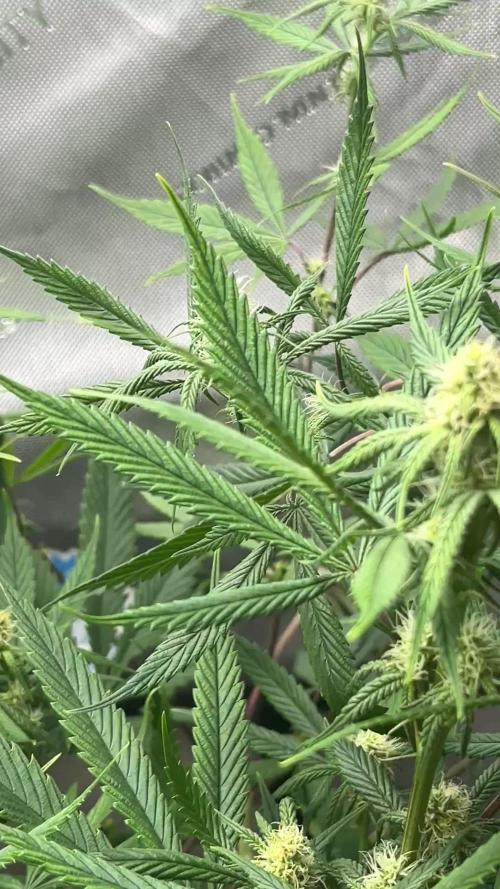
7/28 some light lead pulling removing bottom area and sites that I fill be waste of time taking energy from the tops still RO water and tea every other week
Likes
10
Share


@Hempire
Follow
Hello growers !
This week I start flush ! To clean the roots and to not smoke nutrients left. I fight against bugs and spiders that want to investigate my plants ... I check the trichomes and they are all white
Likes
9
Share

@BLAZED
Follow
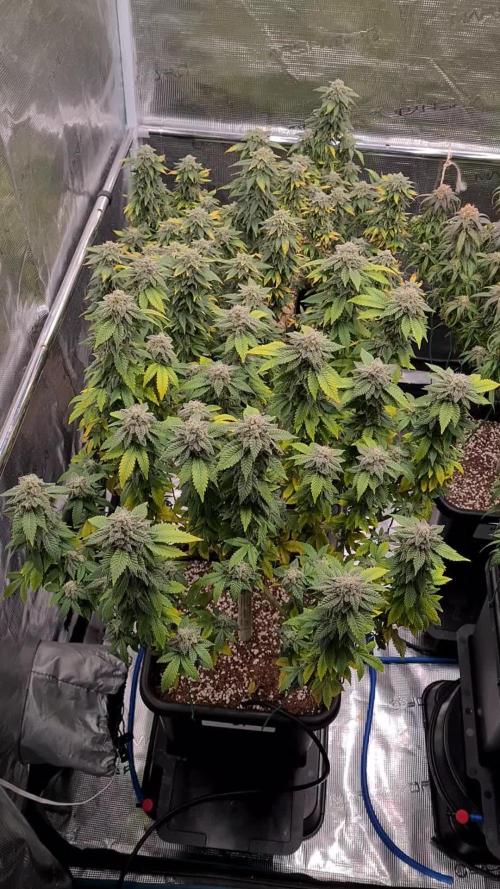
Week 21 (4-11 to 10-11)
4-11
Temps: 18.1 to 23.2 degrees
Humidity: 50% to 64%
5-11
Temps: 17.3 to 25.4 degrees
Humidity: 45% to 61%
Watering: Both 500 ml.
Strength of the light set from 75% to 80%
Dry Weight: Both 3.7 kg.
6-11
Temps: 17.4 to 25 degrees
Humidity: 49% to 67%
Watering: Both 500 ml.
Dry Weight #1: 3.9 kg. #2: 3.8 kg.
7-11
Temps: 17.9 to 24.1 degrees
Humidity: 49% to 67%
8-11
Temps: 17.4 to 25 degrees
Humidity: 49% to 69%
Dry Weight #1: 4.0 kg. #2: 3.9 kg.
9-11
Temps: 18 to 25.5 degrees
Humidity: 47% to 64%
Dry Weight: Both 3.6 kg.
10-11
Temps: 18 to 26.1 degrees
Humidity: 47% to 64%
Likes
15
Share


@Siriuz
Follow
Check out the videos guys, she is flowering real good even tho we are not using any special nute like big bud for example, but i really want to try it soon, hopefully!
Still she is doing great and im happy to have her!
How are you doing growers whats up!?
Dont forget to leave a comment
Any suggestion is welcome!
We are happy to learn new things alwas,
Thanks for the support happy growing everybody
Enjoy the footage thanks to Siriuz

Likes
6
Share


@Barcelona_Farmers710
Follow
Se nos fue un poco de altura pero intentaremos arreglar el error farmers... al final quedo simplemente en podas apicales y de momento ramas muy finas. Iremos comentando el proceso Farmers!🍁

Likes
248
Share


@Ju_Bps
Follow
For this grow I've used,
For the growth
1 Mars Hydro TS1000 (150 W)
2 fan 15w
1 extractor 150mm 350m3/h
1 carbon filter 150mm
1 Hydro Shoot 60x60x140
1 timer
11l geotextile pot
20 Hours On, 4 hours off light
For the soil I've used plagron light mix + batmix in the down
For the blooming
1 Mars Hydro FC300 (300W)@75%
2 fan 15w
Extractor + Filter 150mm
1 Mammoth lite 60 box
1 timer
11l pot
20/04
After harvest,
I've put the stuff in a room with 1 fan 15w
Thanks for all my friends!
And again thanks @Fast_Buds , and Mars Hydro, @Coco_Pan2022 ❤️❤️❤️
Likes
45
Share


@masterofsmeagol
Follow
9/3 Shook the plants off this morning and took a few pics and did a video. Let's see if it uploads. Plants are doing good. Toasted toffy is due for another plant doctor application tonight. It seems like I'm losing lots of leaves. Looking back on my other diaries I guess it's normal. BUT I could've had pest/pathogen problems then. I'm over thinking it. Toasted toffy only needs a few more weeks. It will definitely outvrun the disease. The nugs are super dense too. The plant in the 50 is loosing leaves faster than I'd like. It is also one of the furthest along. The big leaves that turn yellow look like it's a calcium/magnesium issue. The stalk and branches are all bright green and healthy looking. So are the flowers. It could be something below the soil. I couldve been overwatering but last time I waited until it drooped. It will be fine though. I'm happy with my results so far. Not my best or biggest year but I'm going to put in the work and Mae these plants produce the best quality cannabis that im able too. Also I think plant doctor may kill insects. K bicarb with dawn does too. I've found a few dead bugs like flies and pillars. Pillars actually seem to be gone. Not many moths either. Unless I see them I'm not going to treat them for it. This is that magical time where you get to watch the plant produce those beautiful flowers. Despite some small problems I'm very grateful for what I have. I've worked hard for it.
9/4 Watered everything but the sherb pie which was still heavy with leaves yellowing. It's tied for the furthest behind in flower with the seed in the 10. I treated the toasted toffy with 1/4 gallon (4tsp/gallon) of plant doctor. I avoided flowers as much as possible and tried to just get a few leaves. I used the rest on the soil. I just wanted it to absorb a little faster. That's why I sprayed the foliage. It's not 4 days it's 14 days when tje plant doctor just leaves behind a bunch of potassium and phosphorus after it's done its job. Can't be used in a 14 day interval with copper and I think that's what treats septoria best. I dontvknow if I can use that in flower. Doesn't really matter. Things are looking good. Plant Doctor and the K bicarb seem to be doing there job effectively as long as i stick to the application times. I made a short video but didn't upload. I'll try again but I may have some medical emergencies that need to be dealt with. If not I should defoliate and tie down some event horizon branches. I thought about treating the other event horizon as well. I'm not positive it has septoria but it wouldn't hurt anything to be practice. It AT LEAST has a couple suspucuous spots. I smelled a skunk as soon as I got out of my car. It can't get in my grow but I might put out traps to catch it. We'll see how it goes. Video seems to be uploading. It's at 31% so I'll wait for it. I think I've got like four or five weeks on my toasted toffy and one event horizon and the one in the 50 that I THINK is red runtz. That's good that I'll have different plants to harvest at different times. It's seeds from here on out though. It was hard to find info on some of the strains I'm growing but they all have ONE thing in common. They are EXOTIC and they are at least MODERATELY DIFFICULT to grow. AT LEAST lol. Last year I picked the right seefs and strains and it greatly helped. Still, if these are difficult strains to grow, then I'm doing a good job.
EDIT: I WAS STONED BUT IM PRETTY SURE I TREATED THE PLANT IN THE 50 WITH PLANT DOCTOR. DIDNT SPRAY BUDS. TRIED TO GET THE LEAVES THEN USED THE REST ON THE SOIL. I REMEMBER BECAUSE A STREAM ACCIDENTLY HIT A COUPLE LEAVES ON THE HUGE PLANT IN THE 10.
9/5 Sherb Pie was light and drooping. It's not to far in flower and still seemed moist yesterday with a little bit of weight. I watered it a gallon. I defoliated a little but I need to go through that plant. I have a bunch of plants that need a little work. The 50 gal seed is losing lots of leaves. I must not be feeding it enough, overwatering or maybe theres some sort of lock out. The plant looks nice and healthy. Leaves just turn yellow and die. Looked like a calcium or magnesium deficiency but i saw a septoria spot. I wouldn't think I've over feed or locked out using the small amounts of nutes I've used. It will be time to feed again soon. It's in the middle of flowering and still has leaves. I'm hoping things work out. I just have an anxiety disorder and worry too much. I'm GOING To have a great harve! I just need to keep moving forward and putting in the work.
9/6 What a fucking shitty morning. I did research on how to keep skunks out of your garden. Because I smelled it and the neighbors shot a few. Dad put traps out and it caught one. It wasn't a no spray trap so I approached it with him. Both had tarps. I kept telling him to throw it while I was distracting it bur he got a cramp and only got it over half. The half away from my garden. It's pretty far and down in a field but still. We had talked all morning about how to release it. I offered to drive their dog to take it for a walk so his alcoholic girlfriend wouldn't spiteful put the dog on its run. It wouldn't be sprayed but I made it out like it would ruin my plants. Picked dad up and got him to the bathroom. In that 30 seconds the stupid bitch grabbed the dog and brought it outside despite me YELLING "Can't you wait 5 minutes!? We've been dealing with this all morning. I heard fuck you in my head and she did it anyway. Dog ran at the skunk barking and it sprayed. Not a lot but I was fucking pissed. She's a full blown alcoholic and doesn't like me around early or the fact that my old man's 80 and house is mine. Anyway I got back and there was NO SKUNK SMELL. AT ALL! I WATERED EVERYTHING BUT SHERB PIE AND FED EVERYTHING BUT SHERB PIE. ILL FEED AND WATER THAT TOMORROW. WATERED A GALLON WITH A QUART OF FEED. Researched my strains found out they were all "difficult" to grow. One year ago to the Day I cut my first tenth planet. I got a couple close to a few weeks but the others will be later. If I can pull this off though I'll have some crazy quality! Grateful for what I have that's for sure! I doubled beastie bloom this time. We'll see how it goes.nothings uploading. I did some vids a pictures but I'll have to upload today.
9/7 I think it rained last night. I forgot to water and feed the sherb pie but I'll do it when I get back. I shook off the plants the best I could. I need to get the leaf blower out now and put it to use. Buds are swelling like crazy. GMOs are very tight flowers. Same with the event horizon. Rock hard nugs. With the gmo's I'm not worried. The were monster cropped so they have enough leaves even if some do die off. The toasted toffy only has like four weeks left. Same with the event horizon. The plant in the ten is the furthest behind but it's extremely healthy. I removed some leaves from the bottom and large fan leaves. The plant in the 50 I hope finishes before it loses all its leaves. I treated it with plant doctor and SOME people strip their plants but I don't. I'm grateful for what I've got. Won't be the biggest harvest but WHEN I make it to the finish line I will have some incredibly potent strains. I'm proud of myself to even get these to finish seeingvthe level of difficulty on cultivation. I'm trying to upload some stuff. We'll see.
9/8 Apparently it rained pretty hard last night. Took forever to go through and shake everything off and defoliate what needs it. Sherb pie is praying to the sky and almost totally purple. It's flowering so much more in the last couple days. Everything has. Even the one in the ten is stacking up! I defoliated most of what needed it and I was soaked. I noticed a branch on the middle gmo that was getting heavy and starting to break away from the trunk. It wad wobbly but I don't think there was a break un the Cambrian. I made a sling with rope (couldn't find zip ties) and I pulled it tight amd secured that branch to the tomato cage. GMO buds are hard as rocks. Everything is in overdrive. They liked that beastie bloom. I have cha ching but nothings ready for that yet I don't think. We'll the event horizon and toasted toffy might be I'll have to check. It's been beautiful today but not too hot. Lots of wind which is good. I'll upgrade supports as needed. Flowers are progressing at an amazing rate. Weather is supposed to be great the next few days. I'll keep this updated.
9/9 Had to shake the plants off. WATERED EVERYTHING BUT THE SHERB PIE WHICH WAS REALLY HEAVY. It's also lost a lot of leaves and the majority of leaves have turned purple. Toasted toffy and event horizon and red runts are pretty far into flower. I tried to take some pictures. Even the ten is blowing up! That looks like I'm going to switch to cha ching when flower gets further. Trichs are developing nicely on the ones further in flower. This year it's going to be quality over quantity. All these strains are ranked HARD to grow but have insane cannabinoid profiles and high THC %'s. So if I can keep it together for another month I'll be golden. Looking forward to it. This is the fun part. It's also the anxiety provoking part. I've learned a lot just since joining grow diaries.

Likes
8
Share


@AERO_Grower
Follow
3° Semana- Aeroponía - Mejoría apreciable, las raíces están mucho más sanas, la velocidad de crecimiento comienza a ser mayor, además el área de las hojas que realizan fotosíntesis es mayor.
---------------------------------------------------------------------------------------------------------------------------------------------------------------------------------------------------------------------
3° Week- Aeroponics - Appreciable improvement, the roots are much healthier, the speed of growth begins to be greater. The area of the leaves that carry out photosynthesis is greater.


Likes
12
Share


@ChitownCannaChica
Follow
She picking up speed now! Probably a little annoyed from the transplant. Not sure why she looks yellow in the picks, but she’s the perfect healthy green. ✌️🏻💚
Likes
23
Share


@PrairieFrostGrow
Follow
She has fought off all pest and environment issues and is very stable. She was switched to a 20 hour light cycle at mid to end of flower and she took that well and swelled further. Opened her up on the inside to the let the light in and she has rewarded with fat little nugs all the way down her stems!! She liked the LST and would push harder the day after being tied down.
She finished just a beautiful girl and she will be on a screen saver for a few months to come😃😃😃

Likes
26
Share


@C_More_Budz
Follow
Smell is getting intense which is a good problem I always like having lol got the carbon filter running 24/7. The GroBucket system really keeps the soil at the perfect moisture level. Made a aeroponics system that’s got me intrigued lol but all and all things are coasting by it’s just on me to keep environment stable and the reservoirs filled. Check out the channel I got one video I need to upload then I’ll be uploading daily on YouTube check me out
https://youtube.com/@C_More_Budz
Likes
2
Share

@Hidden
Follow
:
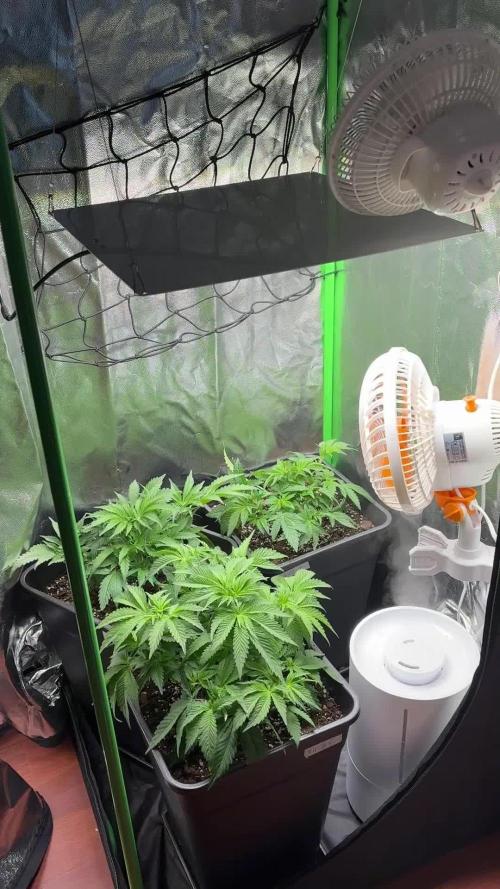
- Day 1 week 5: just checking how lst is doing, they will be ok
- Day 2 week 5: not completely dry to water so I’ll wait for day 3 of week. Did lst to make sure all branches receive as much ligth as possible
- Day 3 week 5: watered them with 4ml/L calmag and 2ml/L bio grow ph 6,5 tap water trough activated carbon filter. RHC#2 broke one of the branches, I had to tape it. Not to be worried, she’ll recover from that. RHC#3 is very slow compared to the others.
- Day 4 week 5: defoliation so sun enters better and wait.
- Day 5 week 5: added 1L of water with 2ml/L Bio grow, 6 ml/L calmag and 2ml/L bio heaven. 1600 us/cm and ph 6,2 - 6,5. RHC#3 suffered of broken branch due lst 😞 still learning about the flexibility of branches. I think she’ll recover hoping not too much stress for her.
- Day 6 week 5: RHC#3 looks good despite broken branch. Not much for today just watch temp and humidity, hoping they grow tall so I can cover a good part of the tent.
- Day 7 week 5: water with the usual calmag and biogrow ph 6,3. Defoliated every 3 days or so to keep light enter every branch
Likes
4
Share

@GrowOpsAnonymous
Follow
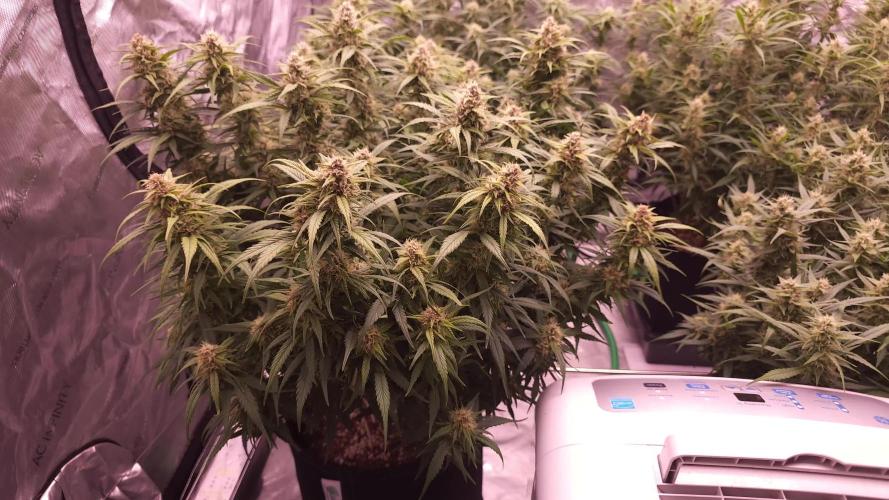
Day 56
Not a lot to update on. Plants are looking good. The EZ Feed settings are still dialed.
I've noticed that the front two plants seem to have fatter buds. #2EZF (rear right) has mostly orange pistils while the others have either none or very few.
#4AP (front left) is purple. I was unaware of the possibility for a purple pheno.
Still getting a much stronger candy rub from #4AP and #2EZF.
I started feeding Fade and PK @1.6 EC today