The Grow Awards 2026 🏆
Likes
Comments
Share
Smallest of them all but the sturdiest of the four plants. As it looks now I see a good 3 weeks remaining.
Likes
1
Share
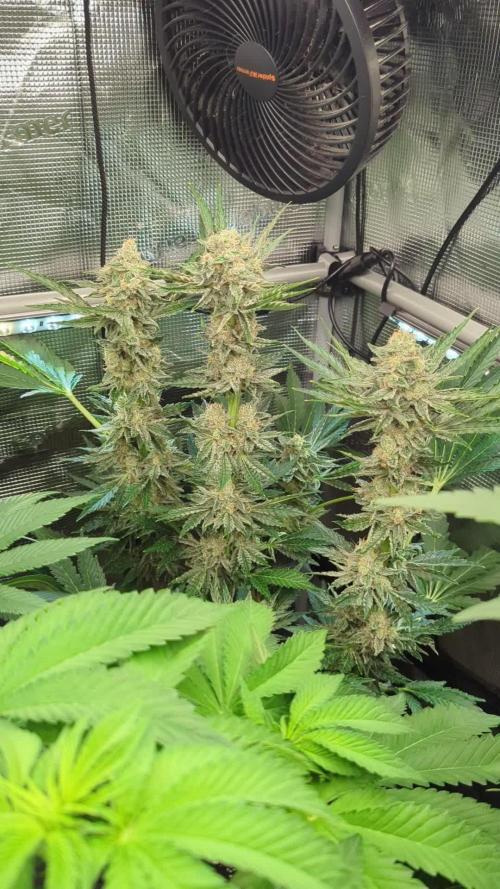
Wochenbericht – Pflanzprojekt (11. Woche – 3. Blütewoche) In der elften Woche entwickeln sich die Buds der Sorten Big Bud, Moby Dick und Amnesia XXL sichtbar weiter. Die Blüten nehmen an Größe und Dichte zu, was auf eine gesunde Entwicklung hinweist. Leider haben die kalten Tage die Temperaturregulierung in der Box erschwert. Die Temperaturen waren über einen längeren Zeitraum eine Herausforderung, und es war notwendig, zusätzliche Maßnahmen zu ergreifen, um das Klima für die Pflanzen stabil zu halten. Trotz dieser Schwierigkeiten sehen die Pflanzen weiterhin vital aus, und die Blütenentwicklung verläuft gut. In den kommenden Tagen wird darauf geachtet, die Temperatur weiterhin zu kontrollieren und den Pflanzen optimale Bedingungen für die nächste Phase der Blüte zu bieten.
Likes
2
Share
She is just on cruise control, receiving 1ml/l cal mag bi-weekly. She seems to be happy and she is growing beautiful frosty buds.
Likes
50
Share
@Roberts
Follow
Thank you grow diaries community for the 👇likes👇, follows, comments, and subscriptions on my YouTube channel👇. ❄️🌱🍻 Happy Growing 🌱🌱🌱 https://youtube.com/channel/UCAhN7yRzWLpcaRHhMIQ7X4g.
Likes
16
Share
Great Strain, I will definitely grow it again and can only recommend it to everyone Nice fruity fuel smell, great color and dense buds
Likes
104
Share
_____Week 6 | Day 43 - 49 ______ Day 42 - 48 🌞 ------ Not much happened this week. I had little time for pictures and documentation. This week I just made sure that the new branches always get a lot of light and are not covered by other leafs. The plants have not grown much, because I constantly stress them and push them down. All new shoots that grow to size were topped, in the middle area of the plant, to keep everything nice and even Day 48 🌞 ------- each Plant 2 Liter...gluck, gluck, gluck.... ____________________________________________________________________________________________ Light - 18/6 h - 400 Watt 60% Dim. PPFD - 600 - 650 µmol Temp. avg. - 22,1° Hum. avg. - 72 % RLH
Likes
38
Share
11 weeks / 77 days old today. They’ve definitely fattened up more this week. We got to a point where we were 50% amber pistils but then both plants sprouted a load of new ones so hoping for another week of bulking up! We have a few more milky looking trichomes too. I’m hoping they’ll be partially done in the next couple of weeks. Inspected all the buds and I’m pretty sure I’m gonna have to harvest in 2 or 3 steps and give the lower buds a bit more time to ripen up. I don’t know what I’ve done to piss her off so much but purple skunk is now covered in brown spots on quite a lot of leaves. I dosed her up with some calmag and since then I’ve switched to water only. I’ve noticed she’s slowed down drinking isn’t taking as much as sticky orange now. Chopped more yellowing leaves from around the bottom. Hoping this is another sign they’re coming towards the end. My patience got the better of me this week and I chopped a little bud off sticky orange to try. I haven’t smoked for months and even though they’re not there yet it almost sent me straight to sleep. So very excited to try the finished product! See you in week 12!
Likes
13
Share
Little defoliation Plants are happy smelling allot
Likes
10
Share
@6toecat
Follow
Using a Rhaspberry Pi 4 to automate the watering and a TP-link 105 smart plug to automate the Viparspectra P2000 LED grow light. You can see how I automated it here: https://hackaday.io/project/188129-rhaspberry-pi4-basic-watering-system-for-balcony Basically, this is an "Automated Watering how-to Guide for Dummies" - as simple as technically possible. You still require some basic command line expertise, but the steps have been proven and I provide links to the gear I used AND the Node Red code, making this EASIER than anything else I've seen online.
Likes
1
Share
Plants were watered on day 4 of week 9, as follows: Lucy: 1 gallon water, pH: 6.27, Height: 22 in. Herbert: 1.25 gallons water, pH: 5.77, Height: 24.5 in. ***Both fed nutrients - 5 ml/.5 gal BioVega (3% N, 1% Phosphate, 5% Soluble Potash), 7 ml/.5 gal BioBoost (1% Phosphate), and 1 ml/.5 gal BioRhizotonic (0.6% Soluble Potash) Plants were watered on day 5 of week 9, as follows: Thin Mint Sr: 1 gallon water, pH: 6.76, Height: 20 in. Thin Mint Jr: 1 gallon water, pH: 6.50, Height: 19.5 in Notes: Thin Mint Jr has nutrient burn and so was NOT fed nutrients today. Thin Mint Sr was fed nutrients at 50% strength 2.5 ml/.5 gal BioVega (3% N, 1% Phosphate, 5% Soluble Potash), 4 ml/.5 gal BioBoost (1% Phosphate), and 0.5 ml/.5 gal BioRhizotonic (0.6% Soluble Potash) (both plants still in nutrient distress - in process of recovery but have some new growth that is greener so improvement is being observed; slowly but surely!) ***Plants ideally would have been transitioned to the flowering phase this week, but due to nutrient deficiencies and nutrient burn on Thin Mint Jr., we are holding off on this transition for 1 week to give the plants a chance to recover from stress.
Likes
56
Share
This week was pretty mellow. Not much done. Watered twice this week, with second watering made some compost tea I brewed up on Thursday. Plants seem very happy. Smell is getting a little stronger. Not sure I have smelled anything some grapey. Very strange doesn't even seem real...lol. Loving this grow!!!
Likes
24
Share
SWISS DREAM ROSE🌹 CBD AUTO KANNABIA SEEDS WEEK #5 Overall June 23rd-30th Week #2 Flower This week I had to adjust the feeding a little as she got a few burn spots on the leaves new organic soil and nutrients so learning what the plant wants and doesn't want. Stay Growing!! Kannabia.com SWISS DREAM RIDE🌹 AUTO
Likes
10
Share
@Xspellsx
Follow
Here it is...Fucking bomb id definitely grow again Sadly this was a single bag seed it did HERM but late in the game so the seeds it did make which there weren't many are white and empty....got clones of his jet fuel so we will see the similarities.. Gave me about 3 ounces. Been smoking on it hard so hard to tell hahha aging well has a grapefruit smell that does not inhibit the taste which is fresh flowery chronic similar to a skywalker but much lighter
Likes
19
Share
@Comfrey
Follow
Tangerine Dream Auto - Barney‘s Farm Mein erster Indoor Keller-Grow neigt sich dem Ende zu. Es ist bunt geworden im Zelt. Die erste Blüte habe ich bereits vaporisiert und bin ziemlich begeistert vom Geschmack und der Wirkung. Leider habe ich aufgrund persönlicher Umstände nicht im Ansatz geschafft hier ein paar Tagebücher zu führen. Es war für mich ein extrem stressiger Winter und ich bin froh, dass ich wenigstens regelmäßig ein paar Fotos machen konnte. Der Anbauraum hatte zwischen den Pflanzen gemessen eine Minimaltemperatur von 17,4 Grad und während der Vegetationszeit konnte ich die Auto-Damen Tagsüber mit bis zu 28 Grad unter einer Sanlight Evo 4-120 1,5 verwöhnen. 18/6 - Licht/aus. Die Luftfeuchtigkeit war in der Veggiephase bei ca. 65-75 Prozent im Zelt und in der Blütephase konnte ich sie Stück für Stück absenken auf 55-43 zum Ende hin. Gedüngt habe ich ein einziges Mal mit 1:20 sauberem Urin am Ende der dritten Woche. Ansonsten gieße ich auf das Terra Preta ähnliche Substrat ausschließlich mit hartem Leitungswasser mit Ph 7,6. Das Substrat wurde kurz nach der Sämlingsphase mit einer dicken Schicht Laub, Braun- und Grünschnitt Mulch abgedeckt, welchen ich zuvor dreißig Minuten bei 150 Grad im Ofen gedämpft habe (Sterilisation). Es kamen Nematoden, Raubmilben und Gelbtafeln zum Einsatz, weil wir mit einer ziemlich unangenehmen Trauermückenplage zu kämpfen hatten. Anfang der Blütephase kam es zu einer Nährstoffblokade aufgrund von Überwässerung. Das Substrat hält die Feuchtigkeit sehr lange und die Mulchschicht verhinderte ein Austrocknen des Substrats. Wir haben anfangs deutlich Zuviel gegossen und das Substrat nicht etwas austrocknen lassen. Nach Anpassung des Gießintervalls auf alle drei Tage mit ca. 2-2,5 Liter, löste sich das Problem nicht in Luft auf, aber wir konnten es aufhalten. Meine Pflanzen sind bereits geerntet und hängen zum Trocknen. Viel Spaß mit den farbenfrohen Bildern. Happy Growing! 💚
Likes
29
Share
23.10. Day 53 of flower. The buds become flesh. Still wonderful sticky. She really likes it moist. Lifted the lamp and switched the white Light off. Just for a while. Because, i think she began to be grilled. Just a little relax for her. Switched to 16_8h light nightschedule. And agaun with white light, FULL POWER. With greetings from the unexpected colorful Trans Syberia..😛 💪
Likes
10
Share
@Hempire
Follow
Hello growers ! This week I start flush ! To clean the roots and to not smoke nutrients left. I fight against bugs and spiders that want to investigate my plants ... I check the trichomes and they are all white
Likes
18
Share
Green light is radiation with wavelengths between 520 and 560 nm and it affects photosynthesis, plant height, and flowering. Plants reflect green light and this is why they appear green to our eyes. As a result, some growers think that plants don’t use green wavelengths, but they actually do! In fact, only around 5 – 10% of green light is reflected from leaves and the rest (90 – 95 %) is absorbed or transmitted to lower leaves [1]. Green wavelengths get used in photosynthesis. Chlorophyll pigments absorb small amounts of green wavelengths. Light that doesn’t get absorbed is transmitted to leaves that are shaded out from direct light. This means that leaves at the bottom of the canopy get more green light than leaves at the top. A high proportion of green wavelengths compared to other colors tells lower leaves that they are being shaded out, so they are able to react accordingly. Lower leaves may react by opening or closing their stomata or growing longer stems that help the leaves reach brighter light [1, 2, 3]. When it comes to growing cannabis, many cultivators are interested in the quality of light used for the flowering stage. In many plants, flowering is regulated by two main photoreceptors: cryptochrome and phytochrome. Both photoreceptors primarily respond to blue light but can also respond to green, although to a lesser extent. Green can accelerate the start of flowering in several species (although cannabis has yet to be tested) [1, 4, 5]. However, once flowering has begun, it’s important to provide plants with a “full spectrum” light that has high amounts of blue and red light, and moderate amounts of green, in order for photosynthesis to be optimized. Green light mediates seed germination in some species. Seeds use green wavelengths to decide whether the environment is good for germination. Shade environments are enriched in green relative to red and blue light, so a plant can tell if it is shady or sunny. A seed that senses a shaded environment may stay dormant to avoid poor growing conditions [1]. Some examples of plant species where researchers have documented this response are: ryegrass (a grass that grows in tufts) and Chondrilla (a plant related to dandelion) [1, 6]. Although green wavelengths generally tell plants NOT to germinate, there are some exceptions! Surprisingly, green wavelengths can stimulate seed germination in some species like Aeschynomene, Tephrosia, Solidago, Cyrtopodium, and Atriplex [1, 6, 7]. Of course, light is not the only factor affecting seed germination – it’s a combination of many factors, such as soil moisture, soil type, temperature, photoperiod, and light quality. When combined with red and blue light, green can really enhance plant growth [1, 8]. However, too much green light (more than 50% of the total light) can actually reduce plant growth [8]. Based on the most current research, the ideal ratio of green, red, and blue light is thought to be around 1:2:1 for green:blue:red [9]. When choosing a horticultural light, choose one that has high amounts of blue and red light and moderate amounts of green and other colors of light. Not many studies can be found about the effect of green light on cannabis growth or metabolism. However, if one reads carefully, there are clues and data available even from the very early papers. Mahlberg and Hemphill (1983) used colored filters in their study to alter the sunlight spectrum and study green light among others. They concluded that the green filter, which makes the environment green by cutting other wavelengths out, reduced the THC concentration significantly compared to the daylight control treatment. It has been demonstrated that green color can reduce secondary metabolite activity with other species as well. For example, the addition of green to a light spectrum decreases anthocyanin concentration in lettuce (Zhang and Folta 2012). If green light only reverses the biosynthesis of some secondary metabolites, then why put green light into a growth spectrum at all? Well, there are a couple of good reasons. One is that green penetrates leaf layers effectively. Conversely red and blue light is almost completely absorbed by the first leaf layer. Green travels through the first, second, and even third layers effectively (Figure 2). Lower leaf layers can utilize green light in photosynthesis and therefore produce yields as well. Even though a green light-specific photoreceptor has not yet been found, it is known that green light has effects independent from the cryptochrome but then again, also cryptochrome-dependent ones, just like blue light. It is known that green light in low light intensity conditions can enhance far red stimulating secondary metabolite production in microgreens and then again, counteracts the production of these compounds in high-intensity light conditions (Kim et al. 2004). In many cases, green light promoted physiological changes in plants that are opposite to the actions of blue light. In the study by Kim et al. blue light-induced anthocyanin accumulation was inhibited by green light. In another study it has been found that blue light promotes stomatal opening whereas green light promotes stomatal closure (Frechilla et al. 2000). Blue light inhibits the early stem elongation in the seedling stage whereas green light promotes it (Folta 2004). Also, blue light results in flowering induction, and green light inhibits it (Banerjee et al., 2007). As you can see, green light works very closely with blue light, and therefore not only the amount of these two wavelengths separately is important but also the ratio (Blue: Green) between these two in the designed spectrum. Furthermore, green light has been found to affect the elongation of petioles and upward leaf reorientation with the model plant Arabidopsis thaliana both of which are a sign of shade avoidance symptoms (Zhang et al. 2011) and also gene expression in the same plant (Dhingra et al. 2006). As mentioned before, green light produces shade avoidance symptoms which are quite intuitive if you consider the natural conditions where the plants grow. Not all the green light is reflected from the highest canopy leaves in nature but a lot of it (50-90%) has been estimated to penetrate the upper leaves at the plant level ((Terashima et al., 2009; Nishio, 2000). For the plant growing in the understory of the forest green light is a signal for the plant of being in the shade of a bigger plant. Then again, the plants growing under unobstructed sunlight can take advantage of the green photons that can more easily penetrate the upper leaves than the red and blue photons. From the photosynthetic pigments in higher plants, chlorophyll is crucial for plant growth. Dissolved chlorophyll and absorb maximally in the red (λ600–700 nm) and blue (λ400–500 nm) regions of the spectrum and not as easily in the green (λ500–600 nm) regions. Up to 80% of all green light is thought to be transmitted through the chloroplast (Terashima et al., 2009) and this allows more green photons to pass deeper into the leaf mesophyll layer than red and blue photons. When the green light is scattered in the vertical leaf profile its journey is lengthened and therefore photons have a higher chance of hitting and being absorbed by chloroplasts on their passage through the leaf to the lower leaves of the plant. Photons of PPFD (photosynthetic photon flux density) are captured by chlorophyll causing an excitation of an electron to enter a higher energy state in which the energy is immediately passed on to the neighboring chlorophyll molecule by resonance transfer or released to the electron transport chain (PSII and PSI). Despite the low extinction coefficient of chlorophyll in the green 500–600 nm region it needs to be noted that the absorbance can be significant if the pigment (chlorophyll) concentration in the leaf is high enough. The research available clearly shows that plants use green wavelengths to promote higher biomass and yield (photosynthetic activity), and that it is a crucial signal for long-term developmental and short-term dynamic acclimation (Blue:Green ratio) to the environment. It should not be dismissed but studied more because it brings more opportunities to control plant gene expression and physiology in plant production. REFERENCES Banerjee R., Schleicher E., Meier S. Viana R. M., Pokorny R., Ahmad M., Bittl R., Batschauer. 2007. The signaling state of Arabidopsis cryptochrome 2 contains flavin semiquinone. The Journal of Biological Chemistry 282, 14916–14922. Dhingra, A., Bies, D. H., Lehner, K. R., and Folta, K. M. 2006. Green light adjusts the plastic transcriptome during early photomorphogenic development. Plant Physiol. 142, 1256-1266. Folta, K. M. 2004. Green light stimulates early stem elongation, antagonizing light-mediated growth inhibition. Plant Physiol. 135, 1407-1416. Frechilla, S., Talbott, L. D., Bogomolmi, R. A., and Zeiger, E. 2000. Reversal of blue light -stimulated stomatal opening by green light. Plant Cell Physiol. 41, 171-176. Kim, H.H., Goins, G. D., Wheeler, R. M., and Sager, J. C. 2004.Green-light supplementation for enhanced lettuce growth under red- and blue-light emitting diodes. HortScience 39, 1617-1622. Nishio, J.N. 2000. Why are higher plants green? Evolution of the higher plant photosynthetic pigment complement. Plant Cell and Environment 23, 539–548. Terashima I., Fujita T., Inoue T., Chow W.S., Oguchi R. 2009. Green light drives leaf photosynthesis more efficiently than red light in strong white light: revisiting the enigmatic question of why leaves are green. Plant & Cell Physiology 50, 684–697. Zhang, T., Maruhnich, S. A., and Folta, K. M. 2011. Green light induces shade avoidance symptoms. Plant Physiol. 157, 1528-156. Wang, Y. & Folta, K. M. Contributions of green light to plant growth and development. Am. J. Bot. 100, 70–78 (2013). Zhang, T. & Folta, K. M. Green light signaling and adaptive response. Plant Signal. Behav. 7, 75–78 (2012). Johkan, M. et al. Blue light-emitting diode light irradiation of seedlings improves seedling quality and growth after transplanting in red leaf lettuce. HortScience 45, 1809–1814 (2010). Kasajima, S., et al. Effect of Light Quality on Developmental Rate of Wheat under Continuous Light at a Constant Temperature. Plant Prod. Sci. 10, 286–291 (2007). Banerjee, R. et al. The signaling state of Arabidopsis cryptochrome 2 contains flavin semiquinone. J. Biol. Chem. 282, 14916–14922 (2007). Goggin, D. E. & Steadman, K. J. Blue and green are frequently seen: responses of seeds to short- and mid-wavelength light. Seed Sci. Res. 22, 27–35 (2012). Mandák, B. & Pyšek, P. The effects of light quality, nitrate concentration and presence of bracteoles on germination of different fruit types in the heterocarpous Atriplex sagittata. J. Ecol. 89, 149–158 (2001). Darko, E. et al. Photosynthesis under artificial light: the shift in primary and secondary metabolism. Philos. Trans. R. Soc. B Biol. Sci. 369 (2014). Lu, N. et al. Effects of Supplemental Lighting with Light-Emitting Diodes (LEDs) on Tomato Yield and Quality of Single-Truss Tomato Plants Grown at High Planting Density. Environ. Control Biol. 50, 63–74 (2012).
Likes
2
Share
Hola a todos!!! Como estan??..espero que bien, a esta cepa BIG BANG, sigue estirandose😃🙌 . Esta semana he regado con top veg 3ml x litro de agua. Se la ve creciendo bien verde. El video corresponde al día 28/12/25 No tengo más para contar😅. Solo deseo que todos tengan un buen 2026. Y de nuevo gracias a @DivineSeeds por hacer posible este diario🙌🙌🙌👏👏👏🤩🤩🤩🤩
Likes
1
Share
🌹Start Flush🌹