Likes
Comments
Share
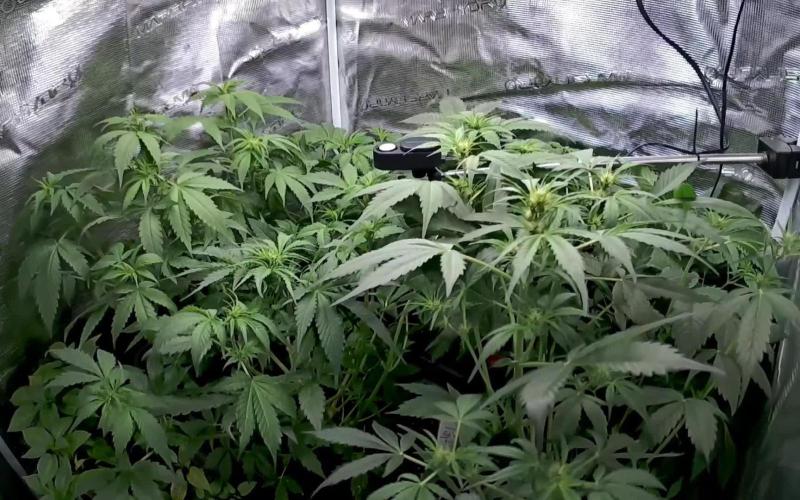
Week 17 for Gelato 41 by seedstockers, All photos were taken on 0.5x because the plant just doesn't fit in the picture frame... She's getting too big😂 I just want her to flower now i don't think i can take her getting any bigger than she currently is. Last week was another hot hot week but we are coming down to the low 30's again for the rest of the upcoming week so think the plants will be happier. Im not sure whether to just leave her be & not defoliate but at this point learning as i go along because ive never grown something so large. 😅
Likes
46
Share
@Visions
Follow
Wow what can I fucking say... A real experience this was. True og x platinum is special cultivator. This freebie was a limited get it or don't this weekend sale only. I was lucky enough to snag some s7, candy cane, and 2 true ogs. The first true og failed due to me trying new germ methods. This one however weather no lights for 8 days with a window seal veg. She them bounced back and grew VIGOROUSLY. With the help of clonex and great white, we were able to top and clone her 2 weeks in veg and with strong lateral roots in 8 days. As week 3 to 4 approached we then transplanted the clones into a new solo which was uneeded I know now. She great rapidly and was then sprayed with 30ppm colloidal silver. This was to prep her for a reversal in hope of a potential keeper just based on her vegetation growth alone. She is incredible man, a really fast grower. As we approached week 5 and 6 of the vegetation process her clones got huge with big fan leaves which is know of the True Og since she is a high Indica hybrid. Her mama was the spread out over theist days of her vegetation cycle and achieved around 32 tops. For and indica she does stretch well but my downfall was not knowing she was indica or "noticing" it by physical traits. I should have given her 8 weeks and then I would have had 64 tops with everything spread out with an impressive lollipop.... maybe 128 one tent?!.. In all honestly I should have given her 8 weeks to create 30 colas instead of bud sites and nice chunky tops. Amazing quality just need the yield... okay back to it.. As the stretch went for around 3 weeks or 20 days, I hsted and lsted where needed to keep an even canopy. She transitions to flower fast and likes bloom around week 3 into 4. She builds heavy frost early on in the first 20 to 30 days to flower. Next time she will definitely go past 70 days. 62 days was definitely pristine and she definitely is a keeper. As mid to late flower set in, I Backed off gradually on the grow and increased on the bloom. I threw in terpinator late but will try near week 4 to 5 next go at her. She stacks incredible fast and well. Each bud created on this monster are dense as golf balls. She then starts to fade around Day 40. The 40s you will see purples and fall colors which then turn into a mix of reds, violets, autumn, and blackish purple. She then throws the most tirchomes once she near day 50. Her bracts bulk hard as they fatten to finish but her pistils which are thin and horse hair like are very very few. This is an amazing feature as her flower to leaf ratio is more hmmm give me bud.. Her terp profile boasts early and bullies other plants until harvest. She smells of berries, just, gas, spice.... honestly it's extremely complex... As I finally pulled her slightly amber on day 62 which was one of her early harvest ranges I'd day 60 to 75 for this strain. She was all cloudy however during the pull. As the mom dried for a couple of days, we pulled some okay numbers and have learned a lot and we also know what to do to triple this harvest number next go.. the clone was also successfully reversed and we believe created f1s true og x plat visions cut and true slurricane by visions... we will updated as soon as we know... Smoke report: OH man... this will be an ongoing thing until Christmas... I won't smoke much more until after march.. She is being saved until I get more. True Og x Plat 💯 hits like a fucking truck. She is a heavy head hitter with body stoning blended in as well which give her a nice balanced hybrid hit. It truly lives up to the platinum lineage tho with inhouses trichome productivity which is sugary and potent on hit almost like the sugar cane 🤔 She is extremely sticky when grinding into a bowl. The bud sticks completely in your top grinder almost every time.. As you smoke her you get the smoothest God damn smoke you'll ever smoke.. The smoke has a diesel pungent sting to the nose immediately after you take a hit. I'd say for a rookie it's probably a no go for you buddy... soon after that you are given the true og coined term "couchlocked" A real winner with other flavors which are extremely complex and can't be named until later--------------->>> The flavors found/ complex terpene profiles given off by this cultivar are I'd say "loud". Very creamy berry kush notes on the jar opening. When you smoke her 2 hits into a bowl, your face with feel red and flushed like a dab would. Shes like smoking pure hash essentially. Thats how greasy she is. On the exhale you experience complex notes but mainly earthy diesel kush funk. Very enjoyable relaxing high. Very potent. 2 friends took 2 hits and said it was too much to function even after that... for an average smoker it needs a warning label 🏷️ True Og X Platinum truly serves its purpose medicinally in large amounts with pain numbing goods and most important sleep. She takes the tension from everyday endeavors and throws that shit in the rear view mirrors. Large amounts induce permanent sleep. This is highly recommended as a night time smoke which worms great with my lifestyle. I really enjoyed growing this cultivar. The only thing I regret is not giving her 2 more weeks in veg. I would have capitalized instead of just getting some. Would have doubled if not tripled my harvest numbers. OH well. There will be a volume 2 shortly 😀 Update: No clone seeds. Pollen was kept. I believe it was due to using a store bought ppm. Nearly 35 days I think to get some pollen. Wasn't strong enough to reverse in a timely fashion for pollination. I'll grab a clone from wicked however and still continue crosses however. Rawtton will get some true og pollen however. All is not lost.
Likes
6
Share
😫PRIMO OVERFERT SENZA AVER DATO NULLA ASSURDO...solo acqua e sono cariche scure ora sono palesemente in over... procederò ancora per altri 10 giorni di acqua il topping a funzionato bene da come si vede nel video ora faro riposare per 15 giorni e poi lancio in flow 14/05/2021 la jungla sembra crescere ora dovrò fare un pò di pulizia defogliare dalle foglie piu grandi e lollipoppare per bene.... sono solo un pauroso di togliere le foglie grandi (foglie primarie) al momento zero fertilizzanti ancora troppo scure 18/05/2021 la sera del 18 a un giorno da un mese di vegetazione in growbox ho lollipoppato e potato i rami i inutili.... ho dovuto anche fare una rotazione di piante in quanto non sono uniformi nel crescere.... ho riempito il bidone da 30 litri e mi sono accorto che le baby ora bevono molto pur troppo sono ancora in forte stress e overfert non capisco da cosa provenga in quanto non ho usato nei fertillizzzante.... vedremo oggi 21 come staranno ora posto le foto del 19 maggio giorno in cui fanno un mese e sono ancora 40cm aime qualcosa sta rallentando la crescita e arrivato il filtro a carboni e pesessantissimo speriamo che la mia box lo regge
Likes
1
Share
Finishing off shortly one last push and then just some water to clean her up.
Likes
10
Share
@DreamIT
Follow
Sponsored by: 🦎THE HIGH CHAMELEON🦎-💡VIPARSPECTRA💡-💐GREEN BUZZ LIQUIDS💐-🛠️WEDRYER🛠️ 🏁 10/8 New sponsor at DreamIT. I am delighted to warmly welcome The High Chameleon to my journals and growboxes. The shipping was fast and the package was anonymous. Instead of the usual plastic to keep the seeds in place, I found a nice bag of chopped hemp, a smart and ecological choice. In addition, a very practical grass holder with attached grinder, really practical and comfortable. I will open a diary for each seed that I will try to grow with different types of training techniques, I will decide which ones along the way. let's begin !! 12/8 open seed! it was not necessary to help her. it is a bit crooked because the light is central and it is already looking for it. transfer tomorrow 18/8 everything is going well __________________________________________ Personal advertising (contains affiliate links) __________________________________________ 🦄 Check out The High Chamaleon website, their first selection criterion is the strong signature of terpenes by taking rare strains while being 100% organic and respecting nature. Safe anonymous shipping! ✅ https://bit.ly/TheHighChameleon __________________________________________ Did you know that Green Buzz Liquids fertilizers are 100% vegan? A complete line of products ready to give the best to each of your plants! Visit the site and see my journals to see how they work 🦄 🤯 And with the code "dreamit" you will immediately receive a 15% discount on your purchases ✅https: //bit.ly/GreenBuzzLiquidsPro __________________________________________ 👀 Are you looking for a good lamp to start with? 👀 🌞Viparspectra has something more than the others, take a look at their site. ⏩ Use "GDVIP" for an extra discount or "DREAMIT3" for an extra 5 %% discount 👀 Search for it on Amazon ✅Amazon USA: https://amzn.to/30xSTVq ✅Amazon Canada: https://amzn.to/38udUVe ✅Viparspectra UE: bit.ly/ViparspectraUE ✅Viparspectra USA: bit.ly/ViparspectraUS ______________________________________________ 🌈 Tired of blowing on your weed hoping it dries quickly? Check out the Wedryer website! You will find a well-made accessory that will help your weed dry in just 8-10 days without the annoying risk of finding mold or other annoyances! (no affiliate links) ✅https: //bit.ly/Wedryer_ ______________________________________________ 📷🥇Follow the best photos on Instagram 🥇📷 https://www.instagram.com/dreamit420/ Backup https://www.instagram.com/dreamit4200/ 🔻🔻Leave a comment with your opinion if you pass by here🔻🔻 🤟🦄💚 Thank you and good growth 💚🦄🤟
Likes
18
Share
Extra few more days then these girls will be coming down , happy with how everything has gone . Blue gelato and inhouse genetics are my favourite . Will update soon
Likes
16
Share
@Comfrey
Follow
Blackberry Kush is in flower. Healthy plant with some leaf anomalies which I can‘t identify. Someone have an idea?
Likes
25
Share
ANTHOCYANIN production is primarily controlled by the Cryptochrome (CR1) Photoreceptor ( !! UV and Blue Spectrums are primary drivers in the production of the pigment that replaces chlorophyll, isn't that awesome! 1. Diverse photoreceptors in plants Many civilizations, including the sun god of ancient Egypt, thought that the blessings of sunlight were the source of life. In fact, the survival of all life, including humans, is supported by the photosynthesis of plants that capture solar energy. Plants that perform photosynthesis have no means of transportation except for some algae. Therefore, it is necessary to monitor various changes in the external environment and respond appropriately to the place to survive. Among various environmental information, light is especially important information for plants that perform photosynthesis. In the process of evolution, plants acquired phytochrome, which mainly receives light in the red light region, and multiple blue light receptors, including his hytropin and phototropin, in order to sense the light environment. .. In addition to these, an ultraviolet light receptor named UVR8 was recently discovered. The latest image of the molecular structure and function of these various plant photoreceptors (Fig. 1), focusing on phytochrome and phototropin. Figure 1 Ultraviolet-visible absorption spectra of phytochrome, cryptochrome, phototropin, and UVR8. The dashed line represents each bioactive absorption spectrum. 2. Phytochrome; red-far red photoreversible molecular switch What is phytochrome? Phytochrome is a photochromic photoreceptor, and has two absorption types, a red light absorption type Pr (absorption maximum wavelength of about 665 nm) and a far-red light absorption type Pfr (730 nm). Reversible light conversion between the two by red light and far-red light, respectively(Fig. 1A, solid line and broken line). In general, Pfr is the active form that causes a physiological response. With some exceptions, phytochrome can be said to function as a photoreversible molecular switch. The background of the discovery is as follows. There are some types of plants that require light for germination (light seed germination). From that study, it was found that germination was induced by red light, the effect was inhibited by subsequent far-red light irradiation, and this could be repeated, and the existence of photoreceptors that reversibly photoconvert was predicted. In 1959, its existence was confirmed by the absorption spectrum measurement of the yellow sprout tissue, and it was named phytochrome. Why does the plant have a sensor to distinguish between such red light and far-red light? There is no big difference between the red and far-red light regions in the open-field spectrum of sunlight, but the proportion of red light is greatly reduced due to the absorption of chloroplasts in the shade of plants. Similar changes in light quality occur in the evening sunlight. Plants perceive this difference in light quality as the ratio of Pr and Pfr, recognize the light environment, and respond to it. Subsequent studies have revealed that it is responsible for various photomorphogenic reactions such as photoperiodic flowering induction, shade repellent, and deyellowing (greening). Furthermore, with the introduction of the model plant Arabidopsis thaliana (At) and the development of molecular biological analysis methods, research has progressed dramatically, and his five types of phytochromes (phyA-E) are present in Arabidopsis thaliana. all right. With the progress of the genome project, Fi’s tochrome-like photoreceptors were found in cyanobacteria, a photosynthetic prokaryotes other than plants. Furthermore, in non-photosynthetic bacteria, a homologue molecule called bacteriophytochrome photoreceptor (BphP) was found in Pseudomonas aeruginosa (Pa) and radiation-resistant bacteria (Deinococcus radiodurans, Dr). Domain structure of phytochrome molecule Phytochrome molecule can be roughly divided into N-terminal side and C-terminal side region. PAS (Per / Arndt / Sim: blue), GAF (cGMP phosphodiesterase / adenylyl cyclase / FhlA: green), PHY (phyto-chrome: purple) 3 in the N-terminal region of plant phytochrome (Fig. 2A) There are two domains and an N-terminal extension region (NTE: dark blue), and phytochromobilin (PΦB), which is one of the ring-opening tetrapyrroles, is thioether-bonded to the system stored in GAF as a chromophore. ing. PAS is a domain involved in the interaction between signal transduction-related proteins, and PHY is a phytochrome-specific domain. There are two PASs and her histidine kinase-related (HKR) domain (red) in the C-terminal region, but the histidine essential for kinase activity is not conserved. 3. Phototropin; photosynthetic efficiency optimized blue light receptor What is phototropin? Charles Darwin, who is famous for his theory of evolution, wrote in his book “The power of move-ment in plants” published in 1882 that plants bend toward blue light. Approximately 100 years later, the protein nph1 (nonphoto-tropic hypocotyl 1) encoded by one of the causative genes of Arabidopsis mutants causing phototropic abnormalities was identified as a blue photoreceptor. Later, another isotype npl1 was found and renamed phototropin 1 (phot1) and 2 (phot2), respectively. In addition to phototropism, phototropin is damaged by chloroplast photolocalization (chloroplasts move through the epidermal cells of the leaves and gather on the cell surface under appropriate light intensity for photosynthesis. As a photoreceptor for reactions such as escaping to the side of cells under dangerous strong light) and stomata (reactions that open stomata to optimize the uptake of carbon dioxide, which is the rate-determining process of photosynthetic reactions). It became clear that it worked. In this way, phototropin can be said to be a blue light receptor responsible for optimizing photosynthetic efficiency. Domain structure and LOV photoreaction of phototropin molecule Phototropin molecule has two photoreceptive domains (LOV1 and LOV2) called LOV (Light-Oxygen-Voltage sensing) on the N-terminal side, and serine / on the C-terminal side. It is a protein kinase that forms threonine kinase (STK) (Fig. 4Aa) and whose activity is regulated by light. LOV is one molecule as a chromophore, he binds FMN (flavin mononucleotide) non-covalently. The LOV forms an α/βfold, and the FMN is located on a β-sheet consisting of five antiparallel β-strands (Fig. 4B). The FMN in the ground state LOV shows the absorption spectrum of a typical oxidized flavin protein with a triplet oscillation structure and an absorption maximum wavelength of 450 nm, and is called D450 (Fig. 1C and Fig. 4E). After being excited to the singlet excited state by blue light, the FMN shifts to the triplet excited state (L660t *) due to intersystem crossing, and then the C4 (Fig. 4C) of the isoaroxazine ring of the FMN is conserved in the vicinity. It forms a transient accretionary prism with the tain (red part in Fig. 4B Eα) (S390I). When this cysteine is replaced with alanine (C / A substitution), the addition reaction does not occur. The effect of adduct formation propagates to the protein moiety, causing kinase activation (S390II). After that, the formed cysteine-flavin adduct spontaneously dissociates and returns to the original D450 (Fig. 4E, dark regression reaction). Phototropin kinase activity control mechanism by LOV2 Why does phototropin have two LOVs? Atphot1 was found as a protein that is rapidly autophosphorylated when irradiated with blue light. The effect of the above C / A substitution on this self-phosphorylation reaction and phototropism was investigated, and LOV2 is the main photomolecular switch in both self-phosphorylation and phototropism. It turns out that it functions as. After that, from experiments using artificial substrates, STK has a constitutive activity, LOV2 functions as an inhibitory domain of this activity, and the inhibition is eliminated by photoreaction, while LOV1 is kinase light. It was shown to modify the photosensitivity of the activation reaction. In addition to this, LOV1 was found to act as a dimerization site from the crystal structure and his SAXS. What kind of molecular mechanism does LOV2 use to photoregulate kinase activity? The following two modules play important roles in this intramolecular signal transduction. Figure 4 (A) Domain structure of LOV photoreceptors. a: Phototropin b: Neochrome c: FKF1 family protein d: Aureochrome (B) Crystal structure of auto barley phot1 LOV2. (C) Structure of FMN isoaroxazine ring. (D) Schematic diagram of the functional domain and module of Arabidopsis thaliana phot1. L, A’α, and Jα represent linker, A’α helix, and Jα helix, respectively. (E) LOV photoreaction. (F) Molecular structure model (mesh) of the LOV2-STK sample (black line) containing A’α of phot2 obtained based on SAXS under dark (top) and under bright (bottom). The yellow, red, and green space-filled models represent the crystal structures of LOV2-Jα, protein kinase A N-lobe, and C-robe, respectively, and black represents FMN. See the text for details. 1) Jα. LOV2 C of oat phot1-to α immediately after the terminus Rix (Jα) is present (Fig. 4D), which interacts with the β-sheet (Fig. 4B) that forms the FMN-bound scaffold of LOV2 in the dark, but unfolds and dissociates from the β-sheet with photoreaction. It was shown by NMR that it does. According to the crystal structure of LOV2-Jα, this Jα is located on the back surface of the β sheet and mainly has a hydrophobic interaction. The formation of S390II causes twisting of the isoaroxazine ring and protonation of N5 (Fig. 4C). As a result, the glutamine side chain present on his Iβ strand (Fig. 4B) in the β-sheet rotates to form a hydrogen bond with this protonated N5. Jα interacts with this his Iβ strand, and these changes are thought to cause the unfold-ing of Jα and dissociation from the β-sheet described above. Experiments such as amino acid substitution of Iβ strands revealed that kinases exhibit constitutive activity when this interaction is eliminated, and that Jα plays an important role in photoactivation of kinases. 2) A’α / Aβ gap. Recently, several results have been reported showing the involvement of amino acids near the A’α helix (Fig. 4D) located upstream of the N-terminal of LOV2 in kinase photoactivation. Therefore, he investigated the role of this A’α and its neighboring amino acids in kinase photoactivation, photoreaction, and Jα structural change for Atphot1. The LOV2-STK polypeptide (Fig. 4D, underlined in black) was used as a photocontrollable kinase for kinase activity analysis. As a result, it was found that the photoactivation of the kinase was abolished when amino acid substitution was introduced into the A’α / Aβ gap between A’α and Aβ of the LOV2 core. Interestingly, he had no effect on the structural changes in Jα examined on the peptide map due to the photoreaction of LOV2 or trypsin degradation. Therefore, the A’α / Aβ gap is considered to play an important role in intramolecular signal transduction after Jα. Structural changes detected by SAXS Structural changes of Jα have been detected by various biophysical methods other than NMR, but structural information on samples including up to STK is reported only by his results to his SAXS. Not. The SAXS measurement of the Atphot2 LOV2-STK polypeptide showed that the radius of inertia increased from 32.4 Å to 34.8 Å, and the molecular model (Fig. 4F) obtained by the ab initio modeling software GASBOR is that of LOV2 and STK. It was shown that the N lobes and C lobes lined up in tandem, and the relative position of LOV2 with respect to STK shifted by about 13 Å under light irradiation. The difference in the molecular model between the two is considered to reflect the structural changes that occur in the Jα and A’α / Aβ gaps mentioned above. Two phototropins with different photosensitivity In the phototropic reaction of Arabidopsis Arabidopsis, Arabidopsis responds to a very wide range of light intensities from 10–4 to 102 μmol photon / sec / m2. At that time, phot1 functions as an optical sensor in a wide range from low light to strong light, while phot2 reacts with light stronger than 1 μmol photon / sec / m2. What is the origin of these differences? As is well known, animal photoreceptors have a high photosensitivity due to the abundance of rhodopsin and the presence of biochemical amplification mechanisms. The exact abundance of phot1 and phot2 in vivo is unknown, but interesting results have been obtained in terms of amplification. The light intensity dependence of the photoactivation of the LOV2-STK polypeptide used in the above kinase analysis was investigated. It was found that phot1 was about 10 times more photosensitive than phot2. On the other hand, when the photochemical reactions of both were examined, it was found that the rate of the dark return reaction of phot1 was about 10 times slower than that of phot2. This result indicates that the longer the lifetime of S390II, which is in the kinase-activated state, the higher the photosensitivity of kinase activation. This correlation was further confirmed by extending the lifespan of her S390II with amino acid substitutions. This alone cannot explain the widespread differences in photosensitivity between phot1 and phot2, but it may explain some of them. Furthermore, it is necessary to investigate in detail protein modifications such as phosphorylation and the effects of phot interacting factors on photosensitivity. Other LOV photoreceptors Among fern plants and green algae, phytochrome ɾphotosensory module (PSM) on the N-terminal side and chimera photoreceptor with full-length phototropin on the C-terminal side, neochrome (Fig. There are types with 4Ab). It has been reported that some neochromes play a role in chloroplast photolocalization as a red light receiver. It is considered that fern plants have such a chimera photoreceptor in order to survive in a habitat such as undergrowth in a jungle where only red light reaches. In addition to this, plants have only one LOV domain, and three proteins involved in the degradation of photomorphogenesis-related proteins, FKF1 (Flavin-binding, Kelch repeat, F-box 1, ZTL (ZEITLUPE)), LKP2 ( There are LOV Kelch Protein2) (Fig. 4Ac) and aureochrome (Fig. 4Ad), which has a bZip domain on the N-terminal side of LOV and functions as a gene transcription factor. 4. Cryptochrome and UVR8 Cryptochrome is one of the blue photoreceptors and forms a superfamily with the DNA photoreceptor photolyase. It has FAD (flavin adenine dinucle-otide) as a chromophore and tetrahydrofolic acid, which is a condensing pigment. The ground state of FAD is considered to be the oxidized type, and the radical type (broken line in Fig. 1B) generated by blue light irradiation is considered to be the signaling state. The radical type also absorbs in the green to orange light region, and may widen the wavelength region of the plant morphogenesis reaction spectrum. Cryptochrome uses blue light to control physiological functions similar to phytochrome. It was identified as a photoreceptor from one of the causative genes of UVR8 Arabidopsis thaliana, and the chromophore is absorbed in the UVB region by a Trp triad consisting of three tryptophans (Fig. 1D). It is involved in the biosynthesis of flavonoids and anthocyanins that function as UV scavengers in plants. Conclusion It is thought that plants have acquired various photoreceptors necessary for their survival during a long evolutionary process. The photoreceptors that cover the existing far-red light to UVB mentioned here are considered to be some of them. More and more diverse photoreceptor genes are conserved in cyanobacteria and marine plankton. By examining these, it is thought that the understanding of plant photoreceptors will be further deepened.
Likes
1
Share
@Ninjabuds
Follow
My Soaptini plant is still on the smaller side, but it's finally starting to take off. I think it's going to stay pretty short and stocky, which will be interesting to see. It's been a challenging week with the constant rain and ridiculously high humidity. Keeping things dry indoors has been a real struggle. Despite the weather, I managed to flip all my feminized photoperiod plants to flower this week. I'm hoping the switch will go smoothly, but with this humidity, it's going to be tough.
Likes
24
Share
Day 56 This plant is developing at a steady pace, but it’s clearly not as frosty as some of the others in the tent. The buds are forming nicely and stacking along the branches, but trichome coverage is noticeably lighter compared to the rest. The sugar leaves have a bit of resin, but not enough to make them look really frosty yet. This might be due to genetics or possibly some mild stress earlier in the grow. One thing I’ve noticed is that several of the larger fan leaves are turning yellow. It doesn’t look like a severe deficiency, but it could be related to light underwatering or the natural process of the plant pulling nutrients from the older leaves during this stage. The yellowing is mostly on the lower leaves, while the top growth and buds still look healthy. The canopy overall looks good, but these signs show the plant might need a little extra attention to keep it on track.
Likes
19
Share
Completing their first week of bloom. They’ll be measured again on Sunday but going into flower they sat at 42”. There was a runt and I was able to hoist up the xxl autopot to even out the canopy before flipping. I did a heavy defoliation but you’d never know. I’ll wait until stretch is over and really get in there to open up the airflow. Super healthy and very vibrant. Constantly praying and up taking Lotus extremely well. I expect a 10-11 week bloom. Happy growing y’all.
Likes
11
Share
@Haoss
Follow
The plant has started active flowering, is actively fed, feels very well 💚❤️💜
Likes
35
Share
Honey Melon Haze and O.G. Kush have been transfered into final pot (26l). Pots supports have been installed. The two Mandarin Punch (Auto) grow well but since their germination has been done a few days later, they are still too small to be transfered into their final pots. It should be for next week :) I put a pH meter in both 26l pots and the pH is 7.0. It's not perfect but it's ok for soil.
Likes
5
Share
Vamos familia, actualizamos la cuarta semana de floración de estas Lemon Mandarin de FastBuds. La temperatura que estuvo entre los 24-26 grados y humedad dentro de los rangos correctos. En cuanto a las plantas las veo verde sano, estiraron bien y ensancharon bastante también. Se nota que los nutrientes de la marca Agrobeta cubre todas las necesidades de cada ejemplar. Las flores empezaron a formarse, por el momento todo correcto, os dejé también alguna novedad y un cambio en la sala, agradecer al equipo de Mars hydro por el nuevo TSW2000. (los últimos 5 años cultive solo con los leds de esta marca)los cuales probé, TS600, TS1000, TS3000, TSL2000. - os dejo por aquí un CÓDIGO: Eldruida Descuento para la tienda de MARS HYDRO. https://www.mars-hydro.com Hasta aquí todo, Buenos humos 💨💨💨
Likes
24
Share
@SwissKush
Follow
Day 57- doing well 2500ml heavy pre-flowering blend Day 58 - Great! 5000ml - Flush with Plain water, getting ready for the Late Flower blend tomorrow Uploaded a video Day 59 3000ml Late Flower Blend - amazing foliar helath and bud development! We will have a great yield Day 60 1500 plain water, then later in the day 1500ml Late Flower Blend, flowering is going very well, light at 100% Day 61 1500ml Late Flower Blend, will folllow by 1500ml plain water Day 62 1500ml Late Flower Blend, will folllow by 1500ml plain water These are going to be super powerful buds! Day 63 1500ml Late Flower Blend, will folllow by 1500ml plain water - growing very well!
Likes
13
Share
@Andres
Follow
She is growing strong and healthu but its to heavy. She is tied with a cable to the wall. She is not perfect in her leaves because she is growing outdoor and finally it is in the last stage. she grew very slow in winter with cloudy days. But now showing its potential with organic products. It is a few weeks to be cut.
Likes
20
Share
Exciting first few days setting up everything in and around the propagator. I think I'll start counting the vegging days when the seedlings are 7-10 days old.
Likes
43
Share
Diese Woche wurden die Babys getoppt :) mir gefällt der neue Haarschnitt :D fleißig Lowstress Training haben sie auch hinter sich was ich bis nächste woche aufjedenfall weiterführen werde :) übernächste woche heißt es dann 12/12 :D bin gespannt
Likes
1
Share
Schädlingsfreiiii.. dafür bissle Magnesiummangel :/