


Likes
Comments
Share


@didioganja
Follow
Started 8 seeds (friend’s hermed a deimos and got seeds and gave me) at a wet towell paper and moved to a basic garden soil that i had at home. Transfered 5 to 1.5Liter pots 50% peat moss 50% perlite with 0 EC and got stunted at the start for 1 and a half month and at week 14 transfered 3 of them at larger pots as described and kept one of the remaining 1.5Liter pot. Watering with just water until i flip to flower because of recent transfer to rich soil. one of the transplanted to bigger pots was stuck for 2 months and then turned out to become a "monster cropped" plant without aplying any techniques to achieve this condition, after stunt started growing in multiple directions.
07/16/2023 - flipped to 12/12 light.
07/17/2023 - fed with 0.5 ml/L biobizz bio-bloom / 0.5 ml/L biobizz top max / 0.5 ml/L biobizz bio-heaven - 225 PPM. lower than indicated dosage because organic soil still has some stored to spare.
bigger one - 700 ml
monster crop one - 500ml
the other one - 700ml
07/18/2023 - sprayed neem oil after lights off as a pest preventive.
07/20/2023 - fed with biobizz line: 0,4 ml/L bio-grow 0,4 ml/L bio-bloom, 0,4 ml/L top max, 0,3ml/L bio-heaven and 0,4ml/L alg-a-mic. still lower dosage than indicated by biobizz because no signs of deficiency and soil seems to be full of nutes still.
bigger one - 500ml
monster crop - 300ml
the other - 500ml
7/21/2023 - im sure i miscalculated number of plants x grow area and im having some space problems. As a try to fix this i removed a quite large number of leafs that was covering some bud spots.

Likes
24
Share


@Spazmagi
Follow
11/10 - Last night I did some late-night defoliation and removed about 30 good sized fan leaves and made some minor adjustments to her ScrOG positioning. She drank steadily through the week and once she drank down about 1 gal (4 days), I checked tds/pH. She measured in at 520ppm and 6.8pH. This was outside of my desired range in both values, so I decided to top-off with some legit full-strength nutes to balance the scales. After adding the solution, she measured 650ppm and 6.2pH. Not ideal, but acceptable for the moment. I feel like every day I check on her, her roots have gotten even bigger.

Likes
2
Share


@TTerpz
Follow
Start of week 12: 4/29/25
Fed with nutrients: 4/29/30
Fed with plain ph water : 4/30/25
Fed with nutrients: 5/2/25
Fed with ph water: 5/5/25
End of week 5/5/25

Likes
25
Share


@Ultraviolet
Follow
ANTHOCYANIN production is primarily controlled by the Cryptochrome (CR1) Photoreceptor ( !! UV and Blue Spectrums are primary drivers in the production of the pigment that replaces chlorophyll, isn't that awesome!
1. Diverse photoreceptors in plants
Many civilizations, including the sun god of ancient Egypt, thought that the blessings of sunlight were the source of life. In fact, the survival of all life, including humans, is supported by the photosynthesis of plants that capture solar energy. Plants that perform photosynthesis have no means of transportation except for some algae. Therefore, it is necessary to monitor various changes in the external environment and respond appropriately to the place to survive. Among various environmental information, light is especially important information for plants that perform photosynthesis.
In the process of evolution, plants acquired phytochrome, which mainly receives light in the red light region, and multiple blue light receptors, including his hytropin and phototropin, in order to sense the light environment. .. In addition to these, an ultraviolet light receptor named UVR8 was recently discovered. The latest image of the molecular structure and function of these various plant photoreceptors (Fig. 1), focusing on phytochrome and phototropin.
Figure 1
Ultraviolet-visible absorption spectra of phytochrome, cryptochrome, phototropin, and UVR8. The dashed line represents each bioactive absorption spectrum.
2. Phytochrome; red-far red photoreversible molecular switch
What is phytochrome?
Phytochrome is a photochromic photoreceptor, and has two absorption types, a red light absorption type Pr (absorption maximum wavelength of about 665 nm) and a far-red light absorption type Pfr (730 nm). Reversible light conversion between the two by red light and far-red light, respectively(Fig. 1A, solid line and broken line). In general, Pfr is the active form that causes a physiological response. With some exceptions, phytochrome can be said to function as a photoreversible molecular switch. The background of the discovery is as follows. There are some types of plants that require light for germination (light seed germination). From that study, it was found that germination was induced by red light, the effect was inhibited by subsequent far-red light irradiation, and this could be repeated, and the existence of photoreceptors that reversibly photoconvert was predicted. In 1959, its existence was confirmed by the absorption spectrum measurement of the yellow sprout tissue, and it was named phytochrome. Why does the plant have a sensor to distinguish between such red light and far-red light? There is no big difference between the red and far-red light regions in the open-field spectrum of sunlight, but the proportion of red light is greatly reduced due to the absorption of chloroplasts in the shade of plants. Similar changes in light quality occur in the evening sunlight. Plants perceive this difference in light quality as the ratio of Pr and Pfr, recognize the light environment, and respond to it.
Subsequent studies have revealed that it is responsible for various photomorphogenic reactions such as photoperiodic flowering induction, shade repellent, and deyellowing (greening). Furthermore, with the introduction of the model plant Arabidopsis thaliana (At) and the development of molecular biological analysis methods, research has progressed dramatically, and his five types of phytochromes (phyA-E) are present in Arabidopsis thaliana. all right. With the progress of the genome project, Fi’s tochrome-like photoreceptors were found in cyanobacteria, a photosynthetic prokaryotes other than plants. Furthermore, in non-photosynthetic bacteria, a homologue molecule called bacteriophytochrome photoreceptor (BphP) was found in Pseudomonas aeruginosa (Pa) and radiation-resistant bacteria (Deinococcus radiodurans, Dr).
Domain structure of phytochrome molecule
Phytochrome molecule can be roughly divided into N-terminal side and C-terminal side region. PAS (Per / Arndt / Sim: blue), GAF (cGMP phosphodiesterase / adenylyl cyclase / FhlA: green), PHY (phyto-chrome: purple) 3 in the N-terminal region of plant phytochrome (Fig. 2A) There are two domains and an N-terminal extension region (NTE: dark blue), and phytochromobilin (PΦB), which is one of the ring-opening tetrapyrroles, is thioether-bonded to the system stored in GAF as a chromophore. ing. PAS is a domain involved in the interaction between signal transduction-related proteins, and PHY is a phytochrome-specific domain. There are two PASs and her histidine kinase-related (HKR) domain (red) in the C-terminal region, but the histidine essential for kinase activity is not conserved.
3. Phototropin; photosynthetic efficiency optimized blue light receptor
What is phototropin?
Charles Darwin, who is famous for his theory of evolution, wrote in his book “The power of move-ment in plants” published in 1882 that plants bend toward blue light. Approximately 100 years later, the protein nph1 (nonphoto-tropic hypocotyl 1) encoded by one of the causative genes of Arabidopsis mutants causing phototropic abnormalities was identified as a blue photoreceptor. Later, another isotype npl1 was found and renamed phototropin 1 (phot1) and 2 (phot2), respectively. In addition to phototropism, phototropin is damaged by chloroplast photolocalization (chloroplasts move through the epidermal cells of the leaves and gather on the cell surface under appropriate light intensity for photosynthesis. As a photoreceptor for reactions such as escaping to the side of cells under dangerous strong light) and stomata (reactions that open stomata to optimize the uptake of carbon dioxide, which is the rate-determining process of photosynthetic reactions). It became clear that it worked. In this way, phototropin can be said to be a blue light receptor responsible for optimizing photosynthetic efficiency.
Domain structure and LOV photoreaction of phototropin molecule
Phototropin molecule has two photoreceptive domains (LOV1 and LOV2) called LOV (Light-Oxygen-Voltage sensing) on the N-terminal side, and serine / on the C-terminal side. It is a protein kinase that forms threonine kinase (STK) (Fig. 4Aa) and whose activity is regulated by light. LOV is one molecule as a chromophore, he binds FMN (flavin mononucleotide) non-covalently. The LOV forms an α/βfold, and the FMN is located on a β-sheet consisting of five antiparallel β-strands (Fig. 4B). The FMN in the ground state LOV shows the absorption spectrum of a typical oxidized flavin protein with a triplet oscillation structure and an absorption maximum wavelength of 450 nm, and is called D450 (Fig. 1C and Fig. 4E). After being excited to the singlet excited state by blue light, the FMN shifts to the triplet excited state (L660t *) due to intersystem crossing, and then the C4 (Fig. 4C) of the isoaroxazine ring of the FMN is conserved in the vicinity. It forms a transient accretionary prism with the tain (red part in Fig. 4B Eα) (S390I). When this cysteine is replaced with alanine (C / A substitution), the addition reaction does not occur. The effect of adduct formation propagates to the protein moiety, causing kinase activation (S390II). After that, the formed cysteine-flavin adduct spontaneously dissociates and returns to the original D450 (Fig. 4E, dark regression reaction).
Phototropin kinase activity control mechanism by LOV2
Why does phototropin have two LOVs? Atphot1 was found as a protein that is rapidly autophosphorylated when irradiated with blue light.
The effect of the above C / A substitution on this self-phosphorylation reaction and phototropism was investigated, and LOV2 is the main photomolecular switch in both self-phosphorylation and phototropism. It turns out that it functions as. After that, from experiments using artificial substrates, STK has a constitutive activity, LOV2 functions as an inhibitory domain of this activity, and the inhibition is eliminated by photoreaction, while LOV1 is kinase light. It was shown to modify the photosensitivity of the activation reaction. In addition to this, LOV1 was found to act as a dimerization site from the crystal structure and his SAXS. What kind of molecular mechanism does LOV2 use to photoregulate kinase activity? The following two modules play important roles in this intramolecular signal transduction.
Figure 4
(A) Domain structure of LOV photoreceptors. a: Phototropin b: Neochrome c: FKF1 family protein d: Aureochrome (B) Crystal structure of auto barley phot1 LOV2. (C) Structure of FMN isoaroxazine ring. (D) Schematic diagram of the functional domain and module of Arabidopsis thaliana phot1. L, A’α, and Jα represent linker, A’α helix, and Jα helix, respectively. (E) LOV photoreaction. (F) Molecular structure model (mesh) of the LOV2-STK sample (black line) containing A’α of phot2 obtained based on SAXS under dark (top) and under bright (bottom). The yellow, red, and green space-filled models represent the crystal structures of LOV2-Jα, protein kinase A N-lobe, and C-robe, respectively, and black represents FMN. See the text for details.
1) Jα. LOV2 C of oat phot1-to α immediately after the terminus
Rix (Jα) is present (Fig. 4D), which interacts with the β-sheet (Fig. 4B) that forms the FMN-bound scaffold of LOV2 in the dark, but unfolds and dissociates from the β-sheet with photoreaction. It was shown by NMR that it does. According to the crystal structure of LOV2-Jα, this Jα is located on the back surface of the β sheet and mainly has a hydrophobic interaction. The formation of S390II causes twisting of the isoaroxazine ring and protonation of N5 (Fig. 4C).
As a result, the glutamine side chain present on his Iβ strand (Fig. 4B) in the β-sheet rotates to form a hydrogen bond with this protonated N5. Jα interacts with this his Iβ strand, and these changes are thought to cause the unfold-ing of Jα and dissociation from the β-sheet described above. Experiments such as amino acid substitution of Iβ strands revealed that kinases exhibit constitutive activity when this interaction is eliminated, and that Jα plays an important role in photoactivation of kinases.
2) A’α / Aβ gap.
Recently, several results have been reported showing the involvement of amino acids near the A’α helix (Fig. 4D) located upstream of the N-terminal of LOV2 in kinase photoactivation. Therefore, he investigated the role of this A’α and its neighboring amino acids in kinase photoactivation, photoreaction, and Jα structural change for Atphot1. The LOV2-STK polypeptide (Fig. 4D, underlined in black) was used as a photocontrollable kinase for kinase activity analysis. As a result, it was found that the photoactivation of the kinase was abolished when amino acid substitution was introduced into the A’α / Aβ gap between A’α and Aβ of the LOV2 core. Interestingly, he had no effect on the structural changes in Jα examined on the peptide map due to the photoreaction of LOV2 or trypsin degradation. Therefore, the A’α / Aβ gap is considered to play an important role in intramolecular signal transduction after Jα.
Structural changes detected by SAXS
Structural changes of Jα have been detected by various biophysical methods other than NMR, but structural information on samples including up to STK is reported only by his results to his SAXS. Not. The SAXS measurement of the Atphot2 LOV2-STK polypeptide showed that the radius of inertia increased from 32.4 Å to 34.8 Å, and the molecular model (Fig. 4F) obtained by the ab initio modeling software GASBOR is that of LOV2 and STK. It was shown that the N lobes and C lobes lined up in tandem, and the relative position of LOV2 with respect to STK shifted by about 13 Å under light irradiation. The difference in the molecular model between the two is considered to reflect the structural changes that occur in the Jα and A’α / Aβ gaps mentioned above.
Two phototropins with different photosensitivity
In the phototropic reaction of Arabidopsis Arabidopsis, Arabidopsis responds to a very wide range of light intensities from 10–4 to 102 μmol photon / sec / m2. At that time, phot1 functions as an optical sensor in a wide range from low light to strong light, while phot2 reacts with light stronger than 1 μmol photon / sec / m2. What is the origin of these differences? As is well known, animal photoreceptors have a high photosensitivity due to the abundance of rhodopsin and the presence of biochemical amplification mechanisms. The exact abundance of phot1 and phot2 in vivo is unknown, but interesting results have been obtained in terms of amplification.
The light intensity dependence of the photoactivation of the LOV2-STK polypeptide used in the above kinase analysis was investigated.
It was found that phot1 was about 10 times more photosensitive than phot2. On the other hand, when the photochemical reactions of both were examined, it was found that the rate of the dark return reaction of phot1 was about 10 times slower than that of phot2. This result indicates that the longer the lifetime of S390II, which is in the kinase-activated state, the higher the photosensitivity of kinase activation. This correlation was further confirmed by extending the lifespan of her S390II with amino acid substitutions. This alone cannot explain the widespread differences in photosensitivity between phot1 and phot2, but it may explain some of them. Furthermore, it is necessary to investigate in detail protein modifications such as phosphorylation and the effects of phot interacting factors on photosensitivity.
Other LOV photoreceptors Among fern plants and green algae, phytochrome ɾphotosensory module (PSM) on the N-terminal side and chimera photoreceptor with full-length phototropin on the C-terminal side, neochrome (Fig. There are types with 4Ab). It has been reported that some neochromes play a role in chloroplast photolocalization as a red light receiver. It is considered that fern plants have such a chimera photoreceptor in order to survive in a habitat such as undergrowth in a jungle where only red light reaches.
In addition to this, plants have only one LOV domain, and three proteins involved in the degradation of photomorphogenesis-related proteins, FKF1 (Flavin-binding, Kelch repeat, F-box 1, ZTL (ZEITLUPE)), LKP2 ( There are LOV Kelch Protein2) (Fig. 4Ac) and aureochrome (Fig. 4Ad), which has a bZip domain on the N-terminal side of LOV and functions as a gene transcription factor.
4. Cryptochrome and UVR8
Cryptochrome is one of the blue photoreceptors and forms a superfamily with the DNA photoreceptor photolyase. It has FAD (flavin adenine dinucle-otide) as a chromophore and tetrahydrofolic acid, which is a condensing pigment. The ground state of FAD is considered to be the oxidized type, and the radical type (broken line in Fig. 1B) generated by blue light irradiation is considered to be the signaling state. The radical type also absorbs in the green to orange light region, and may widen the wavelength region of the plant morphogenesis reaction spectrum. Cryptochrome uses blue light to control physiological functions similar to phytochrome.
It was identified as a photoreceptor from one of the causative genes of UVR8 Arabidopsis thaliana, and the chromophore is absorbed in the UVB region by a Trp triad consisting of three tryptophans (Fig. 1D). It is involved in the biosynthesis of flavonoids and anthocyanins that function as UV scavengers in plants.
Conclusion
It is thought that plants have acquired various photoreceptors necessary for their survival during a long evolutionary process. The photoreceptors that cover the existing far-red light to UVB mentioned here are considered to be some of them. More and more diverse photoreceptor genes are conserved in cyanobacteria and marine plankton. By examining these, it is thought that the understanding of plant photoreceptors will be further deepened.

Likes
4
Share
@Canda
Follow
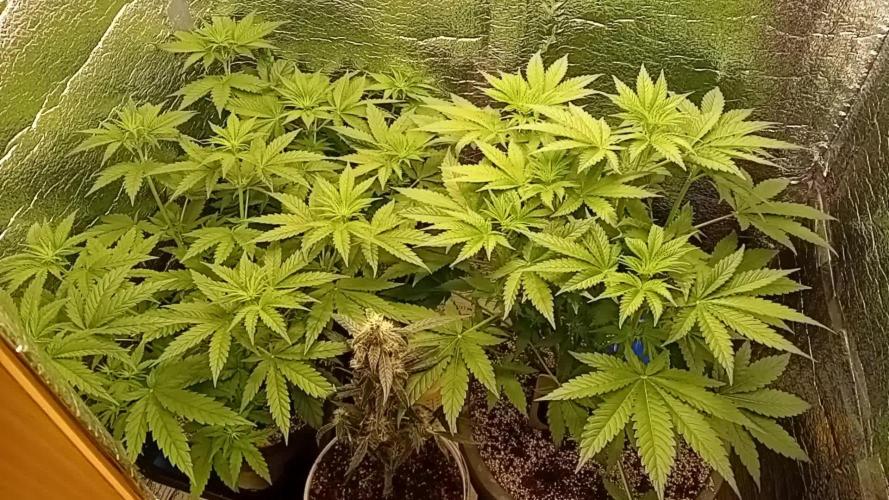
Holkám se daří dobře, vypadají zdravé a vitální, co se týče stretch,. tak vystrelili ze do 300% moc nechybi
Guano odvádí spolecne s vodou dobrou práci a v jidelnicku mame kdyztak biobizz bloom ,jestli bude potřeba tak uvidíme. .jedna z holek ukázala lehce bile spicky listu ale nesiri se to, nemění to barvu tak mam zato ze jde o projev toho ze substrat je nabitéj a chce jenom vodu ..uvidime jak to pujde dal ...
At vám to roste Hombres..Dasvidáňa :D
Likes
27
Share


@GODSGIFT_2005_JM
Follow
🥊
🍼Greenhouse Feeding BioGrow & Bio Enhancer
⛺️MARSHYDRO
The ⛺️ has a small door 🚪 on the sides which is useful for mid section groom room work. 🤩
☀️ MARSHYDRO FC 3000 LED 300W
☀️Also special thanks to VIPERSPECTRA P2000 (200W) & XS2000(240w) LED growlights
🌱 FASTBUDS 420

Processing
Likes
5
Share


@Ashbash
Follow
Slowly continuing on haha. Very light smell coming from it but i had a look at trichs and think its time to start winding down towards no nutes. Colas are not very large or dense but there are quite a few due to the topping so eager to see total weight.

Likes
5
Share


@AustinRon
Follow
TH 1Q2025 - Week 5 - Bolt 2
(ON Haze X Original Haze) X Northern Lights #2
“Todd’s Haze”
Objective
- 8 Female Plants, Topped ONCE @ Flip, 12” when topped
- Modified Sea of Green
Seeds Wet: 1139PM, 28.2.2025
Germinated: 2.3.2025
Flip: 21.3.2025
Harvest: 77 Days, DATE: 6.6.2025
Weeks Summary
- Continuing slow increase of EC & PPFD - Achieved EC: 1.8
- Allowing natural PPFD Increase (STRETCH), and providing modicum of intensity increase.
_________________________________________
__
Fri Apr 4, 2025
TH 1Q25 15:B:2:1
Light Intensity: [ 400, µMol/m2/s]
EC: [ 1.1, mS/cm]
Foliar: # 1 pt Spray Bottle @ Lights ON
- [x] CalMag Fuel: [ 2.5, ml]
- [x] Lush Green: [ 0.67, ml]
- [x] Kelpak (Auxins): [ 1, ml]
- [x] Photosynthesis Plus: [ 1.5, ml]
- [x] Quillaja 60 Powder: [scant]
- [x] Fertigation: 5:2:2:2:2:2:0
__
Sat Apr 5, 2025
TH 1Q25 16:B:2:2
EC: 1.3
- [x] EC: 1.3
- [x] Fertigation: [5.8:5.8:2.3:2.3:2.3:2.3:2.3] # [Primer A:Primer B:CalMag Fuel:Silica Skin:Lush Green:Root Anchor:Peak Bloom]
__
Sun Apr 6, 2025
TH 1Q25 17:B:2:3
- [x] EC: 1.4
Foliar: # 1 pt Spray Bottle @ Lights ON
- [x] CalMag Fuel: [ 2.5, ml]
- [x] Lush Green: [ 0.67, ml]
- [x] Kelpak (Auxins): [ 1, ml]
- [x] Photosynthesis Plus: [ 1.5, ml]
- [x] Quillaja 60 Powder: [scant]
- [x] Fertigation: [6.3:6.3:2.5:2.5:2.5:2.5:2.5] # [Primer A:Primer B:CalMag Fuel:Silica Skin:Lush Green:Root Anchor:Peak Bloom]

__
Mon Apr 7, 2025
TH 1Q25 18:B:2:4
EC: 1.5
Raised Dimmer to 77%
LightIntensity: [ 517, µMol/m2/s]
- [x] Fertigation: [6.3:6.3:2.5:2.5:2.5:2.5:2.5] # [Primer A:Primer B:CalMag Fuel:Silica Skin:Lush Green:Root Anchor:Peak Bloom]
__
Tue Apr 8, 2025
TH 1Q25 19:B:2:5
EC: 1.6
LightIntensity: [ 517, µMol/m2/s]
Foliar: # 1 pt Spray Bottle @ Lights ON
- [x] CalMag Fuel: [ 2.5, ml]
- [x] Lush Green: [ 0.67, ml]
- [x] Silica Skin: [ 2, ml]
- [x] Fertigation: [7.1:7.1:3.5:3.5:2.8:2.8:2.8] # [Primer A:Primer B:CalMag Fuel:Silica Skin:Lush Green:Root Anchor:Peak Bloom]
- [x] Terps Plus: [ 0.2, ml]
- [x] Photosynthesis Plus: [ 6, ml]
__
Wed Apr 9, 2025
TH 1Q25 20:B:2:6
Looking Relaxed, Happy, Lifted, Supple.
EC: 1.7
- [x] Fertigation: [7.1:7.1:3.5:3.5:2.8:2.8:2.8] # [Primer A:Primer B:CalMag Fuel:Silica Skin:Lush Green:Root Anchor:Peak Bloom]
- [x] Kelpak: [ 4, ml]
- [x] Photosynthesis Plus: [ 6, ml]
- [x] Terps Plus: [ 0.2, ml]
- [x] Quillaja 60 Powder: [scant]
__
Thu Apr 10, 2025
TH 1Q25 21:B:2:7
Light Distance: [ 23, in]
HOME Depot Run
- [x] Tube Insulation (Re-Fresh Chiller Insulation)
EC: 1.8 # MAX EC for GROW
Foliar: # 1 pt Spray Bottle @ Lights ON
- [x] CAL106 (Micronized Calcium Carbonate): [ 0.125, g]
- [x] Lush Green: [ 0.67, ml]
- [x] Kelpak (Auxins): [ 1, ml]
- [x] Photosynthesis Plus: [ 1.5, ml]
- [x] Quillaja 60 Powder: [scant]
- [x] Fertigation: [8:8:4.8:4.8:3.2:3.2:0.0:0.0:3.2] # [Primer A:Primer B:CalMag Fuel:Silica Skin:Lush Green:Root Anchor:Peak Bloom]
- [x] PCAL 1660: [ 0.5, gm] # Once or Twice/Week
- [x] Kelpak: [ 4, ml]
- [x] Photosynthesis Plus: [ 6, ml]
- [x] Terps Plus: [ 0.2, ml]
- [x] Quillaja 60 Powder: [scant]

Likes
4
Share


@Organic_meph_head
Follow
So I put this as flowering still since wanted to update but don’t have dry weight yet! Also never bother with wet weight so ya once dry in couple more days I’ll update harvest etc!

Likes
4
Share

@Dameon0803
Follow
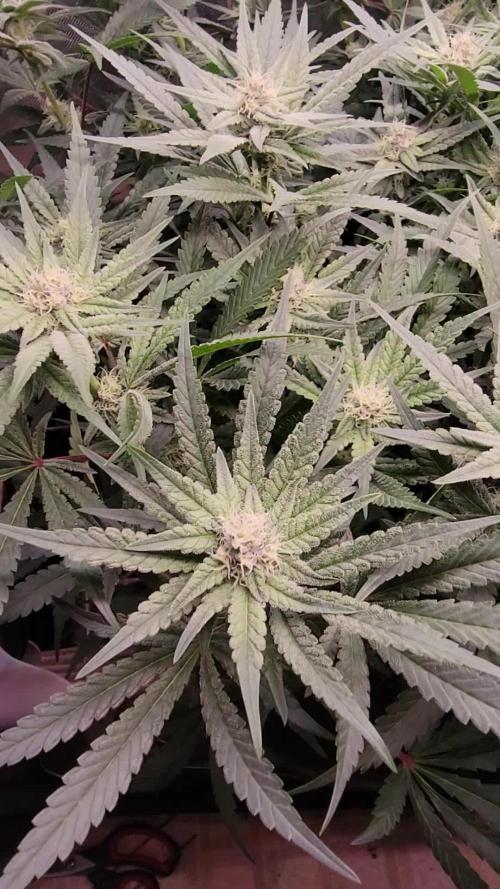
Another easy week. Bud and trichome production seem to be on point. This plant is truly maxed. She is 18 inches with about 12 inches being above the scrog screen. She stretched a little more than expected. She was supercropped in several location and didn't skip a beat. Obviously, the angle of my camera doesn't give the whole picture. But now there's some buds that can be watched in development. I'm fighting night time humidity. My little Vivosun dehumidifier can't keep up. Likely a future upgrade as I'm sure I'll struggle to get to 50% with lights on next week. Temps when my light off could ideally be lower as well. Not enough that I see the need to invest into anything like an A/C. Loving to see the little bits of purple start to come out. I'm sure lower night temps would amplify that. I did a final top dress of Build-A-Flower, an 1/8 cup of Craft Blend, and a topping of Kashi followed by a half gallon watering with the listed nutrients once at the beginning of the week.

Likes
8
Share


@biggerbud420
Follow
i feed a 50/50 mix of fox farm happy frog all purpose and fruit and flower 1 tbs per gallon of media
watered a half gallon
Likes
44
Share


@Chedderbob112
Follow
Waiting on a full plant hang dry so will wait at least two weeks maybe three hope ma vegging station holds up n can dae tge damage the now as av said guys this is definitely not the perfect set up am not on good terms with land lord so basically squatting here lol and growing and a got caught with one in this house the land lord doesn’t even know lol 😂


Processing
Likes
12
Share


@XxxAuto
Follow
Wooow.... real uplifting smoke.. very easy to grow, and extremely fast finish
👽 Test smoke at my birthday 😋BIG THICK HARD AND HEAVY BUDS !!
Likes
7
Share


@Krissci
Follow
Day 1 - LST mostly.
Will start using bloom nutrients this week.
And reduce humidity to 60-55%
Learnt from my last batch that 24hr light is best,
Likes
33
Share

@GermanGrower416
Follow
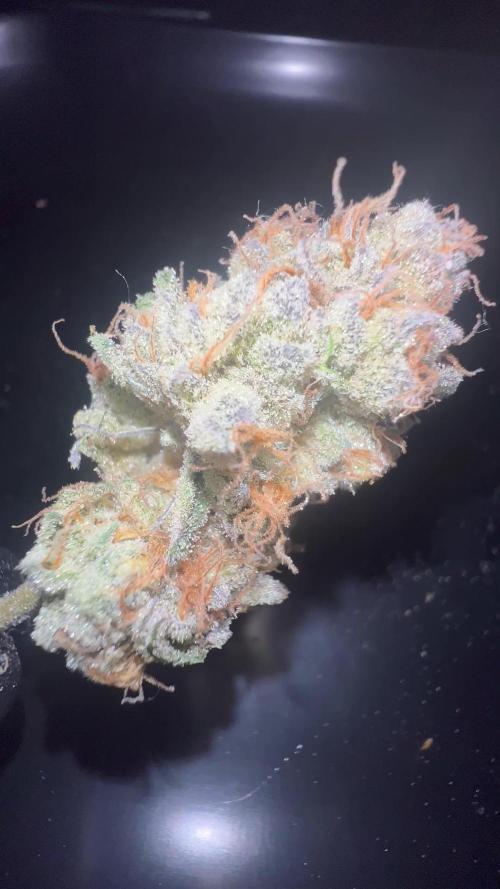
Rückblickend betrachtet hätte ich sie auch noch ein paar Tage länger stehen lassen können. Aber da ich kein Sea of Green habe werden nie alle Buds gleich reif sein.
Processing
Likes
3
Share


@babaweed
Follow
The plants grew really well by about 13 cm. I put the photo period 12/12, they're really fragrant. I provided the right nutrients every day using mycorizze


Likes
34
Share


@SalocinSpecial
Follow
D40 (31/12/2020): Second week of flower and everything is good! They are still stretching a lot. I'm not continuing LST with ties but just by tucking and banding stems and leaves. I will continue to slowly remove leaves and small bud site under canopy that will never receive enough light. The higher buds receive around 520 and 600 PPFD (40 000 to 46 000 lux) for a DLI (for 20 hours of continuous light) around 37,44 and 43,2 moles of photons which is perfect. This Glue Gelato phenotype is weird as it grows weird leaf structure since a couple of weeks. Probably since I discovers a nutrient lock in the soil with too much nutrients. Banana Kush is super healthy and look amazing! 😎
- temp: 25C
- no water
- RH: 56%
D41 (01/01/2021): They are stretching like crazy so it's a sign of good health! I fed with nutrients 3/4 of the recommended dose for transition week. I gave more then a gallon approx. 4L per plant. I did remove leaves today but no bending. I want to let them grow in height.
- temp: 25 C
- water: PH6.3, 820 PPM approx. 4L each plant
- run off: PH6.7, 1150PPM for BK ; PH6.8, 1120 PPM for GG
- RH: 54%
D42 (02/01/2021): Nothing special today. I try to turn the plant 180 degree each day to make sure fan is blowing air on every side of the pot and plant and to make sure light is distributed evenly. I also swap the two plants every 2-3 days to make sure again that the plants receive light equally. I continue removing leaves and small buds site under canopy.
- temp: 25 C
- no water
- RH: 54%
D43 (03/01/2021): The lights are now at 16 inch from the top buds and just 12h later I saw a big difference. They are now ready to receive intense light 😎. They receive approx. 650 to 780 PPFD and even 900 PPFD for the top buds (50 000 to 60 000 lux, and even 70 000 lux). I will check closely in the next days to make sure the buds and leaves are not burning. I fed only Max Minerals full recommended dose for transition week. I gave more then a gallon approx. 4L per plant. I placed a round stake in each pot for when the buds will be heavy.
- temp: 25 C
- water: PH6.3, 460 PPM approx. 4L each plant
- run off: PH6.8, 1550PPM for BK ; PH6.9, 1480 PPM for GG
- RH: 55%
D44 (04/01/2021): Nothing new today.
*** UPDATE ON BUGS: I did not see any more larvae since last week. It's the 3rd week since adding nematodes and after adding 2 pouch per plant, doing 2 insecticidal soap treatment and removing 1 inch of soil, I feel like I did control the infestation. I still see some mature fungus gnats on sticky traps but nothing alarming. Increasing air flow and reducing RH also helped a lot for those bugs.
- temp: 25 C
- no water
- RH: 55%
D45 (05/01/2021): Nothing special today. I let them grow without new LST. I did not removed leaves since a couple of days. They are growing in height and that's what I want. I might do a defoliation in beginning of week 7 (or week 3 of flowering). I want to reduce RH in the tent under 50%. When the lamps are off, I have a lot of difficulties to maintain a proper RH for flowering stage. During night, it is around 57% with the 4 inch AC Infinity inline fan blowing full speed. RH in the room where the tent is is around 35%-40%. With 5 plants in the tent (2 cannabis, 2 tomatoes and 1 mint) it will be more difficult to control RH in the next week with flower and fruit growing bigger. I ordered a small dehumidifier on Amazon to help me reduce the RH.
- temp: 25 C
- no water
- RH: 53%
D46 (06/01/2021): I fed today half of the recommended dose for transition week. The PPM of the run off from last fed was high so I want to cut a bit on nutrients. The run off of both plant is down under 900PPM which is what I wanted 👍
-temp: 25 C
- water: PH6.3, 480 PPM, approx. 3.5L each plant
- run off: PH6.9, 860PPM for BK ; PH6.9, 766PPM for GG
-RH: 52%

Likes
13
Share


@TPBzh
Follow
They are growing well and smelling good! I defoliate quite often, as it is dense in the tente. They look healthy :) all good
Likes
15
Share


@BastiFarm
Follow
3 semana de vegetación y noté una clara deficiencia en las 2 plantas (1 más que en la otra) al principio no sabia lo que podía ser, y varios cultivadores me dieron opciones, busque la composición del alimento que uso y me di cuenta que no tiene calcio y muy poco porcentaje de magnesio, aparte que estoy regando con agua purificada+ósmosis inversa, así que por conclusión es carencia de calcio y magnesio, me recomendaron calmag un alimento rico en los 2 nutrientes así que lo compraré y espero ese sea el problema,
no hay estancamiento pero si están creciendo más lento
Hoy toco riego con alimento siguiendo la tabla de green house, realicé un riego foliar con acti vera como preventivo de alguna plaga u hongo.
