Likes
Comments
Share
@Sergi0
Follow
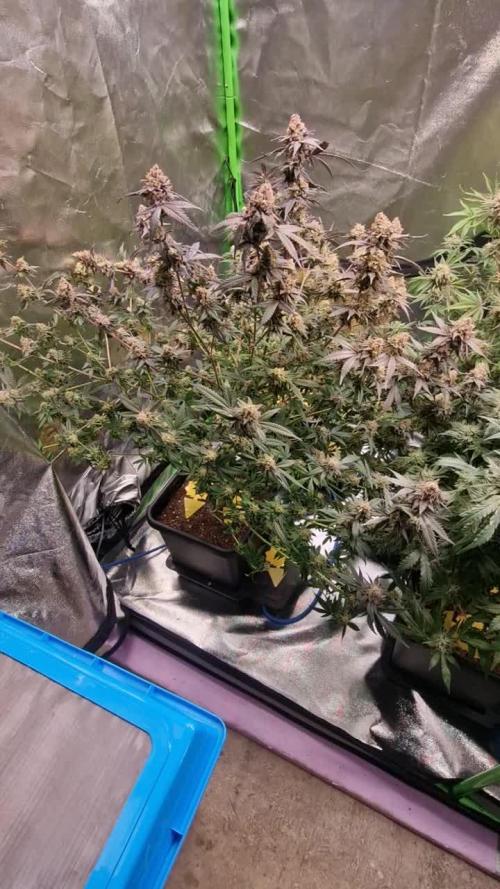
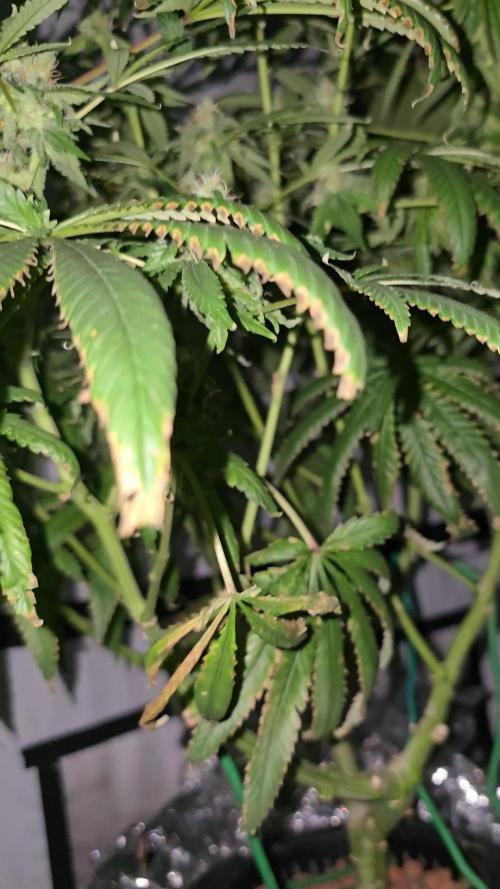
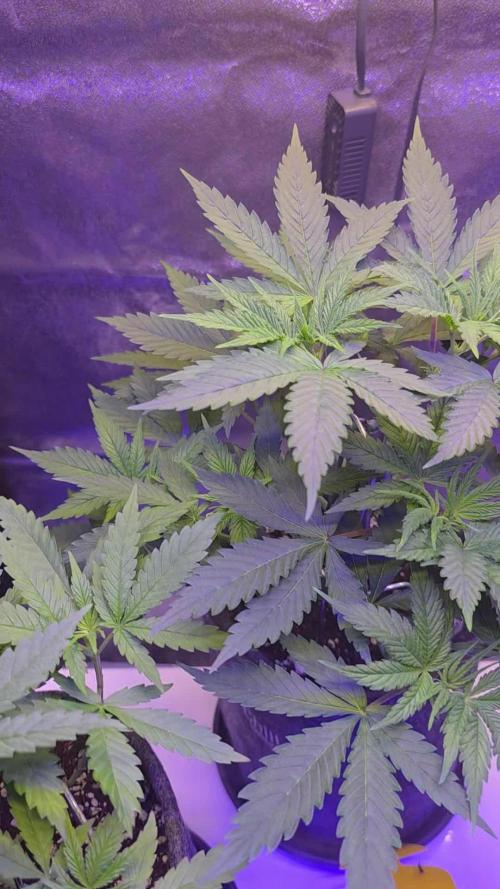
No les pude dar mucha bola esta semana, pero hoy para la foto les estuve sacando hojas amarillas, y las estoy regando con agua con vinagre nomas, seguro que la semana que viene cosecho, o quizás la siguiente si todavía no están jeje...

Likes
9
Share
Start of week 3 flower - days 29 to 4 October/November Light is at 100w and it will remain on the top of the tent for the entire grow. -------------------------------------------------------------------- 30/10/2020 - Increased the light to 115w. 4/11/2020 - Watered #2 added Bud Candy 1ml/L and Great White.
Likes
10
Share
Likes
52
Share
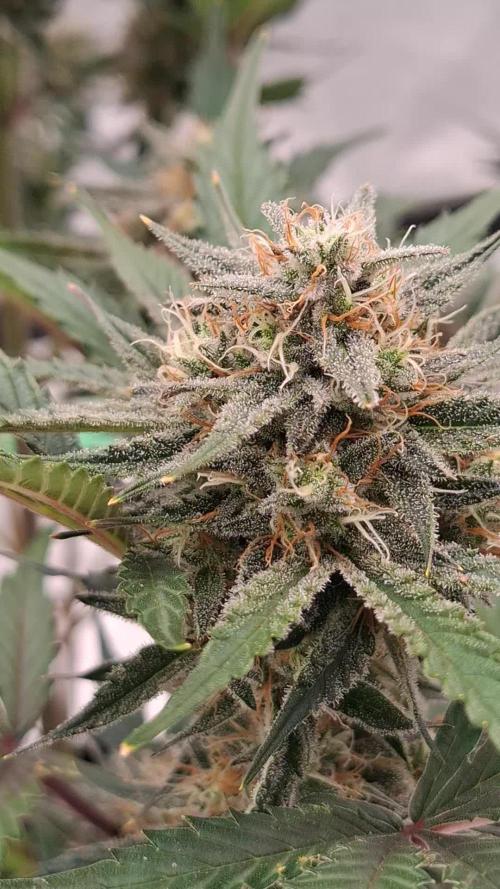
Once again she passes my expectations, late to the show with trichome production. I'm surprised there is purple on the bud, maybe Purpinator does work. I thought I could see hints under the grow lights and thought my eyes were deceiving me, I was just being hopeful. But nah 2 of the 3(under the UV) have developed a beautiful tone of purple. I was never going to bother with a deep freeze but maybe the whole bud will change given conditions, that would be something, fingers crossed. 🤔 was a little skeptical that reducing temps humidity would change density, but it does, buds are solid something I've not been able to achieve before. Rule of thumb is never to surpass 60% RH in the flowering phase and try to progressively reduce it down to 40% in the last 2–3 weeks before harvest. The plant will react as it seeks to protect its flowers, responding by producing denser buds and a higher concentration of resin. Cannabis plants are sensitive to sudden temperature changes, especially in the flowering stage. Extreme heat or cold can impact bud density and overall yields. In nature as a defense mechanism from cold, the plant sensing sudden dips in temperature will attempt to remove the pockets of air within the bud, it achieves this by compacting itself in doing so to better protect itself from cold snaps which are normally indicators in nature that worse weather is on the way. Terpene levels are the highest just before the sun comes out. Ideally, you want as many terpenes present in your plants as possible when you harvest. Cannabis plants soak up the sun during the day and produce resin and other goodies at night. The plant is at its emptiest from "harvest undesirables" so to speak right before the lights on. Boiling cannabis roots during harvesting slows down the drying process. When you boil cannabis roots, it shocks the plant, closing the stomata on the leaves. This prevents massive moisture loss through the leaves, leaving only the floral clusters actively losing moisture at a reduced pace. I've always run a strict 60/60 and it took almost twice as long to dry to a snap than previous grows where I didn't boil for what it's worth. Chlorophyll is good for the plant but not for you. When you harvest the buds, even after you flush them, if you flush them, they’re still filled with chlorophyll. Freshly cut buds are greener than dried buds because they still contain loads of chlorophyll. However, when rushed through the drying process, the buds dry but retain some chlorophyll, and when you smoke it, you will taste it. Chlorophyll-filled buds are smokable, but they aren’t clean. Slow drying gives the buds enough time and favorable conditions to lose the chlorophyll and sugars, giving you a smoother smoke. How the plant disposes of the chlorophyll and sugars by a process of chemically breaking them down and attaching the decomposed matter once small enough to water molecules which then evaporate back into the ether. Time must be given to the process to break down the chlorophyll and sugars. Think of it like optimizing the environment for decay. All the nutrients it could ever need are in abundance, it eats nutrients based on its demand for growth, which is dictated primarily by available light. Plant growth and geographic distribution (where the plant can grow) are greatly affected by the environment. If any environmental factor is less than ideal, it limits a plant's growth and/or distribution. For example, only plants adapted to limited amounts of water can live in deserts. Either directly or indirectly, most plant problems are caused by environmental stress. In some cases, poor environmental conditions (e.g., too little water) damage a plant directly. In other cases, environmental stress weakens a plant and makes it more susceptible to disease or insect attack. Environmental factors that affect plant growth include light, temperature, water, humidity, and nutrition. It's important to understand how these factors affect plant growth and development. With a basic understanding of these factors, you may be able to manipulate plants to meet your needs, whether for increased leaf, flower, or fruit production. By recognizing the roles of these factors, you'll also be better able to diagnose plant problems caused by environmental stress. Water and humidity *Most growing plants contain about 90 percent water. Water plays many roles in plants. It is:* A primary component in photosynthesis and respiration Responsible for turgor pressure in cells (Like the air in an inflated balloon, water is responsible for the fullness and firmness of plant tissue. Turgor is needed to maintain cell shape and ensure cell growth.) A solvent for minerals and carbohydrates moving through the plant Responsible for cooling leaves as it evaporates from leaf tissue during transpiration A regulator of stomatal opening and closing, thus controlling transpiration and, to some degree, photosynthesis The source of pressure to move roots through the soil The medium in which most biochemical reactions take place Relative humidity is the ratio of water vapor in the air to the amount of water the air could hold at the current temperature and pressure. Warm air can hold more water vapor than cold air. Relative humidity (RH) is expressed by the following equation: RH = water in air ÷ water air could hold (at constant temperature and pressure) The relative humidity is given as a percent. For example, if a pound of air at 75°F could hold 4 grams of water vapor, and there are only 3 grams of water in the air, then the relative humidity (RH) is: 3 ÷ 4 = 0.75 = 75% Water vapor moves from an area of high relative humidity to one of low relative humidity. The greater the difference in humidity, the faster water moves. This factor is important because the rate of water movement directly affects a plant's transpiration rate. The relative humidity in the air spaces between leaf cells approaches 100 percent. When a stoma opens, water vapor inside the leaf rushes out into the surrounding air (Figure 2), and a bubble of high humidity forms around the stoma. By saturating this small area of air, the bubble reduces the difference in relative humidity between the air spaces within the leaf and the air adjacent to the leaf. As a result, transpiration slows down. If the wind blows the humidity bubble away, however, transpiration increases. Thus, transpiration usually is at its peak on hot, dry, windy days. On the other hand, transpiration generally is quite slow when temperatures are cool, humidity is high, and there is no wind. Hot, dry conditions generally occur during the summer, which partially explains why plants wilt quickly in the summer. If a constant supply of water is not available to be absorbed by the roots and moved to the leaves, turgor pressure is lost and leaves go limp. Plant Nutrition Plant nutrition often is confused with fertilization. Plant nutrition refers to a plant's need for and use of basic chemical elements. Fertilization is the term used when these materials are added to the environment around a plant. A lot must happen before a chemical element in a fertilizer can be used by a plant. Plants need 17 elements for normal growth. Three of them--carbon, hydrogen, and oxygen--are found in air and water. The rest are found in the soil. Six soil elements are called macronutrients because they are used in relatively large amounts by plants. They are nitrogen, potassium, magnesium, calcium, phosphorus, and sulfur. Eight other soil elements are used in much smaller amounts and are called micronutrients or trace elements. They are iron, zinc, molybdenum, manganese, boron, copper, cobalt, and chlorine. They make up less than 1% of total but are none the less vital. Most of the nutrients a plant needs are dissolved in water and then absorbed by its roots. In fact, 98 percent are absorbed from the soil-water solution, and only about 2 percent are actually extracted from soil particles. Fertilizers Fertilizers are materials containing plant nutrients that are added to the environment around a plant. Generally, they are added to the water or soil, but some can be sprayed on leaves. This method is called foliar fertilization. It should be done carefully with a dilute solution because a high fertilizer concentration can injure leaf cells. The nutrient, however, does need to pass through the thin layer of wax (cutin) on the leaf surface. It is to be noted applying a immobile nutrient via foliar application it will remain immobile within the leaf it was absorbed through. Fertilizers are not plant food! Plants produce their own food from water, carbon dioxide, and solar energy through photosynthesis. This food (sugars and carbohydrates) is combined with plant nutrients to produce proteins, enzymes, vitamins, and other elements essential to growth. Nutrient absorption Anything that reduces or stops sugar production in leaves can lower nutrient absorption. Thus, if a plant is under stress because of low light or extreme temperatures, nutrient deficiency may develop. A plant's developmental stage or rate of growth also may affect the amount of nutrients absorbed. Many plants have a rest (dormant) period during part of the year. During this time, few nutrients are absorbed. Plants also may absorb different nutrients as flower buds begin to develop than they do during periods of rapid vegetative growth. 432 Hz is said to be mathematically consistent with the patterns of the universe. Studies reveal that 432 Hz tuning vibrates with the universe’s golden mean PHI and unifies the properties of light, time, space, matter, gravity and magnetism with biology, the DNA code and consciousness. When our atoms and DNA start to resonate in harmony with the spiraling pattern of nature, our sense of connection to nature is said to be magnified. Another interesting factor to consider is that the A=432 Hz tuning correlates with the color spectrum while the A=440 Hz is off. Audiophiles have also stated that A = 432 Hz music seems to be non-local and can fill an entire room, whereas A=440 Hz can be perceived as directional or linear in sound propagation. Once you adopt the idea that sound (or vibration in general) can have an equalizing and harmonizing effect (as well as a disturbing effect), the science of harmony can be applied to bring greater harmony into ones life or a tune to specific energies. There is a form of absolute and of relative harmony. Absolute harmony can for example be determined by the tuning of an instrument. The ancients tuned their instruments at an A of 432 Hz instead of 440 Hz - and for a good reason. There are plenty of music examples on the internet that you can listen to in order to establish the difference for yourself. Attuning the instrument to 432 Hz results in a more relaxing sound, while 440 Hz slightly tenses up to body. This is because 440 Hz is out of tune with both macro and micro cosmos. On the contrary, 432 Hz is in tune. To give an example of how this is manifested micro cosmically: our breath (0,3 Hz) and our pulse (1,2 Hz) relate to the frequency of the lower octave of an A of 432 Hz (108 Hz) as 1:360 and 1:90. It is interesting to note that 432 Hz was the standard pitch of many old instruments, and that it was only recently (19th and 20th century) the standard pitch was increased. This was done in order to be able to play for bigger audiences. Bigger audiences (more bodies) absorb more of the lower frequencies, so the higher pitch was more likely to “cut through”. One of the oldest instruments of the world is the bell ensemble of Yi Zeng (dated 423 BC), tuned to a standard F4 of 345 Hz which gives an A= 432 Hz. The frequency of 345 Hz is that of the platonic year! Similarly many old organs are tuned in an A=432 as well; for example: St. Peter’s Capella Gregoriana, St. Peter’s Capella Giulia, S. Maria Maggiore in Rome. Maria Renold’s book “Intervals Scales Tones and the Concert Pitch C=128 Hz” claims conclusive evidence that 440 Hz and raising concert pitch above scientific “C” Prime=128 Hz (Concert A=432 Hz) disassociates the connection of consciousness to the body and creates anti-social conditions in humanity. The difference between concert pitch A=440 Hz and Concert A=432 Hz is only 8 cycles per second, but it is a perceptible difference of awareness in the human consciousness experience of the dream we share called existence.
Likes
18
Share
700ppm ff before 3ml of calmag. City water /bubbler. Ph 6.4-6.7. Silica (0-0-1) on water only day 5-7ml per. Feed x2 x w. Water or water cal/mag 3-4 ml/gal only l, 1-2 x w when needed.
Likes
15
Share
First experience, low budget set up, poor product as expected i wanted to try and flavor profile was nice, produce a sleepy effect as i intended but buds are not hard or dense, as i expected…
Likes
2
Share
Semaine 6 – Transition Floraison : Pistils et Défis Nutritionnels Jour 35–41 (17 avril – 23 mai) La semaine 6 marque officiellement l’entrée en floraison. Gorilla Cookies a ouvert le bal avec ses premiers pistils la semaine passée, suivie par Toof Decay. Les autres génétiques (Mephisto’s Wedding, Hubbabubbasmelloscope) montrent des signes avant-coureurs de floraison. L’environnement reste stable : 24–25°C, RH 62–64%, VPD 1.17–1.21 kPa, conditions proches de l’idéal. Nutrition et PPM Transition vers Bud Ignitor (1 ml/L) et maintien du GMB 1:1:1 à 1.5 ml/L. Cal/Mag augmenté à 2 ml/L. = ~570–610 ppm réels. Problèmes identifiés Carence en Cal/Mag sur Hubbabubbasmelloscope et Gorilla Cookies (chlorose interveinal, feuillage jaune). Traitement direct : 2–3 ml/L Cal/Mag appliqué par pot. Réaction positive après 3–4 jours. Observation critique : les 4 plants en AutoPot (AQUAValve 5.0) montrent 2x moins de vigueur que les 3 plants en bases AC Infinity avec les pots en tissus. Hypothèse : le système AQUAValve maintient le substrat trop humide en continu, tandis que les bases AC Infinity crée une meilleure oxygénation. Aussi, c'est seulement sur les auto pots que j'ai observé des carences, peut-être dû à un blocage nutritionnel. À évaluer pour les futures canopées. Lumière et PPFD IF500 (500w) + Mars Hydro 500w maintiennent 660–700 µmol. Pas de stress lumineux, feuillage bien coloré (sauf carence identifiée). Statut réservoir 47L, 15L pots coco 100%. Consommation d’eau stable. Changement complet prévu mi-floraison. Prochaine semaine : suivi de la carence corrigée, ajustement graduel du calendrier nutritionnel Advanced Nutrients pour la phase de développement floral. Tent: 4x8 Gorilla | AC Infinity 69 Pro + Pulse One | 20/4 | 7 plants autoflower | Jour 35 COMPTE RENDU TECHNIQUE — RUN INTÉRIEURE #1 2026 Problème AutoPot et Solution Date du diagnostic :24 mai 2026 (Jour 37) Système : AutoPot 4-pot, AQUAValve 5.0, réservoir 47L Génétiques affectées : Hubbabubbasmelloscope (1), Gorilla Cookies (1) PROBLÈME IDENTIFIÉ Symptômes observés - Décoloration inter-nervures (jaunissement) sur feuilles supérieures - Diagnostic initial : carence en calcium/magnésium (Cal/Mag) - Plantes : Hubbabubbasmelloscope #1 & #2, Gorilla Cookies Prélèvement d’eau au fond des pots AutoPot(jour 37) a révélé : - pH : 6.8(hors cible 5.8–6.2 pour coco) - Eau stagnante depuis activation AutoPot (jour 17 = 20 jours) Analyse de la stagnation 1. Timing AutoPot précoce→ Plantes jeunes, consommation faible 2. Eau restante dans les pots → Contact prolongé avec air dômes 3. Air dômes + coco neuve → Oxydation progressive, dérive pH vers alcalin 5. pH 6.8 en coco→ Blocage d’absorption de Cal/Mg (disponibilité réduite de 40–50%) Résultat : Symptômes de carence alors que les nutriments étaient présents = blocage nutritionnel, pas déficience réelle SOLUTION APPLIQUÉE Étape 1 : Correction immédiate (24 mai) - Prélèvement eau au fond des 4 pots AutoPot - Pompage progressif jusqu’à pH 5.8 - Volume pompé : ~1-2 L par pot (estimation) - Nouveau pH : 5.8 stabilisé Étape 2 : Traitement localisé (jours 20–24) - Application directe Cal/Mag : 2–3 ml/Lpar pot (non-réservoir) Top wathering - Appliqué sur : Hubbabubbasmelloscope Mephisto, Gorilla Cookies Fast Bud - Méthode : versement manuel aux racines - Fréquence : 2 applications espacées de 3–4 jours Étape 3 : Maintenance réservoir - PPM réservoir principal : maintenu 400–420 ppm (Hanna HI98301, scale 500) - Note calibration : Vrai PPM = lecture × 1.4 = ~560–588 ppm - Cal/Mag réservoir : maintenu à 2 ml/L - pH réservoir : vérification quotidienne post-correction Étape 4 : Surveillance continue - Routine hebdomadaire établie : Prélèvement fond pots, vérif pH - Objectif : Détecter remontée pH avant accumulation - Seuil intervention : pH 6.2 = pompage correctif RÉSULTATS & OBSERVATIONS Court terme (5–7 jours post-correction) - Pistillage accéléré visible sur Gorilla Cookies (confirmé jour 37) - Décoloration n’a pas progressé → blocage levé - Plants Mephisto’s Wedding : vigueur stable (10% affectés) - Toof Decay : vigueur stable (10% affectés) Comparaison système Observation importante : Plants en bases tissu AC Infinity (manual feed via bleed valve) montraient plus de vigueur que plants AutoPot - Raison probable : Cycle humide/sec régulier vs eau stationnaire - Implication : AutoPot inadapté pour timing de croissance lente initiale LEÇONS APPRISES Sur le système AutoPot 1. Activation tardive recommandée→ Jour 25–30, pas jour 17 1. Monitoring pH hebdo obligatoire → Coco + air dômes = dérive pH naturelle 1. Eau stagnante = problème→ Même avec nutriments corrects, pH alcalin = blocage Sur la coco neuve - Nécessite ajustement pH plus fréquent en début - Se stabilise après 3–4 semaines d’utilisation - Minéraux s’accumulent lentement → nettoyage hebdo bénéfique Choix système pour Run #3 AutoPot déclassé pour prochaines runs - Passage à : 8× bases AC Infinity + 8× flottes automatiques individuelles - Avantage : drainage régulier, pas de stagnation, PPM/pH plus stables - Setup réel : coco/Bio-Urbain, 5 gallons, 75L réservoir centralisé DONNÉES COMPLÈTES CONCLUSION Problème :Eau stagnante + pH alcalin = blocage nutritionnel (pas déficience) Solution : Correction pH + Cal/Mag localisé + routine hebdo de monitoring Statut : Résolu, plants en rétablissement, early flower progression normale Impact rendement : Minimal — correction avant dégâts sévères
Likes
22
Share
------=======😎👹👺👌12/05/2023 YOOOOO UPDATE GANG!!!!!!!!!! WEEK 13 IN FULL EFFECT GROMIE LFG!!!!!!!!👌👺👹😎=======------ --------------------------------------------------------------------------------------------------------------------------------------------------------------------================================================================================================== 👹👽👺***12/05/2023 10:44 AM DAY 85***---YOO WHATS BRACKIN GD FAM!!! THOUGHT I'D STOP BY N' GIVE YALL AN UPDATE FROM THIS LAST WEEK OF WORK!!!!! SO I DID A FEEDING SUNDAY NIGHT, 1.2 GAL FEEDING TO BE EXACT SPLIT BETWEEN INTERVALS OF 15 MINS TO HELP PROPER ABSORPTION PH'D TO 6.3, ONLY DID A 20/20/40 FEEDING OF NUTRIENTS, NEXT FEEDING WILL ONLY BE JUST WATER AS MENTIONED BEFORE, BUT OTHER THEN THAT SHE'S LOOKING GREAT SMELLS AMAZING LITERALLY LIKE RUBBING GRAPE SKIN TOGETHER IN UR FINGER TIPS HAHA REALLY AMAZING STUFF, GOING TO GET HER READY FOR NEXT WEEK AND THEN THE CHOP PROCESS BEGINS!!!!!!!!!!!!!!!!!! STAY WELL GROMIES AND STAY TUNED!!!!! THANKS FOR STOPPING BYYY!!!! STAY UP!!!!!!👽👌👺👹😎 --------------------------------------------------------------------------------------------------------------------------------------------------------------------================================================================================================== 👹👽👺***12/07/2023 10:44 AM DAY 87***---YOO WHATS BRACKIN GD FAM!!! THOUGHT I'D STOP BY N' GIVE YALL AN UPDATE====-------**** ----------------------------------------------------------------------------------------------------------------------------------------------------------------------- FLUSH HAS BEGUNNN!!!! SO LAST NIGHT I DID THE FIRST FLUSH IN THE BATH TUB WITH 6.3-6.5 PH ADJUSTED DISTILLED WATER, AND USED ABOUT 2 GALLONS OR SO TO FLUSH PROBABLY ABOUT 2.3 GALLONS, WAITED 30 MINUTES BETWEEN EACH WASH, DEFINETLEY SAW ALOT OF STUFF COMING OUT OF THE BOTTOM BUT I WILL CHECK AGAIN 2MARO NIGHT AND SO THANKS GUYS!!! ALLLLSOOOOo!!!!!!!!!!!!!!!!!!!!!!!!!!! YOOOOOO GO CHECK OUT THE NEWEST VIDEO QUALITY IS AMAZINGGG!!!!!!!!!!!!!!!!!!!
Likes
4
Share
@Ryno1990
Follow
All these beautiful girls are going thre flush now getting ready to harvest up they are all very resiny an covered in trichromes all the nugs are nice an dense an are smelling amazing can't wait to be able to dry an start curing them
Likes
22
Share
I’ve added VPD to my dashboard and have now dialed in my climate for a perfect VPD. Home assitant dashboard controlling lamp, up/down humidity and cooling. Exhaust is going to be used to scrub the air and back into the tent. After adding C02 I’m now doing a sealed grow to take better control of the environment. I was dealing with high temps I put a evaporative cooler just in case if I need to up the humidity or lower the temps.
Processing
Likes
11
Share
Plant has shown slow but healthy growth since its arrival, LST continues and I've managed to keep the plant at the same height it was last week but now at a horizontal angle. I did up the nutes for one feed to a slightly under recommended dose but in the days following I noticed the plant looking a little 'droopy' and since she has been with me she hasnt been drinking very well so I opted to flush her for a feed, since then she has seemed very happy :) whilst drinking much better (possible nute lock was imminent). Now back down to half doseages with the exception of CalMg (to help after flush) but will be increasing them in the following days. As of next week I will be transferring her and another plant my partner is nurturing into single bucket DWC set ups. Fingers crossed I will see some hearty results for making the crossover to hydro.
Likes
59
Share
@Mastr
Follow
No much to do this week just keep do lst for bigger yield
Likes
2
Share
D3: refill with fresh flowering mix Out&In: 6.7ph 1.6ec First visible trichoms D4: she’s back at 124cm with main stem only 10cm from lamp. I think without HST she’d be 150cm now D5: magnesium deficiency-adding magnesium sulphate D7: seems like stopped stretching, focus on buds
Likes
3
Share
@P_Silas
Follow
Season 2 is officially underway and so excited for this grow. Growing 4 plants, but space is a lil limited. Growing in an 80x80cm so using small pots. 2x 8l and then 1x 5l and 1x 4.7l (if you wanna be exact lol). This time I decided to experiment a bit. I'm testing 2 different soils, both in 8l pots, both Purple Punch Auto by Fastbuds, both in airpots. Their names are Lily and Robin. Also testing fabric bags against airpots. Both in same soil, both in 5l pots, both Wild Dwarf Auto by Bulk Seed Bank (that was the plan but now it's 1 WD and another Purple Punch). Their names are Jess and Cece. For this one, Jess, had the seed in water for a few hours and then into soil in 5l fabric pot. The seed shell was holding on for its life when it popped up and I had to give it some motivation so hopefully she recovers well.
Likes
9
Share
Welcome to Flower Week 1 of Divine Seeds Auto Fractal I'm excited to share my grow journey with you all as part of the Divine Seeds Autoflowering Competition 2025. It's going to be an incredible ride, full of learning, growing, and connecting with fellow growers from all around the world! For this competition, I’ve chosen the Feminized Automatic strain: Auto Fractal Here’s what I’m working with: • 🌱 Tent: 120x60x80 • 🧑‍🌾 Breeder Company: Divine Seeds • 💧 Humidity Range: 50 • ⏳ Flowering Time: 60 Days • Strain Info: 23%THC • 🌡️ Temperature: 26 • 🍵 Pot Size: 0.5l • Nutrient Brand: Narcos • ⚡ Lights : 200W x 2 A huge thank you to Divine Seeds for allowing me to be a part of this amazing competition and Sponsoring the Strains. Big thanks for supporting the grower community worldwide! Your genetics and passion speak for themselves! I would truly appreciate every bit of feedback, help, questions, or discussions – and of course, your likes and interactions mean the world to me as I try to stand out in this exciting competition! Let’s grow together – and don’t forget to stop by again to see the latest updates! Happy growing! Stay lifted and stay curious! Peace & Buds!
Processing
Likes
7
Share
@x_grower
Follow
Last week the plants grew looking very healthy although I still have a feeling the low humidity is slowing their growth, by the end of the first week I started raising the EC to make the increasing for this week smoother, run-off EC is substantially increasing so I will start to fertigate them twice a day for this week.