


@MistaOC
Follow
**************
13.03. Day 1
**************
🤞🏼😎
I have new cuttings. Sour Frootz from Karma Genetics. I planted the cuttings in 0.2 L pots. I only applied fertilizer to the large pot.
So Let’s grow again 💚💯
*******************************************
18.03. Day 6
sprinkled with bactrex and transferred into the large pots
*******************************************


@Mission420
Follow
This was the first week with no nutes, just straight out of the tap water. I also upped the watering schedule to 3 times per day for 1 min each. I am thinking after watching this weeks timelapse that I will run the pump for 2 means on the parts of the schedule that the lights are on and see if that helps any.
I also noticed that 1 of my plants, the one with the bigger buds and more crystals seems to be having its leaves turning yellow which I have tried to show in the last picture above. I believe it is because I have stopped feeding any nutrients and so now it is sucking what it can from the leaves. The other plants, especially my featured one do not seem to be doing this as of yet.
I was hoping my closeup star of this diary, which happens to also be the tallest stem of the girls would also show the most growth, but as such, not much can seen to be happening. 1 more week to go before I cut and hang them to harvest and I will let you know how things turned out weight wise.



@RevvshiWoW
Follow
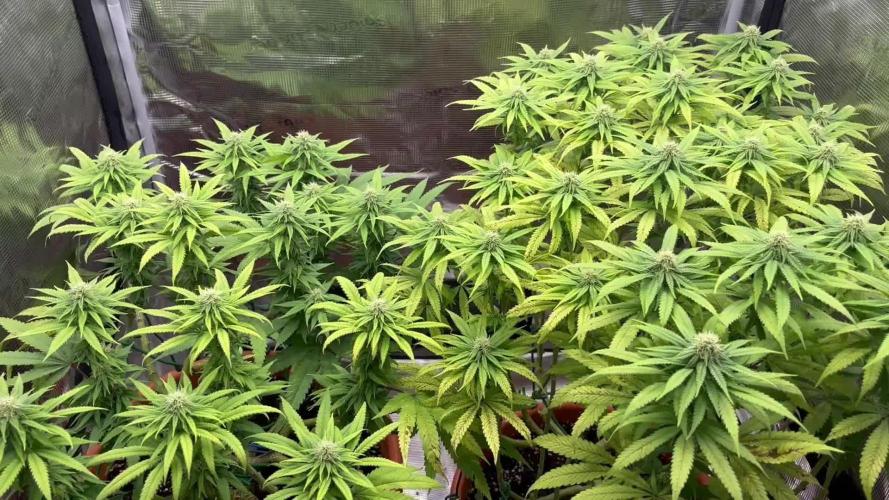
Week 3 of flowering is now complete, and I’m very happy with how the buds are looking so far – there’s definitely some real potential here! The next topdress will take place next Friday, marking the start of week 5.
I’m currently dealing with quite high temperatures, reaching up to 30°C at times, but the humidity is holding steady at around 60%, which is helping to keep things in balance.


@Ultraviolet
Follow
Green light is radiation with wavelengths between 520 and 560 nm and it affects photosynthesis, plant height, and flowering. Plants reflect green light and this is why they appear green to our eyes. As a result, some growers think that plants don’t use green wavelengths, but they actually do!
In fact, only around 5 – 10% of green light is reflected from leaves and the rest (90 – 95 %) is absorbed or transmitted to lower leaves [1].
Green wavelengths get used in photosynthesis. Chlorophyll pigments absorb small amounts of green wavelengths. Light that doesn’t get absorbed is transmitted to leaves that are shaded out from direct light. This means that leaves at the bottom of the canopy get more green light than leaves at the top. A high proportion of green wavelengths compared to other colors tells lower leaves that they are being shaded out, so they are able to react accordingly. Lower leaves may react by opening or closing their stomata or growing longer stems that help the leaves reach brighter light [1, 2, 3].
When it comes to growing cannabis, many cultivators are interested in the quality of light used for the flowering stage. In many plants, flowering is regulated by two main photoreceptors: cryptochrome and phytochrome. Both photoreceptors primarily respond to blue light but can also respond to green, although to a lesser extent. Green can accelerate the start of flowering in several species (although cannabis has yet to be tested) [1, 4, 5]. However, once flowering has begun, it’s important to provide plants with a “full spectrum” light that has high amounts of blue and red light, and moderate amounts of green, in order for photosynthesis to be optimized.
Green light mediates seed germination in some species. Seeds use green wavelengths to decide whether the environment is good for germination. Shade environments are enriched in green relative to red and blue light, so a plant can tell if it is shady or sunny. A seed that senses a shaded environment may stay dormant to avoid poor growing conditions [1]. Some examples of plant species where researchers have documented this response are: ryegrass (a grass that grows in tufts) and Chondrilla (a plant related to dandelion) [1, 6].
Although green wavelengths generally tell plants NOT to germinate, there are some exceptions! Surprisingly, green wavelengths can stimulate seed germination in some species like Aeschynomene, Tephrosia, Solidago, Cyrtopodium, and Atriplex [1, 6, 7].
Of course, light is not the only factor affecting seed germination – it’s a combination of many factors, such as soil moisture, soil type, temperature, photoperiod, and light quality.
When combined with red and blue light, green can really enhance plant growth [1, 8]. However, too much green light (more than 50% of the total light) can actually reduce plant growth [8]. Based on the most current research, the ideal ratio of green, red, and blue light is thought to be around 1:2:1 for green:blue:red [9]. When choosing a horticultural light, choose one that has high amounts of blue and red light and moderate amounts of green and other colors of light.
Not many studies can be found about the effect of green light on cannabis growth or metabolism. However, if one reads carefully, there are clues and data available even from the very early papers.
Mahlberg and Hemphill (1983) used colored filters in their study to alter the sunlight spectrum and study green light among others. They concluded that the green filter, which makes the environment green by cutting other wavelengths out, reduced the THC concentration significantly compared to the daylight control treatment. It has been demonstrated that green color can reduce secondary metabolite activity with other species as well. For example, the addition of green to a light spectrum decreases anthocyanin concentration in lettuce (Zhang and Folta 2012).
If green light only reverses the biosynthesis of some secondary metabolites, then why put green light into a growth spectrum at all? Well, there are a couple of good reasons. One is that green penetrates leaf layers effectively. Conversely red and blue light is almost completely absorbed by the first leaf layer.
Green travels through the first, second, and even third layers effectively (Figure 2). Lower leaf layers can utilize green light in photosynthesis and therefore produce yields as well.
Even though a green light-specific photoreceptor has not yet been found, it is known that green light has effects independent from the cryptochrome but then again, also cryptochrome-dependent ones, just like blue light. It is known that green light in low light intensity conditions can enhance far red stimulating secondary metabolite production in microgreens and then again, counteracts the production of these compounds in high-intensity light conditions (Kim et al. 2004). In many cases, green light promoted physiological changes in plants that are opposite to the actions of blue light. In the study by Kim et al. blue light-induced anthocyanin accumulation was inhibited by green light. In another study it has been found that blue light promotes stomatal opening whereas green light promotes stomatal closure (Frechilla et al. 2000). Blue light inhibits the early stem elongation in the seedling stage whereas green light promotes it (Folta 2004). Also, blue light results in flowering induction, and green light inhibits it (Banerjee et al., 2007). As you can see, green light works very closely with blue light, and therefore not only the amount of these two wavelengths separately is important but also the ratio (Blue: Green) between these two in the designed spectrum. Furthermore, green light has been found to affect the elongation of petioles and upward leaf reorientation with the model plant Arabidopsis thaliana both of which are a sign of shade avoidance symptoms (Zhang et al. 2011) and also gene expression in the same plant (Dhingra et al. 2006).
As mentioned before, green light produces shade avoidance symptoms which are quite intuitive if you consider the natural conditions where the plants grow. Not all the green light is reflected from the highest canopy leaves in nature but a lot of it (50-90%) has been estimated to penetrate the upper leaves at the plant level ((Terashima et al., 2009; Nishio, 2000). For the plant growing in the understory of the forest green light is a signal for the plant of being in the shade of a bigger plant. Then again, the plants growing under unobstructed sunlight can take advantage of the green photons that can more easily penetrate the upper leaves than the red and blue photons. From the photosynthetic pigments in higher plants, chlorophyll is crucial for plant growth. Dissolved chlorophyll and absorb maximally in the red (λ600–700 nm) and blue (λ400–500 nm) regions of the spectrum and not as easily in the green (λ500–600 nm) regions. Up to 80% of all green light is thought to be transmitted through the chloroplast (Terashima et al., 2009) and this allows more green photons to pass deeper into the leaf mesophyll layer than red and blue photons. When the green light is scattered in the vertical leaf profile its journey is lengthened and therefore photons have a higher chance of hitting and being absorbed by chloroplasts on their passage through the leaf to the lower leaves of the plant.
Photons of PPFD (photosynthetic photon flux density) are captured by chlorophyll causing an excitation of an electron to enter a higher energy state in which the energy is immediately passed on to the neighboring chlorophyll molecule by resonance transfer or released to the electron transport chain (PSII and PSI). Despite the low extinction coefficient of chlorophyll in the green 500–600 nm region it needs to be noted that the absorbance can be significant if the pigment (chlorophyll) concentration in the leaf is high enough.
The research available clearly shows that plants use green wavelengths to promote higher biomass and yield (photosynthetic activity), and that it is a crucial signal for long-term developmental and short-term dynamic acclimation (Blue:Green ratio) to the environment. It should not be dismissed but studied more because it brings more opportunities to control plant gene expression and physiology in plant production.
REFERENCES
Banerjee R., Schleicher E., Meier S. Viana R. M., Pokorny R., Ahmad M., Bittl R., Batschauer. 2007. The signaling state of Arabidopsis cryptochrome 2 contains flavin semiquinone. The Journal of Biological Chemistry 282, 14916–14922.
Dhingra, A., Bies, D. H., Lehner, K. R., and Folta, K. M. 2006. Green light adjusts the plastic transcriptome during early photomorphogenic development. Plant Physiol. 142, 1256-1266.
Folta, K. M. 2004. Green light stimulates early stem elongation, antagonizing light-mediated growth inhibition. Plant Physiol. 135, 1407-1416.
Frechilla, S., Talbott, L. D., Bogomolmi, R. A., and Zeiger, E. 2000. Reversal of blue light -stimulated stomatal opening by green light. Plant Cell Physiol. 41, 171-176.
Kim, H.H., Goins, G. D., Wheeler, R. M., and Sager, J. C. 2004.Green-light supplementation for enhanced lettuce growth under red- and blue-light emitting diodes. HortScience 39, 1617-1622.
Nishio, J.N. 2000. Why are higher plants green? Evolution of the higher plant photosynthetic pigment complement. Plant Cell and Environment 23, 539–548.
Terashima I., Fujita T., Inoue T., Chow W.S., Oguchi R. 2009. Green light drives leaf photosynthesis more efficiently than red light in strong white light: revisiting the enigmatic question of why leaves are green. Plant & Cell Physiology 50, 684–697.
Zhang, T., Maruhnich, S. A., and Folta, K. M. 2011. Green light induces shade avoidance symptoms. Plant Physiol. 157, 1528-156.
Wang, Y. & Folta, K. M. Contributions of green light to plant growth and development. Am. J. Bot. 100, 70–78 (2013).
Zhang, T. & Folta, K. M. Green light signaling and adaptive response. Plant Signal. Behav. 7, 75–78 (2012).
Johkan, M. et al. Blue light-emitting diode light irradiation of seedlings improves seedling quality and growth after transplanting in red leaf lettuce. HortScience 45, 1809–1814 (2010).
Kasajima, S., et al. Effect of Light Quality on Developmental Rate of Wheat under Continuous Light at a Constant Temperature. Plant Prod. Sci. 10, 286–291 (2007).
Banerjee, R. et al. The signaling state of Arabidopsis cryptochrome 2 contains flavin semiquinone. J. Biol. Chem. 282, 14916–14922 (2007).
Goggin, D. E. & Steadman, K. J. Blue and green are frequently seen: responses of seeds to short- and mid-wavelength light. Seed Sci. Res. 22, 27–35 (2012).
Mandák, B. & Pyšek, P. The effects of light quality, nitrate concentration and presence of bracteoles on germination of different fruit types in the heterocarpous Atriplex sagittata. J. Ecol. 89, 149–158 (2001).
Darko, E. et al. Photosynthesis under artificial light: the shift in primary and secondary metabolism. Philos. Trans. R. Soc. B Biol. Sci. 369 (2014).
Lu, N. et al. Effects of Supplemental Lighting with Light-Emitting Diodes (LEDs) on Tomato Yield and Quality of Single-Truss Tomato Plants Grown at High Planting Density. Environ. Control Biol. 50, 63–74 (2012).


@Therbalist
Follow
After strength training and taking a cutting off the tall one to the left, all plants are at 90cm. I also removed the two lowest branches for cuttings.
The two on the right have much less of a Sativa shaped leaf and also grew very quickly even in the rain and thunderstorms!
All seem to have recovered from strength training and growing vigorously!


@xbrico
Follow
D85/FD57 - Should probably put this week down as a "Harvest Week" but hopefully some more to save, even though it will be smaller stuff - right now with the dead loss, everything counts! Really sad too as the plant was looking great!!! Some nice pink flowers in there, just a real pity about its mold resistance!!! :/ Would maybe consider this one more time for a grow when I get the new extraction in but yeah, disappointed is not the word! On the plus side, tent humidity has dropped a fair bit!!!
With the work last night culling the Cookies, I was lazy tonight, just did an add back (Didnt clean the Wilma out like I do every week). Put in at normal ratio's but as the base water was EC0.7 (Rather than 0.2), the same recipe took me up to 1.5 (I should have adjusted but seeing as I dont know whats out, i'd rather give enough of whats needed and just dilute through the week (even if daily!!!). Expecting water consumption to drop now with the cookies halved in size and now just waiting on the rest ripening! Lets hope this is the last pain til I get this tent emptied out and cleaned down for a winter run!!!
Anyway, happy growing all!!! 💪


@xXTazfamilyXx
Follow
Just perfect harvest thanks to Platinium for their great fertilizer and to barney's farm for this strain that I recommend a just incredible taste🤤🤤🙏


@Tropicannibis_Todd
Follow
Start of day 21 ..... Oct 30
Check out the full grow video on latest weekly update
Exceptional Growth
Started LST ON day 19 , re-adjusting daily ... and leaf tucking daily ....
Water Only when needed and adjusting lights when needed.......
Rain Water Only !!!!!!
Sidenote : Being that it's my first autoflower and being a spong and learning, I am impressed so far at the stage growths however a little surprised at NL 2 showing Pre-flowers already on day 21 ,and NL 1 decided to show her pre-flowers on day 26 , super happy with the grow so far,
Truly Love it !!!!!!!



@Borberad
Follow
Woche 9
Sie wird weiter von innen möglichst Blattfrei gehalten um eine gute Durchlüftung zu gewährleisten. Solange gesamte kommt die Blüte richtig in Gang.
Tag 58. Ganz schön durstig die Gute. Heute gab's 4l und trotzdem fast kein Drain. Müssen wohl die Wassermenge erhöhen.
Tag 61 Wir haben sie nochmal etwas auseinandergezogen. So breit gezogen, braucht sie das Zelt fast für sich allein. Morgen wird sie sich nach oben gestreckt haben, dann passt es wieder.


@AsNoriu
Follow
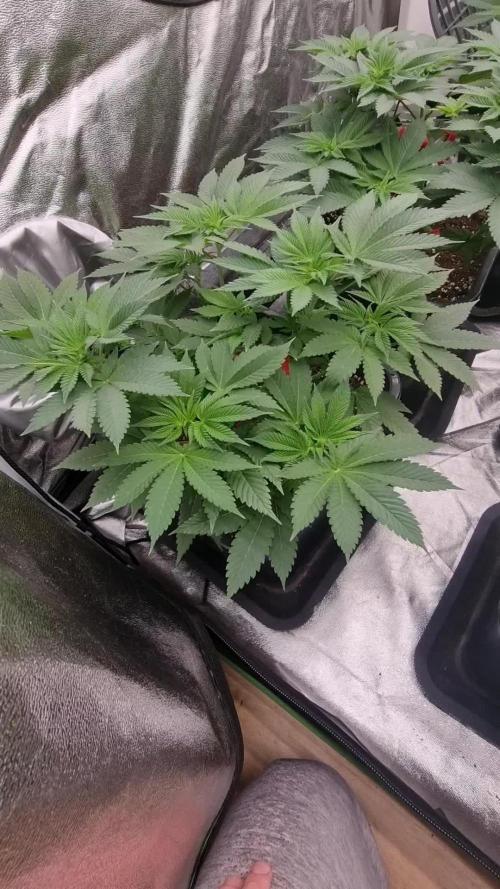
Day 65. Heavy training in progress ...
All done, hopefully not many natural protectors lost, took about 30 liters bag full off leaves and shoots, could do like 100 clones easy ;)))
All girls lolitoped, cleared, defoliated, rewired, some had supercroping.
Skunks were happy when last Cheese was done, so i think/hope - all will go smooth.
This time i really cleared them a lot, maybe the most in my career ...
Cheeses performed thicker and more stacked branches .
Fun is starting !!!
Day 66. Got my last puzzle of protection against thrips. I think i beat them already, yesterday haven't noticed any thrips on leaves, but i am old and blind ;)))
They where ordered a week ago, so just in case ...
Girls look just fabulous !!! I think it will be very nice harvest by bag appeal, hopefully weight will make me smile too ;))))
I still think to strip them hard at the end of week 5 or week 6 if they will delay in progress .... At the moment they are just perfect !
Day 69. Here comes my moan ;)) Stretch was not so big as i expected, looks like 80 is more real target than 100.
They look very nice and healthy and i beaten thrips , but this time i cleared too much i feel ;))))) Future will show ...
Happy Growing !!!


@Pblc_10
Follow
03.12.25
Die Mädels stehen richtig gut da. Alles wirkt gesund, gleichmäßig und schön kompakt. Im Schnitt sind sie jetzt bei etwa 25 cm angekommen. Das Topping und das LST haben sie ohne Probleme mitgemacht. Die CO₂-Bags hängen seit ein paar Tagen drin.
Vor zwei Tagen gab’s nach dem Umtopfen das erste Mal Dünger, was sie gut wegsteckten. Beim nächsten Gießen gehe ich auf ungefähr 80 % vom Schema. Mein Leitungswasser ist zurzeit etwas hoch im pH (zwischen 7.2 und 7.9), deswegen muss ich inzwischen regelmäßig mit pH-Down korrigieren.
Ich lasse sie noch ungefähr eine Woche in der Vegi und schicke sie dann in die Blüte darauf freue ich mich schon am meisten.
06.12.25
In 2 Tagen gibt's nochmal Dünger ansonsten passiert nix weiter und wenn alles passt gehen sie am 13.12 in die Blüte
Hat zwar doch ne Woche länger gedauert als geplant aber ich bin optimistisch das es sich lohnen wird nochmal 7 Tage zu warten👍
Verbesserungsvorschläge sind erwünscht ✌️🍀


@JohnnyBlaz3
Follow
Wow what a strain! The flowers are absolutely caked with trichs, making the flowers look heavily frosted. The smell is pungent and pretty dank smelling. The taste I find to be pretty mild. Where this strain stands out is the very powerful punch it packs! WOW lol this one will have you staring at a blank tv screen for 30 minutes before you remember what you were doing lol no complaints on this strain, have it growing again this run too! Thanks for following along!!! On to the next one!


@drbill
Follow
More mistakes made (I'm so worried I'm killing them), but trying to tone everything down to recover. I'm staying with 25% of nutes for now
Smell has increased. My whole basement has a very green "Plant" smell. It's less earthy now and more green.
First floor only smells on occasion... No carbon filter used yet...
Day 50 July 16 raised lights (saw a lot of light burn) and reduced power to 75%. fed 800ml water each (saw a bit of nutrient burn, slowing it down a bit)
Day 52 July 18 #2 1100ml to each 2.5ml calmag, 2.5ml micro, 1.25ml gro, 3.75ml
per gallon. pH meter issues 1L fed to each
Day 54 July 20 fed each 1l of water
Day 55 July 21 nut made 2.5ml calmag, 2.5ml micro, 1.25ml gro, 3.75ml bloom 6.36ph ppm 490 fed 1L each