


Likes
5
Share


@Deli_Weed
Follow
Esta semana fue solamente de flush 🚿 en esta ocasión decidí usar florakleen para ver con cual obtengo mejor resultado si con este o con flawless finish, lo hice así, primero hice un lavado con pura agua con ph de 6.2 lo hice desde el ultimo día de la semana anterior, fue lavado doble, uno en cuanto se encendio la luz y otro justo antes de apagarse, luego empezando esta semana regué dos dias usando el florakleen y ph de 6.2, el tercer día no regué y al final de ese día le di corte ✂️ y la colgué, actualmente ya la tengo curando, la tuve 10 días secándose con una humedad de entre 50 y 60% para un secado lento.

Likes
152
Share


@BioBuds
Follow
Beginning of week 7, 6 full weeks of flower done, they should be ready this or next week. Trichomes are still mostly milky with few to no ambers. Some clear also still there. Found some larf hiding but able to reach the light so they are also fattening.
Really hard to estimate how much it is going to be. So as a growquestion and a bit of a pool amongst us and to have an idea what the more experienced growers think, I'm giving away three Zambeza White Cheese Fast regular seeds to the GD meber who comes closest to real result, which I will display here once dried.
Rules: This is, if you are over 18, from a country where sending and owning seeds is legal, have a GD account with at least one active grow. Otherwise you get a prize in same value but legal. This all if this is not against GD rules (couldn't find anything). Just to spice things up a bit.
To participate just answer the growquestion from this post. Answers are valid until final tally has been made. Total of buds and small buds. Larf and sugarleaf not included.
I'm not sponsored by Zambeza nor do they know anything about this quiz (these seeds are fresh though), I do not have any affiliation with any cannabis realated organisation and I only grow for my own medical purposes. Just for fun, I know rare these days....
If I had some Advanced seeds I would offer them to be in style with the grow, but allas, I don't.
See you next week, can't wait to hear your estimates!
Details about the grow and setup:
- 300 watt lights in 3 100 watt boards, 252 LM301b with 12 Cree. Thats one board per plant basically, giving 850 ppfd on average on canopy level.
- 140 cm (4.5 ft) by 70 cm (2ft) by 200 cm (6.5 ft) growtent.
- Temps have been stable, so has humidity but 10 % more than I would want in this stage of flower, at 50 to 55 %. Nugs feel dense though, compact and weight to it.
- middle plant has more buds, but are more larfy and little less dense.
- all buds have sprouted little mini buds on them adding weight
- Underlayer of buds are all less dense and more larfy.
So I wonder what you all think!! See you soon with some results.
As a reminder: I plan to dry-cure for at least 10 days at 15% celcius (60F) and 62% RH.
When the buds itself reach 62% RH, the weigh commences.
Although flavors might ot be ready. Final weight will have been established.
Happy guessing all.
One entry per GD account!! XXX Your buddy, Biobuds...

Likes
6
Share


@420DeepGrow
Follow
📆 Semana 6
Retorno a exterior tras periodo de lluvias y fase en interior. Con la mejora del tiempo, la planta vuelve al campo y entra en fase de readaptación a luz solar directa, aprovechando el vigor acumulado para retomar el crecimiento vegetativo con más fuerza.
El cambio de entorno implica ajuste progresivo a mayor intensidad lumínica y variaciones térmicas, pero la planta responde bien, manteniendo buena turgencia y brotes activos. El objetivo ahora es estabilizarse en exterior y recuperar ritmo tras la transición.
⚡ EC: 0.9
💧 pH: 6.2–6.4
🌡️ Agua: 20–22°C
🌫️ Humedad: 55–65%
💡 PPFD: luz solar exterior (~1000–2000 PPFD en horas centrales)
🌡️ Temp ambiente: 24–26°C
🔥 Nota: El paso de interior protegido a sol directo marca un cambio fuerte de demanda. Si la adaptación es buena en los primeros días, el crecimiento en exterior se acelera notablemente.
Seguimos creciendo fuerte 💪!

Likes
22
Share


@Damonkey
Follow
Steady progress from last weeks update. Although I may have mixed two of the plants up and the one I think is red dragon could actually be Zombie Kush, but I’m sure that’ll show in the next couple of weeks, there are actually 2 Zombie Kush in there, the mix around came at the time of repotting, if a mix around there was, ah the mystery of it all😜 smelling great in there. The purple strawberry really does have an amazing aroma, and the blue fire og has a super stench, I thought it might be a bit more fruity but I’m not complaining. The gorilla Zkittles is just pouring oil, the leaves and buds are covered, it’s been sticky for a while now the smell not so intense. The Zombie Kush are looking great (1 especially but this as aforementioned may be red dragon🙃) The red Dragon is also looking really good and filling up space along the stems with bud, not so much of a show of trichomes as far as this one goes but theyre there🤤 the critical orange punch is also doing well but isn’t that great to look at, I’m hoping as the buds fatten they’ll tighten up a bit. The smell from this one is gorgeous though and no doubt it will make great smoke. April is looking like a good month for flavours🤤🤤🤤🙏🏻🙏🏻🙏🏻


Likes
7
Share


@Snooziecheesecake
Follow
I have decided to chop the most mature plant of the three, even though it could go longer I was originally going to be chopping all three because I am about to leave on a trip, however a friend of mine is able to take care of the other 2 less mature ones. I was planning on just saying fuck it and chop them all but the less mature ones have still mostly white pistils and I can’t bring myself to do it, they started putting more weight on these past few days and I know if they just could get a few more weeks they will really be amazing with a lot of weight. Interesting that one matured faster than the other 2, although I think this corresponds with the size of the buds as the mature plant’s buds are not particularly big, hoping to pull 25 grams at least from it.
The less mature plants are beginning to bulk and as I stated earlier, I just can’t chop them and ruin all their potential yet. The calyxs are swelling a lot and looking super tasty.
Will continue to add updates for the other 2 plants

Likes
39
Share


@Herbz_Unkraut
Follow
I'm not happy with the overall harvest...it produced some good tasty smoke due to fine nutes and a wonderfull strain but i fu**ed it up by using a very bad soil...growth was very slow and also lost like 25g due to budrot/mold...again my fault as i set up ventilation the wrong way (RH was good but some buds didn't get enough airflow)
Again i learned alot of things and got 275g of good, great smelling smoke...so not that bad...but could be much better 🙂

Likes
6
Share


@Lordviper28
Follow
These lady's have been weird but have been growing great I got two them with Topps showing orange furs and are frosty as hell and smelling lovely this thebstart of the 5th week of flower

Likes
Comments
Share

@Klaurenz
Follow
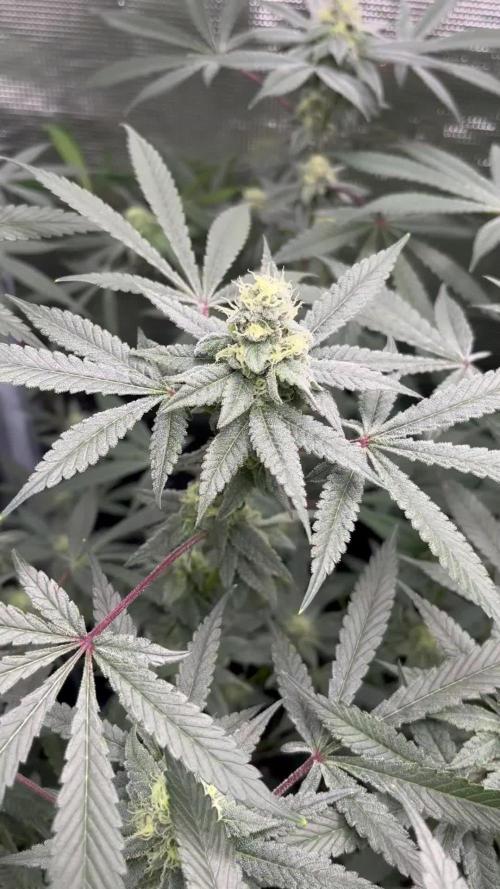
Pheno 1: Bigger Buds, weaker Stems, a little weird structure.
Pheno 5: Smaller Buds, bigger Stems (not really good either), better structure.


Likes
19
Share


@adam_pawloski87
Follow
This week went real great, 2 ogreberrys and Bruce banner got trimmed up an jarred ! We chopped the 3 other Ogreberrys on Sunday the 14th , they will hang out to dry for 14 days ! Stay tuned for next update! More trimming an weight an overall photos! Cheers to y’all 😶🌫️💨💨💨💨


Likes
72
Share


@BodyByVio
Follow
Beginning of week 8 and seems like a long way to go. Most of the hairs still white. Hopefully the buds will fill in more! As right now I’m planning to take it 10+ weeks.
This week I will lower the CO2 slowly 50 PPM every day until I will reach 800PPM. Also I will lower the light intensity by 2% every day.
This week I lowered the day temp to 79 degrees and next week I’m playing to lower it every further to 76 degrees Fahrenheit. Water temp is at 68 degrees and probably from week 9 I will lower it to 66.
Beginning of week 8 TDS is at 550PPM.
I sent adding the Late bloom enhancer from Current Culture!
End of week 8 : lowered the TDS to 470ppm , she seems that it not eating so much nutrients anymore. She still drinking 3 gallons of water every single day.

Likes
19
Share


@Ganjagrandaddy
Follow
Day 63: Another week passes and the girls are now building nice long Colas all over . Buds are looking good and smelling so pineapple/fruity now. Buds are looking nice and hairy without looking airy.
#1 In the organic soil is overall the widest and area hungry lady but her sisters are taller .
#2 has been quietly pushing her way through the middle position in the grow and has some nice fat looking buds forming.
#3 Is a surprise for me as I wasnt sure it would make it this far. No matter what I do , the leaf continues to look awful but the size of her and her now forming so many stacking buds , I am glad I kept her going now !. I do think at least 3 weeks for these ladies before harvest but hope to give them room to swell when the space is opened up.
Likes
2
Share


@TheHollyweed
Follow
Looking shiny and healthy to me. I remember the temperature was realy high and i'v got Problems with the GSC-Auto. Ohh, Wonder xD.
Next Pictures are better.

Likes
55
Share


@Ultraviolet
Follow
What's in the soil? What's not in the soil would be an easier question to answer. 16-18 DLI @ the minute. +++ as she grows.
Probably not recommended, but to get to where it needs to be, I need to start now.
Vegetative @1400ppm 0.8–1.2 kPa 80–86°F (26.7–30°C) 65–75%, LST Day 10, Fim'd Day 11
CEC (Cation Exchange Capacity):
This is a measure of a soil's ability to hold and exchange positively charged nutrients, like calcium, magnesium, and potassium. Soils with high CEC (more clay and organic matter) have more negative charges that attract and hold these essential nutrients, preventing them from leaching away.
Biochar is highly efficient at increasing cation exchange capacity (CEC) compared to many other amendments. Biochar's high CEC potential stems from its negatively charged functional groups, and studies show it can increase CEC by over 90%. Amendments like compost also increase CEC but are often more prone to rapid biodegradation, which can make biochar's effect more long-lasting. biochar acts as a long-lasting Cation Exchange Capacity (CEC) enhancer because its porous, carbon-rich structure provides sites for nutrients to bind to, effectively improving nutrient retention in soil without relying on the short-term benefits of fresh organic matter like compost or manure. Biochar's stability means these benefits last much longer than those from traditional organic amendments, making it a sustainable way to improve soil fertility, water retention, and structure over time. Needs to be charged first, similar to Coco, or it will immobilize cations, but at a much higher ratio.
a high cation exchange capacity (CEC) results in a high buffer protection, meaning the soil can better resist changes in pH and nutrient availability. This is because a high CEC soil has more negatively charged sites to hold onto essential positively charged nutrients, like calcium and magnesium, and to buffer against acid ions, such as hydrogen.
EC (Electrical Conductivity):
This measures the amount of soluble salts in the soil. High EC levels indicate a high concentration of dissolved salts and can be a sign of potential salinity issues that can harm plants.
The stored cations associated with a medium's cation exchange capacity (CEC) do not directly contribute to a real-time electrical conductivity (EC) reading. A real-time EC measurement reflects only the concentration of free, dissolved salt ions in the water solution within the medium.
98% of a plants nutrients comes directly from the water solution.
2% come directly from soil particles.
CEC is a mediums storage capacity for cations. These stored cations do not contribute to a mediums EC directly.
Electrical Conductivity (EC) does not measure salt ions adsorbed (stored) onto a Cation Exchange Capacity (CEC) site, as EC measures the conductivity of ions in solution within a soil or water sample, not those held on soil particles.
A medium releases stored cations to water by ion exchange, where a new, more desirable ion from the water solution temporarily displaces the stored cation from the medium's surface, a process also seen in plants absorbing nutrients via mass flow. For example, in water softeners, sodium ions are released from resin beads to bond with the medium's surface, displacing calcium and magnesium ions which then enter the water. This same principle applies when plants take up nutrients from the soil solution: the cations are released from the soil particles into the water in response to a concentration equilibrium, and then moved to the root surface via mass flow.
An example of ion exchange within the context of Cation Exchange Capacity (CEC) is a soil particle with a negative charge attracting and holding positively charged nutrient ions, like potassium (K+) or calcium (Ca2+), and then exchanging them for other positive ions present in the soil solution. For instance, a negatively charged clay particle in soil can hold a K+ ion and later release it to a plant's roots when a different cation, such as calcium (Ca2+), is abundant and replaces the potassium. This process of holding and swapping positively charged ions is fundamental to soil fertility, as it provides plants with essential nutrients.
Negative charges on soil particles: Soil particles, particularly clay and organic matter, have negatively charged surfaces due to their chemical structure.
Attraction of cations: These negative charges attract and hold positively charged ions, or cations, such as:
Potassium (K+)
Calcium (Ca2+)
Magnesium (Mg2+)
Sodium (Na+)
Ammonium (NH4+)
Plant roots excrete hydrogen ions (H+) through the action of proton pumps embedded in the root cell membranes, which use ATP (energy) to actively transport H+ ions from inside the root cell into the surrounding soil. This process lowers the pH of the soil, which helps to make certain mineral nutrients, such as iron, more available for uptake by the plant.
Mechanism of H+ Excretion
Proton Pumps: Root cells contain specialized proteins called proton pumps (H+-ATPases) in their cell membranes.
Active Transport: These proton pumps use energy from ATP to actively move H+ ions from the cytoplasm of the root cell into the soil, against their concentration gradient.
Role in pH Regulation: This active excretion of H+ is a major way plants regulate their internal cytoplasmic pH.
Nutrient Availability: The resulting decrease in soil pH makes certain essential mineral nutrients, like iron, more soluble and available for the root cells to absorb.
Ion Exchange: The H+ ions also displace positively charged mineral cations from the soil particles, making them available for uptake.
Iron Uptake: In response to iron deficiency stress, plants enhance H+ excretion and reductant release to lower the pH and convert Fe3+ to the more available form Fe2+. The altered pH can influence the activity and composition of beneficial microbes in the soil. The H+ gradient created by the proton pumps can also be used for other vital cell functions, such as ATP synthesis and the transport of other solutes. The hydrogen ions (H+) excreted during photosynthesis come from the splitting of water molecules. This splitting, called photolysis, occurs in Photosystem II to replace the electrons used in the light-dependent reactions. The released hydrogen ions are then pumped into the thylakoid lumen, creating a proton gradient that drives ATP synthesis.
Plants release hydrogen ions (H+) from their roots into the soil, a process that occurs in conjunction with nutrient uptake and photosynthesis. These H+ ions compete with mineral cations for the negatively charged sites on soil particles, a phenomenon known as cation exchange. By displacing beneficial mineral cations, the excreted H+ ions make these nutrients available for the plant to absorb, which can also lower the soil pH and indirectly affect its Cation Exchange Capacity (CEC) by altering the pool of exchangeable cations in the soil solution.
Plants use proton (H+) exudation, driven by the H+-ATPase enzyme, to release H+ ions into the soil, creating a more acidic rhizosphere, which enhances nutrient availability and influences nutrient cycling processes. This acidification mobilizes insoluble nutrients like iron (Fe) by breaking them down, while also facilitating the activity of beneficial microbes involved in the nutrient cycle. Therefore, H+ exudation is a critical plant strategy for nutrient acquisition and management, allowing plants to improve their access to essential elements from the soil.
A lack of water splitting during photosynthesis can affect iron uptake because the resulting energy imbalance disrupts the plant's ability to produce ATP and NADPH, which are crucial for overall photosynthetic energy conversion and can trigger a deficiency in iron homeostasis pathways. While photosynthesis uses hydrogen ions produced from water splitting for the Calvin cycle, not to create a hydrogen gas deficiency, the overall process is sensitive to nutrient availability, and iron is essential for chloroplast function.
In photosynthesis, water is split to provide electrons to replace those lost in Photosystem II, which is triggered by light absorption. These electrons then travel along a transport chain to generate ATP (energy currency) and NADPH (reducing power). Carbon Fixation: The generated ATP and NADPH are then used to convert carbon dioxide into carbohydrates in the Calvin cycle. Impaired water splitting (via water in or out) breaks the chain reaction of photosynthesis. This leads to an imbalance in ATP and NADPH levels, which disrupts the Calvin cycle and overall energy production in the plant. Plants require a sufficient supply of essential mineral elements like iron for photosynthesis. Iron is vital for chlorophyll formation and plays a crucial role in electron transport within the chloroplasts. The complex relationship between nutrient status and photosynthesis is evident when iron deficiency can be reverted by depleting other micronutrients like manganese. This highlights how nutrient homeostasis influences photosynthetic function. A lack of adequate energy and reducing power from photosynthesis, which is directly linked to water splitting, can trigger complex adaptive responses in the plant's iron uptake and distribution systems.
Plants possess receptors called transceptors that can directly detect specific nutrient concentrations in the soil or within the plant's tissues. These receptors trigger signaling pathways, sometimes involving calcium influx or changes in protein complex activity, that then influence nutrient uptake by the roots. Plants use this information to make long-term adjustments, such as Increasing root biomass to explore more soil for nutrients. Modifying metabolic pathways to make better use of available resources. Adjusting the rate of nutrient transport into the roots. That's why I keep a high EC. Abundance resonates Abundance.
Likes
34
Share


@SknHaze
Follow
So far I haven't had any issues besides some N toxicity from C.S.S. in early flowering.
I wanted to check if there was some mold or rot on the buds at the back so I removed the scrog net since its job was done. Everything was just fine.😅😅
I also ran out of Sugar Royal and I don't feel like buying another one so lets hope for the best😜


