Likes
Comments
Share
@Tazard
Follow
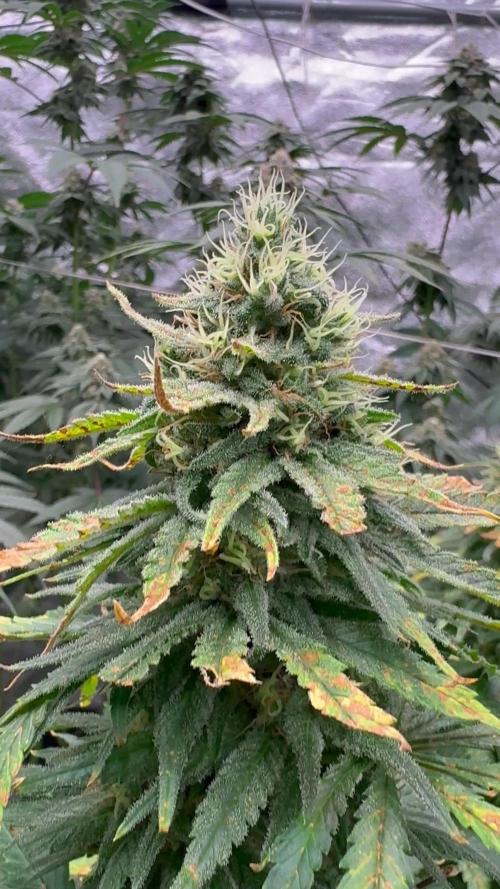
Color me absolutely impressed! This girl is huge and covered in Bud’s. The bud sites are tight! She really is a beautiful plant no wonder she’s currently sold out! Thanks for following along.
Likes
7
Share
Likes
7
Share
I am well happy with the yield from this one auto flower it is all nice dense bud as well🤙🙏👍 I'm going to cure for about four to six weeks and then be back with a smoke update
Likes
34
Share
@Canna96
Follow
This is my second run of Dutch Passion with my first being a monster Blueberry Auto. Massive plant, and her pungent odor overtook my entire home while trimming her today. While trimming her it smelled like I was in an earthy Pine Forest with a hint of berries, and it was one of the strongest smelling plants I've ever run. Very easy to grow, responded to all training methods with VIGOROUS growth. I topped her above the 7th node and removed the bottom one so I had 12 mains total. It took me almost 8 hours and I even had help for 4 hours.. Trimming is definitely my least favorite part of cultivating this species. I am super impressed with this strain and really everything Dutch Passion. They have not even sent me a single seed or even acknowledged me on here but this is my second run of their autos and I anticipate each will be a massive yielder. I will probably take a month off then start a run of a few photoperiod mainlines. I will be back with a final smoke report after she's cured, Stay Safe and Blaze On!!! 💪 Website: https://medicgrow.com/ https://growdiaries.com/grower/medicgrowled
Processing
Likes
7
Share
Not sure if the tap root has hit the Kind Soil yet or but she seems to be growing pretty steadily. She's trying to keep up with her growing sister but struggling since the 4AM is fast as shit.
Likes
26
Share
@BigBlu3
Follow
Week 7 Guys!!!! Welcome Back, And Thanks For Checking In on us!!!! To Begin: We Moved The Mimosa To Tent 1 to start Flowering *All Autos Are Together* We Set The Timer And Started The 12/12 for the Tropicana in Tent 2 We Ended Week 6 With Defoliation to Tent 1 (GC,Mimosa,SB) to make way for light to the bud sites We Have Done Some Research And Will Be Feeding A Compost Tea Roughly Tomorrow evening consisting of (1 cup Worm castings, 2 tbsps. Alfalfa Meal, 2 tbsps. Organic Molasses, 2 tbsps. Bat Guano, 2 tbsps. kelp meal) As Per *Canucks Grow* 24 hours water aerated & 24 hours for the Tea to Cook! Water is still Ph'd 6.5-6.7 is the highest ive seen so far Tent 1- Is In Flower roughly 2 weeks in- 20/4 light schedule Distance from light to plant tops- 19in Gorilla Cookies from Soil 16in Mimosa from Soil 14in Strawberry Banana from Soil 15.5in As For Tent 2- Just Started Flower We've Added a Humidifier to raise and keep the RM to 50-60% The Tropicana has Been Set and Flipped To 12/12 At 100% Lighting We will do some select Defoliation In a Few Days To get Light to the Plant Tropicana Cookies Photo From Soil 13in Light to Plant 18in This was a quick rundown this Week As Always Drop A Like, Leave a Comment And Just Show Some Love!!!! See You Guys Next Week!!!!
Likes
3
Share
@Kadash368
Follow
Ready for Harvest ❤️🍇🌲🍆🌺🌞
Likes
57
Share
what do they say about different strains on the same RES, in the same pot??? welp, here goes nothing... Last time I saw this waterfarm I was still a teenager. Ran it in a closet with two 4ft flouro shop lights either side going vertically upward like the letter "A". Had two BIG ASS plants roughly 4ft tall in it side by side going STRONG! Healthy asf, huge ass healthy leaves, some 13 fingered. Flipped em and turned out BOTH were male... Been toying with the idea of doing it again... So what the hell... Here goes, 2 Girls 1 Cup or "pot"... One Herbies Godzilla Cookies Auto and one Fastbuds Wedding Glue Auto. Current setup: -36x36x60 tent -"1000w" led light (130w from the wall) -4in extraction fan/scrubber -20+ yr old GHE Waterfarm fitted with ice probe w/ controller and PLENTY of insulation around RES. -Multiple circulation fans -Taotronics humidifier Stay tuned to watch me fuck this up too 🤣 *Sow'd em both in organic peat pellets after a 24hr soak. Getting them acclimated to their new home early. Doing environment tests and dialing it in with the new to me ice probe, and the change to hydro versus soil plants that were in there. Will be more moisture in the air until a canopy covers my balls with the evaporation from the light. **lookey lookey, BOTH have come to life and are making way to the surface. Not long and they'll be in their new "cup". Last update on germination week as once they pop we start counting I suppose.
Processing
Likes
11
Share
@Hawkbo
Follow
Couple got a little burn I think maybe a little too much soil in there with the coco on top of the light feed? I got all the final pots filled up today they will go in 3 gal bags either today or tmm. It's a Greentree pro ultra coco/perlite mixed with some roots organic soil about 70/30. This ones in the other humidity dome I gotta get back up and take a pic
Likes
307
Share
@Ju_Bps
Follow
Hello growmies 👩‍🌾👨‍🌾🌲🌲, 👋 Burning look under control, so keep water only for this week, will use nutes next week. 💪 Start to be really times to defoliate, but I miss time this week, will be for next week! 💧 Give water each 2/3 day 2 l Water Only PH @6 💡Mars Hydro - FC 3000 50% 28 cm Mars Hydro Fan kit Setting 8 Have a good week and see you next week 👋 Thanks community for follow, likes, comments, always a pleasure 👩‍🌾👨‍🌾❤️🌲 Mars Hydro - Smart FC3000 300W Samsung LM301B LED Grow Light💡💡 https://www.mars-hydro.com/fc-3000-samsung-lm301b-led-grow-light Mars Hydro - 6 Inch Inline Fan And Carbon Filter Combo With Thermostat Controller 💨💨 https://www.mars-hydro.com/6-inch-inline-duct-fan-and-carbon-filter-combo-with-thermostat-controller Anesia Seeds - High Mars 36% THC🌲🌲 https://anesiaseeds.com/product/high-mars/
Likes
3
Share
Day 43. A little cleanup some old leaves and opening up budsites. No nutrients all week, pant were on the verge of getting nute burn. Water every day, back feeding next week.
Likes
27
Share
@LSchnabel
Follow
What an explosion in growth for week 5. Every day this plant is growing like crazy. Had to trim up some lower foliage to allow better airflow. Tied down some more branches to even the canopy especially the main stem. Rubbing the stem gives an amazing smell and can’t wait till it matures fully. Looking like this plant will be a great yield of everything keeps rocking like it has. I’m feeding a worm castings compost tea spiked with Cultured Biologix EZ Tea Bloom to feed the microbes in the soil that are essential for trichome production. Also started feeding silicon to strengthen the stems and Trichomes. Week 6 is going to be nuts with growth I can already tell.
Likes
1
Share
Likes
56
Share
What's in the soil? What's not in the soil would be an easier question to answer. 16-18 DLI @ the minute. +++ as she grows. Probably not recommended, but to get to where it needs to be, I need to start now. Vegetative @1400ppm 0.8–1.2 kPa 80–86°F (26.7–30°C) 65–75%, LST Day 10, Fim'd Day 11 CEC (Cation Exchange Capacity): This is a measure of a soil's ability to hold and exchange positively charged nutrients, like calcium, magnesium, and potassium. Soils with high CEC (more clay and organic matter) have more negative charges that attract and hold these essential nutrients, preventing them from leaching away. Biochar is highly efficient at increasing cation exchange capacity (CEC) compared to many other amendments. Biochar's high CEC potential stems from its negatively charged functional groups, and studies show it can increase CEC by over 90%. Amendments like compost also increase CEC but are often more prone to rapid biodegradation, which can make biochar's effect more long-lasting. biochar acts as a long-lasting Cation Exchange Capacity (CEC) enhancer because its porous, carbon-rich structure provides sites for nutrients to bind to, effectively improving nutrient retention in soil without relying on the short-term benefits of fresh organic matter like compost or manure. Biochar's stability means these benefits last much longer than those from traditional organic amendments, making it a sustainable way to improve soil fertility, water retention, and structure over time. Needs to be charged first, similar to Coco, or it will immobilize cations, but at a much higher ratio. a high cation exchange capacity (CEC) results in a high buffer protection, meaning the soil can better resist changes in pH and nutrient availability. This is because a high CEC soil has more negatively charged sites to hold onto essential positively charged nutrients, like calcium and magnesium, and to buffer against acid ions, such as hydrogen. EC (Electrical Conductivity): This measures the amount of soluble salts in the soil. High EC levels indicate a high concentration of dissolved salts and can be a sign of potential salinity issues that can harm plants. The stored cations associated with a medium's cation exchange capacity (CEC) do not directly contribute to a real-time electrical conductivity (EC) reading. A real-time EC measurement reflects only the concentration of free, dissolved salt ions in the water solution within the medium. 98% of a plants nutrients comes directly from the water solution. 2% come directly from soil particles. CEC is a mediums storage capacity for cations. These stored cations do not contribute to a mediums EC directly. Electrical Conductivity (EC) does not measure salt ions adsorbed (stored) onto a Cation Exchange Capacity (CEC) site, as EC measures the conductivity of ions in solution within a soil or water sample, not those held on soil particles. A medium releases stored cations to water by ion exchange, where a new, more desirable ion from the water solution temporarily displaces the stored cation from the medium's surface, a process also seen in plants absorbing nutrients via mass flow. For example, in water softeners, sodium ions are released from resin beads to bond with the medium's surface, displacing calcium and magnesium ions which then enter the water. This same principle applies when plants take up nutrients from the soil solution: the cations are released from the soil particles into the water in response to a concentration equilibrium, and then moved to the root surface via mass flow. An example of ion exchange within the context of Cation Exchange Capacity (CEC) is a soil particle with a negative charge attracting and holding positively charged nutrient ions, like potassium (K+) or calcium (Ca2+), and then exchanging them for other positive ions present in the soil solution. For instance, a negatively charged clay particle in soil can hold a K+ ion and later release it to a plant's roots when a different cation, such as calcium (Ca2+), is abundant and replaces the potassium. This process of holding and swapping positively charged ions is fundamental to soil fertility, as it provides plants with essential nutrients. Negative charges on soil particles: Soil particles, particularly clay and organic matter, have negatively charged surfaces due to their chemical structure. Attraction of cations: These negative charges attract and hold positively charged ions, or cations, such as: Potassium (K+) Calcium (Ca2+) Magnesium (Mg2+) Sodium (Na+) Ammonium (NH4+) Plant roots excrete hydrogen ions (H+) through the action of proton pumps embedded in the root cell membranes, which use ATP (energy) to actively transport H+ ions from inside the root cell into the surrounding soil. This process lowers the pH of the soil, which helps to make certain mineral nutrients, such as iron, more available for uptake by the plant. Mechanism of H+ Excretion Proton Pumps: Root cells contain specialized proteins called proton pumps (H+-ATPases) in their cell membranes. Active Transport: These proton pumps use energy from ATP to actively move H+ ions from the cytoplasm of the root cell into the soil, against their concentration gradient. Role in pH Regulation: This active excretion of H+ is a major way plants regulate their internal cytoplasmic pH. Nutrient Availability: The resulting decrease in soil pH makes certain essential mineral nutrients, like iron, more soluble and available for the root cells to absorb. Ion Exchange: The H+ ions also displace positively charged mineral cations from the soil particles, making them available for uptake. Iron Uptake: In response to iron deficiency stress, plants enhance H+ excretion and reductant release to lower the pH and convert Fe3+ to the more available form Fe2+. The altered pH can influence the activity and composition of beneficial microbes in the soil. The H+ gradient created by the proton pumps can also be used for other vital cell functions, such as ATP synthesis and the transport of other solutes. The hydrogen ions (H+) excreted during photosynthesis come from the splitting of water molecules. This splitting, called photolysis, occurs in Photosystem II to replace the electrons used in the light-dependent reactions. The released hydrogen ions are then pumped into the thylakoid lumen, creating a proton gradient that drives ATP synthesis. Plants release hydrogen ions (H+) from their roots into the soil, a process that occurs in conjunction with nutrient uptake and photosynthesis. These H+ ions compete with mineral cations for the negatively charged sites on soil particles, a phenomenon known as cation exchange. By displacing beneficial mineral cations, the excreted H+ ions make these nutrients available for the plant to absorb, which can also lower the soil pH and indirectly affect its Cation Exchange Capacity (CEC) by altering the pool of exchangeable cations in the soil solution. Plants use proton (H+) exudation, driven by the H+-ATPase enzyme, to release H+ ions into the soil, creating a more acidic rhizosphere, which enhances nutrient availability and influences nutrient cycling processes. This acidification mobilizes insoluble nutrients like iron (Fe) by breaking them down, while also facilitating the activity of beneficial microbes involved in the nutrient cycle. Therefore, H+ exudation is a critical plant strategy for nutrient acquisition and management, allowing plants to improve their access to essential elements from the soil. A lack of water splitting during photosynthesis can affect iron uptake because the resulting energy imbalance disrupts the plant's ability to produce ATP and NADPH, which are crucial for overall photosynthetic energy conversion and can trigger a deficiency in iron homeostasis pathways. While photosynthesis uses hydrogen ions produced from water splitting for the Calvin cycle, not to create a hydrogen gas deficiency, the overall process is sensitive to nutrient availability, and iron is essential for chloroplast function. In photosynthesis, water is split to provide electrons to replace those lost in Photosystem II, which is triggered by light absorption. These electrons then travel along a transport chain to generate ATP (energy currency) and NADPH (reducing power). Carbon Fixation: The generated ATP and NADPH are then used to convert carbon dioxide into carbohydrates in the Calvin cycle. Impaired water splitting (via water in or out) breaks the chain reaction of photosynthesis. This leads to an imbalance in ATP and NADPH levels, which disrupts the Calvin cycle and overall energy production in the plant. Plants require a sufficient supply of essential mineral elements like iron for photosynthesis. Iron is vital for chlorophyll formation and plays a crucial role in electron transport within the chloroplasts. The complex relationship between nutrient status and photosynthesis is evident when iron deficiency can be reverted by depleting other micronutrients like manganese. This highlights how nutrient homeostasis influences photosynthetic function. A lack of adequate energy and reducing power from photosynthesis, which is directly linked to water splitting, can trigger complex adaptive responses in the plant's iron uptake and distribution systems. Plants possess receptors called transceptors that can directly detect specific nutrient concentrations in the soil or within the plant's tissues. These receptors trigger signaling pathways, sometimes involving calcium influx or changes in protein complex activity, that then influence nutrient uptake by the roots. Plants use this information to make long-term adjustments, such as Increasing root biomass to explore more soil for nutrients. Modifying metabolic pathways to make better use of available resources. Adjusting the rate of nutrient transport into the roots. That's why I keep a high EC. Abundance resonates Abundance.
Likes
33
Share
@BADKUSS
Follow
Hello everyone , Here is the phase of completed stretch, and the fertilizer fertilizer contribution are 100%, flowering starts very well and the appearance of the first pistil are visible everywhere. For the height of the plants I find it reasonable and thus keeping all this world a good size the luminous penetration will be excellent ... until now hene no sign of problem for my plants I think that the flowering will follow its rhythm .. to see in the coming weeks ... now place to photos ...
Likes
71
Share
@Roberts
Follow
Quebec Blast is growing good. I am doing a solution change about every 4 days. Which is not bad since it is only a gallon switch, and I do all 4 plants in this grow at once. Soon as my ph bottoms out I know it is time. That means plant is feeding water vs water is feeding plant. Another token of experience I have learned. I am growing her in a New Level Hydro bucket, under a Spider Farmer SE5000 light with 3 other strains. Links below. Thank you New Level Hydro, Quebec Seeds, and Spider Farmer. 💪❄️🌱 Thank you grow diaries community for the 👇likes👇, follows, comments, and subscriptions on my YouTube channel👇. ❄️🌱🍻 Happy Growing 🌱🌱🌱 https://youtube.com/channel/UCAhN7yRzWLpcaRHhMIQ7X4g SE5000 https://amzn.to/3qFpAML Spider Farmer Official Website Links: US&Worldwide: https://www.spider-farmer.com UK: https://spiderfarmer.co.uk CA: https://spiderfarmer.ca EU: https://spiderfarmer.eu AU: https://spiderfarmer.com.au Coupon Code: saveurcash Www.newlevelhydro.com Www.hygrozyme.com
Likes
65
Share
@3lementa1
Follow
She's growing so fast. I was just watering the rockwool cube whenever it dried out but I put it in the net pot today and covered it in LECA clay pellets. I topped her yesterday as well. PH and ppm look good. I'm just going to plug in the dripper every once in a while until the roots start growing through the net pot. I don't want the rock wool to be submerged. The top is covered with clay now so shouldn't be susceptible to mold from the light reaching it. Looking at my last grow (CBD Blue Shark / Wedding Cake) I didn't provide enough light or nutrients at the start and wasn't able to top until week 6. Growing in peat/rockwool instead of paper towel/soil, adding nutrients right away, and using the HID grow light from the start instead of a smaller cloning light seem to have made a big difference.
Likes
14
Share
Week six of flower I went in to the tent today an lots of new purple on the buds, couldn't believe how nice they look💚🤩, man does she look stunning, I'm in awe with these beautiful flowers👌🏻