


Likes
Comments
Share


@thelatebloomer
Follow
First time using skunkwerks. A little nutrient burn so next time I’ll start with 3-3.5 ml but overall it’s 10/10!

Likes
11
Share


@NOLOGIK
Follow
21/4
a beautiful plant, but this time the growth of the branches, had problems turning into each other! until it looks like a single bush !. now it's taking shape, because I cut all the extra leaves and twigs that were blocking the light. I look forward to!

Likes
45
Share


@Ultraviolet
Follow
My homework.
Rubisco regeneration is intrinsically linked to nitrogen supply because Rubisco is a major sink for nitrogen in plants, typically accounting for 15% to over 25% of total leaf nitrogen. The regeneration phase itself consumes nitrogen through the synthesis of the Rubisco enzyme and associated proteins (like Rubisco activase), and overall nitrogen status heavily influences the efficiency of RuBP regeneration.Structural Component: Nitrogen is an essential building block for all proteins, and the sheer abundance of the Rubisco protein makes it the single largest storage of nitrogen in the leaf.
Synthesis and Activity: Adequate nitrogen supply is crucial for the synthesis and maintenance of sufficient Rubisco enzyme and Rubisco activase (Rca), the regulatory protein responsible for maintaining Rubisco's active state. Nitrogen deficiency leads to a decrease in the content and activity of both Rubisco and Rca, which in turn limits the maximum carboxylation rate, Vmax, and the rate of RuBP regeneration Jmax, thus reducing overall photosynthetic capacity.
Nitrogen Storage and Remobilization: Rubisco can act as a temporary nitrogen storage protein, which is degraded to remobilize nitrogen to other growing parts of the plant, especially under conditions of nitrogen deficiency or senescence.
Nitrogen Use Efficiency (NUE): The allocation of nitrogen to Rubisco is a key determinant of a plant's photosynthetic nitrogen use efficiency (PNUE). In high-nitrogen conditions, plants may accumulate a surplus of Rubisco, which may not be fully activated, leading to a lower PNUE. Optimizing the amount and activity of Rubisco relative to nitrogen availability is a target for improving crop NUE.
Photorespiration and Nitrogen Metabolism: Nitrogen metabolism is also linked to the photorespiration pathway (which competes with carboxylation at the Rubisco active site), particularly in the reassimilation of ammonia released during the process.
To increase RuBisCO regeneration, which refers to the process of forming the CO2 acceptor molecule Ribulose-1,5-bisphosphate (RuBP) during photosynthesis, the primary methods involve optimizing the levels and activity of Rubisco activase (Rca) and enhancing the performance of other Calvin-Benson-Bassham (CBB) cycle enzymes.
Biochemical and Environmental Approaches:
Optimize Rubisco Activase (Rca) activity: Rca is a crucial chaperone protein that removes inhibitory sugar phosphates, such as CA1P (2-carboxy-D-arabinitol 1-phosphate), from the Rubisco active site, thus maintaining its catalytic competence.
•Ensure optimal light conditions: Rca is light-activated via the chloroplast's redox status. Adequate light intensity ensures Rca can effectively maintain Rubisco in its active, carbamylated state.
•Maintain optimal temperature: Rca is highly temperature-sensitive and can become unstable at moderately high temperatures (e.g., above 35°C/95F° in many C3 plants), which decreases its ability to activate Rubisco. Maintaining temperatures within the optimal range for a specific plant species is important.
•Optimize Mg2+ concentration: Mg2+ is a key cofactor for both Rubisco carbamylation and Rca activity. In the light, Mg2+ concentration in the chloroplast stroma increases, promoting activation.
•Manage ATP/ADP ratio: Rca activity depends on ATP hydrolysis and is inhibited by ADP. Conditions that maintain a high ATP/ADP ratio in the chloroplast stroma favor Rca activity.
Enhance Calvin-Benson-Bassham (CBB) cycle enzyme activity: The overall rate of RuBP regeneration can be limited by other enzymes in the cycle.
•Increase SBPase activity: Sedoheptulose-1,7-bisphosphatase (SBPase) is a key regulatory enzyme in the regeneration pathway, and increasing its activity can enhance RuBP regeneration and overall photosynthesis.
•Optimize other enzymes: Overexpression of other CBB cycle enzymes such as fructose-1,6-bisphosphate aldolase (FBA) and triose phosphate isomerase (TPI) can also help to balance the metabolic flux and improve RuBP regeneration capacity.
Magnesium ions, Mg2+, are specifically required for Rubisco activation because the cation plays a critical structural and chemical role in forming the active site: A specific lysine residue in the active site must be carbamylated by a CO2 molecule to activate the enzyme. The resulting negatively charged carbamyl group then facilitates the binding of the positively charged Mg2+ion. While other divalent metal ions like Mn2+ can bind to Rubisco, they alter the enzyme's substrate specificity and lead to dramatically lower activity or a higher rate of the non-productive oxygenation reaction compared to Mg2+, making them biologically unfavorable in the context of efficient carbon fixation. The concentration of Mg2+ in the chloroplast stroma naturally increases in the light due to ion potential balancing during ATP synthesis, providing a physiological mechanism to ensure the enzyme is activated when photosynthesis is possible. At the center of the porphyrin ring, nestled within its nitrogen atoms, is a Magnesium ion (Mg2+). This magnesium ion is crucial for the function of chlorophyll, and without it, the pigment cannot effectively capture and transfer light energy.
Mg acts as a cofactor: Mg2+ binds to Rubisco after an activator CO2 molecule, forming a catalytically competent complex (Enzyme-CO2-Mg2+). High light + CO2) increases demand: Under high light (60 DLI is a very high intensity, potentially saturating) and high CO2, the plant's capacity for photosynthesis is high, and thus the demand for activated Rubisco and the necessary Mg2+ cofactor increases. Mg deficiency becomes limiting: If Mg2+ is deficient under these conditions, the higher levels of Rubisco and Rubisco activase produced cannot be fully activated, leading to lower photosynthetic rates and potential photo-oxidative damage.
Optimal range: Studies show that adequate Mg2+ application can enhance Rubisco activation and stabilize net photosynthetic rates under stress conditions, but the required concentration is specific to the experimental setup.
Monitoring is key: The most effective approach in a controlled environment is to monitor the plant's physiological responses e.g., leaf Mg2+ concentration, photosynthetic rate, Rubisco activation state, and adjust the nutrient solution/fertilizer to maintain adequate levels, rather than supplementing a fixed "extra" amount.
In practice, this means ensuring that Mg2+ is not a limiting factor in the plant's standard nutrient solution when pushing the limits with high light and CO2.
Applying Mg2+ through foliar spray is beneficial to Rubisco regeneration, particularly in alleviating the negative effects of magnesium (Mg) deficiency and high-temperature stress (HTS). While Mg can be leached from soil, within the plant it is considered a mobile nutrient, particularly in the phloem. Foliar-applied Mg is quickly absorbed by the leaves and can be translocate to other plant parts, including new growth and sink organs.
Foliar application of: NATURES VERY OWN MgSO4 @ 15.0g L-1 in a spray bottle.
Foliar sprays are often recommended as a rapid rescue measure for existing deficiencies or as a supplement during critical growth stages, when demand for Mg is high. Application in the early morning or late evening can improve absorption and prevent leaf burn.
The starting point [of creativity] is curiosity: pondering why the default exists in the first place. We’re driven to question defaults when we experience vuja de, the opposite of déjà vu. Déjà vu occurs when we encounter something new, but it feels as if we’ve seen it before. Vuja de is the reverse—we face something familiar, but we see it with a fresh perspective that enables us to gain new insights into old problems.
Likes
Comments
Share

@Wizardgreen317
Follow
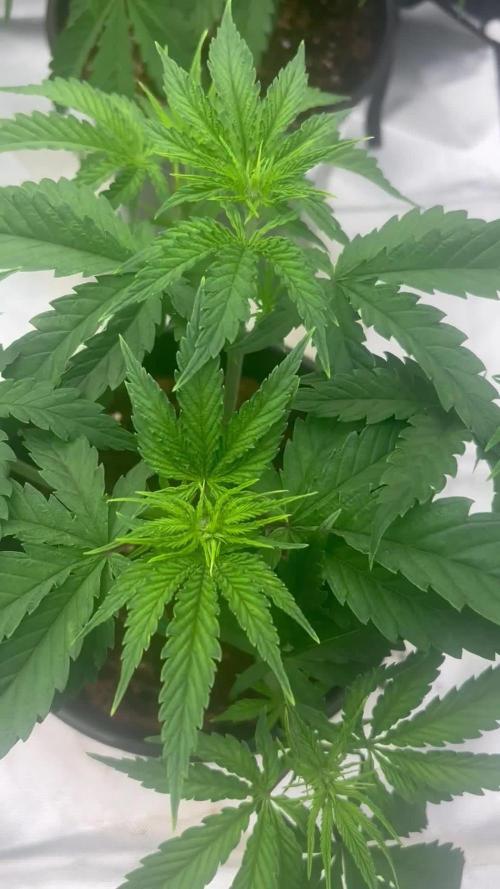
Well these plant will be going flower next week I know the stretch is going to be real . They grow well no transplant shock nothing maybe eat more than all the other plant and drinks a shit ton of water cause every time I touch the pot the ladies be empty.. but I can say one thing these are the one I thought I was going to have trouble with lol but great seeds great growth, want these seeds go to North Atlantic seed bank and got to there white label seeds or just type ..I’m think about getting there permanent marker.. so yeah I think I’m keep these in the rotation .. these are my fav I love all of them but I love me a sour diesel or diesel what ever lol but yeah I know this is gonna be a long flower.
Likes
7
Share


@Nikkov
Follow
well, another week goes by and it's growing not like I expected hehehe but that's ok, living and learning, and for now I'll just wait for this cycle to end to start a new one and post it here and I'll tell you right away that I ordered a kit advanced nutrients starter and will test it on the new cycle. =D
Likes
13
Share


@NanoLeaf
Follow
Very happy overall, had some difficulties hitting the sweet spot through the cycle but managed to pull it through brilliantly at the end.
This is definitely a very deserty and cookie like strain. Oven baked freshness!


Likes
30
Share


@valiotoro
Follow
Hello everyone week 4 of flower has passed for this Skywalker haze auto 💥
Mars hydro SP-6500 75%
Same feeding schedule
have a great day and wish you all happy growing 😎👨🌾🏻
Likes
3
Share


@G_abitbol
Follow
Still not over with quite a lot of new pistils all over the buds. I thought it would stop and fatten up.

Likes
8
Share


@Skinnytalls420
Follow
Day 23-18/05/22 all looking good I think a few are showing early signs of flowering
Likes
9
Share


@TrialAndErrorGrows
Follow
Week 1 bloom
Everything stretched a lot this week. I’m not sure why. My lights are powerful I’m feeding by the green planet chart. So lots of nutes. Hopefully they slow down or I’m going to run out of room.
At the end of this week I did another lollipop and small defoliation. The canopy was super dense.
If you got this far hit the like button and give me some validation lol.


Likes
4
Share


@Shotter
Follow
These have been on water there entire lifes I'm I am a new grower and learned the hard way have now got a full parcel of green buzz liquids on the way
Likes
6
Share

@k0nz1
Follow
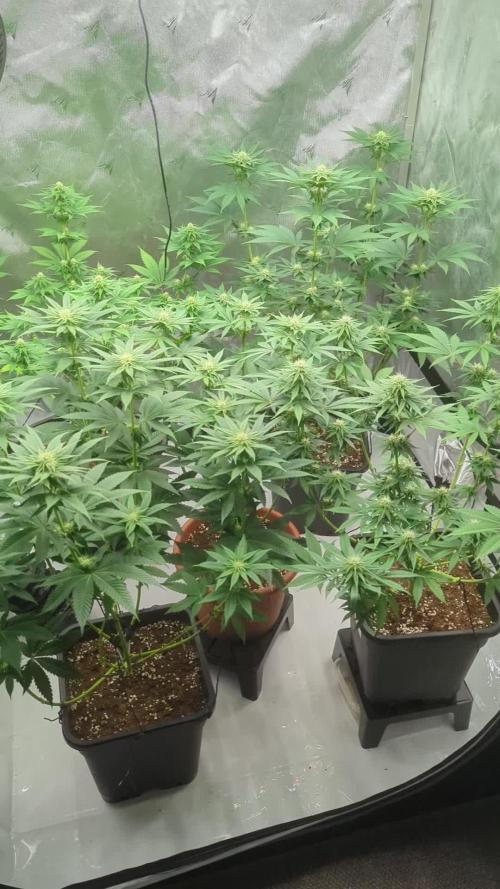
Big defoliation and lollipopping on day 18 flower. Now push Back und bulking Phase after. LO got a little stem split due to too heavy LST... Could fix it with wire and tape.
Trichome developement starts now and the smell in the tent ist getting stronger. LO already with a nice citrusy and sweet aroma.
Lights 100%
Temp 25/20 Celsius
RH 53-58 %
VPD 1.1 - 1.4


Likes
19
Share


@Teydoee
Follow
How do you control really huge fan leaves that are putting too much weight on lower leaves?

Processing
Likes
2
Share


@Ay_ef_see
Follow
Repotted veg area. Most are still babies. Will receive final transplants before going into flower in a couple more weeks. The clone I took from the sativa-dom is doing well, as is the og lemon x cupcake. Will veg these two for the longest, and will eventually end up in 5-7 gal pots. Also plan to take some cuttings from these two.
Two girls in flower are approx 21 days apart. I call them the supercroppeds because that’s what they are. Sc1 is on day 49 of flower a/o aug28 and sc2 is on day 28. Both seem happy and healthy. Believe there may be an abundance of nitrogen in sc1 as some leaf tips are burnt and folding back. Two plants about a month in veg have been put into flower as well. A sort of 12/12 from seed kinda thing.
I have been experimenting with the basics thus far. A sea of green will be underway in a couple more weeks, once these babies grow to toddlers. Been outdoors mostly, no nutrients. Plain Jane from Mother Earth. Comes out great each year. All unknown strain bagseed. A tad different growing in a 2x2 room.


Processing
Likes
9
Share


@TheWeedPimp
Follow
Damn they fine looking Ladies!🌿😍
Doing LST on the next week

Likes
4
Share


@Peloxiraptor
Follow
Temperatures this whole week:
MAX - 25.8ºC
MIN - 18.5º C
MAX HUMIDITY - 90%
MIN HUMIDITY: 44%
Aprox Plants Height Sunday 26:
Persian Pie 1 - 23cm
Persian Pie 2 - 18cm
Persian Pie 3 - 21,5cm
Persian Pie 4 - 20,5cm
All Gas OG - 14cm
Irrigation:
21/3 - 2L (400ml each) of alkaline tap water (6.9 Ph, 127ppm) with 0.1 ml/L of silic boost, 1ml/L of Terra Leaves and 1ml/L of Atazyme.
24/3 - 2L (400ml each) of alkaline tap water (6.72Ph, 117ppm) with 0.1ml/L of silic boost and 0.2ml/L of Rootbastic. (last alkaline irrigation, last dose of rootbastic)
-The stains seems to be drops of water from the humidificator, probably they're falling there when i move the deposit to refill it. Next week i should put the light closer, make apical pruning and pull in the tent a scrog web to put a limit to the plants height because they're starting to grow willowy and the tent is only 1.80m tall. I should also make an abundant irrigation to check earth's Ph and PPM again and get the A/C ready to be plugged to the tent because temperatures are rising up exponentially outside and some local growers are starting to have issueswith that.
Cheers guys, have a great week and good luck with the outdoor season. Good luck with the harvest to those on the other side of the equator 🙌🙌
Likes
30
Share


@ArtisticGrown
Follow
Sooooo this has been an amazing and exciting week! Ive been patient with this last plant and really checking the trichomes i inly wanted a few amber caps on the nugs, was looking for milky on this one! Shes smelling amazing and the color change was such a sight to see! She did so well with the nutrients and loved the 2 week flush i did! I cut her down did a wet trim and have em in the drying rack! Im excited to see how she cures and drys ready for the smoke reveal! Much love and happy growing!!!
*check out the examples of the rewards from the traing i did with lst, hst, desolation love seeing this!!* learning this craft and style of growing is a blast! And everyone should try it!
