


Likes
14
Share


@MasterKush714
Follow
Yoooo!!! What's brackin fam!!! Update!!!
Soo! She stretched almost an inch in 6 days maybe more it's truly amazing and this cropsalt stuff is no joke I'll literally challenge anyone to use it by direction and not see why it's the best!!! PERIOD!!
other then that she is drinking alot more and eating steadily more as well, I am going to cut clones by this week or next and then start that GD foenthe large tent, this girl is fairing really well considering the home conditions I have with her but otherwise she has been absolutely a breeze to grow!!! Thanks for stopping by will update as this week goes on thanks!!!

Likes
2
Share

@Philhsy
Follow
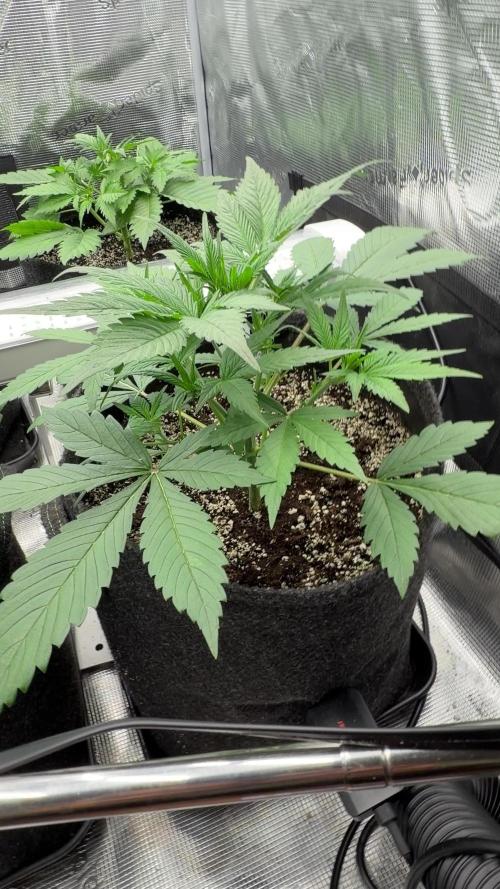
🍓 Strawberry Gorilla RF3 Auto – Week 3 Update
Week 3 is in the books and everything is going according to plan! 🌱
Strawberry Gorilla RF3 is showing strong, healthy growth with a compact structure and plenty of side branching developing. The canopy is filling out nicely, leaves are a healthy green, and the plant is responding well to the environment. No major issues so far, just steady growth and vigorous development.
I’ve continued focusing on keeping the conditions stable, and the plant seems to be loving it. Looking forward to seeing the stretch begin soon and watching this lady really take off over the next couple of weeks.
-A light feeding done at half strength done
- some defoliation done
- tlc
Fast Buds genetics are showing their quality once again, and I’m excited to see what this beast can do in flower. 🍓🦍❄️

Likes
3
Share


@Gahskel
Follow
Erste Woche der Blüte. Leichte Verfärbungen wirkt wie verbannt an der Spitze an einzelnen Blättern. Kann mir nicht herleiten woher diese kommen? Hat jemand Tipps?
Am 3 Tag waren die erste Anzeichen für eine Vorblüte entdeckt(Video)

Likes
10
Share


@Diegobike
Follow
Esta semana ha Sido súper buena para mí planta cada vez se ven más pistilos y la resina y su olor no dejan nada de que hablar. Simplemente son innumerables los terpenos que tiene esta planta a metros puedo olerla. Últimamente todos los días llueve con gran intensidad gracias a tanta humedad algunos cogollos presentaron botritis pero pude calmarla quitando los cogollos afectados y aplicándoles un poco de agua oxigenada. En resumen va de locos ya quiero probarla



Likes
23
Share


@GreenthumbJacobs
Follow
Ich kann es nicht beschreiben.
Sie ist ein Traum!
Wächst und wächst und sieht sehr gesund aus.🤩❤️
Likes
14
Share


@MG2009
Follow
03/18/2021
Making the switch to 12-12, flowering should Start by next week.
Likes
4
Share


@XxDetermined100
Follow
The plant was easy to grow overall .. it grew fast and a little on the tall side which had me nervous but I was able to raise the lights up just enough to finish, so it all worked out in the end. buds came out hard and frosty no complaints . This was a freebie seed too! didn’t expect it to come out as fire as it did man was i wrong. Straight fire 🔥
Ran into root rot in the beginning of veg but the great white and hydroguard saved my ass.🙏


Likes
21
Share

@MG2009
Follow
11/10/2021
Catching up on some back burner projects Blue Matter F2 being upgraded to
#1) dropped a few seeds into some RO water over night.
Following night into paper towel in zip lock bag.
Next day seeds cracked, put in jiffy pellets to finish germination under
humidity dome. Will post pics when popping through soil.
Searching for a special couple male and female's for open Pollination
(Keeping clone of each just incase I get a keeper). Male or female😉
Original KOS Seed released through the gamblers table on KOS site
Description by
The
REV
BLUE MATTER
Description
Blue Matter (Dark Matter male x Blue Rhino 1947 f1)
Welcome to the Gamblers’ Table section of KOS. Here and there we sell untested varieties for a real cool deal, there’s really not a ton of risk here, but every once in awhile shit can go south.
Now here is a really trippy blend here amigos, and let me tell you why. When I brought up my BR1947 plants from seed, I got one of the small females, that is just resin soaked and much more potent than any other BR1947 phenotype, in my experience. This pheno of the BR1947 also has the strongest medical properties regarding her abilities to calm down nerve damage type spasms. But she doesn’t get very big, short and stocky with average yields and serious Blueberry flavors and smells.
The father is the Dark Matter, which is my Rusty Haze male x my Cherry Thunderfuck. This plant (Dark Matter) gets large and often imparts a Grape Crush type influence into fruity/berry flavored varieties it breeds with. So while this cross is essentially the same parental varieties as the KOS Dark Rhino, this one was made with a very special female and sure to deliver a unique connoisseur treat.
These will likely go 9 or 10 weeks, yields should be alright, smells and flavors should be off the hook, medical properties should be at full power, and she will fairly likely stay on the shorter more stacked side regarding morphology. So check out this special girl if you think she may be what the doctor ordered!
11/11/2021
#1 is above ground! Going to measure ppfd tomorrow to figure out where to put them so I don't burn leaves or stress without enough light.
11/12/2021
Three more popped up today at four and counting.
11/13/2021
3 more sprouts today total of, 7 of 11 seeds so far good. Germ rate considering how I stored them. In a warm dresser drawer since 2017?
11/14/2021
Seven of 11 so far. Up potted our #1 sprout to her home for the next 30 or so. Also up pot others as needed over the next week. Veg should be start soon.
11/16/2021
6 days and 7 out of 11 sprouting. So I'll pot up the 7 sisters ( fingers crossed) and ad others if they sprout.
11/18/2021
8 out of 11 germinated potted up 5 got 3 more to transplant. Should be ready to start veg soon got single fingered leaves but waiting on first set of 3 leaves to begin veg.
72.2 germ rate on improperly stored seed. Decent.


Likes
61
Share


@PEAKYPLANTERS
Follow
wau what pistils !!!! my puppies have blossomed exaggeratedly .... some are very long ... others have remained shorter ... I hope not to damage these magnificent buds under the lights and to give all my girls the light they deserve ... I have to learn the fucking techniques of you masters of cultivation ... I'm here to learn the best from you !!
* some leaves are starting to make purple funte ... I don't know what the fuck it is ... maybe it's a question of genetics I think ...
Likes
21
Share


@Rollex420
Follow
The girls are recovering well.. They certainly haven't given up! So they have a lot to give on the next few remaining weeks, flowers daily increase their volume.. 🙌🏻📊

Likes
11
Share


@Beans416
Follow
Another week. going to switch the 4 over to flower in the next couple days.
And move the clones to another tent.
Thanks for looking happy growing .


Likes
Comments
Share


@TexasJack0418
Follow
Week 3 is starting off busy. Day 14 I finally got some Bone Meal. So, I added 2 more inches on topsoil. 1st I added 1/4 cup of Bat Guano ea., 1/3 cup Bone Meal ea., 2tbsp of Potassium Nitrate and Calcium Nitrate ea. Lightly mixed into top 1" of coco. Then I added 1-1/2" of Canna coco mix (perlite10%, worm casting25%) over top of soil. Then, I topped it of with cedar chips spread over both surfaces. Day 15, 12noon I watered both girls with 1/2Lt of 6.4PH water only. 8pm I decided to LST a couple of umbrella leaves each. Hope it helps with light penetration. There's a bunch of new growth under those two leaves. How does it look so far....
Day 18: Lot of changes... Switched my lights around. The TS-1000 made heat where the Pro2 Epistar 400W didn't. Was just a hunch but as soon as I changed the temp of the room went down 8degrees. The TS-100 was directly under the exhaust fan. Cool... Took the fan out and modified the base to give some more floor room, then added a humidifier. Was going to install a DIY Co2 generator but my silicone must he too old and didn't dry. I'll clean off, fix and install tomorrow. Ladies look great, I removed the LST wires from the two umbrella leaves. 2 days were enough to get the under foliage to grow past them. Watered 1Lt "water only" PH 6.2 each plant. Added some Epson Salt to foliar spray and cleaned off the leaves on each plant.

Likes
2
Share


It was a nice experience, It helped me with some things that I didn't know before. It was hard at the beginning because the plant was on a bad situation. But thanks to some fertilizers everything changed, also with love and patience. Good production but it could have been more. Next times will be better, now we have to be thankful and ready to continue😜

Likes
24
Share


@Homestickycannabis
Follow
Well it's dry and cureing in jars. I ended up with 78 grams of dry sticky buds. Growing this cultivar was a breeze! I mailined her for 8 main kola's and I would say that it was a success. I did however end up with more larf than I would have liked, but I'll be using that for fresh flower rosin in my Rosineer press. This particular pheno did not like her nutrients above a mild strength at all !!! I did flush her 3 times during her life and with good results. The first was to clean and build up of veg nutrients , primarily nitrogen. And the other two times were during flower. I wanted a good transition into flower. I've had a bad habit of thinking that a super dark green plant is what I want in flower. All in all she was a delight to grow. Not to finicky and a forgiving strain imo.


Likes
63
Share


@Momentum
Follow
lyncht mich nicht Leute, sie hat nur 7 Wochen Blüte gemacht und war am Anfang der 8.. Viel Stress hier für mein illegales Hobby.
See ya! ✌️