


Processing
Likes
Comments
Share


@NewbieLearner
Follow
Flowering coming along very well. THE BIG STRETCH has begun haha. All the plants stretching and getting ready for flowering is what I mean haha. Smell is super nice from the gorilla glue and the mold is decreasing rapidly.
Used half milk and half ph solution along with many copper treatments to help cure the mold situation which came up from bringing an outdoor plant indoors, never so this!


Likes
9
Share


@Mr_nugs_lover_David
Follow
Another beautiful pheno of the big jeff by Gecko seeds which is the cross of: Cookies kush X Casey Jones, the plant is showing beautiful indica hybrid characteristics, it's gonna be a wonder plant for sure! Let's keep on working!! 💛💚❤️👨🌾


Likes
3
Share

@mftexans420too
Follow
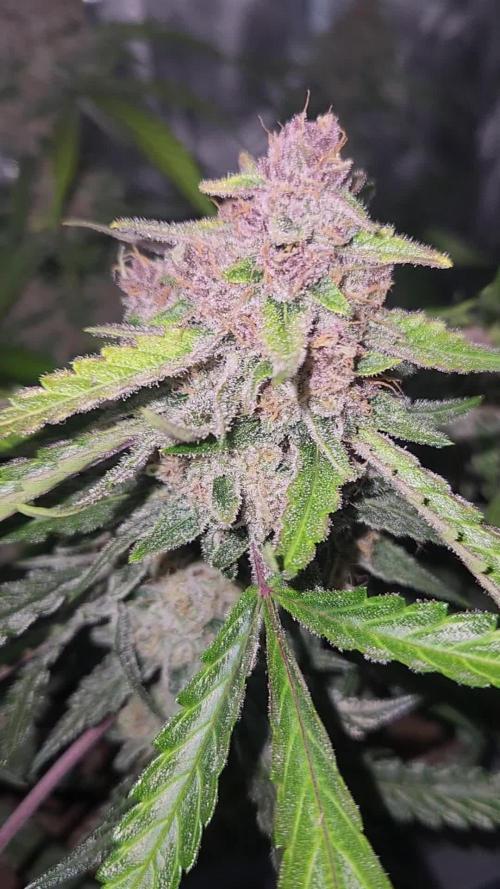
Mz Blizz doing her. Dayyyum thang defo nutes #vgrowlea #automatic pilot #soilless

Likes
1
Share

@Weedman268
Follow
She smells really nice this is her last week will be picking her in the next day or two


Processing
Likes
3
Share


@Kushizlez
Follow
Day 12F-19F (May 3rd - May 10th)
(Day 13) Pots are still super heavy and I don’t see these things drying out anytime soon so we’ll see over the next few days. Still no signs of overwatering.
(Day 14) I’m going to do a little lst. Better late than never and since the pots are saturated the stems are bendier. I noticed they were quite droopy during lights off but are praying by lights on.
(Day 16) Man these things are filling out slow. I’m going to drop the light a few inches and see if that helps at all. Definitely no early trichs.
(Day 19) So I haven’t had to water at all in the last 10 days and the pots are still quite heavy. Oddly enough, I still see no signs of overwatering. Perlite did it’s job I guess.


Likes
24
Share


@Spazmagi
Follow
11/10 - Last night I did some late-night defoliation and removed about 30 good sized fan leaves and made some minor adjustments to her ScrOG positioning. She drank steadily through the week and once she drank down about 1 gal (4 days), I checked tds/pH. She measured in at 520ppm and 6.8pH. This was outside of my desired range in both values, so I decided to top-off with some legit full-strength nutes to balance the scales. After adding the solution, she measured 650ppm and 6.2pH. Not ideal, but acceptable for the moment. I feel like every day I check on her, her roots have gotten even bigger.

Likes
11
Share


@Slurpy_Terpy
Follow
==> Decreased the base nutrients for less Nitrogen
She is doing great!
Calyxes swelling nicely :)
Starting to get some color in the leaves on the higher buds :D
The nice smells of watermelon candy and sour weed are slowly intensifying and the macro pictures surprised me!
I can't wait till she is ready, I think she will be ready first :D

Likes
16
Share


@Mo_Powers
Follow
i actually wanted to harvest it at the end of the week, but i will give it another week to ripen. the trichomes are not yet at the stage i would like them to be. so far i have not discovered any mould. due to the changeable weather and the sometimes very high humidity, it is quite possible that it will develop. unfortunately this happened with my white widow. let's hope that she continues to do well and that i will be able to harvest her.

Likes
22
Share


@GermanGrow182
Follow
Sehr gutes blütenwetter. Eine Woche warm und sonnig, ein kleiner Schauer..
Die 5 Damen entwickeln sich nach Plan. No.1 ist am weitesten. Unglaublich harzig, süß zitroniger Geruch, wie zitronenkuchen. Trichome überwiegend milchig. Schätze, sie brauch nur noch eine Woche.
No.3 ist auf Platz 2, was die reife angeht, etwa eine Woche in der Entwicklung hinter no.1
No.2,4 und5 brauchen wohl noch mindestens 2 Wochen.
Der stemrub zeigt überall den amnesia cookies Duft, wie man sich ihn vorstellt, wenn man beide kennt. Herrlich.
Wuchs ist immernoch gleichmäßig bei allen5.super gene @dutchfem.
Hab etwas entlaubt, um den unteren Blüten in den letzten Tagen noch mehr licht zu geben.
Es läuft prima. Bis nächste Woche ✌️


Likes
32
Share


@BreakingBud
Follow
Will post bud shots this evening. Overall royal queen seeds critical kush is a great strain! Would grow again. 0

Likes
38
Share


@Chucky324
Follow
Hello. This is the end of week 8 and the beginning of week 9 of flowering.
Getting near the end and I've started flushing. I like to flush for 2 weeks. I find I get a better end product if I flush.
Things are looking good in here. I had the light up to 80% so the leaves in the main lighting area are turning a little yellow. I'll turn the light down to 70% for a couple of days to slow the yellowing and then back to 80% to finish off this week.
OK, we have finished the Grow Yer Own Stone book printed in 1970 for Canada. My only hope was that you got something out of it that might help your grow or further your knowledge.😊 And it was fun to read too.
OK, Have fun out there. Chuck

Likes
4
Share


@xmackobox
Follow
Vale pues arrancamos el seguimiento de estas semillas de Ukhta Genetics estoy muy hypeado y ya impaciente xd
Vamos a tener como gama de fertilizantes a Atami, todo el mundo conoce y sabe lo que esta marca ofrece a las plantas :D
Semillas empezadas a germinar el día 18/06/2024 y van a ser 12 macetas de 1 litro y haremos trasplante entre la 2ª y 3ª semana de crecimiento a la maceta definitiva de 7 litros.
Usare como sustrato el Janeco Light Mix de Atami por supuesto.
**22/06/2024 Subo nuevas fotos y vemos a las plantas con 4 días desde que se empezaron a germinar.
**28/06/2024 Fotos añadidas de como va la germinación 10 dias despues de empezar y además vemos la nueva cepa, Watermelon ZUM ZUM de Ukhta Genetics.

Likes
95
Share


@DogDoctorOfficial
Follow
Week 4 day 2 since i start germination, and i think they are evolving quite ok. CS1 is for now the queen in all aspects, shes the stronger, the most beautiful formation with no problems what so ever , CS2 is following and CS 3 also but with mutant leaves all over her, i will however keep giving her love and dedication, mb in the end she compensate with some beautiful flowers 🤞
As for the Tropicannas, TP2 its an amazing girl, no mutations and growing as it should, TP1 is recovering fast from her accident 😅🤞 and she is on the way to become a strong and beautiful girl.
They are adapting super well to the new ligth 😅 one less solution to find 👌
Day 27 veg And I’ve been kind off busy, sorry i miss 2 days of updates, but between this 5 girls, my veg room and harvesting my flower run, time only stretches so much since one still have a life beyond the love gardens 😅 but non or less here we are and they look fantastic 🤩😆 all showing strong genetics and i thing i will have different phenotypes on the Chocolate department lets see😁 so far the strongest CS still is number one and number three still mutating her self from day one 😆 but she will take all my love till the end ( we never know ) on the Tropicana department, both looking amazing, number one completely recovered from the led accident 😅 end growing in a way t hat i start to think that she will catch up with the rest pretty soon 🤞TP2 is now the tallest plant of them all With 16cm high 👏
Day 28 veg No updates , all going as it should 😅🤞
Little battle between Topicanna Poisen from @sweetseeds vs Chocolate Skunk from @00Seeds (just for fun)
TP = Tropicana Poison
CS = Chocolate Skunk
All i grow is medecine for myself, nothing to sell, dont even ask !!!!
Stay safe and do it with love for the love ❤️ 🙏


Likes
5
Share


@BigGGrows
Follow
This week was good for the Cream auto. I performed some defoliation and undid the LST for a couple days as well as raised the lights to 24" to induce some stretching. I did selectively begin LST on the Cream towards the end of week 5. She has been getting 1/4 strength flower nutes and recieved a fresh top dressing of hot soil coco coir mix; as her roots were surfacing. So far so good. Atleast 20 budsites are visible and she has responded well to all the training and is coming into her stretch period. Now all we are waiting on is them white pistols to start shooting at the budsites. Hopefully week 6 will entail this! She should be at about half of her life span at this point. 4-5 weeks more of flower is expected before harvest.

Likes
1
Share


@Bernd_Bonaparte
Follow
Great news—my Banana Kush seed has popped and is standing tall! 🎉 Tiny cotyledons are already showing a healthy green, and I’m excited to watch this girl take off over the next few days. Here’s to a strong start! #BananaKush #Seedling #GrowDiaries
**Day 5 – Seedling Update**
Great news: all three Banana Kush seedlings are settling into veg! 🌱
The cotyledons look bright and healthy, and each plant has its first true leaf set. They did stretch a touch at the start, but the lowered light and steady airflow should help them thicken up fast.
---
### Environment
* **Temp / RH:** 25 °C day – 21 °C night / **75 % RH**
* **Light:** LED at 35 %, now **20 cm** above the canopy, 18/6 schedule
* **Airflow:** Two fans have been running unfortunatley only since yesterday to keep fresh air moving and strengthen the stems
* **Medium:** Light mix with extra perlite in 0.5 L peat pots on a seed-heat mat
### Watering & Feed
* Still giving only **plain Gerolsteiner Naturell** (pH ≈ 6.2 out of the bottle) – no nutrients yet; runoff looks clean.
### Observations
* Stems are a little lanky from the earlier light distance, but colour is good and the new growth looks happy.
* Roots should start circling the peat pots soon; a gentle tug already shows light resistance.
### Next Moves
1. **Up-pot in 3–4 days** into 3 L Air-Pots and bury an extra couple of centimetres of stem to fix the stretch.
2. Keep RH around 70–75 % for another week, then start lowering to ~60 % as they bulk up.
3. Gradually ramp the light to 40–45 % once they’re settled in the new pots.
So far, so sweet—here’s hoping for chunky Banana Kush colas down the road! 🍌✨

Likes
2
Share


@RatmanJR
Follow
July 26th. 63 days post flip.
Flowers are continuing to fatten and swell. Same shots from last week looks like flowers gained about 10% size
Difficult to get good shots but it looks like I still have a lot of clear Trichomes. Going to let her go one more week until she hits about 30% amber Trichomes. Going to check every day though.
Nothing but water for this living soil for the last few weeks. Been watering by hand last two weeks because setup was under watering. This along with lowering the lights last week from 80% to 60% last week and I noticed leaves are doing a lot better.
Smells like straight grape juice mixed with mint at this point. Amazing and absolutely cannot wait to try it.
God bless!
Likes
6
Share


@TheOtherSide
Follow
Gorilla Girl XL Auto - A 6th Generation autoflowering strain. A tall, “Super Strong” marijuana strain produced by crossing two of most powerful varieties in the Cookies family: Gorilla Girl®️ x Sweet Gelato Auto®️ (SWS74 x SWS76).
10.14 - 10.20
-----------------------------------
10.12 - 2 M, 4 B, .25 Flp, 1 FS, .5 Molasses #1
10.13 - 2 M, 4 B, .25 Flp, 1 FS #2
10.15 - 2 M, 4 B, .25 Flp, .25 EW #1
10.18 - 2 M, 4 B, .25 Flp, .25 EW #2
-----------------------------------
3 Gallon Fabric Pot
67% Cana-Coco
33% Perlite - Sta-Green
Green Clips
-------------------------
Tent:
2’x4’x5’ GA Tent 600D
1 Gal Humidifier
1x 6” Clip Fan
1x 28” Oscillating Fan
1x 4” Carbon Filter with 2x 200 CFM
-------------------------------------------
3 Gallon Tall Fabric Pots
Spider Farmer SF1000 LED - Spider-Farmer
Optic 1 54W 3500k - opticledgrowlights
Optic 1 XL 100W 3500k – opticledgrowlights
Optic 1 XL 100W 3500k (Dimming) – opticledgrowlights
Cana COCO - Coco Brick
Perlite - Sta-Green
Filtered Water – Everest Machine
Botanicare Cal-MAG Plus
General Hydroponic – Flora Series
General Hydroponic – pH Up, pH Down
Blue Planet Nutrients - Root Magic Mycorrhizae+
Real Growers – Recharge
Fish Head Farms – Fish Shit
Brer Rabbit – Blackstrap Molasses
Zelda – Terpenez Essential Oil Intensifier
--------------------------------------------
Variety: SWS82
Indica: 42,1%
Sativa: 57,5%
Ruderalis: 0,4%
THC: 18-25%
CBD: 0,1%
Indoor Yield: 450-550 g/m²
Outdoor Yield: 50-160 g/plant
Indoor/Outdoor Harvest: 9 weeks from germination
Height: 60-120 cm
Effects: Stimulating, Psychoactive
Taste: Cypress, Fruity, Citrus, Earthy, Woody, Sweet
Likes
2
Share


@Oldwied
Follow
Day 24
Fotoshooting
Light Power: 60%
Since I was away for a week, the plant was on its own. Unfortunately, the humidifier ran out of water, so the humidity was only 40% for two days.
But despite that, the little plant survived. However, it’s showing signs of overwatering and heat stress.
Since the roots had grown quite a bit in the tank by then, I cut them off—along with the excess wick—and planted the little one in its final pot.
Afterward, I added 750 mL of SF nematodes.