Likes
Comments
Share


@Schnabeldino
Follow
Week 10...
This Girl is ready to Harvest...
Plant number 2 started flowering a week later and therefore needs another week...update is coming

Likes
74
Share


@Ganjagrandaddy
Follow
after lots of screw ups and rescues, res changes , ph research and advice from respected growers , it feels things are on the way in the right direction.
The girls have been through a lot and now seem over the worst . Reading and listening to the logic behind keeping the P.H at 6.2 for RDWC seedlings and young plants to help with heat stress and also to lessen the stress of cal and mag issues. It has been a great sucess here and the first night they fed the most they have since i set this up. They are looking very green and healthy where new growth has been happening. the roots are getting bigger and longer and i can see why people talk about the roots so much . lol.
i did think i had got root rot due to losing some roots into the tubs but this was due to the damamge from feeding too strong. the suspected root rot was from the Golden tree and was actually working wonders on te dead roots. . onward and upward .

Likes
14
Share


@Rock_n_Roll_Randy
Follow
FOR EVERYTHING MARS HYDRO VISIT:
www.mars-hydro.com
www.marshydroled.ca
PROMO CODE: rocknroll
VISIT THE ALIEXPRESS STORE:
@marshydro_aliexpress
Instagram: @marshydropenny
https://youtube.com/channel/UChU5ZWwNi-DvnO3oWVU3ceA
(NEW) STRIVE NUTRIENTS 💪
Thanks for taking the time to read and check out my diary🤜🤛
FC-E6500 LED GROW LIGHT:
FC-E6500 grow light with 3978pcs OSRAM BridgeLux Diodes & Moso Driver, market-leading PPF 2.7 µmol/J, Max 2.5g yield/watt with 30% higher Average PPE, more cost-effective when compared to same style type lights. Only consumes 650W, perfectly cover 5x5ft (personal), 4x4ft (commercial) grow space. Innovative Precise Uniform Lighting-Built-in removable bars interval & dimmability enable the exact & dynamic PPFD control over each of the plant growing stages, FC-E6500 detachable bars deliverSuperior Heat Dissipation: Real Aluminum heatsink together with 6 slim profile passive cooled bars (THINNER & LARGER surface) and detachable Meanwell Driver, create less heat. save 50% hydro than other old grow lights! Driver can be mounted remotely on the side of a grow tent/rack or on an adjacent wall to remove heat from grow space. Full Spectrum UV IR LED: With Yield Max spectrum (660nm Osram enhanced Deep Red,2800k-5000k,730-740nm IR,380-410nm UV LEDs), Average PPFD the FC-E6500 LED grow lamp enables cultivators to produce BIG FAT Dense Buds, perfect for full-cycle hydroponic, soil, grow tent/grow room.
Dimmable Commercial Grow Light: Cost-efficient, easy dimming & daisy chain With a max up to 20 lights, IP65 Waterproof, master light easily controls the rest. Perfect for commercial & home horticulture.
FC4800 LED GROW LIGHT:
GET THE MAX FROM MARS👍: Welcome one of the newest members of the Mars Hydro family🤜🤛🤘. The Mars Hydro FC 4800 480W LED Grow Light can accommodate up to a 4' x 4' area for flowering. It has OVER 2000 LED chips consisting of the best selling Samsung LM301B diodes which has a Luminous Efficacy of: 220 lm/W
0.2 W, 3 V mid power,
Osram 660nm Diodes, Infrared light and UV LIGHT👍. It boasts the incredible efficiency of 2.8 µmol/J, maximum 2.5gram yield per watt with 30% higher Average PPFD. This High-intensity spectrum is beneficial for plants at all stages - from veg to bloom, and creates Big dense Buds👍. achieve 50% higher yields & quality compared with the old lights! Only consumes 480W for 4x4ft personal grows, and 3x3ft for commerical grow. It comes with a dimmer and daisy chain function with a maximum of up to 15 lights, the master light controls the rest👍. Wide 6-bar design offers even & wide canopy coverage and can maximizes your grow space. slim 180° FOLDABLE DESIGN... YES I SAID FOLDABLE🤘🤣 , making it compact and easy to install, it's IP65 WATERPROOF and will give you no worries while growing in a humid environment and makes it a flexible high performance commercial grow light for enormous SUPER FROSTY yields.😛😛😛. MARS GETS EM FROSTY BOYS👍
AWESOME HEAT DISSIPATION: The Low energy consumption FC4800 growing light has 6 passive-cooled bars and an aluminum heat-sink a removable driver you can upgrade later or have it outside your tent. with zero noise you can save up to 50% in your electricity bill compared to HID's or HPS lights!
It also has a removable driver so you can upgrade it in the future or have it outside your grow space for better heat control in your growroom👍
UPGRADED FULL SPECTRUM: Yield Max Spectrum with enhanced red (Top-Bin Samsung 3000k-5000knm, Osram 660nm Deep Red), speed up blooming & fruiting, perfectly suited for full-cycle growing. The FC4800 LED grow lamp was born for Big Buds, perfect for commercial, grow tent, grow room, hydroponics, and all soil grows.👍
THE BEST SAMSUNG DIODES: THE FC4800 has Top Bin genuine Samsung Osram Diodes, combined with remarkable 2.8 µmol/J Efficacy, 30% higher Average PPFD, 50% less energy consumption, to maximize your yields. They give you a TRUSTED 3 years warranty 100% Satisfactory guaranteed!!!
TSW2000 LED GROW LIGHT:
INCREASE YIELD AND CROP QUALITY WITH MARS HYDRO LED GROW LIGHTS: NEWEST SMD LED technology provides the highest PAR/LUMEN output (1122umol@18") and can make you get 30% higher yield compared to OLD blurple led lights. Max 2.5g yield per wattage and achieve maximum quality and quantity, much better than traditional HPS grow systems
LOW ENERGY CONSUMPTION LED GROW LIGHT: Consuming only 300W true output with 684 LEDS! It saves up to 50% energy than other led grow lights. Perfect for 3.5x3.5ft bloom stage, 4x4ft veg stage. Over 90% light energy can be absorbed by plants, it will have higher intensity in a MARS HYDRO grow tent with diamond design mylar, or by crossing over using multiple TSW2000
HIGH EFFICIENCY FULL SPECTRUM INDOOR GROW: 3000K 5000K and IR 660nm 760nm RED, makes it close to natural light, highly engineered to provide improved growing performance for plants at all stages of growing, rapid plant response from seed to flower; Uniform and wide-beam light distribution for your plant's optimal growth
8x8 1680D GROW TENT
The MARS HYDRO 8x8 Grow Tent interior is made of a unique diamond design mylar which is highly reflective. (Other companies mylar and reflective rate is as low as 50%, and it won't provide efficient light. They use thick 1680D oxford canvas, and being double stitched, it is tear proof and perfect for locking in the light. Their grow tent keeps 100% of the light inside the tent and helps your plants absorb more light. EXTRA-THICK material means No light leaks or rips at all.👍
Strong Stable metal corner adapters and poles are the trustful supporters of the tent. It's very sturdy, neither rusting or paint flaking off. quick and easy tool-free setup. They use heavy-duty metal zippers, with double layer black lining, by far the best on the market which creates a light-proof seal.
The Easy observation windows are made by double layers of cloth. Observe the growing conditions of your plants without opening the tent and avoid disturbing your plants. The observation windows also serves to dissipate heat and ventilate the air.
The tent includes 2 removable waterproof floor trays to hold soil and water. The removable tray can be taken out to wash easily.
They guarantee the grow tents are easy to install even if you've never done something like this before. Clear Instructions and no tools needed! They also offer 30-day unconditional refunds for quality problems. Just contact their friendly 24 hours customer service 👍


Likes
10
Share


@Zeravlab
Follow
Beg of week 1/22/24 - just trying to maintain. Having ph swings. Taking at least 200ml a day sometimes double


Likes
35
Share


@TheBudWhisperer
Follow
Week 5 of the reveg. And no more than 1 week left to launch!👍. They’ve all taken off over the last week with the boogie nights finally bursting into mature veg. Same goes for the Blueberry which has been the slowest to date. They’ll need the rest of the week for sure.
Funny thing is that it’s starting to look like this reveg. Run was unnecessary. The mothers have recovered from the light cycle disaster and are now looking like budding winners once more. I’m too far in to this run to pull the plug now which is frustrating. We’re anxious to get into a few reg. Seeds next cycle for another pollen collection so this has slowed the sched. Considerably. Despite such it’s been a great test for the dutchy system and our new nute line from Druid Nutrients.
I don’t shout out shit unless it’s truly doing something good and Druid is proving a remarkable component. No issues or deficiencies. Even with one particular strain (the Skywalker) where a calmag def. was expected to be a certainty. U folks keep up the good work👍.
Not long now y’all - think we’re gonna have some more untameable monsters🤟🤟🤟👌.
Background
This ones tied to part 2 of the pollen chuck. They were supposed to be a clone run for pollination but the mothers all reveg’d due to a timer incident and high stupidity. These will be the inaugural flowering run of the revamped dutchy system. Growing made easy😉. Shit ton of finagling and setup but once she’s ready - sit back, relax and watch em grow😍😎. Thanks for take’n a look.


Processing
Likes
4
Share


@ReelEyezEnt
Follow
Finally flipped the lights over to flower mode and took the humidifier out of the tent.
So far so good we are gonna keep watching to make sure we didn't over do the nuts. Don't want any Nut burn that can be annoying.
make sure you hit the follow button
Likes
26
Share


@darb35
Follow
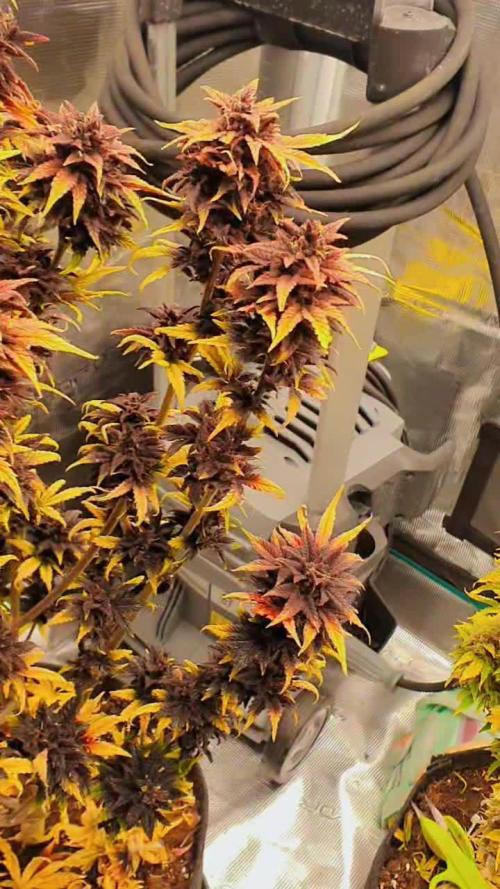
Day 14 - no water today, the girls seem to like their new pots (10 cm)
Day 15 - 300 ml water with Acti+Heaven+Grow (Ph 6.8)(11 cm)
Day 16 - litttle bit water (Ph 6.6)(13 cm)
Day 17 - 300 ml water with Acti+Heaven+Grow+Calmag (Ph 6.7)(14 cm)
Day 18 - 400 ml water + LST (Ph 6.6)(15 cm)
Day 19 - no water (16 cm)
Day 20 - 660 ml water with Acti+Heaven+Grow (Ph 6.5)(17 cm)
Day 21 - no water (starting to show preflower pistils)(20 cm)


Likes
16
Share


@Ladyblazed
Follow
Started a little training, cut down the older fan leaves and topped up. I’m adding a tiny bit of root stimulator cause changed the pot size last week so it will to promote a faster growth. Gotta keep this lady low cause the box is quite small. So excited 😆


Likes
14
Share


@GodZilla_Owner
Follow
Week 10 Update – Full Throttle with Advanced Nutrients 🌱
I’m now feeding 100% of the Advanced Nutrients schedule with all components. I noticed a slight calcium deficiency in the AN plants, so I’ve increased the base nutrients from 75% to 100%. Advanced Nutrients CalMag Xtra remains at 1ml/L, and it has been reliable throughout the grow with 0 EC osmosis water.
BioBizz#1 – BT42
The trichome ripeness is mixed—there are both amber and clear trichomes, so it’s not quite consistent yet. CalMag issues show up occasionally, but nothing that’s throwing me off balance—she’s doing fine! 🤞
AN#4 – BT42
She’s asking for a bit more calcium here and there but continues to dominate BioBizz#1 in terms of development.
EC: 2.5
pH: 6.4
Drain: pH 6.1 (EC not measurable due to organic soil).
AN#3 – BT38
This plant is visually about 2 weeks behind the others. The space between her and the lamp is down to 1-2cm—a disaster, but there’s nothing I can do at this point. PPFD is off the charts (1200), but she’s handling it and developing beautiful buds. Big respect to this strain—the stretch was no joke!
Humidity is well under control at
Likes
57
Share


@SmokieMcPot
Follow
PSA!! PSA!! PSA!!
WATCH those ZeroWater pitchers... when the filter goes, it goes FAST. Leaves you with a ton of undesirables, and AN EXTREMELY ACIDIC PH!! Acidity in the body leads to CANCER! will kill your plants fast as fuck too.
========================================================================================================
2 Girls 1 Cup week 11? We should come to a finish this week... oh the excitement. Can't wait to see WG without her leaves. Going to have to cut each branch and hang individually due to the density of its structure. Got this far, don't want to risk moldy weed.. damn I'm gonna get bored while drying/curing not having a plant or diary to occupy the time.
Day 77- currently flushing the girls. GC isn't ready for it, but she isn't in charge here. She should have stuck with WG when she extended a helping hand. Since falling behind, WG has thrown up a peace sign to GC as to say "see ya sucker". It's my favorite bud by far on WG. Bitch has got an attitude 🤣. RES sitting at 87ppm @5.9. Yellowing has started.. going to have to check trics more often so I get that sweet spot I'm looking for.
========================================================================================================
Day 78- these girls are starting to stink! Come on WG... ripen up so we can get this over with.. lowered lights power a bit today. RES climbed from 87 to 137. Drained 2gal, added 2gal RO. down to 38ppm. Forgot to mention the ice probe has been unplugged for over a week now. Been putting a 3/4 full 1L frozen bottle in the RES to chill. Rotate out every 12hr with a fresh. At lights on, and 12hr later. Full bottle got Temps too low for my liking.
========================================================================================================
Day 79- tick tock.. tick tock.. come on WG.. she's showing a little fade on her leaves. Seeing more of a calcium difficiency on her fans than fading honestly. Trichomes taking their time ripening as well. I'm SURE this strain ambers up.. taking their time for me though.. dont know how long I feel comfy flushing hydro though.. I did notice a few exploded trichomes up top, which has me thinking I need to go ahead and chop within the next couple days. If I notice any more ruptured anywhere else I haven't poked it with the scope.. I'm hanging the bitch that night. May give her 24hr dark period, since I've tried some other bro-science and it seemed to help.
*edit* felt bad starving WG and she's not more amber coated. Gave her a bit of nutrition tonight. GHE aggressive ripen. M-2.8mL/g G-2.8mL/g B-4.5ml/g and 5mL calmag (using RO). Came out high @ 867 so I pulled 2L and dumped 2L RO in. Sitting at 613 @ 5.9.
========================================================================================================
Day 80- well, the 3 days starving the girls kicked their metabolism back in gear. I want more amber before chop chop. They quit eating and were drinking MUCH less signaling the end. Was down to topping off once a day, maybe a liter to a liter and a half. Since feeding yesterday, they've started eating and drinking like they were on week 10 again. Topped off 3.5L in the last 16hrs. TDS dropping with water level, even more when topped off with straight RO. I'm not giving em any more nutes. Last push for some extra weight before the end. ALLOT more frosty today than yesterday as well.
========================================================================================================
Day 81- Started flushing again. Maybe starting their metabolism again will help ripen these trics. If not, they're getting chopped @ day 84. Don't want to let em go too long and regret it. I may have f'd em up feeding again after the 3 days starving. Time will tell
========================================================================================================
Day 83- still waiting... 💤
Going to order some bubble bags. Freezing all GC and trim/larf from WG for some bubble hash. GC is frosty and all white like WG, just tiny popcorn shit everywhere since it's been neglected and abused over and over and over and over 🤣.
========================================================================================================
As always, thanks for stopping by and checking out my current grow. full timelapse added to this week 27-70 (looks better on YT.. https://youtu.be/8JdUkR36Wfc)
Likes
5
Share

@Growfather1
Follow
Hello everyone.
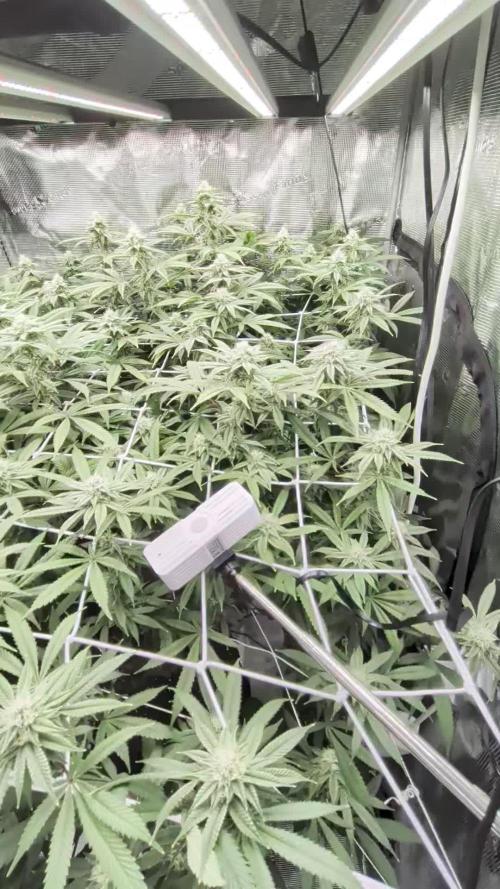
It is Day 27 of flowering, and she is stretching like she just woke up from a long nap.
The conditions are being a bit moody this week, with humidity swinging around 67% in the lung room and temperatures creeping up to 29°C inside the tent due to the dehumidifier working overtime.
On the feeding side, I started pushing the limits with PK 13/14 at 1.5 ml per 1 liter, alongside 2.8 ml per 1 liter of Canna Coco A and B.
Thank you for stopping by and have a nice day.
Best regards,
Growfather.

Likes
37
Share


@GreenHouseLab
Follow
Apple Fritter smell for days, makes you want to keep your nose in the bag. Ill need to grow this one again.
Likes
3
Share


@SamDo
Follow
🌱 Grow Journal – Week 8
This week, the plant kept growing steadily and looks healthy overall. She gained almost 8 centimeters in just seven days—that’s more than a centimeter per day, which is a great sign of strong development.
I’m planning to work on her structure a little: probably a topping in the coming days, along with a light defoliation. The goal is to open up the canopy, improve airflow, and make sure the light is distributed more evenly, while guiding her growth in a balanced way.
The main challenge this week has been the pH. This morning, the reservoir measured 4.8 while the tray was at 5.2, a 0.4 difference. I honestly don’t understand why the drop was so sharp. I had added Athena Balance, which should stabilize the nutrient solution. The only explanation I can see is the heat—we hit almost 31°C this weekend, and I suspect the nutrient solution was heavily affected by the temperature rise. If anyone reading this journal has insights on why this happens, I’d be glad to hear them.
It’s a bit frustrating, because Autopots are supposed to make things simple. But in reality, I still need to monitor closely, especially since the coco buffer doesn’t seem to be doing its job properly—or maybe the reservoir just dropped too low and threw everything off. Either way, I’ll stay vigilant. Hopefully, with summer ending and temperatures cooling down, the solution will stabilize and the pH won’t swing so much.
On the positive side, I’m still really happy with Athena nutrients. The solution stays crystal clean, no buildup, no deposits, and that makes things a lot easier to manage.
So overall: strong growth, healthy plant, but pH management continues to be the main challenge. Let’s see how things evolve next week.

Likes
Comments
Share

@BushDoctor740
Follow
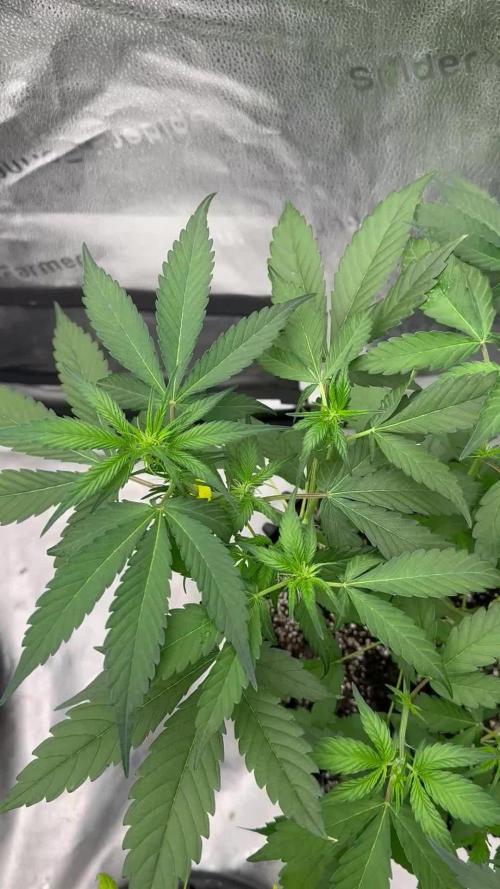
They have all started showing signs of flower and moving along quickly.Im seeing a huge stretch this week and the girls are filling out nicely.I have increased the se7000 to 60 percent light intensity and they are taking it well.Maybe I’ll add a net to get more light penetration or maybe not as I like to be able to spin the pots around.
Likes
52
Share


@MadeInGermany
Follow
Flowering day 44
since time change
to 12 / 12 h
Hey guys :-)
The buds are becoming incredibly beautiful and smelling better and better ☺️.
Today there was again the full load of food and will be slowly driven down as soon as it comes to an end :-)
Was watered 3 times a week with 1.2 l each (nutrients see table above)
Otherwise everything was cleaned.
Have fun and stay healthy 💚💚💚
👇🏼👇🏼👇🏼👇🏼👇🏼👇🏼👇🏼👇🏼👇🏼👇🏼👇🏼👇🏼
You can buy this Nutrients at :
https://greenbuzzliquids.com/en/shop/
With the discount code: Made_in_Germany you get a discount of 15% on all products from an order value of 100 euros.
👇🏼👇🏼👇🏼👇🏼👇🏼👇🏼👇🏼👇🏼👇🏼👇🏼👇🏼👇🏼
You can buy this strain at :
https://www.ripperseeds.com/en/feminized/kmintz-feminized-cannabis-seeds
Water 💧 💧💧
Osmosis water mixed with normal water (24 hours stale that the chlorine evaporates) to 0.2 EC. Add Cal / Mag to 0.4 Ec Ph with Organic Ph - to 5.8 - 6.5
MadeInGermany