




Likes
5
Share


@Vegetoo420
Follow
End for this SLH ! Dutch classic I must ran ! Never forget the first time I smoke it in Amsterdam XXX !

Likes
1
Share


@I_Identify_As_A_Dan
Follow
Week 4 for AK Triple Haze Auto by SSSC,
This strain has doubled in size since last week, but unfortunately as you can see she's already in full preflower mode😒 meaning she wont be a massive plant, was really hoping she would give 6weeks of veg time not 3....😂 But in saying that i still love her structure & really look forward to seeing how she comes out in flower😍 I will be moving her outdoors today as well as we have a few cloudy days coming up that should help her have a smooth transition to the outdoor sun 💪.
Will also start doing some LST on her now that she will have wayyy more room to go side ways.
Shes still only being fed water only because of her @naturelivingsoiluk mix😇


Processing
Likes
Comments
Share


@CityFarmer
Follow
Hello everyone,
The girls are finally outside in 20 gallon fabric pots. This season I have a greenhouse for them and I hope it goes good. Still have to build the first cages around them and start stretching them. 🎊🎉 finally, summer is here 🎉🎊
See you guys next week 🤞🤞🤘🤘👊👊👊
Likes
14
Share


@Chronigmatic
Follow
Ok so it ends here.
Loved this babies fron the begining. I was starting to have issues with neighbors about the smell so did the cut. I think not that far from point.
Fresh weight
Pheno 1: 322g
Pheno 2: 288g
Overall: 610g
Hope like 180g dry.

Likes
5
Share


@wheedtobeus420
Follow
Day 40 she’s beautiful and huge and just perfect. I’m very excited for her and how she had progressed so far.

Likes
15
Share


@DRO420
Follow
Switched to my 4x4 tent with 400 watt bloom plus. Also added my first video of this diary. Plants have been repotted into bigger medium. Only the Blue Dream and Blue Haze will stay in this tent because they are both sativa leaning. The blue cheese will go back into my other custom cabinet for flowering. I keep them separate so I can grow bigger plants and Indica flowers for roughly 2 weeks longer than sativa strains .

Likes
12
Share


@StonedandSteady
Follow
AutoBlueberry 11th w/ 6th W/ Flower breed by #DivineSeeds #DivineSeedsSquad #DivineSeedsBreedingCompany
4th feed of #NukeHeads Nutrients #PlutoniumBloom Check out these Lush Ladies and those Awesomely Purple Budz with Trippy Trichomes Growing on! I'm also trying to make and/or convert one of my Budz into a Polyploid (Bigger and More Bulbous Bud) This AB is Flowering out and her Smells are Super Strong of Gasy and Candied Blueberries! I recently Trained down her branches to expose more Bud sites and Removed the Biggest fan leaves to expose the Bud site's to this Glorious #OsreeQB1000w Full Spectrum Grow Light! I've also Super Cropped, Topped um, Defoliated, Leaf tucked, and Implement the 3D's method like my Broski #TigerfishOrganics to remove the Dead, Dying and Diseased leaves!
Origin:Afghani/Thai
Type:50% Indica/ 40% Sativa/ 10% Ruderalis
Flowering:56 days
THC:22%
Harvest:400-550 g/m2
Height:110-150 cm
They were Growing under the #Growatt600w and in my #TopoLite 24×24×48 Grow Tent but I've Upgraded and Updated it to my #OsreeQB100W I'm also using #TNBNaturals #TheEnhancer Co2 Despersal Canister and using thier Ph⬆️⬇️ for my Decolinated Tap Water!
Green and Growing Up Great! She's Growing into her 6th week of Flower! She's Growing in my special blend of ProMix potting mix, a 1/2 bag of Earthworm castings and 2 light handfuls of Diatomaceous Earth mixed Up well for before transplanted! Diatomaceous Earth: Diatomaceous earth is made from the fossilized remains of tiny, aquatic organisms called diatoms. Their skeletons are made of a natural substance called silica. WHAT IS DIATOMACEOUS EARTH?
In a nutshell, DE comes from the fossilised remains of small marine organisms called diatoms. Over a 30 million year period, these hard-shelled algae collected on the bottom of bodies of water, eventually forming into a type of sedimentary rock. Fast forwarding, it wasn’t until around 1836 that a German peasant Peter Kasten discovered the ivory-coloured, powdery substance while drilling a well in northern Germany. Ever since, the usefulness of DE for multiple purposes, including industrial and horticultural applications, has been well-reported. Just sprinkle some diatomaceous earth on top of your soil and watch mother nature's secret weapon work its magic.CONDITIONS THE SOIL
When it comes to growing cannabis, everyone strives to provide the best soil to grow the best plants—but there’s always a way to make it even better. Making the soil a better medium is called soil conditioning, which is exactly what diatomaceous earth does. It works by improving the retention of moisture in your potting soil, holding a large amount of fluid and drying at a rate that’s much slower. This natural soil additive also helps to retain nutrients and allows for better oxygenation of the substrate. NATURALLY CONTROLS PESTS
DE is an all-natural, safe-to-use substance that doesn’t harm the cannabis plant with toxic chemicals. The nature of diatomaceous earth makes it useful against most types of insect infestation you might be experiencing; and unlike chemical insecticides, insects can’t develop a resistance to the effects of DE. So once they’re gone, they’re gone for good. DE is an abrasive. and when used as an insecticide, it gradually scrapes away an insect’s exoskeleton, absorbs the fluids, and dehydrates insects and other critters to eventual death. IMPROVES PLANT STABILITY
When using DE in your soil, it can be especially beneficial as it frees up nutrients so that they are made available to the plants as needed. This works via the silica content of DE being absorbed into the plant tissue, which helps improve the plant’s ability to respond and receive more nutrients as DE activates. This in turn results in greater yields and better stability under small pH fluctuations!
https://divineseeds.net/
https://instagram.com/divine.seeds?igshid=osxe2v7en33v https://divineseeds.net/
Thanks Again to All my Friends, Family's, Teams, Sponsors, Followers and Subscribers!!! Your Genetics are Merry Magnificent, Mega Marvelous and Mighty Medical! Love um!!! I really Can't stress enough how Thankful and Grateful I am of All of you and what you've Shared with Us! Means the World!!! It's definitely a Pleasure being able to Grow with these Phenomenal Grow Lights! Please Enjoy! BudBrothers4-Life! Cheers Famz!!! Much Props and Much Topz!💯🔥 #Osree #GrowStarStore #Growatt #TNBNaturals #TNBTeam #GrowYourOwn #Bliss
https://instagram.com/osree.light?utm_medium=copy_link
https://instagram.com/as420.ca?igshid=1f116alw054wp
The Grow Bags: https://www.as420
https://instagram.com/tigerfish_organics?utm_medium=copy_link
https://www.facebook.com/Tigerfishorganic/
#TigerfishOrganics YouTube Channel Link: https://youtube.com/channel/UC6OSXTda1JYaVNoCxdcYqIg

Likes
14
Share


@Crazy_Doofus
Follow
Bit of amber, its time! The buds are really thick!! 66gr wet, not a lot... 17gr dry, in a jar +58% humidity pack
Likes
4
Share


@Sternharvest
Follow
First week after germination.
Started to use some BioBizz products. (Root Juice, Bio-Heaven, CalMag).
The water I started with is demineralized and has an PPM of 45.
I moved the lamp to 25in (63.5cm) and turned on the lamp intensity to 60%.
I will start Bio Grow + FishMix + Alg-a-mic + acti-vera in week 2 and remove Root Juice
Water + BioBizz:
Day 1 = 1L each plant -->EC 0.270
Day 2 = 500ml each plant -->EC 0.270
Day 3 = 500ml --> EC 0.300
Day 4 = 1L --> EC 0.300
Day 5 = 1L --> EC 0.300 --> lowered the light to 22inches, Added a humidifier to keep it at 55-60%
Day 6 = 1L --> EC 0.300 --> added a second fan, 1 wasn't enough.
Day 7 = 1L --> EC 0.300 --> lowered light to 17in. humidity 55-60c
I am currently watering manually and decided to not use the Autopot, but instead get two water pumps to extract the run-off and feed. Will add pictures when done with the set up.
Lessons learned:
Should feed with 1L water instead of 0.5L since EC runoff is much higher with feeding 500ml.
I think i could have started with the lamp at 25in once i transplanted it in the final pot.


Likes
27
Share


@Elixx
Follow
It's start the 10th week, I think it will the last week and after I will harvest it. Buds have a very good density and smell is amazing. The cage is very usefull I don't notice any other attack in both plants.👌

Likes
11
Share


@CrushedCana
Follow
La planta le encantó la nueva luz y empezó estirarse demasiado tanto que para controlar su altura apliqué una poda apical la cual respondió muy bien y empezo a sacar 2 puntas principales

Likes
8
Share


@viriato0811
Follow
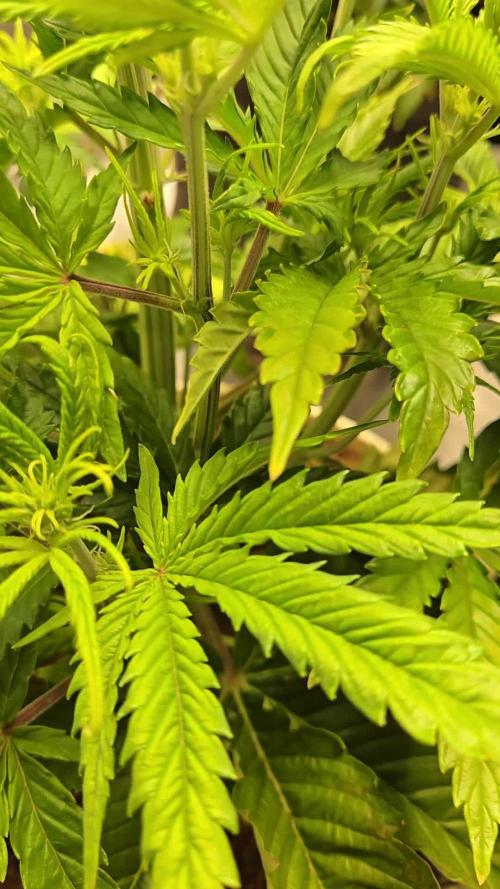
Well all going good around here. This week will see a significant stretch, now that she is heading towards full flowering. Will stay close and keep removing leaves blocking the light to bud sites. 👍🏻👍🏻🌱🌱

Likes
5
Share


@Ninjabuds
Follow
I'm really happy with the gas tax x obama runtz plant is doing. It started out so small, I wasn't sure if it was gonna make it. But lately it's taken off. The leaves are a lot bigger and the colors are so vibrant. I can tell it's happy and healthy now.
Well, it's Christmas again. This year feels a little different, though. Maybe it's the snow blanketing everything, or the way the tree lights up the whole living room. Either way, it's cozy and warm, even when it's freezing outside. I'm really looking forward to seeing what Santa brings. I hope I get that new video game I've been wanting. But most of all, I can't wait to spend time with my family. We always have so much fun
This past week was a good one for the plants. They started the first week of their stretch, and they've already grown a decent amount. I can really see them filling out. It's cool to watch them grow so fast. I can't wait to see how big they get by the end
I always get a little worried at this stage, like they're not gonna get as big as I want them to. But then I remember how they always end up surprising me. By the end, they're always perfect.
Likes
34
Share


@BelSun_420
Follow
I would like to express my gratitude to Plagron and Zamnesia for organizing this incredible contest, providing the community with the opportunity to participate, showcase their skills, and learn from one another for free.
Initiatives like this strengthen the spirit of the community and highlight the talent of so many unknow dedicated growers.
I am BelSun, a 34-year-old guy who started planting in 2018, mainly focusing on autoflowers,indoor setups and organic grow .
Hope you enjoy my Journey on Eternity Grow Cup 2025 🏆💚
The main setup and a simple recipe on this journey as a thank you to Plagron and Zamnesia 👨🏻🌾
Runtz Automatic Zamnesia (3 seeds)
Fabric Pot 3x15L
RoyalRoom Classic C100
Electric Sky 180w v2
Plagron - Seeding & Cutting Soil
Plagron - BatMix Soil
Plagron - Perlite
Plagron - MegaWorm
Lurpe - Earth Vibes Super Soil
Lurpe - Volcanic Ash
Cultivers - Basalt Powder
THC - Epson Salt
THC - Delomite
Vithal - Bokashi
Mycoterra - Alfalfa Meal
Canna-BioRHIZOTONIC
Agrobactérias - Bactomatik Rex
Plagron - Alga Bloom
Plagron - GreenSensation
*Plagron Schedule 100% Natural
*Topdress amendments along the way if needed.
*Light Schedule: 20h
*Watering System: Manualy
*Paper Towel MethodI
I'm going to start in the middle of January, for now I still have some plants finishing flowering in the tent.
Good luck for all!
💚
-------------------------------------------------------------------
#10/01/2025
I’ve prepared my Super Soil mix, and it’s now cooking until I start germination, which will be in about 3 weeks.
-------------------------------------------------------------------
#03/02/2025
For germination, I leave the seeds in a bottle of water for 12 hours, then transfer them to a paper towel until they sprout a root. This method has worked well for me!
-------------------------------------------------------------------
04/02/2025
I’ve transferred the seeds to the paper towel method!
Now it's time to Pot preparation!
For my pots, I use a three-layer method, filling each layer while shaping them with different-sized pots:
- First layer: Super Soil
- Second layer: Regular fertilized soil (BatMix by Plagron in this case)
- Third layer: A light soil with mycorrhizae (Seeding Soil by Plagron)
-------------------------------------------------------------------
#05/02/2025
I’ve planted the seeds!
I'm using a cheap LED light from Amazon just to kickstart germination and gain a few extra days to finish flowering the plants in my tent. As soon as they sprout, I'll transfer them to the tent, where my old but fantastic Electric Sky 180W is waiting for them!
-------------------------------------------------------------------
#08/02/2025
Two of them have already germinated, but one still hasn’t. I’m struggling with low temperatures, as it's been only 12°C during the day and between 3°C and 7°C at night.
Unfortunately, I had a bit of bad luck—my lamp fell onto the pot, disturbing the soil and seeds of two plants. One of them is the one that hasn’t germinated yet.
Just in case, I’ve put two more seeds in the paper towel method as backups. If I don’t need them, I’ll give them to a friend!
🙂
-------------------------------------------------------------------
#10/02/2025
I placed them in the tent on the 10th. Two of them germinated on the 8th, while the other was affected by the lamp falling.
I’ll probably replace it with one of my backup seeds and offer #R03 to a friend, but it all depends on how things go in the next few days.
-------------------------------------------------------------------
#12/02/25
I replaced the seed that went into shock with one of my backups. So, from now on, #R03 will be the backup seed, and it will be about a week behind the others.
---------------------------------------------------------------------
#13/02/2025
The backup seed has sprouted! 🌱
---------------------------------------------------------------------

Likes
6
Share


@GrapevineGrower2
Follow
Days 42 through 49 of flower and all three Phenos are expressing themselves differently. Pheno #1 continues to express darkened fan leaves almost purple and much more frosty than her sisters. Pheno #2 is the other end of the spectrum remaining green, but less frost. Pheno #3 seems to be a mix of the other two and its fan leaves are turning colors of autumn. Those are my visual observations as we head into week 8 of flower with harvest just around the corner.
No nutrients or grow techniques used during week 7 flower. Other than a watering to saturation on day 42, I really haven't done anything other than observing and maintaining health of plant. For me, that involves tracking VPD to ensure optimal plant performance. Able to track VPD with recent upgrade to the AC Infinity Cloudline Pro fan system. The integrated environmental controls managed on my smart phone has been a game changer. So, happy that I made the upgrade.
Thanks again for stopping by and checking out the diary.


Likes
35
Share


@g_slim
Follow
The weather has been better: 3 days with no rain and the other days had at least a couple of hours of sun, more or less.
We fed compost tea on day 61, other than that mother nature provided rain during the week.
I put up netting for the other two Passion #1 (1+4). It is not pretty, but useful, both have taken well to the LST. The pictures on day 66 show it. Number 4 is finally comming along, although number 7 is still far ahead.
The ICE are still filling in. I hope they are ready by mid July, because I plan to go on vacation and wanna harvest before then. They are producing resin, but I am not impressed yet.
The Cream are going to be ready by mid July for sure. Number 8 is already showing up to 20% amber triches, depending on where you look. I might harvest the main bud next week and let the sides sit for another week or so. Number 9 will need 2 more weeks at least, from what I can tell. I havent even ckecked her triches so far.
Defoliated all autos some more and took of the lowest shoots on the Passion.
Addendum: unfortunately the time lapse on my security cam bugged out and I had to start a new one. I hope, this one will record until October...

