




Likes
7
Share


@Cultivatorcarlos
Follow
Week 4 was actually pretty smooth. she was showing nitrogen and potassium deficiencies because she was being terribly underfed and because i had weened her off the veg nutes WAY too soon. I found the dyna gro nutrient schedule and ive been following that. i will definitely be following the schedule much better next round as i wasnt actually aware they had a schedule out. Shes currently week 5 day 1 and shes already fat af and super trichomey.s he still got at least 2 weeks left. she might be ready by week 7 honestly tho who knows guess well see. Ive been giving her 1 gal each time of dechlorinated tap water just straight water. it has been phd to 6.6 ph. runoff tested at 6.3 ph. will probably flush one last time before continuing the bloom feed.

Likes
5
Share


@Rock_n_Roll_Randy
Follow
This was a nice taller plant that filled in nice and is extremely delicious. It has a slight orange flavor and smell mixed with a very strong sherbert taste and smell and very dank kushy skunk exhale but I still taste the orange sherbet too and it is mouthwatering and potent. I smoke it at night because it is very strong stuff. Highly recommended strain because it is very strong and very delicious

Likes
Comments
Share

@cdxxbuds
Follow
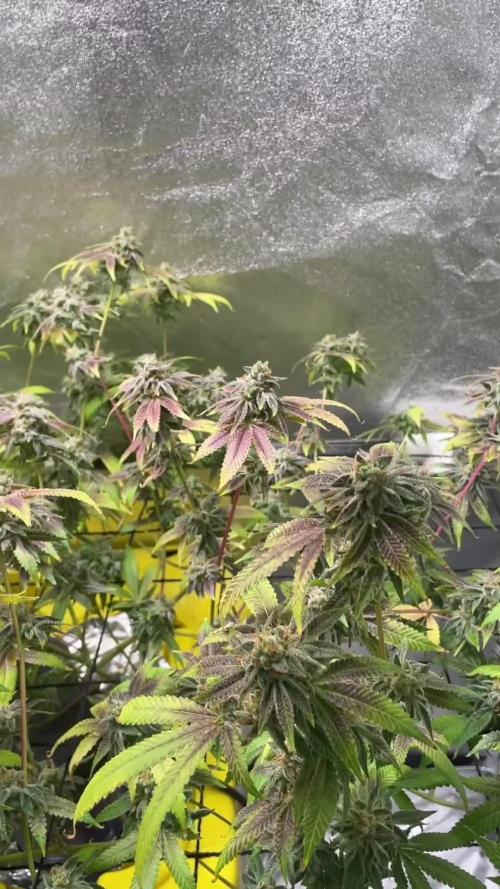
Week 8 and we done . Harvest tonight. These ladies arr hella frosted. 56/56

Likes
11
Share


@Willy_Balls
Follow
There is not much stretching going on probobaly due to root issues I've had before. Pythium I guess.

Processing
Likes
15
Share


@MG2009
Follow
02/15/2021
In the first pic you will notice bottom growth which will become my new moms! At least 3 there now. Top is stretching nicely I will have to decide soon if I want to top her or not, I will know better next week.
02/17/2021
Got two cuts today maybe two more by next week. 3 for the garden, 1 for mother plant.
Ps.
She grew an inch and a half in two days, so all is well.
02/20/2021
Stretching up to 13.5 inches(34.9cm) almost 5" in less than a week, I think she is happy!
On a side note lower growth will produce two more clones for summer garden. can't wait to see her flower! I will probably need to top as she should stretch 1.5-2 X's in flower stretch.
Till next weekly update happy growing!🙏
Likes
118
Share


@SwissKush
Follow
Day 71 - BEAST!
a. her size is so large, and the buds are def "Big Bud"! there is resin everywhere, very fruity like pineapple express
b. will be topping off the DWC all week with 6.0 water.. gradually diluting the ripening formula, 1300ppm right now, end of week should be at 400ppm, then flush week
c. light schedule is now 14 hours on, 10 hours off. this allow the buds to mature properly and become potent, next week probably 12/12.
d. still drinking 6 litres of water a day
Day 72 - fat buds
a. her buds keep swelling outward, the calxes are exploding, some stigmas are turning brown, about 5%
b. these buds are very hard, cant understand how dense these are!
c. really happy with this strain!
Day 73 - 10th day of ripening
a. the pistils are slowly becoming brown, maybe 7% of the plant has matured
b. the smell is unreal, VERY fruity and gassy
c. ppms have been controlled at 1300ppm with plain water diluting the pool
Day 74 - flush beginning
a. pumped out 10L from the DWC, and added 10L of 6.0 water, 650ppm
b. the flowers are smelling very strong
c. the buds are becoming ripe, the stigmas are turning colors
Day 75 - pistils 30% orange/red/brown
a. set lighting intensity to 50%, simulating the sun moving farther away from the plant like in fall
b. drinking 5-6L a day still
c. the buds are very hard, thick and oily, the resin on my hands smells very good
Day 76 - maturing great
a. cutting down the temperatures, and humidity and lessening the intensity of the light always causes nice dense matuation
b. DWC running de-chlorinated tap water, 140 ppm
c. next week is all flush week, and turning to 12/12
d. she is still drinking 5-6 litres of water a day!
e. the buds are maturing very nicely, the smell is INTENSE!
Day 77 - mature buds
a. the buds are maturing, calyxes are swelling, and the buds are getting heavier
b. about 50% orange stigmas, trichomes there are still some clears left, no amber visible yet
c. DWC is being kept full of plain water, 160 ppm in DWC
Processing
Likes
20
Share


@Cinderman
Follow
Same nutes, I'm keeding usually but 1/3 than usage even less.. sweet smell start raising stronger.


Likes
4
Share


@Grow_bob
Follow
Vorgestern hesi Dünger gegeben Heute nur Wasser und Supervit das in 2 tage nochmal und in 4 Tagen weiter düngern mit hesi

Likes
2
Share

@GingerGarageGrow420
Follow
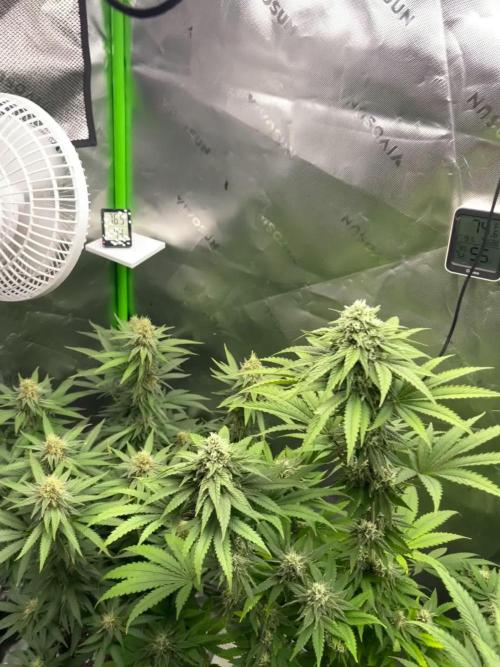
Strain: Chill Out OG F4
Day 35 Flower
Day: 84 from sprout
Medium: Fox Farm Ocean Forest
Light: Vivosun VS2000 at 75%
VPD: 1.5 kPa
Light Distance: 12 inches
Watering: By hand, ~oz daily
Nutrients: pH Perfect Advanced Nutrition Grow, Bloom, Micro 2 ml / L, 1 ml / L big bud
Pistols and terps looking great


Likes
12
Share


@GanjaGecko
Follow
WEEK4/1F
Die Guava befindet sich parallel zur Blütenbildung auch ordentlich im Stretch. In der Höhe hat die Guava gut um das doppelte zugelegt. Zur Stabilisierung und dem Schutz vor zu viel Wind hat die Guava eine kleine Stütze an ihre Seite bekommen. Mit der direkten Sonne ohne den Schutz vom Mini-Gewächshaus hat sich die Guava super arrangiert. Zum Ende der Woche war das Wetter recht durchwachsen und es gab leider etwas weniger Sonne und leider auch etwas Regen. Dafür soll es aber Dienstag/Mittwoch kommender Woche ordentlich Sonne geben💪🏼
Gegossen wird immer nur nach Bedarf. Bei dem Regen Ende der der woche brauchte natürlich nicht viel gegossen werden.
Likes
10
Share


@BodyByVio
Follow
This week I Supercrop all the plants and spred them out over both lights. One more week of Veg and they are ready to explode
Check me out on Instagram @growmorestressless


Likes
12
Share


@Sieben
Follow
I got at least 2 vids this time , in the next week a lil bit more , i use the whole hesi nutrient pack btw and are really impressed what LED and a noob scrog grow results to , don´t get me wrong but its a huge difference to hps and some untopped plants under it ;) , happy about all feedback btw.
The small growing Orange Lemon in mid seems to have a lot more haze DNA .
Left Gran Jefa, right back Fullgas , right Front and mid Lemon Orange.


Likes
2
Share

@DogDoctorOfficial
Follow
👑 Godfather OG – Pheno A
Week 7 | Reaching for the Sky
Welcome back to another chapter of the 8×8 Adventure!
One of the things I enjoy most about this project is seeing just how differently genetics express themselves when every plant shares exactly the same environment.
Every phenotype receives the same light.
The same nutrients.
The same temperatures and humidity.
The same care.
And yet...
Every single one chooses her own path.
Godfather OG Pheno A has clearly decided that her path is upward.
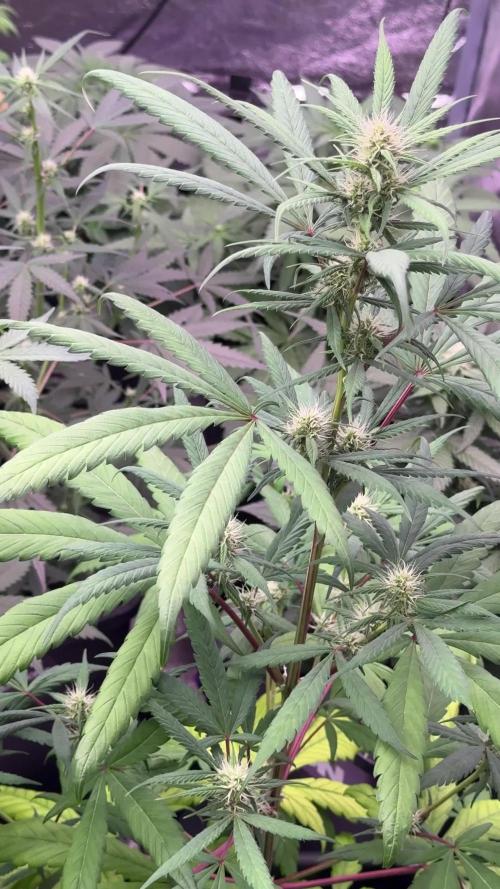
At approximately 166 cm tall, she has become one of the tallest ladies in the room, stretching confidently above much of the canopy while maintaining an elegant structure that seems almost effortless.
She's becoming difficult to ignore.
🌱 One Garden, Twelve Different Stories
For anyone joining this diary for the first time, welcome!
This entire project is an experiment in growing twelve different cultivars using the 12/12 From Seed technique.
Instead of giving the plants a traditional vegetative period, every seed was placed under a 12-hour light and 12-hour dark cycle from the very beginning.
The result is something I absolutely love watching.
Every phenotype writes its own story.
Some remain compact.
Some focus on branching.
Others build flowers early.
And then there are plants like Godfather OG Pheno A...
...whose first instinct seems to be reaching for the lights before settling down to build flowers.
It's a perfect reminder that genetics will always have the final word.
👑 Chasing the Ceiling
This week she continued doing exactly what she's been doing since flowering began...
Stretching.
And she's doing it beautifully.
Despite her impressive height, the internodal spacing remains excellent, giving every future flower plenty of room to develop while allowing light to penetrate deep into the canopy.
Rather than becoming lanky or unbalanced, she carries herself with remarkable elegance.
Every branch appears purposeful.
Every node seems perfectly placed.
Watching her grow feels less like managing a plant and more like watching architecture slowly build itself.
🍃 A Picture of Health
If I had to describe this phenotype in one word this week...
Healthy.
The foliage carries a rich, vibrant green colour from top to bottom.
The leaves are perfectly formed, reaching confidently toward the light without any signs of stress.
The stems remain thick and sturdy, easily supporting the rapid vertical growth.
Sometimes the healthiest plants aren't the ones screaming for attention.
They're simply the ones that quietly look perfect day after day.
Godfather OG Pheno A is quickly becoming one of those plants.
🌸 Flowers Beginning to Take Shape
The stretch may still be continuing, but flowering is becoming more obvious with every passing day.
Fresh white pistils continue appearing across every branch, and the individual flower sites are beginning to develop into recognizable bud formations.
They're still early.
Still delicate.
Still building their foundations.
But the framework is now clearly visible.
The coming weeks should see these small clusters begin merging together into longer, fuller colas as the plant gradually shifts more of her energy away from vertical growth and toward flower production.
🌿 Letting Genetics Lead
One of the things I've learned over the years is that not every vigorous plant needs constant intervention.
Sometimes the smartest decision is simply getting out of the way.
Only minimal adjustments continue this week.
A little leaf tucking.
The occasional branch repositioning.
Nothing more.
Her natural structure is already doing an outstanding job of distributing light throughout the canopy, and I don't see any reason to fight what her genetics are naturally trying to accomplish.
Sometimes nature really does know best.
🍽️ Feeding the Entire Room
As with the rest of the 8×8 Adventure, nutrition is shared across the entire reservoir, each phenotype receives the exact same nutrient solution hand feeding or autopot.
This week's feeding included:
• Terra Bloom – 2 ml/L
• Green Sensation – 1 ml/L
• Sugar Royal – 1 ml/L
• Power Buds – 1 ml/L
• pH adjustments using Lemon Kick and pH Plus when required
The increase to 2 ml/L of Terra Bloom wasn't made specifically for this plant but for the entire room, as all twelve ladies continue moving deeper into flowering together.
Even though every phenotype responds differently, they all share the same table.
🌡️ Environmental Conditions
Maintaining consistency remains one of the biggest priorities throughout this grow.
This week's averages included:
• Day temperature: 29°C
• Night temperature: 25°C
• Relative humidity: 60%
• pH: 5.8
• EC: 1.95 mS/cm
• Nutrient solution: 22°C
• Root zone: 21°C
• CO₂ concentration: 639 ppm
Stable conditions allow the genetics to express themselves naturally, and this room continues proving just how important consistency really is.
📸 This Week's Gallery
This week's photographs tell an exciting story.
The wide shots immediately reveal just how much taller she's becoming compared to many of the surrounding plants.
The close-ups showcase beautiful early flower development, vibrant green foliage, and exceptionally clean internodal spacing.
One of my favourite images captures her standing proudly above the canopy.
It's almost as if she's announcing to the room that she isn't finished stretching just yet.
She's becoming one of the true standouts of this project.
🔮 Looking Ahead
The biggest question for next week is simple...
Will she finally slow down?
Or does she still have another growth spurt waiting?
Either way, I expect the stretch to gradually begin easing while flower production starts taking priority.
Those clusters of fresh white pistils should continue stacking into larger bud sites, and if everything continues progressing as smoothly as it has so far, the first noticeable resin production shouldn't be too far away.
She's already among the tallest plants in the room.
Now it's time to see if she can become one of the most productive as well.
💚 Thank You
Thank you so much for following another chapter of this 8×8 Adventure.
Every week reminds me why phenotype hunts are so fascinating. Even when every variable is carefully controlled, each plant still finds her own unique way to express the genetics she's carrying.
Watching those differences unfold week after week has been one of the most rewarding experiences of this entire grow, and I'm grateful to everyone sharing the journey with me.
A special thank you to:
💚 GrowDiaries for giving growers around the world a place to document, learn, and inspire one another.
Zamnesia for providing the outstanding genetics that make this phenotype hunt possible.
🌱 Plagron for the nutrients supporting every stage of this grow.
💡 Future of Grow LED for delivering the power behind every leaf and every flower.
🌿 TrolMaster for helping keep the environment stable around the clock.
✨ Lumiflora for adding under-canopy lighting that helps ensure the lower flower sites receive the light they deserve.
And finally...
Thank you to everyone who follows these diaries, leaves a comment, shares advice, or simply enjoys watching these twelve very different personalities grow together.
Your support makes every update even more enjoyable to write.
I'll see you all next week as Godfather OG Pheno A continues her race toward the ceiling and, hopefully, begins transforming all that incredible structure into equally incredible flowers.
Until then...
Growers Love and happy growing, everyone! 🌱👑💚
Likes
48
Share


@CHILLING_RACOONS
Follow
Dear Friends ❤️
in this week we topped again and bended these two Mob Boss by Anesia Seeds.
They recovered really fast from this stress, from now they will develope a lot of bud sites!
the week of difference is allways less noticeable. I missed to give top crop Big one at 14 october, it is important to give 10 days before flowering
The last day of this week we switched the light to 12/12
week #5 of vegetation
The 240w light is working at 50% power and now it is combined with the 480w quantum board.
I consider week 4 the week from 18/10 to 24/10.
day to day fert schedule:
📅 18/10
📅 19/10 NEEM OIL
📅 20/10
📅 21/10 Top Veg 3ml/L-Deeper Underground 2ml/L - Green Explosion 2ml/L - big one 2ml/L - PURPINATOR 1,2ml/L
📅 22/10
📅 23/10
📅 24/10
I really want to thank Martin of Anesia Seeds, he helped us with the strain's choiches, so THANK YOU Martin, thank you Anesia seeds.
Seeds and merchandising ( my god we love these things ❤️❤️❤️) were sent in a dark discret package, shippin was incredibly fast, now is our mission to achieve the best from these lovely seeds.
Germination was incredibly fast, less than 36Hours to make the root sprout on.
ABOUT MOB BOSS🤓
Mob Boss, feminized Seeds
The rare Mob Boss genetics of Anesia is an extremely resinous, potent and high-yielding cannabis strain that sets new standards. To develop the Mob Boss strain ANESIA Seeds crossed a Chemdawg D with a Tang Tang and selected the resulting plants for potency and big yields over several generations. We stabilized the genes over many generations and have brought with it a true miracle of resin on the market.
Mob Boss has 2 phenotypes, which differ slightly in growing and blooming period. The flowering time of the stocky growing variation is 60-65 days, while the higher growing pheno requires 5-10 days more to mature fully. During her flowering phase she produces yields of 700g per square meter. Outdoor she can be harvested in early October and you can look forward to about 800g per plant. Because of her huge resin production this strain is well suited for the production of BHO and other extractions.
The aroma of the Mob Boss is very fruity with berry notes. The first Pheno offers strong psychedelic effects and triggers daydreams while the second pheno delievers a more clear and energetic head-high. Mob Boss relaxes the body and is an ideal strain for the weekend with its unique intensive and versatile effects. It helps to relax your mind and body while recharging you.
The Mob Boss strain is rare and special cannabis genetics which could be safed and stabilized by Anesia. With their extremely frosty and resinous flowers and their high production she has made herself a name and inspires every grower who once cultivated her. The buds look impressiv crystalline and often red or pruple coloured. The effects of Mob Boss are long-lasting, extremely strong and fast hitting. She has an THC content up to 28,7% and is specially recommended for experienced users.
Growing Mob Boss
Mob Boss is a perfect plant for SCROG methods, as it will produce large colas on well-trained side branches and continues growing more dense into the next time. This plant seems give the best combination of yield and quality when grown hydroponically.
Medical Use
This strain is used for mood elevation, appetite stimulation and for pain relief. It is a strain for daytime use.
• Yield: 700g/m² • 800 g/plant
• Genetics: 40% Indica, 60% Sativa
• Flowering time: 60-75 Days
• Outdoor harvest: Mid of october
• suitable for indoors and outdoors
• Height: 110-120 cm • 180-230 cm
• THC: 28.7%
• Aromas/ flavors: forest berries
BUY MOB BOSS FEMINIZED: https://anesiaseeds.com/product/mob-boss/
🔧💡WHAT I AM USING💡🔧
-LIGHTS:
💣Quantum board - 480w - 4x120w Boards by Zhoangshan Koray Opto-Electronic Ltd.
Samsung LM301B 288 led/board
+24led/board led Osram 660nm
Efficiency 2.6 umol/J 220 lm/w
Driver: Meanwell HLG-480H-36B
temperature: 3000k
Heat dissipator board: No
Noise: 0dB
💣Quantum board - 240w - 2x120w Boards by Shenzen Yuanhui Led Ltd.
Samsung LM301H 504 led
+24led/board led Osram 660nm
Efficiency 2.7 umol/J 220 lm/w
Driver: Meanwell HLG-240H-48B
temperature: 3500k
Heat dissipator board: YES 15MM
Noise: 0dB
-ESTRACTION FAN:
Blauberg 125 Turbo Pro Series
Power: 42-50W
RPM: 1940-2620 minimum -1
Maximum air flow: 430-560 m³ / h
Sound pressure level at 3 m: 32-44 dBA
-FANS:
A)OSCILLATING FAN
Maximum consumption: 20 W
Minimum consumption: 17 W
Fan diameter: 15 cm
Housing diameter: 20 cm
Height with handle: 35 cm
2100 revolutions per minute
Two speeds
B) COMPUTER FAN Sunon DP200A - 230V
Nominal power: 22/21 Watt
Noise level: 44 / 49dB (A)
Rated speed: 2700/3100 RPM ± 10%
Air delivery: 95/115 CFM
C)Cornawall Electronics Multifan Turbo, three speeds, can be used both on support surfaces and mounted on the wall. High capacity, about 740 m3 / h, can be used in medium-sized rooms. High silence and reliability make it adaptable and versatile.
Technical details:
Rotation range of 90 degrees
Tilt adjustment
Three speeds of rotation
Suitable for wall and ceiling suspension
Power Consumption: 35 Watts
Air Flow: Approx. 740 mc / h
Operating noise: approx. 39 db
Diameter: 20 cm
Voltage: 220-240V
Frequency: 50Hz
Dimensions: L 28 x D 16 x H 28 cm
💊💉💊FERTILIZERS:
MAIN FERTILIZER BRAND: TOP CROP
I use these products:
-DEEPER UNDERGROUND: to stimulate roots system
-TOP VEG: for a excellent growth in the vegetative phase
-GREEN EXPLOSION: to promote creation of bud sites and to allow a faster growth
-MICRO VITA: bacterias for equilibrate the soil and to make the plant healty
-BIG ONE: to stimulate bud sites and to stimulate resin production
-TOP BLOOM: to achieve excellent big and hard buds
-TOP CANDY: to feed the buds with molasses for a tastier smoke and to gain weight
-TOP BUD: to enlarge buds and to gain weight
PLAGRON: PK 13-14 to have big and hard buds and to feed plants with lower effort
ADVANCED NUTRIENTS: Sensi Cal-Mag Extra-> for cal mag deficiency
GROTEK: CAL MAG for cal mag deficiency
HESI: PowerZyme to clean and balance the soil. It feeds the plant cleaning the soil.
GHE: - Final Part (ex Ripen) accelerate the final flowering phase, dissolves minerals in excess
- Flash Clean to flush the plant and to be sure that all excesses are out from plant and pot
These two products improve A LOT the smoke of our babies
-PURPINATOR to stimulate flavonoids and to have a better taste and smell.
____________________________________________________________________________________________
❤️ THANK YOU FOR BEING HERE ❤️
Please leave a comment with your opinions, it is very important to us to have a comparison.
If you like our job, tap the weed button and follow us. It will be really appreciated.
🌿Thank you again🌿
❤️Sweet hugs❤️
👨🌾CHILLING_RACOONS👩🌾


Likes
14
Share


@Onlygrow99
Follow
Empezamos 3ª semana de crecimiento, durante esta semana, podare los bajos y algún nudo. Tras unos días de recuperación pasaremos a floración.
Se empezaron a germinar el día 10/10/23 llevamos 27 días desde que se empezó a germinar.
Hoy día están siendo regadas con 1.5 de ec y 6.0 de ph, usando la gama de abonos orgánicos de boom nutrientes y CALMAG. Uso de sustrato el LIGHT MIX de GBNUTRIENTS.
Son frondosas con grandes hojas, nudos muy corto entre si y además están verdes. Se nota que la luminaria hace su trabajo sin calentarse y por eso la tengo cerca de las plantas evitando que se "espiguen"
**Actualización 08/11** he podado bajos de todas las plantas y alguna hoja grande que tapa las formaciones.
En pasar 2-3 días para que se recuperen, pasamos a floración.
