


Likes
Comments
Share


@oldschoolS2
Follow
Hey!
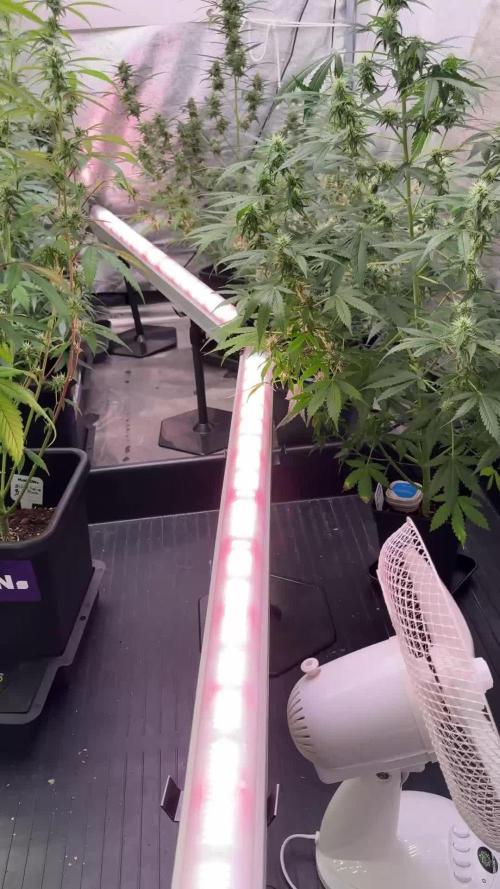
Day 35 after flip of Zombie Kush!
Growing nicely, strong intense smell ..and we can see the topped one is a little behind on bud production aswell... see u next week!


Likes
5
Share


@Burneracct
Follow
Was out of town all week and came back to find the CBD Star in my space bucket not looking good. It looks like a phosphorus deficiency but not entirely sure. Yellow leaves with brown/black spots and dark red/purple stems. I flushed it with 2 gallons 6.5 pH water, re-fertilized, put it out in the sun and defoliated. I defoliated pretty heavily since many of the fan leaves were yellowed and blocking light from the lower bud sites. The center was also getting pretty dense so I carefully removed some of the leaves to help with airflow.
Despite the stress, It seems to have bounced back reasonably well. There’s probably irreparable damage given the level of yellowing but the buds continue to grow and thicken.
Cheese has absolutely exploded and looks great. It probably doubled in height last week with many bud sites on the 5 main stalks. Excited to see how it turns out.


Likes
6
Share


@SonGoku848
Follow
Fine 4 settimana di flow procede tutto bene 2 LH2P mangiano di più rispetto le altre, alla fine le due ermafrodite dopo aver eliminato i rami con i fiori maschi non se ne sono più formati quindi ottimo ormai dovrei essere fuori pericolo ma continuo a controllare

Likes
10
Share


@SmokieMcPot
Follow
Haven't really been updating much as traction is low and I keep hella notes upstairs and on paper.
Flowers forming, slight stretch began days ago. Looking and smelling good. May need to hook up the external RES with how massive the root system has gotten. Main stem is over an inch thick. She's drinking ALLOT and eating well.
F Day19 - RES clean/change. Mixed 3gal
M-4.6ml/g
G-4.6ml/g
B-6.6ml/g
PH'd to 6.2 since it's been dropping last few days on its own and needing adjustment.
F Day23- stripping day... added a goodmorning vid of the Booshberry prior to stripping it. Will update post pics/vid this afternoon.
Likes
2
Share

@DogDoctorOfficial
Follow
🌸 Week 9 – Opening the Door for the Flowers
Blueberry Muffin has always had an interesting personality in this tent.
She's not the tallest plant.
She's not the largest plant.
But she's been quietly building herself into a compact flowering machine.
And that's exactly why I decided that a little selective defoliation was appropriate this week.
We're not trying to strip her.
We're not trying to make her naked.
We're simply opening some space.
A few leaves here.
A little overlap there.
Removing foliage that is no longer helping the structure we're trying to maintain.
The goal is simple:
More breathing room.
Better light movement.
Better airflow.
Less unnecessary congestion.
And when you have twelve different plants sharing the same room, sometimes opening one plant slightly also helps the environment around her.
That's the beauty of working with the whole garden rather than looking at each plant in isolation.
✂️ Defoliation – It's About Purpose, Not Punishment
I've talked about this before, but this week is a perfect opportunity to repeat it.
Defoliation isn't about removing leaves because leaves are somehow "bad."
They're not.
Healthy leaves are incredibly valuable.
They're photosynthetic organs.
They're producing the energy the plant uses to grow and develop.
So when I remove a leaf, I want to have a reason.
Maybe it's heavily overlapping another leaf.
Maybe it's sitting inside an increasingly congested section of the canopy.
Maybe it's shading a developing flower while contributing relatively little to the structure.
Maybe removing it creates a much better pathway for air.
And sometimes...
it's simply part of cleaning the plant.
That's the approach we're taking with Blueberry Muffin.
Selective. Intentional. Moderate.
We're not trying to win a defoliation competition.
We're trying to create a healthier, more manageable flowering plant.
💨 Airflow Becomes More Important as Flowers Develop
This is where the timing becomes particularly interesting.
As the plant gets deeper into flower, the canopy naturally becomes more complicated.
Flowers get larger.
Leaves overlap.
Branches carry more biomass.
And spaces that were wide open earlier in the grow can gradually become pockets of dense vegetation.
That's not automatically a problem.
But it's something worth managing.
One of the reasons I wanted to open Blueberry Muffin a little more this week was simply to maintain air movement through the plant.
Good airflow doesn't mean blasting the flowers with a hurricane.
It means avoiding stagnant pockets of humid air trapped inside dense vegetation.
And as we move further into flowering, that's increasingly important.
Because nobody wants to discover a problem after flowers have already become dense.
Prevention is much easier than trying to fix a problem later.
💧 Helping the Room Breathe
There's another interesting side effect to opening the canopy.
The plants are collectively producing and moving a lot of moisture through transpiration.
When twelve plants are sharing a relatively enclosed environment, the canopy itself becomes a major part of the room's microclimate.
Opening congested areas gives moving air more pathways through the plants.
That can help reduce pockets of trapped humidity around the foliage.
And when the canopy breathes better, the whole room benefits.
Again, this isn't about expecting defoliation to magically control room humidity.
The ventilation system is still doing the heavy lifting.
But good canopy management can make the environment easier to manage.
And that's exactly what we're looking for.
💡 Every Photon Has Somewhere to Go
Blueberry Muffin is also at an interesting size.
She's approximately 75 cm tall.
That's not a huge plant.
And because she's relatively compact, I want to make sure the available light isn't unnecessarily intercepted by layers of foliage sitting on top of other foliage.
Yes, she has support from the under-canopy and inner-canopy lighting strategy.
And that's fantastic.
But additional lighting doesn't mean we should deliberately create unnecessary barriers between the light and the flowers.
If we can open a section naturally and allow more photons to travel through the canopy, why not?
We're not trying to expose every square centimetre of the plant.
We're simply making the canopy a little more efficient.
Sometimes the best lighting upgrade is simply...
removing something that doesn't need to be in the way.
🌸 The Flowers Are Taking Over Now
And this is where the photographs become particularly exciting.
The flowers are becoming increasingly obvious throughout the plant.
The white pistils are still doing a lot of the visual talking, but the individual flowering sites are gaining structure and substance.
She's moving away from that early-flower appearance where everything is basically a collection of little pistil-covered points.
Now we're beginning to see the plant building actual floral mass.
The branches are carrying their flowers with confidence.
The canopy has become more compact.
And the whole plant feels like she's entering another chapter.
This is the stage where I stop being interested in how much she's going to stretch...
and become much more interested in how much she's going to stack.
? The Blueberry Muffin Personality
One thing I really appreciate about this phenotype is how different she looks when compared with some of the other genetics in the tent.
She's not trying to dominate.
She isn't the tallest.
She doesn't have the most dramatic structure.
But she's developing her own little architecture.
And that's what this entire 8×8 Adventure is about.
Twelve genetics.
One room.
One general environment.
And twelve completely different answers.
Blueberry Muffin's answer seems to be:
"Give me some time."
And now she's starting to show us why.
💚 Nutrition – Staying the Course
There's no reason to reinvent the feeding programme this week.
We're keeping nutrition essentially unchanged.
Current feeding remains:
Terra Bloom — 2.2 ml/L
Pure Zym — 1 ml/L
Power Buds — 1 ml/L
Sugar Royal — 1 ml/L
pH Plus / Lemon Kick — as required
The plant continues receiving the same flowering nutrition rather than reacting to every small visual change with another adjustment.
That's important.
We made a structural intervention this week.
We don't need to simultaneously start changing everything else.
One change at a time makes the plant much easier to read.
🌡️ The Room Has Changed
And this week we do have a small but interesting environmental change.
The daytime temperature remains around:
29°C
But the night temperature is now approximately:
26°C
Last week we were around 25.6°C, so the difference isn't dramatic, but the overall night temperature is slightly warmer.
That means our day/night temperature differential is now smaller.
We're also sitting around:
RH: 60%
Solution temperature: 25°C
Root-zone/substrate temperature: 25°C
CO₂: ~693 ppm
Light schedule: 12/12
Watering: ~1.3 L per plant / 24h
Container: 15 L
And I actually like observing these little changes.
The room doesn't have to remain frozen in time.
What matters is understanding what changed and watching how the plants respond.
At this stage, with flowers getting denser, keeping the canopy open and maintaining good air movement becomes even more valuable.
🌙 Day vs Night – The Difference Matters
One of the things I enjoy about documenting these numbers is that they tell us more than a single temperature reading.
We're running approximately:
29°C during the day → 26°C at night.
That's only about a 3°C difference.
Earlier in the run, the difference was a little larger.
As the room changes, so does the relationship between temperature, humidity, transpiration and plant development.
And this is why I don't like looking at temperature or humidity as isolated numbers.
The plant doesn't experience "29°C."
It experiences:
temperature + humidity + light + airflow + root-zone conditions + CO₂ + time of day.
Everything interacts.
And right now, I'm happy with what the room is showing us.
We're watching it.
We're measuring it.
And we're adjusting when necessary rather than reacting to every little fluctuation.
🔬 One More Reason I Like This Defoliation
There's something else happening here that I think is easy to overlook.
Cleaning the plant isn't only about what remains.
It's also about what we can see afterward.
Once some of the unnecessary foliage is removed, I can see the flowering structure much more clearly.
I can see which branches are developing strongly.
I can see where flowers are stacking.
I can see where the canopy remains dense.
And I can see what might need attention later.
In other words...
defoliation also improves observation.
And for this project, observation is half the fun.
🔮 Looking Ahead
From here, I want to keep things relatively simple.
No unnecessary training.
No dramatic interventions.
No chasing numbers just because they're numbers.
We'll continue watching the flowers develop, monitoring the canopy and paying attention to how she responds to the cleanup.
The next stage should increasingly be about:
🌸 flower stacking
🌸 calyx development
🌸 increasing resin production
🌸 increasing flower density
🌸 maintaining airflow
🌸 keeping the environment stable
The framework is already there.
Now we're entering the part of the journey where patience becomes more important than intervention.
We've done our job.
Now...
let Blueberry Muffin do hers.
💭 Final Thoughts – Making Space for What's Coming
I think this week is a really good example of how I like to grow.
We didn't defoliate because someone told us:
"Week 9 means defoliation."
We did it because the plant changed.
She's becoming more compact.
She's developing more flowers.
The canopy is getting denser.
She isn't a particularly tall plant, so making the available photons work efficiently matters.
And with twelve plants sharing the same room, keeping air moving through the garden matters too.
So we opened her up.
Not dramatically.
Not aggressively.
Just enough.
And now she looks cleaner, more open and easier to read.
That's what I wanted.
Not a naked plant.
A better-organised plant.
And honestly...
she looks fantastic.
Blueberry Muffin may not have started this journey as the plant that immediately grabbed everyone's attention.
But she's slowly becoming one of those phenotypes where you look back at the earlier photographs and think:
"Oh... now I see what she was doing."
She's been building toward this.
And now she's starting to show it.
?🌸🔥
🙏 Thank You
A huge thank you once again to Zamnesia for giving us the opportunity to explore these genetics, Plagron for supporting the garden throughout the journey, Future of Grow for providing the light that powers this experiment, Lumiflora for bringing additional light into the inner and lower canopy, TrolMaster for helping maintain environmental stability, and of course everyone following this 8×8 Adventure on GrowDiaries.
Every week gives us another little lesson.
Sometimes it's about nutrition.
Sometimes it's about environment.
Sometimes it's about genetics.
And sometimes...
it's simply about knowing when to take a few leaves away and give the plant a little more room to breathe.
Blueberry Muffin is entering another chapter now.
The canopy is open.
The flowers are developing.
The room is stable.
And there's still plenty of story left to write.
Until next week...
Growers Love and happy growing! 🌱💚?
Likes
16
Share

@MaryJaneJo
Follow
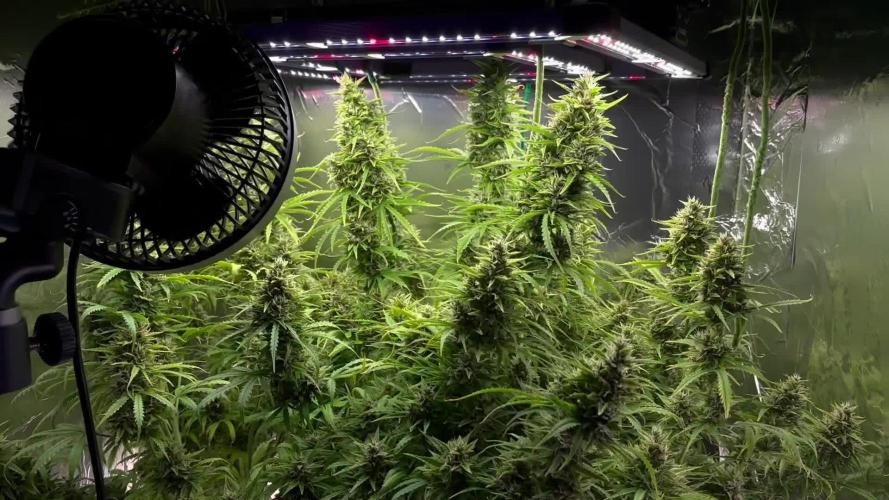
On the contrary, last week was problematic. It started with a reading of 3.22 mS (my input was 1.4 mS), which gave me a little kick. I flushed with pH 5.8 water for three waterings (until the reading was 0.9 mS) and then continued with FinalPart.
Because the buds are collapsing under their own weight, I had to install support, so rotating the plant is impossible now. I have two additional fans running to protect from bud rot & humidity is at 50%. She looks like her time is nearing the end.
Growers, eyes on the trichomes 👽

Likes
5
Share

@Abendkraut
Follow
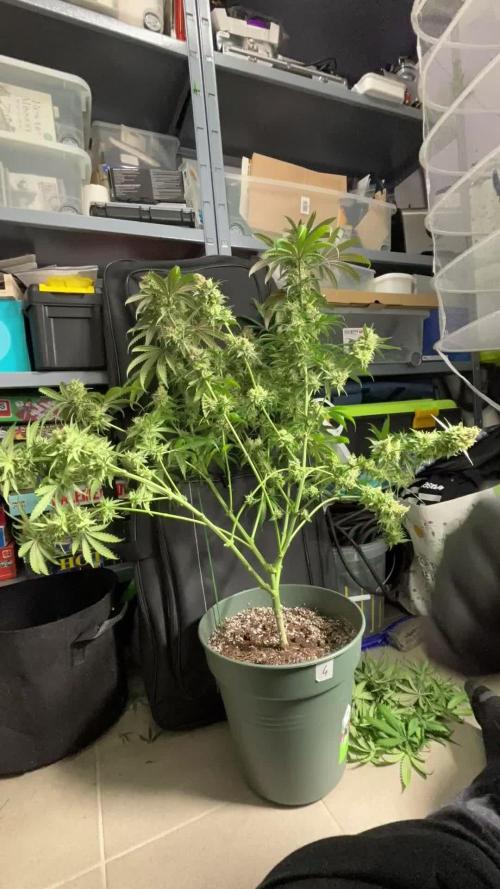
I harvested today and took the time to remove most large and non frosted leaves. I didn't realise how much weight the scrog was holding. once the net removed all 4 plants were unable to hold the weight. That's a good thing....I think.
I decided to go with another flo-week entry rather than using the harvest option on growdiary. I believe it asks too many information that I don't have at this point.


Likes
13
Share


@Weird_Jimmy
Follow
👉I used the seedling solution 3-4 days too long and the plant looked like it was starting to have issues. I mixed some early growth solution and amost immediatly the plant looked happier and started to take off. It got no stretch so I anticipate the plant will be another short bush.
Likes
6
Share


Likes
6
Share


@XanHalen
Follow
Officially week 7
Dec 31:
Came back a week later to very heavy pots, needed 36 hour drying period, not happy, smaller plant has tips of leaves curling down, some like taco, dryed out the pots and went back to normal conservative feeding, need to fine tune the auto irrigation setup before I use it again for sure. All in all, nothing crazy happened. Really cool to see a plant be small, but way bigger after a week of vacation. First grow seems to be going pretty good!
PS: I think my hygrometer is broken, saying 85-100% RA even when I significantly improve airflow and it doesn't seem anywhere near that. Gonna do the salt paste test on the hygrometer
.
Jan 1:
I recalibrated my hygrometer and it’s working great, weird leaf curling of smaller plant still happening but seems to be improving, big plant is frosty and fat for week 7, seems to be at same stage in development as smaller plant but the pheno is beautiful.

Likes
35
Share


@Theia
Follow
Forgive my language but I fucking love this plant. She is just a beast only restricted by the 5l pot I shackled her to.. but considering the pit size the main on this thing is offensive! It is a dirty great big donkey dong that smells like fresh fruit.. I'm confused 😜😜.
She needs another 2 weeks to finish I think but because of how fat her main is I'm quite concerned about rot. I've set triggers to keep my room at 50% and temps at 24c. I'm getting within +/- 2c and Rh is actually more like a 48%.
I will ease off the feeds of npk after the next feed which will be around a 1.5ec. then she will get just water ..
Thanks for stopping by on my strawberry adventure.
Grow well 👍🏼💚🌿🇬🇧

Likes
23
Share


@nonick123
Follow
Día 20 (13/05) Todas las plantas muestran las preflores!
Día 21 (14/05) Baño de sol de 2 horas!
Día 22 (15/05) NYC Sour D Auto empieza a mostrar algo de clorosis intervenal...
El gran @Thecannalife420 me diagnostica deficiencia de Mg
Aplico foliarmente Sales de Epson
Día 23 (16/05) Las plantas han reaccionado muy bien a las sales de Epson!
Riego 750 ml H2O + Regulator 0,15 ml/l + CaMg-Boost 0,25 ml/l + Startbooster 0,25 ml/l - pH 6.2
Día 24 (17/05) Las plantas salen al exterior! 😍 Les aplico heno como mulch (acolchado)
Día 25 (18/05) Riego 250 ml solo agua todas las plantas
Día 26 (19/05) Riego 250 ml H2O + Regulator 0,15 ml/l + CaMg-Boost 0,25 ml/l + Startbooster 0,25 ml/l + TopBooster 0,2 ml/l- pH 6.2
💦Nutrients by Aptus Holland - www.aptus-holland.com
🌱Substrate PRO-MIX HP BACILLUS + MYCORRHIZAE - www.pthorticulture.com/en/products/pro-mix-hp-biostimulant-plus-mycorrhizae
Likes
8
Share


@JohnnyBarrel
Follow
Week 14 - July 30
Last vegetation weeks. On 4 plants: 2 healthy / 2 injured.
Royal Moby and GMOxZombieK were seriously contaminated with aphids. To stop the propagation I did many washes with black soap and neem oil but may be I treated at the wrong time: morning, even soon; is too late by a hot sunny summer day. I think the 2 plants are suffering from sunburn… and they still have aphids…
I stopped soap treatments and try another recipe which seems working very good against aphids and revitalizing all plants: spraying Garlic + Laurel
-I cooked separately during 1h garlic (5 cloves) and Lauren leaves (12) in approximately 1L of water
-filtered the preparations and wait 4 days
-for 1L of water to spray: 15cl garlic mixture + 5 cl laurel BEWARE: checking Ph… last year I burned plants with garlic + chili mixture: it was catastrophic.
Brake Pad Breath and Flash Back are beautiful and healthy. Aphids aren’t interested by this 2 plants.
I did preventive treatments Neem oil and soap but not so much. Good reaction to the Garlic+Laurel.
Plants are bushy, densely ramified. Deep green color, the female sexual signs are visible.
Ready for flowering.
Watering with a little bit of nutrients 1.5L/plants each 2 or 3 days
Defoliation
Now I quit the “garden” for 7 days…traveling to Amsterdam (NL) and Prague (CZ) for holidays.
I installed automatic watering systems (Blumat) and sticky traps, locked the veranda, programmed the Ventilation and crossed fingers.
I’m not afraid about heat or dry…. More about pests and diseases….and rubbery too cause I have 6 auto flowering quasi ready.
I’m writing this in Prague, returning in my country to the west side in 2 days.
After smoking lot of joints in Amsterdam (3 days)
Amnesia haze
Tangerine dream
Kush Mints
Super Lemon Haze
Dynamite cookie
Intergalactic toad
Super Silver Haze
In Prague Weed (THC) is prohibited. But I discovered that you can buy pre roll joints (100% pure hemp-Thc-sativa, hybrid etc…) in strange gifts shops for 6€. It’s really not the best weed but it’s Strong and easygoing.


